

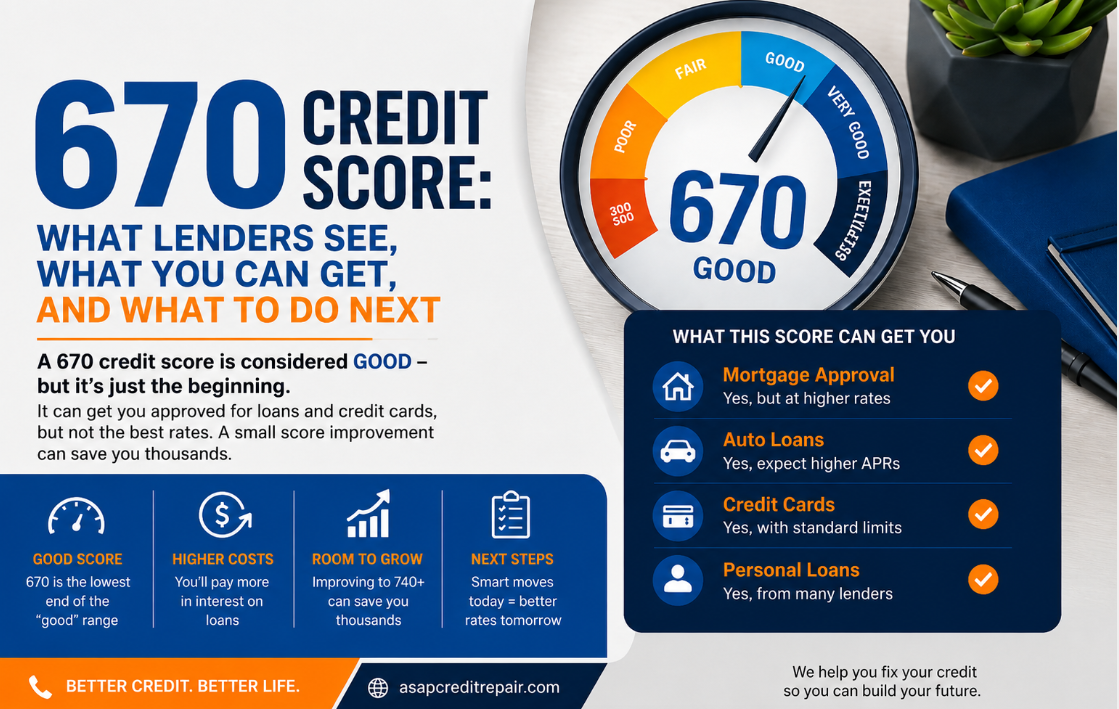
A 670 credit score puts you in the "good" range on the FICO scale, which runs from 300 to 850. Most lenders will approve you for loans and credit cards. But 670 sits at the lower end of that good range, and that gap matters when it comes to interest rates and loan terms.
I run a credit repair company. I hear this score a lot. One client told me, "I thought 670 was great until I saw my car loan rate." That moment is what this article is about.
Real people share the same frustration online. In one active Reddit thread on r/personalfinance (source), users with 670 scores reported getting approved for auto loans but paying rates 3 to 4 percentage points higher than friends with 740+ scores. That small score gap was costing them hundreds of dollars a year.
Is a 670 Credit Score Good or Bad?
A 670 credit score is good, but only just barely.
FICO defines "good" as any score between 670 and 739. So 670 is the floor of that range. The average U.S. FICO score in 2025 is 715, according to Experian. That means 670 falls below average.
Here is how the full FICO scale breaks down:
300–579: Poor
580–669: Fair
670–739: Good
740–799: Very Good
800–850: Exceptional
About 21% of Americans have a score in the good range. Lenders will work with you at 670. But they will not give you their best rates. You are "acceptable" to them, not preferred.
The practical difference between 670 and 740 is real. Lenders reserve lower interest rates for borrowers in the very good and exceptional tiers. At 670, you qualify for most products, but you pay more for them.
How Good Is a 670 FICO Score?
A 670 FICO score gets you through the door for most loan types. The question is what terms you walk out with.
Lenders see 670 borrowers as solid but not low-risk. Experian data shows that 65% of people with scores in this range have at least one late payment (past due 30 days) on their credit report. That tells lenders there is some risk, even if the score is technically "good."
Here is what the score signals to a lender:
You pay most bills on time
You may have some credit card balances that are higher than ideal
Your credit history may be shorter or mixed
You are unlikely to default, but not a sure bet
The key number to watch is 740. That is where lenders shift from average rates to preferred rates. Going from 670 to 740 can save you thousands of dollars over the life of a mortgage or auto loan.
Can I Get a Personal Loan With a 670 Credit Score?
Yes. A 670 credit score qualifies you for personal loans. Not all lenders will approve you, but many will.
Some lenders require scores above 700 or even 720. Others, like Upstart and Upgrade, use non-traditional factors beyond credit scores, such as income, job history, and education, so they are more likely to approve a 670 borrower.
The tradeoff is your interest rate. Personal loan APRs for borrowers in the 670 range typically run between 14% and 25%, depending on the lender and your other financial details. Borrowers with scores above 740 often get rates below 10%.
Last year, we saw a clear pattern in the cases that came through our credit repair firm: clients with 670 scores who cleaned up just two or three negative items, like a late payment or a collection account, pushed into the 700s within 60 to 90 days and secured personal loan rates 5 to 8 points lower.
To improve your chances with a 670 score:
Pay down credit card balances below 30% of your limit
Apply to lenders that use alternative underwriting models
Add a co-signer with a stronger credit profile
Avoid applying to multiple lenders in the same week (unless they are the same loan type, which FICO treats as a single inquiry)
Can a 670 Credit Score Get a Car Loan?
Yes. Getting a car loan with a 670 credit score is straightforward. About 66% of people with a 670 score already have an auto loan, according to Experian.
The real issue is the rate.
According to Experian's State of the Automotive Finance Market report, new car loan rates in Q1 2025 averaged 5.18% for borrowers with excellent credit. Borrowers with poor credit averaged 15.81%. Borrowers in the "good" range, where 670 typically falls, often land somewhere in the middle, often between 8% and 12% for used vehicles.
On a $30,000 car loan over 60 months:
At 7% interest: monthly payment is $594, total interest paid is $5,640
At 12% interest: monthly payment is $667, total interest paid is $10,020
That is a $4,380 difference from one score range to another.
One strategy that works: shop multiple lenders before visiting the dealership. FICO treats multiple auto loan inquiries within a two-week window as a single hard inquiry. So rate shopping does not hurt your score.
Also consider credit unions. They consistently offer lower auto loan rates than traditional banks, especially for borrowers in the 670 to 710 range.
Can You Buy a House With a 670 Credit Score?
Yes. A 670 credit score qualifies you for a mortgage. Conforming loans through Fannie Mae and Freddie Mac require a minimum of 620. FHA loans require a 580. You clear both thresholds.
But qualifying is only half the story.
With a 670 score, your mortgage rate will be close to the national average, not below it. Fannie Mae's lending standards also cap your debt-to-income ratio (DTI) at 36% if your score is below 720. Borrowers above 720 can have a DTI as high as 45% with a standard down payment. That restriction can limit how much home you qualify for.
About 36% of people with a 670 score currently have a mortgage, according to Experian. It is doable. You will just pay more in interest compared to a 740+ borrower, and you will need stronger supporting factors like steady income and a low existing debt load.
What Factors Are Pulling Your 670 Score Down?
A 670 score usually means something specific is holding you back. The most common culprits:
High credit utilization, using more than 30% of your available revolving credit
One or more late payments in the past two years
A short credit history or thin credit file
A collection account or charge-off that has not been resolved
Too many hard inquiries from recent loan or credit card applications
Payment history carries the most weight in FICO scoring at 35%. Credit utilization is second at 30%. Together, they make up nearly two-thirds of your score. Fixing those two factors alone can move a 670 into the 700s faster than most people expect.
The average consumer with a FICO score above 795 carries a credit utilization rate of just 7%, according to Upstart. Most people stuck at 670 are running 40% or higher.
How to Move From 670 to 740 (and Why That Number Matters)
The jump from 670 to 740 is not symbolic. It unlocks a different tier of lending.
At 740, most lenders shift you from "acceptable" to "preferred." Interest rates drop. Approval odds go up. Mortgage DTI caps relax. The difference over a 30-year mortgage can exceed $40,000 in total interest.
Here is what actually moves the needle:
Pay all bills on time, every month, even one 30-day late payment drops scores sharply
Bring credit card balances below 10% utilization for maximum impact
Dispute inaccurate negative items on your credit report through the three major bureaus (Equifax, Experian, TransUnion)
Keep old accounts open; credit age matters, and closing accounts shortens your average history
Avoid opening multiple new credit accounts within a short window
Removing even one collection account or correcting one bureau error can add 20 to 40 points in a single reporting cycle. At our firm, we have seen clients go from 670 to 720 in under 90 days through targeted dispute work on just two or three items.
What Credit Cards Can You Get With a 670 Credit Score?
A 670 score opens access to a solid range of credit cards, including some rewards cards.
You will likely get approved for:
Cash-back cards with no annual fee
Entry-level travel rewards cards
Balance transfer cards with introductory 0% APR offers
Secured or unsecured cards from mid-tier issuers
You will not qualify for premium cards like the Chase Sapphire Reserve or American Express Platinum. Those typically require 720 to 740 or higher.
The best move at 670 is to use a rewards card responsibly, keep utilization below 15%, and let your on-time payment record build. Within 12 to 18 months of clean behavior, many borrowers in this range cross 720.
Stuck at a 670 Credit Score?
A 670 credit score can get you approved, but it may still cost you more in interest. See what is holding your score back and take the next step toward better rates.
Check My Credit ReportImprove today. Save tomorrow.
Should You Apply for New Credit With a 670 Score?
Only if you need it.
Each hard inquiry from a new credit application can drop your score by 5 to 10 points temporarily. At 670, already at the lower edge of "good," a few inquiries can push you back into the fair range.
The strategic approach: decide whether you need a loan in the next 3 to 6 months. If you do, apply soon and focus on one product at a time. If you have time, spend that window improving your utilization and payment history first, then apply when you are closer to 700 or 710.
Borrowers who cross 700 before applying for an auto loan often save $1,500 to $3,000 in interest over the life of a 60-month loan. That math makes a 90-day delay worth it.
A 670 credit score is not a problem; it is a starting point. You qualify for real loans, real credit cards, and real mortgages. The goal is not just to get approved. The goal is to get approved at terms that do not cost you thousands of dollars more than they should.
The path from 670 to 740 is available to almost anyone willing to pay on time, lower their balances, and address errors on their report. Most people can make that move within 6 to 12 months with focused effort.