
A 701 credit score is where things start getting interesting.
You are no longer stuck in the “bad credit” conversation. Banks usually see a 701 score as good credit. That means better approval odds, lower rates, and access to credit cards that were probably out of reach before.
In my close to 20 years running a Houston credit repair company, I see this score range all the time. A lot of people hit 700 and think they’ve made it. Then they apply for a mortgage or car loan and realize lenders still care about other things too.
I’ve seen people with a 701 credit score get approved fast. I’ve also seen people with the same score get denied because of high balances, recent late payments, or too many applications in a short period.
That’s why this score matters so much.
You are close enough to qualify for strong offers, but still close enough to the edge where one mistake can hurt your rates. A maxed-out card or missed payment can pull you backward fast.
The good news is that moving from 701 to the mid-700s is usually easier than going from the 500s to 700.
Small changes start making a bigger difference once your credit foundation is already solid.
Is a 701 Credit Score Good
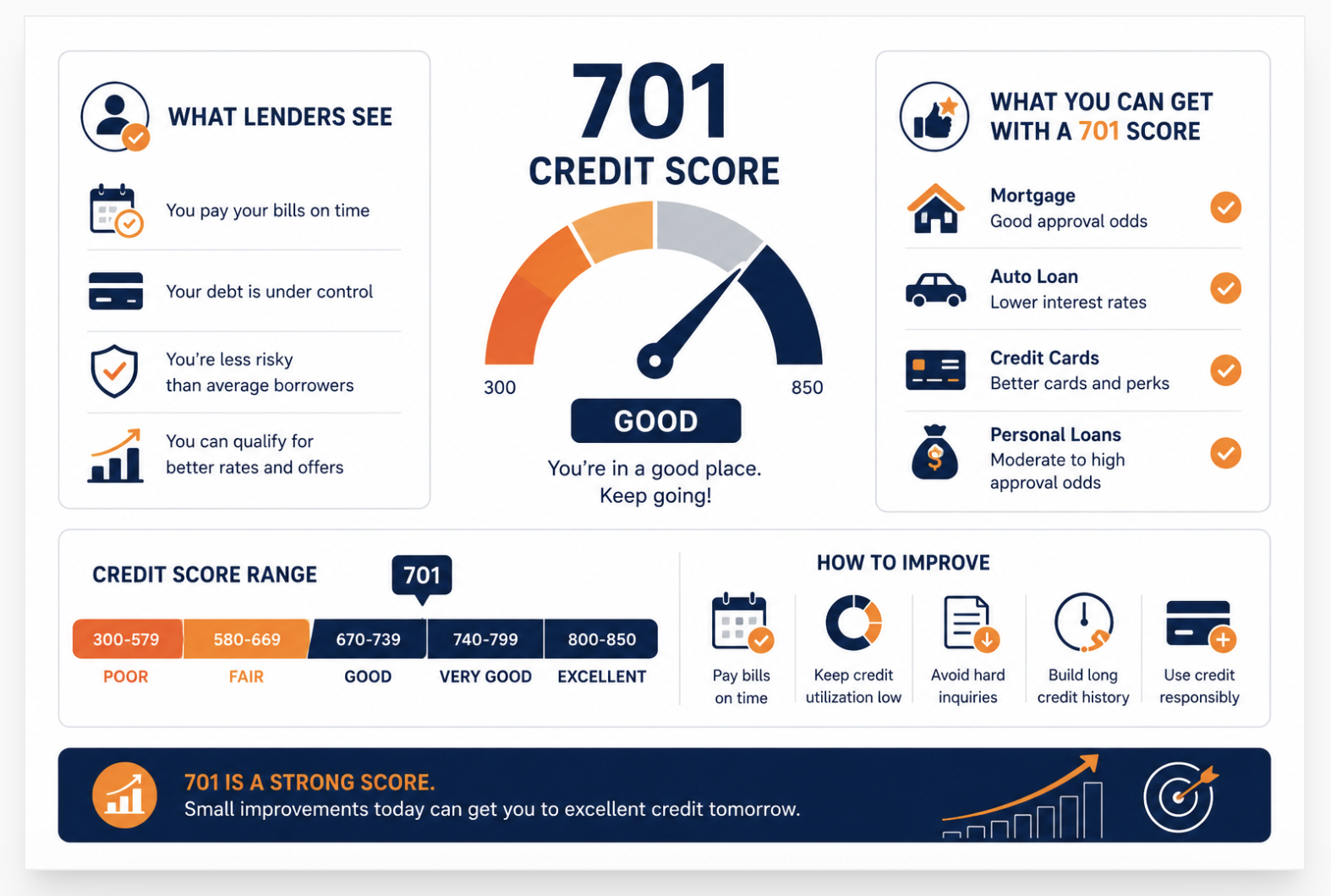
Yes. A 701 credit score is Good. FICO classifies 670-739 as Good, and 701 falls in that range. Most lenders see you as a lower-risk borrower. You qualify for most standard credit products. But the best rates , and some premium cards , go to borrowers above 740 or 760.
The FICO scale runs from 300 to 850. Here is where 701 fits.
For everyday lending decisions, 701 is fine. You get approved. You get reasonable rates.
What you miss at 701 is the top shelf , premium travel cards, 0% APR promotional offers, and the absolute lowest mortgage rates. Those start becoming accessible around 740-760.
Understanding where each credit score range opens and closes different lending options gives you a clearer picture of what the next 39 points are actually worth financially.
What Can You Get With a 701 Credit Score
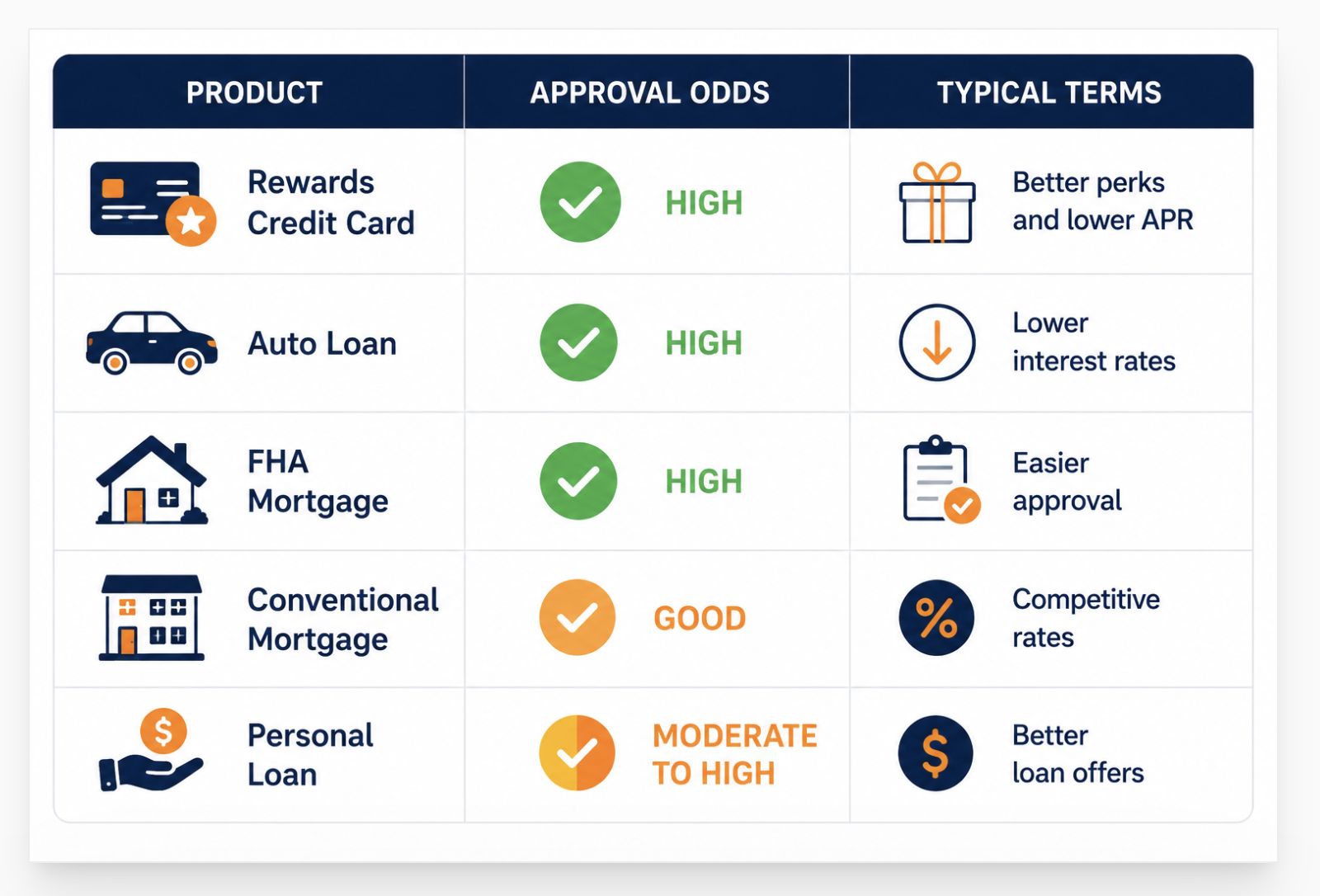
With a 701 credit score, you can get conventional and FHA mortgages, auto loans at prime rates, most major credit cards, and personal loans with decent terms. You will not get the absolute lowest rates or every premium card, but most products are open and approval odds are strong.
| Product | Approval Odds at 701 | What to Expect |
|---|---|---|
| Conventional Mortgage | Strong | 620 minimum required. 701 qualifies easily. Fannie Mae DTI cap is 36% at 701 vs 45% at 720+. |
| FHA Mortgage | Strong | 580 minimum for 3.5% down. 701 qualifies with full lender participation. Lower mortgage insurance than conventional in some cases. |
| New Car Loan | Strong | Prime borrower tier. Average APR around 6.51% (Experian Q3 2025 data). Most manufacturers and banks approve at 701. |
| Used Car Loan | Strong | Average APR around 9.65% at this tier. Still well below subprime rates. Most lenders approve on good-quality used vehicles. |
| Rewards Credit Card | Strong | Most major rewards cards are accessible. Chase Sapphire Preferred, Citi Double Cash, Capital One Venture , all within reach. |
| Premium Travel Card | Limited | Amex Platinum, Chase Sapphire Reserve , typically prefer 720-740+. A 701 may get approved but odds improve at 740. |
| Personal Loan | Strong | Average APR for 690-719 range: about 14.48%. Plenty of lender options. Not the lowest tier, but far from the worst. |
| Balance Transfer Card | Moderate | 0% APR promotional offers exist at 701 but the longest terms and best cards prefer 720-740+. |
Can You Buy a House With a 701 Credit Score
Yes. A 701 credit score clears both the FHA minimum of 580 and the conventional mortgage minimum of 620. You qualify for most loan programs. The average 30-year fixed rate at 700 was 6.63% as of March 2026. The bigger issue at 701 is the Fannie Mae DTI cap , 36% below 720, versus 45% at 720 and above. That gap limits how much home you can afford on the same income.
The Fannie Mae DTI difference is worth understanding in dollar terms.
Say you earn $80,000 per year , $6,667 per month. At 701, your maximum monthly debt including the mortgage payment is $2,400 (36% DTI). At 720, it rises to $3,000 (45% DTI). That $600 per month difference supports roughly $80,000-$100,000 more home at current rates.
As Experian's mortgage rate data shows, the rate gap between a 700 score and a 760+ score can translate to a meaningful payment difference over a 30-year term. Getting to 720 before applying gives you both the DTI room and slightly better rate positioning.
FHA loans work well at 701. They require only 580 for 3.5% down, so 701 clears that threshold by 121 points. FHA is worth comparing to conventional if your down payment is under 10%.
Best Credit Cards for a 701 Credit Score
Most major credit cards are accessible at 701. Here is what works well at this score.
Chase Sapphire Preferred , One of the best mid-tier travel cards. Approvals happen at 700-710 regularly. Starting limits vary. Strong sign-up bonuses and flexible travel points.
Citi Double Cash , 2% cash back on everything. No annual fee. Approved frequently at 700+. Good for consumers who want simple, flat rewards without category tracking.
Capital One Venture Rewards , Capital One uses a different approval model than most banks. The 701 range gets strong approval odds. Flexible travel miles that transfer to airlines.
Capital One Quicksilver , 1.5% cash back, no annual fee. Accessible at 700. Good option if you want a no-fee card with rewards without a high limit requirement.
Bank of America Travel Rewards , No annual fee travel card. Preferential rates for Preferred Rewards members. Works well at 701 if you have a BofA banking relationship.
Can You Get a Car Loan With a 701 Credit Score
Yes. A 701 score puts you in the prime borrower tier for auto lending. Average APRs for this tier are 6.51% for new cars and 9.65% for used cars (Experian Q3 2025). Those rates are significantly better than near-prime or subprime. You will not get the super-prime rate of 4.66%, but you are in the range where most mainstream lenders compete for your business.
The rate difference between 701 and 780+ adds up over a 60-month loan.
At 6.51% APR on a $30,000 new car over 60 months, you pay $587 per month and approximately $5,220 in total interest. At 4.66% APR (super prime), the same car costs $560 per month and $3,600 in interest. That is $1,620 in total savings for 79 points of score improvement.
Good dealers and banks compete for 701-score borrowers. You have options. Shop at least three lenders , your own bank or credit union, the dealership's finance office, and an online lender like LightStream or Capital One Auto Finance.
Based on NerdWallet's 2026 auto loan rate analysis, Edmunds reported an average of 7% APR on new cars in March 2026 for all borrowers. A 701-score prime borrower typically lands near or just under that mark. As Bankrate's auto loan interest rate data shows, the prime tier (661-780) receives meaningfully better rates than near-prime, but still pays more than super prime borrowers. The exact gap depends on the lender and vehicle age.
What Interest Rates Can You Expect
Here are the approximate rates you can expect at 701 across major product types, based on 2025-2026 data.
| Product | 701 Score Rate (Approx.) | 740+ Score Rate (Approx.) | Difference |
|---|---|---|---|
| 30-yr fixed mortgage | ~6.63% (Curinos Mar 2026) | ~6.3-6.4% | ~0.25-0.35% |
| New car loan (60-mo) | ~6.51% (prime tier) | ~4.66% (super prime) | ~1.85% |
| Used car loan (60-mo) | ~9.65% (prime tier) | ~7.43% (super prime) | ~2.22% |
| Personal loan | ~14.48% (690-719 avg) | ~11.81% (720-850 avg) | ~2.67% |
| Credit card APR | 20-24% range | 18-22% range | ~2-3% |
On a mortgage specifically, the gap between 701 and 760 is real but not devastating. The bigger financial impact at 701 is the Fannie Mae DTI limit , the rate gap matters less than the borrowing capacity gap for many buyers.
The personal loan gap is the sharpest at this score range. Going from 701 to 740 could move you from 14.48% to something closer to 11-12%. On a $15,000 loan over 36 months, that difference saves approximately $1,100 in interest.
701 Credit Score vs 750 Credit Score
This comparison is worth understanding before you decide whether to apply now or wait.
- Mortgage approvals: yes, most programs
- Fannie Mae DTI cap: 36% (standard down)
- Auto loans: prime rates available
- Premium travel cards: possible but not guaranteed
- Personal loan APR: ~14.48% avg
- Balance transfer 0% offers: accessible but shorter terms
- Mortgage approvals: yes, all major programs
- Fannie Mae DTI cap: 45% (standard down)
- Auto loans: near super prime rates
- Premium travel cards: strong approval odds
- Personal loan APR: ~11.81% avg
- Balance transfer 0% offers: longest terms available
The DTI change matters most for home buyers. The personal loan rate gap matters most for borrowers consolidating debt. The auto rate gap matters most for anyone financing a car in the next 12 months.
From 701 to 750 is 49 points. Most borrowers can reach that in 6-12 months. The specific milestones to hit along the way are covered in the 745-750 credit score guide.
How to Improve a 701 Credit Score
The fastest path from 701 to 740+ is lower credit card utilization. Get every card below 10% before the statement close date. That alone can add 20-40 points in one billing cycle. After that, avoid new applications for six months and keep every payment on time. Those two actions protect and build the score simultaneously.
The balance on your statement is what the bureau reports. Not the balance after you pay the due date. Find the statement close date in your account settings and pay before that date. Getting from 50% utilization to under 10% can add 20-40 points within one billing cycle.
Timeline: 25-35 days | Potential: 20-40 pointsAt 701, a single 30-day late mark costs 60-100 points and stays for seven years. That drops you from Good into the top of the Fair range immediately. Autopay protects your payment history , the largest scoring factor at 35% , across every account with no mental overhead.
Timeline: Set up today | Protects score from day oneEvery application generates a hard inquiry costing 5-10 points. Multiple applications in a short period can push 701 below 680 temporarily. A 6-month pause gives existing accounts time to age and inquiry impact to fade.
Timeline: No cost. Immediate protection.Average account age controls 15% of your score. Closing an old credit card removes its age from the calculation and reduces available credit at the same time. Put a small recurring charge on old cards to keep them active and reporting positively each month.
Timeline: Ongoing. Account age grows passively every month.Pull your Equifax, Experian, and TransUnion reports at AnnualCreditReport.com. Look for wrong balances, wrong dates, accounts that are not yours, or duplicate entries. A single inaccurate collection removed through dispute can add 30-60 points. Many borrowers stuck at 701 have at least one disputable item suppressing the score.
Timeline: 30-45 days per dispute cycle | Potential: 30-60 pointsWhat Hurts a 701 Credit Score
Knowing what can drop the score is just as useful as knowing what builds it. These are the moves that hurt most at the 700-level.
High credit card utilization. Using more than 30% of your limit hurts the score actively. Using more than 50% hurts it significantly. At 701, high utilization is the most common reason a borrower cannot break past the 720 wall. It is also the fastest thing to fix.
Any missed payment. One 30-day late mark at 701 can drop the score to 620-640 overnight. Payment history is 35% of the FICO score. The risk of a missed payment is higher than any other single action.
Applying for multiple cards or loans at once. Every hard inquiry costs points. Applying for two cards and a personal loan in the same month could drop the score 20-30 points temporarily. Space applications 3-6 months apart.
Closing old accounts. This shrinks both average account age and available credit simultaneously. The score often drops 10-20 points after closing a card, even if the card had no balance.
Maxing out or over-using a single card. Even if overall utilization is low, a single card at 90% utilization can suppress the score because FICO evaluates each card individually, not just the total.
How Long Does It Take to Reach 750
From 701 to 750 , a jump of 49 points , takes most borrowers 6-12 months. If high utilization is the primary issue, the jump can happen in 60-90 days. If the score needs time and clean payment history to build, expect 9-18 months. The fastest path is always utilization reduction first.
| Action | Estimated Gain | Timeline |
|---|---|---|
| Lower all cards below 10% utilization before statement close | 20-40 points | One billing cycle (25-35 days) |
| Remove one inaccurate collection via dispute | 30-60 points | 30-45 days |
| 12 months of clean on-time payment history | 10-25 points | 12 months |
| No new applications for 6 months | 5-15 points (inquiry fade) | 6-12 months |
| Authorized user on a long-standing low-utilization account | 10-30 points | 30-60 days |
The borrowers who move fastest from 701 to 740+ are usually the ones who fix utilization first. That is the single biggest lever available at this score range.
If you want to know exactly where your score stands before picking your strategy, a credit score estimator based on your specific profile factors helps identify which factors are holding back your 701 score the most.
Frequently Asked Questions About a 701 Credit Score
Is 701 a good credit score?
Yes. FICO classifies 670-739 as Good, and 701 falls in that range. Most lenders approve borrowers at 701 for credit cards, car loans, and mortgages. The national average FICO score is 715, so 701 sits just below average. You qualify for most standard credit products. The best rates and premium cards start becoming more accessible above 740.
What APR can I get with a 701 credit score?
APRs vary by product. For a 30-year fixed mortgage, expect around 6.63% at 700 (Curinos, March 2026). For a new car loan, prime borrowers (661-780) averaged about 6.51% in Q3 2025 according to Experian. For personal loans, the 690-719 range averages around 14.48%. For credit cards, expect 20-24% APR on standard products. Every product improves meaningfully once the score crosses 740 and again at 760.
Can I get approved for an American Express card at 701?
Possibly. Amex approves a range of consumers and uses its own internal scoring. The Amex EveryDay and Amex Blue Cash Everyday cards are accessible in the 700 range. The Amex Platinum and Gold , their premium cards , typically prefer scores of 720-750 and above. A 701 is not disqualifying for Amex, but the premium card approvals are more likely at 720+.
Does utilization still matter above 700?
Yes , and it matters a lot. At 701, utilization is often the primary factor keeping the score from reaching 720-740. The difference between 50% utilization and 10% utilization at 701 can be 20-40 points. High utilization suppresses the score regardless of payment history. Getting every card below 10% before the statement close date is the single fastest move available at this score level.
Can I refinance with a 701 credit score?
Yes. A 701 score qualifies for most refinance programs , conventional, FHA, and VA (with other eligibility criteria). The rate lands near the national average, not the best available. For a mortgage refinance, reaching 720 before applying improves the Fannie Mae DTI limit and can slightly improve the rate. For auto refinancing, 701 gets prime rates that are significantly better than anything below 660.
Stuck at 701? Find Out What's Holding Your Score Back.
High utilization, inaccurate entries, or timing issues can keep a 701 score from moving to 720 or 740 for months. A free 3-bureau audit shows exactly what each bureau reports so you know which specific factors to fix first.
Get My Free 3-Bureau Audit → Secure · 2 minutes · No credit card required-
Credit Score Ranges , What Is Good and What Each Tier Gets You A 701 score is Good , but understanding what opens at 670, 700, 720, 740, and 760 helps you prioritize where to aim next. This covers the specific lending products, rate improvements, and approval thresholds tied to each tier so you know exactly what the next 39 points from 701 are worth in real financial terms.
-
745 Credit Score Guide , What It Means and How to Get There The target above 701. A 745 score puts you solidly in the Very Good tier with improved mortgage DTI limits, better auto rates, and premium card access. This covers what a 745 score looks like in practice, the specific behaviors and account patterns that get you there from 700, and the rate improvements you can realistically expect across the products you already use.
-
Does Autopay Build Credit At 701, one missed payment is the fastest way to undo months of progress. This covers how autopay protects payment history , the largest FICO factor at 35% , which account types autopay actually helps, and the one hidden risk of autopay that most borrowers do not know about until it is too late.
701 Credit Score Approval Odds
A 701 credit score puts you in a strong position with many lenders. Most people in this range qualify for better credit cards, lower interest rates, and more flexible loan options compared to average borrowers.