
800-955-6600 is widely reported as a number associated with Capital One and debt collection calls, but seeing that number on your caller ID does not prove who is actually calling or that you owe the debt they may be contacting you about. Caller ID can be spoofed, and recent consumer reports involving this number include both collection-related calls and complaints alleging unwanted or suspicious calls.
That distinction matters before you provide a Social Security number, bank information, payment, or even confirm details about an account. The Federal Trade Commission recommends getting debt validation information when a collector contacts you. This should help identify the collector, creditor, amount claimed, and your debt-collection rights. If you don't recognize the debt, the FTC recommends disputing it in writing within the applicable 30-day validation period.
At ASAP Credit Repair, nearly 20 years of experience helping consumers navigate credit-report problems has shown us that an unexpected collection call can raise two separate questions: “Do I actually owe this?” and “Is this being reported correctly on my credit?” Those questions should be answered before assuming a phone call is legitimate or inaccurate.
This guide explains who's behind calls from 800-955-6600. How to verify the caller and debt, your collection rights, and what to check if the account appears on your credit reports.
800-955-6600 Calling You? Who It May Be and What to Do
Who's Calling Me From 800-955-6600?
Consumer reports and third-party identification most commonly connect 800-955-6600 to Northland Group, a debt collection agency, calling on behalf of Capital One. But a phone number appearing on caller ID alone should not be treated as proof of the caller's identity, because caller ID can be spoofed.
This identification comes from consumer-reported data and third-party caller databases, not an official phone registry. That is a meaningful difference, and it is exactly why the next section matters before you act on anything a caller tells you.
Is 800-955-6600 a Scam?
How to verify the caller safely
- Don't give out sensitive information right away.
- Ask for the caller's company name.
- Ask for the name of the original creditor.
- Ask for written validation information.
- Compare the account details with your own records.
- Contact the creditor using a phone number you find independently, not one the caller gives you.
Not Sure If This Debt Is Even Yours?
See exactly what's on your credit report before you confirm anything to a caller or make a payment.
Get My Free Credit Analysis Now →Why Is 800-955-6600 Calling Me?
Not everyone who gets this call actually has a Capital One debt. Possible reasons include:
- A past-due account
- Active collection activity
- An attempt to reach a different person who used to have your number
- A simple wrong number
- Caller ID spoofing
- General account-related communication
What Is Northland Group?
SoloSuit and several other consumer-reporting sources have connected this number to Northland Group. Understanding the difference between an original creditor and a debt collector helps explain why.
| Term | What it means |
|---|---|
| Original creditor | The company you actually opened the account with, like Capital One |
| Debt collector | A company trying to collect a debt for another company, or one that bought the collection rights to the account |
A debt collector like Northland Group may be working on Capital One's behalf, or it may have purchased the account outright. Either way, the collector is still required to follow federal debt collection rules.
Verify the Debt Before You Pay Anything
Ask for debt validation information
Under FTC guidance, a collector must give you this within five days of first contacting you:
- The collector's name and mailing address
- The name of the creditor you owe
- How much you owe, broken down to show interest, fees, payments, and credits
- Your rights as a consumer in the collection process
Compare the debt with your credit reports
A collection call and a collection account on your credit report are related, but they are not the same thing. Check your reports for:
- The creditor's name
- The collection agency
- The account balance
- Account ownership
- Payment history
- Dates
- Account status
- Duplicate collection accounts for the same debt
What if the Debt Isn't Mine?
If you don't recognize the debt, the FTC says you can dispute it and request written verification within 30 days of first contact. Consider whether identity theft or a mixed credit file, where your information gets confused with someone else's, could explain the call.
What if the Debt Is Mine?
If the debt is legitimate, work through it carefully rather than reacting to pressure on the phone. Consider:
- The current balance
- Who currently owns the debt
- Your payment options
- Whether settlement is realistic for you
- Getting any agreement in writing before paying
- How the account could affect your credit
How to Stop Calls From 800-955-6600
If they're calling the wrong person
Tell the collector directly that they have reached the wrong person, and keep a record of the call, including the date, time, and what was said.
If you want the calls to stop
You can send a written request to stop contact. Federal law gives you this right, but stopping calls does not erase the underlying debt.
If the calls feel abusive or threatening
Write down the date, time, number, caller's name, company, and exactly what was said. Save voicemails and texts. This record matters if you file a complaint or need legal advice later.
Know Your Rights Under the FDCPA
Covered debt collectors generally cannot use abusive, deceptive, or unfair practices. Under FTC guidance, debt collectors generally cannot:
- Threaten you or use abusive language
- Call you more than seven times within a seven-day period about the same debt
- Threaten actions they cannot legally take
- Misrepresent the amount you owe
- Pretend to be an attorney or a government official
- Publicly reveal your debts to others
Can a Debt Collector Keep Calling You?
Collection communication, the existence of a debt, and credit reporting are three separate issues. Handling one does not automatically resolve the others.
Can 800-955-6600 Affect Your Credit?
Check all three credit reports
- The original creditor
- The collection account
- The balance
- The dates
- Account status
- Duplicate reporting
- Accounts you don't recognize at all
What if the Collection Information on Your Credit Report Is Wrong?
If a reported account has information you have a legitimate reason to believe is inaccurate or incomplete, identify exactly what's wrong. Common examples include:
- An account that isn't yours
- The wrong balance
- An incorrect payment status
- Wrong dates
- A duplicate collection entry
- Identity theft
- Incorrect account ownership
If you find any of these, our step-by-step dispute guide walks through exactly how to challenge it with the credit bureaus.
Should You Block 800-955-6600?
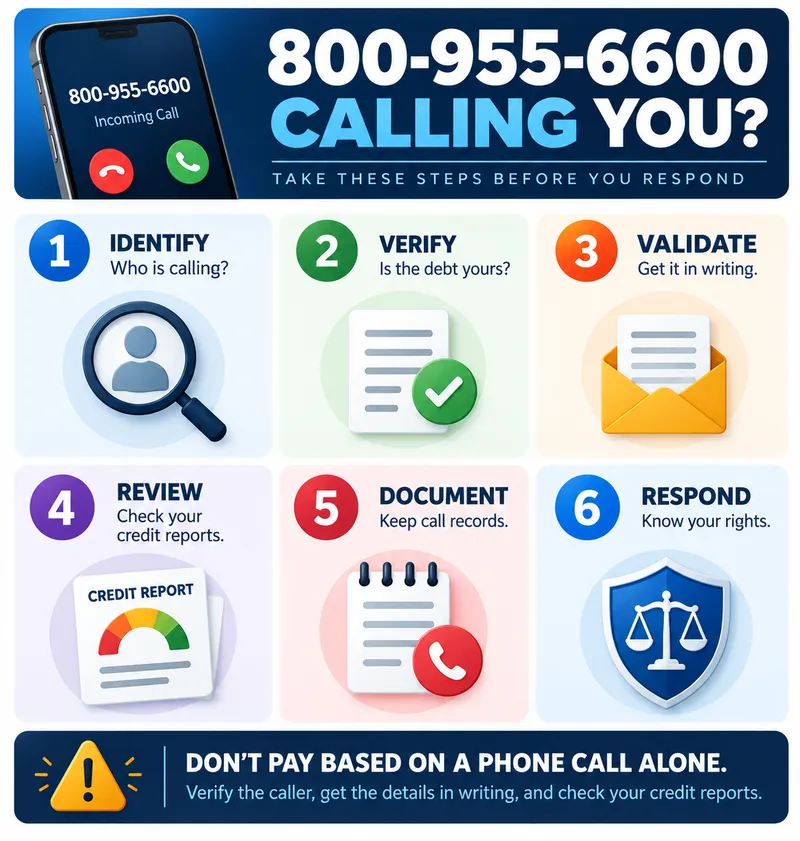
Work through this order first: identify the caller, verify the debt, document what you learn, then decide whether blocking makes sense for you.
What to Do After a Call From 800-955-6600
- Don't panic or pay immediately
- Don't share sensitive information until you've verified the caller
- Ask who is calling and who they represent
- Request written validation information
- Compare the debt against your own records
- Check your credit reports from all three bureaus
- Dispute any information you have a legitimate reason to believe is wrong
- Keep records of every collection call or letter
- Report suspicious or abusive conduct when it happens
Frequently Asked Questions
Who is calling from 800-955-6600?
800-955-6600 has been widely reported by consumers and identified by other sources as connected to Northland Group, a debt collection agency, calling on behalf of Capital One. Caller ID can be spoofed, so it is worth verifying the caller before sharing any information.
Is 800-955-6600 Capital One?
Not directly. Reports connect this number to Northland Group, a debt collector, rather than Capital One's own customer service lines. Northland Group may be collecting on Capital One's behalf or may have purchased the account.
Is 800-955-6600 a debt collector?
Consumer reports and third-party identification most commonly connect this number to Northland Group, a legitimate debt collection agency, though it is still worth verifying independently.
Is 800-955-6600 a scam?
Not automatically. The number has a long history of reports connecting it to Capital One collection activity, but scammers can spoof legitimate-looking numbers, so verify the caller before providing information or making a payment.
Why does 800-955-6600 keep calling me?
Common reasons include a past-due account, active collection activity, a wrong number, an attempt to reach someone else, or caller ID spoofing.
How do I stop calls from 800-955-6600?
Send a written cease communication request, which legally obligates a covered debt collector to stop contacting you except for limited purposes. Stopping calls does not erase a legitimate debt.
What is Northland Group?
Northland Group is a debt collection agency commonly associated with this number and with Capital One accounts, either collecting on Capital One's behalf or after purchasing the debt.
Why would a debt collector call me if I don't owe money?
This can happen due to mistaken identity, a wrong number, identity theft, a mixed credit file, or outdated records after a debt was already paid.
Should I answer a debt collector's call?
You are not required to. If you do answer, avoid confirming personal details or paying until you have verified the caller and requested written validation.
Should I block 800-955-6600?
Blocking may stop the calls, but it does not resolve a legitimate debt, fix inaccurate credit reporting, or confirm whether the caller was genuine.
What should I ask a debt collector before paying?
Ask for the collector's company name, the original creditor, the exact amount owed with a breakdown, and written validation information, then compare it all with your own records.
Can a debt collector affect my credit?
A phone call itself cannot affect your credit, but the account connected to that call can, if it is reported to a credit bureau.
Can I dispute a collection account that isn't mine?
Yes. If a collection account is not yours or contains inaccurate information, you can dispute it directly with the credit bureaus under the Fair Credit Reporting Act.
What should I do if a collection agency has the wrong person?
Tell them in writing, request validation, keep records, and dispute the account with the credit bureaus if it later shows up on your credit report.
Is the Collection Showing Up Correctly on Your Credit Report?
A collection call is one issue. What appears on your credit reports is another. If an account connected to a call like this shows up on your report, review the creditor name, balance, dates, ownership, and account status carefully.
Claim My Free Credit Analysis Now →Related Reads
Sources: FTC – Debt Collection FAQs, CFPB – Regulation F, Notice for Validation of Debts.