

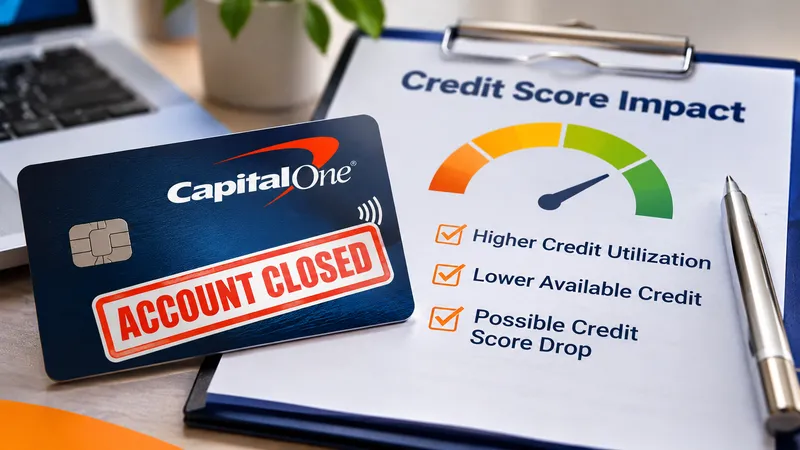
Capital One closed my account without warning. Will it hurt my credit score? Yes, an unexpected credit card closure can lower your credit score, even if you never missed a payment. The biggest concern is your credit utilization ratio, which measures how much of your available credit you use. According to FICO, amounts owed account for approximately 30% of your credit score, with credit utilization playing an important role. For example, if you owe $4,000 across credit cards with a combined $20,000 limit, your utilization is 20%. If Capital One closes a card with an $8,000 limit, your available credit drops to $12,000, raising your utilization to 33%. That change can affect your score once the updated account information reaches the credit bureaus. However, a credit card closure does not automatically count as a negative mark, and an account closed in good standing can remain on your credit report for up to 10 years.
At ASAP Credit Repair USA, our nearly 20 years of experience helping consumers address credit reporting problems have shown why reviewing closed accounts matters. A Capital One account closure and an inaccurate credit report are two different issues that require different solutions. Consumers should check whether Capital One reported the correct account balance, payment history, and closure status to Equifax, Experian, and TransUnion. Under the Fair Credit Reporting Act (FCRA), consumers have the right to dispute inaccurate or incomplete credit information. This guide explains why Capital One may close an account without advance notice, how the closure affects your credit score, and what steps can help reduce the impact. You will also learn how to identify reporting errors, protect your remaining credit accounts, and dispute inaccurate information before it creates additional financial problems.
Can Capital One Close My Credit Card Account Without Warning?
Yes. Capital One and every other card issuer reserve the right to close an account at any time under the cardmember agreement. Federal law does not require advance notice before a closure. Capital One is required to send an adverse action notice after the fact if the closure was based on information in your credit report — but that notice arrives after the account is already closed.
Every credit card agreement contains language giving the issuer the right to close the account at its discretion. Capital One's cardmember agreement is explicit about this. The closure is a unilateral decision; the cardholder has no right of prior approval and no statutory right to advance notice.
Capital One closes accounts for a range of reasons. The most common patterns we see in client files are extended inactivity a card unused for 12 to 24 months and a drop in the cardholder's credit score or a change in their credit profile that triggers a periodic account review. Late payments on the Capital One account itself or on other accounts visible on the credit report also trigger closures. Fraud suspicion, regulatory requirements, and business decisions to exit a product line are less common but real.
The closure itself is legal. What matters for your credit is how Capital One reports it and what it does to your utilization ratio. Those are the two things you control after the fact.
How Does a Closed Capital One Account Hurt My Credit Score?
The most immediate damage is to your credit utilization ratio. When Capital One removes a high credit limit from your available credit pool, your utilization rises sometimes sharply enough to drop your score 20 to 50 points or more within one billing cycle. The second impact, on average age of accounts, is gradual. The closure is not itself a derogatory mark. The score damage is structural, not punitive, and the utilization portion is reversible once you reduce balances on other accounts.
Credit Utilization: The Immediate Hit
Credit utilization measures the ratio of your revolving balances to your total revolving credit limits. It accounts for approximately 30% of a FICO score and updates every billing cycle. When Capital One closes your account, your total available credit drops by the full credit limit on that card. If you carry balances on other cards, those balances now represent a larger share of your reduced available credit.
The math is what causes the score drop. If you had $4,000 in balances across $20,000 in total credit, your utilization was 20%. If Capital One closes a card with an $8,000 limit, your total available credit falls to $12,000. The same $4,000 in balances now represents 33% utilization — a jump that scoring models penalize directly.
| Before Capital One Closure | After Capital One Closure | Score Impact |
|---|---|---|
| $4,000 balance / $20,000 total credit = 20% utilization | $4,000 balance / $12,000 total credit = 33% utilization | Moderate drop — 15 to 25 points typical |
| $5,000 balance / $18,000 total credit = 28% utilization | $5,000 balance / $8,000 total credit = 63% utilization | Severe drop — 40 to 70+ points possible |
| $0 balance / $15,000 total credit = 0% utilization | $0 balance / $7,000 total credit = 0% utilization | Minimal — no utilization impact if balances are zero |
Average Age of Accounts: The Gradual Effect
Closed accounts stay on your credit report for up to 10 years if the history is positive. During that window, the account continues to contribute to your length of credit history and average age of accounts. The age impact of a closure is gradual; you do not lose the account's history the day it closes. The damage accelerates when the account ages off your report entirely, which makes long-tenured accounts particularly important to keep open if possible.
Credit Mix: A Minor Factor
Credit mix accounts for approximately 10% of a FICO score and considers whether you have a range of account types, revolving credit, installment loans, and so on. If the Capital One card was your only revolving account, its closure removes revolving credit from your profile. That is a secondary concern compared to utilization, but it matters for consumers with thin files.
Will Capital One's Closure Show as Negative on My Credit Report?
A closure by the creditor is not a derogatory mark. The account shows as "closed" with the notation "closed by credit grantor." That status is neutral; it tells future lenders the issuer closed it, not that the account defaulted. The damage to your score comes from utilization and account age, not from the closed status itself. What does count as negative is any late payment history Capital One reported before closing the account, and those late marks are separate from and older than the closure itself.
The distinction between "closed by credit grantor" and "charged off" is critical and frequently misunderstood. A charge-off means the lender gave up collecting the debt and wrote it off as a loss; it is a severe derogatory mark that stays on your report for seven years and signals financial default to every future lender. A closure by Capital One on an account in good standing is nothing like that.
What stays on your report from a closed account in good standing is your full payment history. If you paid on time for five years before Capital One closed the account, that five-year positive payment history continues to benefit your score for up to 10 more years. The account closing does not erase that history.
"Closed by credit grantor" is a neutral account status. It tells lenders the issuer terminated the relationship. "Charged off" is a derogatory status that signals the lender declared the debt a loss after extended non-payment. If Capital One closed your account while it was current and your credit report shows a charge-off, that is a reporting error, and it is disputable under FCRA Section 623.
The reporting errors we see most often on Capital One closed accounts are a balance still showing after the account was paid to zero, a late payment mark on a month when the payment was actually made on time, and a charge-off or derogatory status on an account that closed in good standing. All three are inaccurate. All three are correctable through a formal dispute.
See Exactly What Capital One Is Reporting on Your Closed Account
A free 3-bureau audit pulls your current Equifax, Experian, and TransUnion reports so you can see the exact status, balance, and payment history Capital One reported and identify any inaccuracy before you file a dispute.
Claim My Free Credit Analysis Now → Secure · 2 minutes · No credit card requiredHow Do I Minimize Credit Score Damage After Capital One Closes My Account?
Act on your utilization ratio within the current billing cycle. Pay down balances on all remaining revolving accounts to get utilization below 30 percent, ideally below 10 percent. Do not close other cards. Request a credit limit increase on a remaining card to partially offset the lost available credit. If your profile qualifies, apply for a replacement card once utilization is under control. The utilization damage reverses within one to two billing cycles if you reduce balances.
The score damage from a Capital One closure is real, but most of it is structural rather than punitive, and structural damage responds to structural fixes. The utilization spike is the fastest-moving variable. Reducing balances on other revolving accounts brings utilization back down, and scoring models update that factor every billing cycle. You do not have to wait years for the score to recover.
- ✓ Calculate your new utilization immediately. Add up all revolving balances and divide by your remaining total credit limit. If that number is above 30%, you have a utilization problem that needs to be addressed before your next statement date.
- ✓ Pay down revolving balances aggressively. Even partial paydowns on other credit cards help. Each dollar of balance reduction improves your utilization ratio. Prioritize accounts with the highest balances relative to their limits.
- ✓ Request a credit limit increase on a remaining card. Contact another issuer and ask for a credit limit increase. An approval adds available credit back to your profile and lowers utilization without requiring you to pay down any balances. Many issuers approve limit increases through an online request with no hard inquiry.
- ✓ Keep all other revolving accounts open and active. Dormant cards risk the same treatment Capital One just gave you. Use each remaining card for a small purchase once every few months and pay it in full to prevent inactivity-based closures.
- ✓ Apply for a replacement card when your utilization is under control. Once your utilization is below 30%, a new card application adds available credit and starts building a new account age. Apply for a card your current score qualifies for; a denial adds a hard inquiry with no benefit.
- ✗ Do not apply for multiple new cards at once. Multiple hard inquiries in a short period signal credit-seeking behavior and suppress your score further. One well-targeted application is the right move, not a flurry of applications to replace a lost credit limit quickly.
- ✗ Do not pay to reopen the Capital One account. Some consumers attempt to reopen a closed account by paying any outstanding balance. Capital One rarely reopens closed accounts, and paying a zero balance on a closed account does not change its status. Focus on the existing open accounts and the reporting accuracy of the closed one.
What If Capital One Is Reporting Inaccurate Information on the Closed Account?
File a written dispute with Capital One and simultaneously with all three credit bureaus. Under FCRA Section 623, Capital One has 30 days to investigate and correct any inaccurate information. The most common errors on closed accounts are a balance still showing after the account was paid to zero, a late payment mark that is incorrect, and a charge-off status on an account that closed in good standing. Each of these is disputable and correctable.
The closure is legal and not disputable. The reporting of that closed account is a separate matter, and inaccurate reporting is fully disputable under the FCRA. Capital One is a data furnisher. As a furnisher, it is required under FCRA Section 623 to report accurate information and to investigate disputes within 30 days of receiving notice.
Identify the Specific Error Before You File
Pull your current reports from all three bureaus at AnnualCreditReport.com and look at the Capital One entry on each one. The same account sometimes shows differently across bureaus because Capital One reports to each one separately. Note the balance, the payment history, the account status, and the date of last activity. Compare what you see to your own records — your last statement, your payment confirmations, your correspondence with Capital One about the closure.
The Most Common Reporting Errors to Look For
A balance still showing after the account was paid to zero before closure is the most frequent issue. The account closed with a zero balance, but the final reporting cycle sent the previous month's balance figure. That zero needs to be reflected. A late payment notation on a month you paid on time is the second most common error — particularly if Capital One closed the account shortly after a payment dispute or a returned payment that was subsequently resolved. A charge-off or collection status on an account that never reached charge-off is the most damaging error and demands an immediate dispute.
- ✓ Document the specific inaccuracy on each bureau. Note the exact field that is wrong: balance, payment status, account status, and the value shown versus the correct value. A specific dispute is harder to dismiss than a general complaint.
- ✓ Gather your supporting documentation. Collect the final statement showing zero balance, payment confirmation records, any correspondence from Capital One confirming the account was closed in good standing, and any adverse action notice you received.
- ✓ File a written dispute with Capital One directly. Send a formal dispute letter to Capital One's credit dispute address. Identify the account, the specific inaccuracy, and attach copies of your documentation. Send by certified mail with return receipt.
- ✓ File simultaneously with all three bureaus. Dispute online at Equifax.com, Experian.com, and TransUnion.com or mail certified written disputes to each. The same error appearing on all three reports requires three separate disputes; the bureaus do not share dispute resolutions.
- ✓ Track the 30-day response window. From the date each bureau receives your dispute, they have 30 days to complete their investigation. Mark your calendar. If you do not receive a response within that window, you have grounds to escalate.
If the Dispute Does Not Resolve the Error
File a complaint with the Consumer Financial Protection Bureau at consumerfinance.gov/complaint. The CFPB routes the complaint to Capital One and requires a formal response, typically within 15 days. Capital One's compliance team handles CFPB complaints at a different level than its standard dispute department. In the files we review, CFPB complaints after rejected disputes resolve reporting errors in a substantial portion of cases.
Under FCRA Section 611(a)(7), you also have the right to request a written description of the method the bureau used to verify the disputed item. If the bureau confirmed an inaccurate status after your dispute, ask how it verified that status. A bureau that cannot describe what Capital One provided to confirm the specific balance figure or payment status has not met its verification obligation.
If the inaccurate reporting caused documented financial harm — a denied credit application, a higher interest rate, a lost opportunity — FCRA Sections 616 and 617 give you the right to sue Capital One or the bureau in federal court. You are entitled to actual damages, statutory damages, and attorney's fees. This is not a first step, but it is a real remedy when the violation is documented, and the harm is quantifiable.
Capital One closing your account without warning is legal. The score damage is real, mostly from utilization, and mostly reversible. The closure itself is not a negative mark on your report. What matters is whether Capital One reported it accurately and whether you act quickly to bring your utilization back down on other accounts. If Capital One left an inaccurate balance, late mark, or incorrect status on the closed account, that is an FCRA dispute you file and win with documentation.
Can Capital One close my credit card account without warning?
Yes. Capital One and every other card issuer reserve the right to close an account at any time under the cardmember agreement. Federal law does not require advance notice before an account closure. The most common reasons are extended inactivity, a drop in credit score, late payments on the Capital One account or other accounts, fraud suspicion, or a periodic account review that flags increased risk. Capital One is required to send an adverse action notice explaining why if the closure resulted from information in your credit report, but that notice comes after the closure, not before.
How does a closed Capital One account hurt my credit score?
The most immediate damage comes from credit utilization. When Capital One removes a high credit limit from your available credit pool, your utilization ratio rises sometimes sharply. If Capital One was your highest-limit card and you carry balances on other accounts, that ratio change alone can drop your score 20 to 50 points or more. The second impact is on your average age of accounts over time, as the closed account stops contributing to your open account age once it falls off your report. Credit mix is affected if the Capital One card was your primary revolving account.
Will Capital One's account closure show as negative on my credit report?
A closure by the creditor is not the same as a charge-off and does not carry the same weight as a derogatory mark. The account shows as "closed" with the notation "closed by credit grantor." If the account had a positive payment history, that history stays on your report for up to 10 years. The closure itself is not a negative mark — but if Capital One reported any late payments before closing the account, those late marks are what cause score damage, not the closure status.
How do I minimize credit score damage after Capital One closes my account?
Act on your utilization ratio immediately. Pay down balances on any remaining revolving accounts to bring utilization below 30 percent. Do not close other credit cards in response, as that makes the utilization problem worse. Request a credit limit increase on a remaining card to partially offset the lost available credit. If your credit profile still qualifies, apply for a replacement card once your utilization is under control. The utilization damage is real but reversible within one to two billing cycles if you reduce balances.
What if Capital One is reporting inaccurate information on the closed account?
File a written dispute directly with Capital One and simultaneously with all three credit bureaus: Equifax, Experian, and TransUnion. Under FCRA Section 623, Capital One must investigate the dispute within 30 days and correct any inaccurate information. The most common errors on a closed account are a balance still showing when the account was paid to zero, a late payment notation on a payment that was made on time, or a charge-off status on an account that was closed in good standing. Each of these is disputable and correctable.
Find Out Exactly What Is on Your Three Credit Reports Right Now
A free 3-bureau audit shows every account, balance, and status on your Equifax, Experian, and TransUnion files, including what Capital One reported on the closed account and whether it matches your records. Know the full picture before you take any action.
Claim My Free Credit Analysis Now → Secure · 2 minutes · No credit card required-
Canceled GAP Insurance but Auto Loan Balance Is Still Wrong? Here's Why Covers how a GAP refund or total-loss payout should reduce your reported loan balance and what to do when the lender fails to update what it reports to the bureaus.
-
My Lender Went Out of Business: Who Fixes Its Credit Reporting Errors? When a lender closes or transfers its portfolio, reporting errors follow the account. Learn who is legally responsible and how to dispute errors from an acquired or closed lender.
-
How to Dispute Credit Report Errors: A Step-by-Step Guide The complete FCRA dispute process — what to include, what the bureaus are required to do, and what happens when a dispute is rejected, or the error persists.