

A car lease extension credit report error can leave you facing a past-due notice even after you arranged to keep your vehicle and continued making payments. You expected the extension to keep your account on track, so a late payment entry raises an urgent question: does the finance company’s reporting match your agreement? The first step is to compare your approved extension dates, payment requirements, and transaction history with the specific months marked late on your credit report.
Resolving the mismatch starts with establishing what the finance company approved and how it applied your payments. A written extension, confirmation emails, and account statements help explain what happened, while payment acceptance alone does not establish every term of an extension. This guide explains how to review those records, distinguish a reporting error from an actual overdue amount, and prepare a clear dispute when the reported information is wrong.
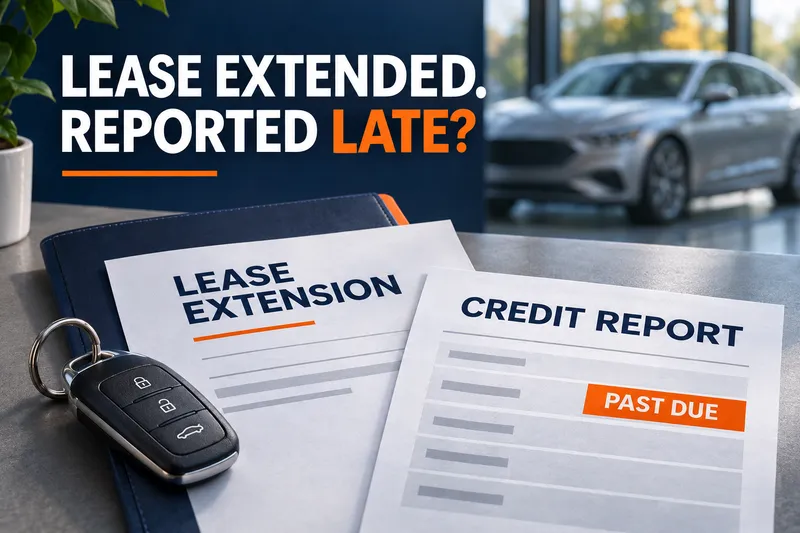
Why Does a Car Lease Extension Show as Past Due on a Credit Report?
When a car lease is extended, the finance company's reporting system does not always update the maturity date. The original end date remains in the system, and once that date passes, automated reporting flags the account as past due even though payments are current and the extension was agreed upon. The error comes from the lender's internal data, not the borrower's payment behavior.
Auto lease agreements have a specific end date written into the contract. When a lease is extended, two things are supposed to happen: the lender approves the extension, and its credit reporting system gets updated with the new maturity date. The first step usually happens. The second one frequently does not.
Captive finance companies Toyota Financial Services, Ford Motor Credit, GM Financial, Honda Financial Services, Ally Financial, and similar lenders use automated reporting systems that pull from the original contract terms. If a customer service representative approves a three-month extension but does not trigger a system update to the account maturity date, the system continues treating the original end date as the payment due date. When the original end date passes, and the system sees no payoff or return of the vehicle, it reports the account as past due.
The borrower made every payment. The lender agreed to the extension. The credit report reflects neither of those facts correctly. That is the core of the problem.
What Is the Difference Between a Formal Lease Extension and a Month-to-Month Holdover?
A formal lease extension is a written agreement that moves the lease end date to a specific new date, with updated paperwork reflecting the new terms. A month-to-month holdover occurs when the lessee continues making payments after the original end date, and the lender accepts them without new documentation. Both are common, but only a signed extension agreement provides documentation to support a credit dispute.
Understanding which situation applies determines what documentation you have — and what you can prove when filing a dispute.
Formal Lease Extension
A formal extension is documented. The lender sends updated paperwork or a written confirmation email specifying the new end date and the agreed monthly payment. The account should be updated in the lender's system with the new maturity date. If a past-due notation still appears after a formal extension, the error is straightforward: the system update did not happen, and the written agreement is your evidence to prove it.
Month-to-Month Holdover
A holdover is less formal. The original lease ends, the lessee keeps driving and keeps paying, and the lender keeps accepting the payments without issuing new paperwork. Many leases contain a provision allowing this arrangement automatically. The lender's acceptance of continued payments is evidence of agreement. Bank records showing those payments were made and accepted serve as documentation in a dispute.
| Arrangement | Documentation Available | Reporting Risk | Dispute Strength |
|---|---|---|---|
| Formal extension | Signed agreement or written confirmation with new end date | Low — if system is updated correctly | Strong — written agreement is direct evidence |
| Month-to-month holdover | Payment records showing accepted payments post-original end date | Higher — no system update trigger | Moderate — payment history proves lender acceptance |
| No agreement, no payments | None | Legitimate past due or repossession | Not a dispute situation |
How Does a Lease Extension Past Due Error Damage Your Credit Score?
A single 30-day late mark drops a FICO score by 60 to 110 points. Payment history is 35 percent of a FICO score, making it the single largest factor. An incorrect past-due notation from a lease extension error that is not disputed promptly stays on the credit report for seven years and raises the cost of every loan and insurance policy in the meantime.
The damage from a wrongly reported past-due lease is not abstract. It shows up in real numbers on the next loan application, the next apartment application, and the next car insurance renewal. Lenders and insurers pull credit scores and see a delinquency. They do not know the context. They see the number and price their risk accordingly.
The score impact compounds based on how many months the false late mark covers. If a lease extension runs three months and the reporting system flags each month as past due, the report shows three separate late payment notations. Each one reduces the score independently. A 30-day late, a 60-day late, and a 90-day late from the same lease extension error are three separate scoring hits.
See Every Account Currently Reporting on Your Three Credit Files
A free 3-bureau audit pulls your current Equifax, Experian, and TransUnion reports and shows exactly which accounts are reporting, what status each one carries, and where errors are most likely hiding — including lease accounts with incorrect past-due notations.
Claim My Free Credit Analysis Now → Secure · 2 minutes · No credit card requiredHow Do You Dispute a Past Due Lease Extension Error on Your Credit Report?
Gather written proof of the extension or written confirmation that holdover payments were accepted. File a dispute directly with the auto finance company under FCRA Section 623 and simultaneously file disputes with all three credit bureaus. Include documentation with each dispute. The bureaus have 30 days to investigate, and any item they cannot verify must be deleted under FCRA Section 611.
Work through this in sequence. Filing with the bureaus alone without notifying the furnisher leaves the lender free to re-report the same error after the bureau temporarily removes it. Filing with both simultaneously forces two parallel investigations and creates a stronger paper trail.
- ✓ Get your documentation in order first. Find the written extension agreement, the email or letter from the lender confirming the extension, or bank statements showing accepted payments after the original lease end date. If you approved the extension by phone only, call the lender and request written confirmation before you file anything.
- ✓ Pull your reports from all three bureaus. Go to AnnualCreditReport.com and pull your current Equifax, Experian, and TransUnion reports. Identify every past due notation tied to the lease account and note the exact dates reported.
- ✓ File a written dispute with the auto finance company. Under FCRA Section 623, the furnisher must investigate and correct inaccurate information. Address your dispute to the lender's credit reporting or customer dispute department — not general customer service. Include your account number, the specific months reported as past due, and a copy of your extension documentation.
- ✓ File disputes with all three bureaus simultaneously. Dispute online at Equifax.com, Experian.com, and TransUnion.com, or mail written disputes via certified mail to each. Attach the same documentation to every dispute. The 30-day investigation window starts on receipt.
- ✓ Specifically identify each incorrect entry. State the account name, the account number, and each month reported as past due that is wrong. A vague dispute is easier to dismiss. A precise dispute tied to documented evidence is not.
- ✓ Keep records of everything submitted. Save your dispute confirmation numbers, submission dates, and all correspondence. You need this documentation if the dispute is rejected and escalation becomes necessary.
- ✗ Do not close or return the vehicle until the dispute is resolved. Returning the leased vehicle while a dispute is active changes the account status and complicates the paper trail. Finish the dispute process first.
What If the Lender Says the Past Due Reporting Is Correct?
File a complaint with the Consumer Financial Protection Bureau at consumerfinance.gov/complaint. The CFPB contacts the lender and requires a formal response. If the error caused documented financial harm, you have the right to sue the furnisher or bureau under FCRA Sections 616 and 617. You can also add a 100-word consumer statement to your credit file that appears on every future pull.
A rejected dispute does not mean the lender is right. It means their internal investigation concluded the original reporting was accurate. That conclusion can be wrong, and you have further options to push back.
Under FCRA Section 623, furnishers must report information they know or have reasonable cause to believe is inaccurate. A finance company that accepted lease extension payments and then reported the account as past due for the same period reported information it had reason to know was wrong. That is a furnisher violation, not a debatable interpretation.
File a CFPB Complaint
A complaint at consumerfinance.gov/complaint escalates the issue to federal regulatory oversight. The CFPB forwards the complaint to the lender and requires a formal response, typically within 15 days. Lenders take CFPB complaints seriously because the agency tracks complaint patterns and uses them in examination and enforcement. A captive finance company that consistently fails to update maturity dates after extensions is exactly the kind of systemic issue the CFPB monitors.
Request the Method of Verification
Under FCRA Section 611(a)(7), you have the right to request a written description of the procedure the bureau used to verify the disputed item. Send that request in writing after a rejected dispute. If the bureau cannot explain what source confirmed the past-due status or cannot produce documentation, you have grounds for a follow-up dispute and a stronger CFPB complaint.
Add a 100-Word Consumer Statement
FCRA Section 611(b) gives you the right to add a brief statement to your credit file explaining the dispute. The statement appears every time a lender pulls your report. It does not remove the notation, but it tells every future reviewer that the past-due entry is contested and provides context a bare credit report cannot.
Your Right to Sue Under the FCRA
FCRA Sections 616 and 617 give consumers the right to sue furnishers and bureaus in federal court for failing to meet their FCRA obligations. If the incorrectly reported lease extension caused a documented financial loss — a loan denial, a higher mortgage rate, a lost housing application — you have the right to seek actual damages, statutory damages, and attorney's fees. This is not the first step, but it is a real legal remedy when the violation is clear, and the financial harm is documented.
A car lease extension showing as past due is a furnisher error, not a borrower error. The finance company accepted the payments and failed to update its reporting system. The fix is a simultaneous dispute to the lender and all three bureaus, backed by written documentation of the extension. If that fails, the CFPB complaint process and your FCRA rights under Sections 616 and 617 give you meaningful escalation options. Act fast — every month the false late mark sits on your report costs you in rates, approvals, and options.
Why does a car lease extension show as past due on a credit report?
When a car lease is extended, the finance company's reporting system does not always update the maturity date. The original end date remains in the system, and once that date passes, automated reporting flags the account as past due even though payments are current and the extension was agreed upon in writing or verbally. The fix requires a formal dispute backed by documentation of the extension agreement.
What is the difference between a formal lease extension and a month-to-month holdover?
A formal lease extension is a written agreement that moves the lease end date to a new, specific date. A month-to-month holdover occurs when the lessee keeps making payments after the original end date with the lender's acceptance but without new paperwork. Both are legitimate arrangements, but only a signed extension agreement provides documentation to support a credit dispute if the lender reports the account incorrectly.
How much can a lease extension past due error damage your credit score?
A single 30-day late mark can drop a score by 60 to 110 points depending on the starting score and credit profile. Payment history is 35 percent of a FICO score, making it the single largest factor. A past-due notation from a lease extension error that is not disputed promptly stays on the report for seven years and affects every loan application, mortgage rate, and insurance premium in the meantime.
How do you dispute a past-due lease extension error on your credit report?
Gather written proof of the extension or written confirmation that holdover payments were accepted. File a dispute with the auto finance company under FCRA Section 623 and simultaneously file disputes with Equifax, Experian, and TransUnion. Include a copy of the extension agreement or payment acceptance confirmation with each dispute. The bureaus have 30 days to investigate, and any item they cannot verify must be deleted under FCRA Section 611.
What can you do if the lender insists the past-due lease reporting is correct?
File a complaint with the Consumer Financial Protection Bureau at consumerfinance.gov/complaint. The CFPB contacts the lender and requires a formal response within 15 days. If the error caused documented financial harm such as a loan denial or higher interest rate, you have the right to sue the furnisher or bureau under FCRA Sections 616 and 617. You can also add a 100-word consumer statement to your credit file that appears on every future pull.
Find Out What Your Credit Report Actually Says Right Now
A free 3-bureau audit shows every account currently reporting on your Equifax, Experian, and TransUnion files — including any auto lease account with a past-due notation, an incorrect balance, or a status that does not match your payment history. See the full picture before your next application.
Claim My Free Credit Analysis Now → Secure · 2 minutes · No credit card required-
My Lender Went Out of Business. Who Fixes Its Credit Reporting Errors? Covers what happens to furnisher obligations when a lender closes and how to dispute errors when the original creditor no longer exists.
-
I Paid My Mortgage, but the Money Is "Unapplied": Why Am I Reported Late? The same system-update problem in a mortgage context — servicer received payment, payment sat in suspense, report shows delinquent.
-
How to Dispute Credit Report Errors: A Step-by-Step Guide The complete FCRA dispute process — what documentation to include, how bureaus are required to respond, and what to do when a dispute is rejected.