

Clean credit files are credit reports that show accurate information. It reflects current positive activity and no unnecessary negative items across Experian, Equifax, and TransUnion.
A clean file does not mean a perfect score. It means lenders can review consistent data without errors, duplicate accounts, or unmanaged risk signals.
Many consumers focus only on the score and ignore the file behind it. Lenders often review both. A score may improve, but outdated late payments, wrong balances, mixed files, or unresolved collections can still affect approvals.
In credit files we review, approvals are often delayed by reporting issues rather than score alone.
The three bureaus do not always update in the same way or at the same time. One report may show a paid collection removed, while another still reports it. That is why building clean credit files requires reviewing all three bureaus. Not one monitoring app or one score source.
This guide explains how to build clean credit files across all three bureaus.
Knowing what to correct first and how to create stronger approval signals over time.
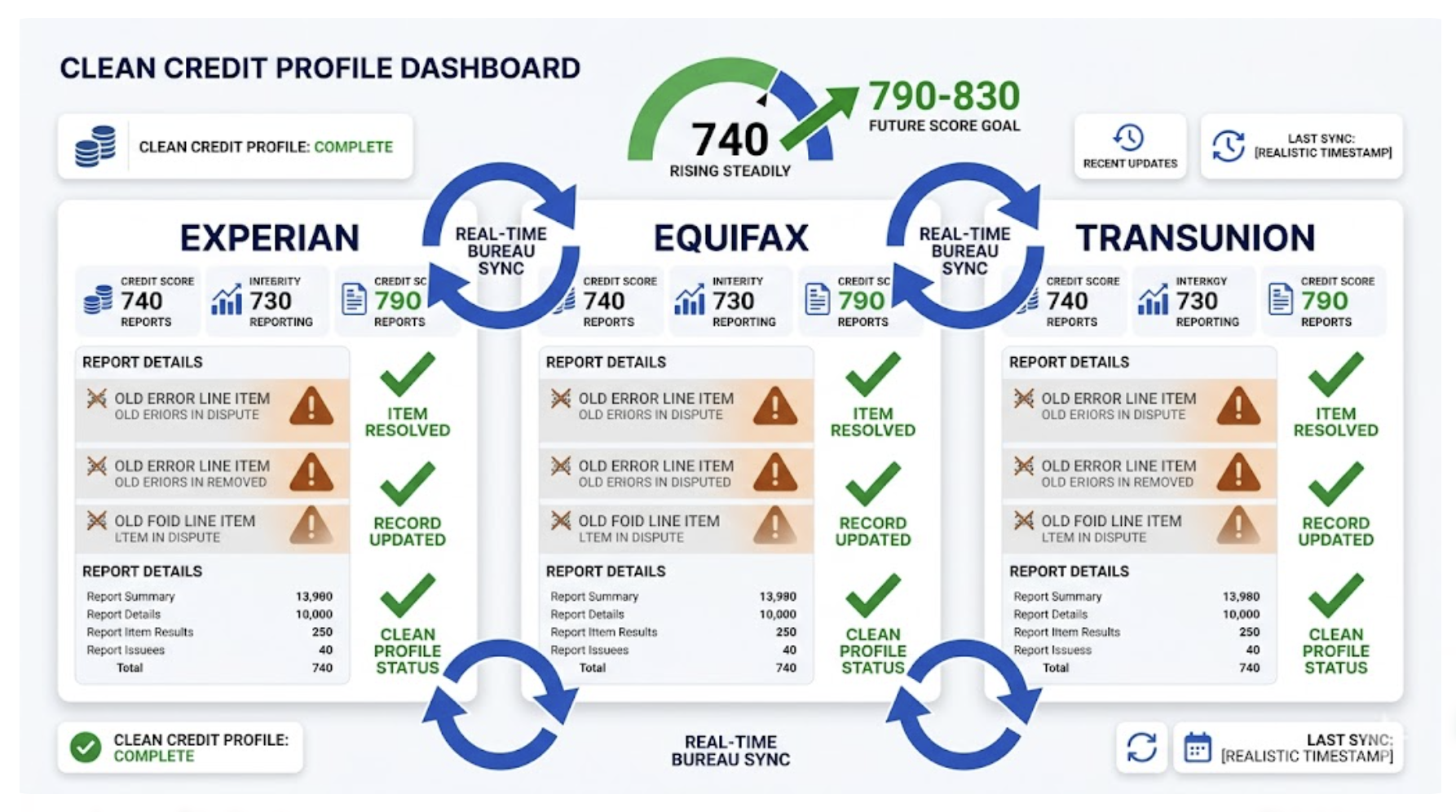
How to Build Clean Credit Files
What Improves a Credit File
Accurate personal information
On-time payment history
Low revolving balances
Aged open accounts in good standing
Paid or resolved negative accounts where appropriate
What Damages a Credit File
Reporting errors
Duplicate accounts
High utilization
Recent late payments
Unverified collections or mixed-file issues
What to Review Across All 3 Bureaus
Account balances match
Payment history is consistent
Closed accounts reported correctly
Personal identifiers are accurate
Public records or collections are valid
Americans with at least one credit report error
44%
Almost half of all credit files contain at least one item that is disputable under the FCRA
Score drop from a single incorrect entry
50–100
points. One wrong late payment or unverified collection can move you into a higher-rate loan tier.
Time to resolve disputes (simultaneous filing)
30–45 days
Each bureau has 30 days to investigate under the FCRA. File all three on the same day for fastest results.
At a Glance
A clean credit file means every item on your Equifax, Experian, and TransUnion reports is accurate, verifiable, and within its legal window. The bureaus do not share corrections. An item removed from one stays on the others until you dispute it there too. Building clean files across all three requires pulling every report, disputing errors simultaneously, and adding positive accounts. This is the process, in order.
CR
ASAP Credit Repair USA · Credit Repair Company · Nearly 20 Years · Registered under CROA
We pull thousands of credit reports per year. The most common pattern: a borrower has one bureau clean, two still damaged. They were declined for a mortgage because the lender ran a tri-merge and used the middle score - which was still damaged. All three matter, every time.
What "Clean Credit Files" Actually Means
A clean credit file is not a perfect score. It is a report free of inaccurate, unverifiable, or expired entries. You can have a clean file with a score of 650. You can have a dirty file with a score of 720 where one wrong item has not yet dragged the score down.
The Fair Credit Reporting Act (FCRA) sets the legal standard. Every item on your report must be accurate, complete, and verifiable. If a creditor cannot verify an item during a dispute, the bureau must remove it. If an item is past its reporting window - 7 years from the original date of delinquency for most negatives - it must come off. A clean file is simply a report that passes this standard on every single line.
The three major bureaus - Equifax, Experian, and TransUnion - each collect data independently. A creditor that reports your payment history may report to all three, two, or just one. That means the same account can appear with different balances, different dates, or different statuses on different reports. It also means an error corrected at one bureau is not automatically corrected at the others. As our top credit repair mistakes guide explains, sequential bureau disputes extend your timeline by 60 to 90 days and leave the other bureaus dirty throughout. You must dispute all three at once.
Ready to improve your credit?
Get Started →Why All 3 Bureaus Must Be Clean Simultaneously
Mortgage lenders run a tri-merge credit report that pulls all three bureaus and uses your middle score for qualification. If your Experian score is 720, your TransUnion is 695, and your Equifax is 668 because one uncorrected collection is still reporting there - your qualifying score is 695. The lender prices your loan at 695, not 720. You pay the higher rate for the entire loan term.
Auto lenders, landlords, insurance companies, and credit card issuers each choose which bureau to pull. You do not know in advance which one they will check. A clean Experian file means nothing if the landlord who reviews your application pulls only TransUnion, where a disputed collection is still reporting.
The tri-merge standard: Most mortgage lenders use the middle of three FICO scores at underwriting. Some lenders use the lower of two scores for a co-borrower. In either case, a single dirty bureau suppresses the qualifying score and raises the rate. The only way to protect every possible lending scenario is to clean all three files before applying.
The 4-Step Process to Build Clean Credit Files
Clean Credit Files: Step-by-Step Process
1
Pull all three reports - right now
Go to AnnualCreditReport.com - the only federally authorized source. Under the current FTC policy, you can pull one free report from each bureau every week, not just once a year. Download and save each as a PDF. Do not use Credit Karma or similar apps for this - they show a version of your report that may omit items that appear on the full bureau report. You need the full file from Equifax, Experian, and TransUnion separately.
Free. No card required. Takes 10 minutes.
2
Review every line of every report for errors
Go account by account. Compare each report against the others - the same account may show different information across bureaus. Flag anything that is inaccurate, unrecognized, outdated, or duplicated. Pay special attention to the original delinquency date on negative items - that date controls when the item expires. A wrong date can keep a negative item on your report longer than the law allows. Our step-by-step credit report dispute guide covers exactly what to look for and how to document each error before filing.
Most people find at least one error. Research puts the rate at 44% nationally.
3
Dispute all three bureaus on the same day
File online through each bureau's official dispute portal, or by certified mail for a written record. Each bureau has 30 days to investigate independently under the FCRA. If the furnisher (the creditor who reported the item) cannot verify the entry, it must be removed. Unverifiable does not mean untrue - it means the creditor failed to respond or failed to provide sufficient documentation within the investigation window. Filing simultaneously gets you results from all three within the same 30 to 45-day window instead of 90 to 135 days of sequential filings.
File simultaneously. Equifax + Experian + TransUnion. Same day, same items.
4
Add and maintain positive accounts
Removing negatives cleans the file. Adding positives builds the score. The FICO model rewards payment history (35%), utilization (30%), account age (15%), credit mix (10%), and new accounts (10%). Keep utilization below 30% on all cards. Keep old accounts open even at zero balance - a closed account removes available credit and raises your utilization ratio immediately. One on-time installment loan and one on-time revolving account reporting monthly is the foundation of a clean file that also has a strong score.
Positive history is built one month at a time. Start the clock now.
What Errors Actually Qualify for Dispute
Not everything negative is disputable. Accurate, verifiable negative items within the reporting window stay. The list below covers what is genuinely disputable - items where the bureaus are legally required to investigate and remove if unverifiable.
Always Disputable
✗Accounts you do not recognize
✗Late payments on accounts you paid on time
✗Wrong original delinquency date
✗Duplicate entries for the same debt
✗Items past the 7-year reporting window
✗Wrong balance or incorrect amount
✗Paid accounts still showing unpaid
✗Settled accounts still showing full balance
Also Check These
✓Personal info: wrong SSN, name, address
✓Mixed files: another person's accounts on your report
✓Charge-offs showing as open active accounts
✓Collections transferred between agencies - dates may reset incorrectly
✓Closed accounts showing open (affects utilization calc)
✓Hard inquiries you did not authorize
✓Medical debt (removed from all reports as of 2023-2025 CFPB rules)
✓Bankruptcy discharge date incorrectly listed
What you cannot dispute away: Accurate, verified, within-window negative items stay. A late payment from 3 years ago that you genuinely made late, reported correctly with the right date - that stays until year 7. Trying to dispute accurate items wastes your dispute cycle and creates a record of failed challenges that can make future disputes less effective. Focus disputes on genuine errors.
The Clean Credit File Timeline
Day 1
Pull all 3 reports. Flag errors.
AnnualCreditReport.com. Review all three simultaneously.
Day 1-3
File disputes - all 3 bureaus same day
Online or certified mail. Each bureau has 30 days to investigate.
Day 30-45
Results arrive. Items removed or verified.
Score impact appears in next reporting cycle - usually within 2-6 weeks of removal.
Month 3-24
Positive history builds on clean file
On-time payments compound monthly. Credit age grows. Score climbs steadily.
How Equifax, Experian, and TransUnion Differ
The three bureaus are not identical in what they report, how they investigate disputes, or how they handle certain account types. Understanding the differences helps you file more effective disputes.
FactorEquifaxExperianTransUnion Dispute portal equifax.com/dispute experian.com/disputes transunion.com/disputes Online dispute tracking Yes Yes Yes Investigation window 30 days (45 if you submit additional info) 30 days (45 days if additional info submitted) 30 days (45 days if additional info submitted) Certified mail address P.O. Box 740256, Atlanta, GA 30374 P.O. Box 4500, Allen, TX 75013 P.O. Box 2000, Chester, PA 19016 Do corrections auto-share to other bureaus? No No No Used by mortgage lenders? Yes (tri-merge) Yes (tri-merge) Yes (tri-merge)
The bureaus are independent businesses that do not share corrections. A dispute result at Experian does not trigger any update at Equifax or TransUnion. Each bureau must be disputed separately for the same item. Certified mail provides a delivery record - useful if a bureau disputes whether your dispute was received. Source: ASAP Credit Repair USA, dispute process documentation; FCRA 15 U.S.C. §1681i (30-day investigation requirement).
After the Dispute: Keeping Files Clean
A dispute removes an item. Your behavior going forward determines whether new negatives replace the old ones. A clean file stays clean through three habits: paying on time every month, keeping revolving balances below 30% of each card's limit, and checking all three reports at least twice a year for new errors.
New errors appear constantly. Creditors submit data to bureaus in batch reports and make mistakes. A payment marked late in error, a closed account reopened incorrectly, or a sold debt reported under both the old and new collector - these appear without warning. The only way to catch them is to pull your reports regularly and review them.
The full process for identifying and targeting every type of error is covered in our proven guide to cleaning your credit report - including what supporting documents to include with each dispute type and how to escalate to the CFPB when a bureau refuses to investigate.
One number to watch across all three: Your oldest account's age, which counts as 15% of your FICO score under credit history length. Closing any account - even one with a zero balance - reduces average account age and can drop your score 10 to 30 points immediately. Keep old accounts open. The utilization and age benefits of an open zero-balance card are real and ongoing.
Frequently Asked Questions
What is a clean credit file?
A clean credit file is a credit report that contains no inaccurate, unverifiable, or outdated negative entries across Equifax, Experian, and TransUnion. Every item must be accurate, verifiable by the reporting creditor, and within the FCRA's 7-year reporting window for most negatives. A clean file can coexist with a credit score below 750 - it simply means the negative entries that are present are accurate and not removable.
Why do I need to clean all 3 bureaus, not just one?
Bureaus do not share corrections. An item removed from Experian stays on Equifax and TransUnion until you dispute it there separately. Mortgage lenders run tri-merge reports using all three bureaus and base your rate on the middle score. Auto lenders, landlords, and credit card issuers each choose which bureau to pull - you do not know in advance which one they will check. One dirty bureau can cost you a loan approval or push you into a higher-rate tier regardless of how clean the other two are.
How long does it take to build a clean credit file?
The dispute phase takes 30 to 45 days when you file all three bureaus simultaneously. Score impact from removed items typically shows within 2 to 6 weeks after removal. Building positive history on a clean file takes 6 to 24 months depending on starting point - each on-time payment adds to the foundation. The total timeline from starting disputes to a substantially clean, score-improving file is typically 3 to 6 months for most borrowers.
Can I remove accurate negative items from my credit file?
No. The FCRA does not allow removal of accurate, verifiable, within-window negative information. What you can do is let time work - most negatives expire after 7 years from the original delinquency date. You can also add positive accounts to dilute the impact of accurate negatives on your score. For legitimate debts, a pay-for-delete agreement - where you negotiate removal as part of a settlement - is sometimes possible but is not guaranteed and cannot be legally compelled. Focus disputes on genuinely inaccurate or unverifiable items, not simply items you dislike.
Should I hire someone to build clean credit files for me?
The dispute process itself is free and available to any consumer - you can do everything a credit repair company does using the FCRA's rights. What a legitimate company provides is time, expertise in identifying specific errors, knowledge of effective dispute language, and follow-up management. They cannot legally do anything you cannot do yourself for free. If you hire one, the Credit Repair Organizations Act requires them to give you a written contract, prohibits upfront payment before services are delivered, and gives you three business days to cancel. Any company that guarantees removal of accurate items or promises a specific score improvement is violating federal law.
ASAP Credit Repair USA · Registered under CROA
See Every Entry Across All 3 Bureaus Before You Dispute
A free 3-bureau audit shows exactly what Equifax, Experian, and TransUnion are reporting on your file right now - including items that may not show on credit monitoring apps. It identifies every entry that is inaccurate, outdated, or unverifiable before you file a single dispute.
Get My Free 3-Bureau Audit →Secure · 2 minutes · No credit card required
Related Posts
Top 7 Emergency Loan Providers for Low Credit Scores in Harris County A clean credit file directly affects the APR you receive on emergency loans. This covers the 7 lenders that approve Harris County borrowers with scores under 580, what each one actually requires, and why the difference between a 560 and a 600 score can mean 8 to 12 percentage points in rate.
Best Installment Loans for Collection Accounts in Charlotte Collection accounts are the single most common dirty entry on credit files. This covers how Charlotte lenders evaluate applicants with active collections, which lenders weigh income over score, and how cleaning a collection from your report before applying changes both approval odds and rate offers.
High Home Prices in San Diego: Are FHA Loans Enough? FHA's 3.5% down requires a 580 credit score. Conventional at 5% down requires 620. That 40-point gap is often one disputed entry. This explains exactly where clean credit files change the product you qualify for in San Diego's market and what the lifetime financial difference between FHA MIP and cancelable PMI actually adds up to.
How Fast Can a House Be Foreclosed in Phoenix? Pre-foreclosure late payment notations are independently reported to all three bureaus starting at 30 days past due. Each notation stays for 7 years. This covers the Phoenix foreclosure timeline, which credit entries are generated at each stage, and why the pre-foreclosure window - not the foreclosure itself - is when the most damage is done to your credit file.
Property Tax Increases in Austin: Can This Push You Into Default? Austin's 2025 average property tax increase of $1,123 raised monthly mortgage payments by $200 to $400. For homeowners who missed payments as a result, those 30-day notations are now on all three bureau reports. This covers how an escrow shortage creates credit file damage and what to do when late payment entries are inaccurate or post-dated incorrectly after a servicer error.
Disclaimer: This article is for general educational purposes only and does not constitute legal or financial advice. Credit repair outcomes vary by individual file. Nothing in this article guarantees removal of specific items. ASAP Credit Repair USA is registered under the Credit Repair Organizations Act (CROA). Consumers have the right to dispute credit report errors for free directly with the bureaus at no cost.
Final Thoughts About Clean Credit Files
Clean credit files are built through accuracy, consistency, and time. The goal is not only a higher score. The goal is a report lenders can review without unnecessary risk signals.
If you are rebuilding credit, check all three bureaus and fix differences early. A strong score on one report does not always reflect what another lender will see.
The cleaner the file, the clearer your approval profile becomes.