

A credit dispute verified but still wrong can leave consumers with inaccurate information on their credit reports even after an official investigation. The problem is more widespread than many borrowers realize.
According to a Federal Trade Commission study, one in five consumers had an error on at least one of their three major credit reports corrected after filing a dispute. More importantly, 5% of consumers had errors serious enough to potentially affect their credit scores and borrowing terms. These findings highlight why an investigation result should not be treated as proof that every reported detail is accurate.
Under the Fair Credit Reporting Act (FCRA), credit bureaus generally have 30 days to investigate a dispute, with certain circumstances allowing up to 45 days. However, a completed investigation does not guarantee that an incorrect account balance, late payment, or collection entry will be corrected. When a credit bureau verifies disputed information, consumers can request a description of the reinvestigation procedure, provide additional evidence, and challenge inaccuracies directly with the company furnishing the information.
The consequences of unresolved credit reporting errors can extend beyond a credit score. Incorrect account details may affect mortgage applications, auto financing, credit card approvals, and the interest rates lenders offer.
This guide explains why credit disputes come back verified, what the investigation results actually mean, and seven steps consumers can take to challenge information that remains inaccurate.
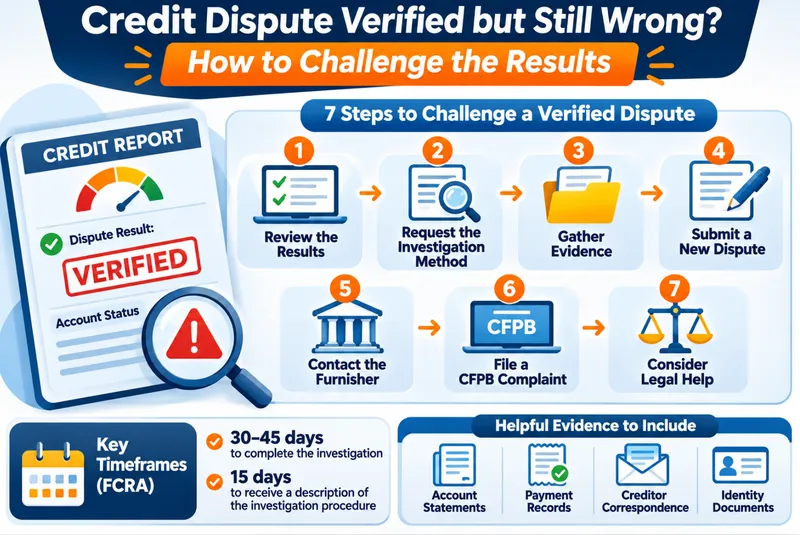
Credit Dispute Verified but Still Wrong? How to Challenge the Results
Credit dispute verified is one of the most frustrating results you receive after you challenge an error. You sent documents, waited for the investigation, and expected a fix. Instead, the letter says the information was verified, and the same wrong balance, late payment, or collection is still there.
The stakes go beyond a bad number. In a 2012 FTC study, one in five consumers had an error corrected by a credit bureau after a dispute. An unresolved error shapes how a lender sees your mortgage, auto refinance, or credit card application.
Here is the good news. A verified result does not automatically prove every reported detail is correct. Under the Fair Credit Reporting Act (FCRA), a bureau must conduct a reasonable reinvestigation of the disputed information, and you keep the right to keep challenging errors that remain.
You still have moves left. You request a description of the investigation procedure, submit better evidence, dispute with the furnisher, and escalate when needed. This guide explains what a verified dispute means, why wrong information stays, and exactly what to do next, step by step.
- Verified is not the same as accurate. It means the investigation left the information in place.
- New evidence changes the outcome. Repeating the same dispute does not.
- Work two fronts. Dispute with the bureau and with the furnisher.
- Escalation is real. A CFPB complaint or a consumer-law attorney is the next rung.
What Does It Mean When a Credit Dispute Comes Back Verified?
A verified result means the investigation did not correct or remove the disputed information. The furnisher, the company that reports the data, confirmed its records to the bureau. No judge ruled that the account is accurate.
Think of "verified" as a status, not a verdict. The bureau asked the furnisher to check its own records, and those records still match what is on your report.
Your results letter shows one of four outcomes. Here is how to read each one.
| Investigation Result | What It Means |
|---|---|
| Verified or remains | The disputed information was retained |
| Updated | Some reported information was changed |
| Deleted | The disputed item was removed |
| Frivolous or irrelevant | The bureau declined to investigate under an applicable exception |
The law sets the standard. If the agency finds an item inaccurate, incomplete, or unverifiable, it must delete or modify it. "Verified" means that did not happen, so the gap between your records and theirs is still open.
Why Would a Credit Bureau Verify Information That's Still Wrong?
Bureaus do not own the data. They pass your dispute to the furnisher, and the furnisher answers from its own records.
Nothing here assumes bad faith. Four ordinary problems explain most verified results.
The Creditor's Records Still Contain the Error
If the lender's system holds the wrong balance, it confirms the wrong balance. The furnisher "verifies" what it has.
Fix: Challenge the source. A direct dispute (Step 5) targets the records themselves.
Your Supporting Documents Did Not Resolve the Discrepancy
A bank statement shows a payment, but not which account or which month it covered. The reviewer sees a document that proves something else.
Fix: Match each document to one specific field, as the evidence table below shows.
The Dispute Did Not Identify the Specific Reporting Error
"This is not mine" or "this is wrong" gives the investigator little to check. A dispute that names the field, the reported value, and the correct value is easy to test.
Fix: Name the account, the field, what the report says, and what is true.
The Investigation Failed to Resolve Conflicting Information
Your records say one thing, and the furnisher's say another. The result letter names a winner but not the reason.
Fix: Ask for the description of the procedure (Step 2) to see what the furnisher actually reviewed.
Credit Dispute Verified but Incorrect? Take These 7 Steps
If your credit dispute came back verified but the information is still wrong, review the investigation results and gather evidence supporting the error. Request a description of the credit bureau's reinvestigation procedure, submit a more specific dispute, and contact the creditor or collector that furnished the information. If the issue remains unresolved, consider filing a CFPB complaint or seeking legal advice. A verified result does not prevent you from challenging inaccurate credit reporting.
Step 1: Compare Your Investigation Results With Your Credit Report
Start with the facts on the page. Pull your results letter and a fresh report, and find the exact fields that are still wrong.
- ✓Balance: does the amount match your latest statement?
- ✓Payment status: does it show a late payment you made on time?
- ✓Dates: opened, last payment, and first delinquency
- ✓Ownership: is the account yours, and reported once?
The bureau must send you the results in writing, plus a copy of your updated report. Note what changed and what did not.
Step 2: Request the Credit Bureau's Investigation Procedure
You have a right to ask how the investigation ran. Under 15 U.S.C. 1681i(a)(7), the bureau must provide a description of its reinvestigation procedure within 15 days of your request. The description includes the furnisher the bureau contacted.
People call this a "method of verification" request. The statute uses different words: it covers a description of the procedure, not every original contract or transaction record.
Step 3: Gather Evidence That Directly Contradicts the Reporting
More paper does not mean a stronger case. Collect the one or two documents that prove the exact field is wrong.
A payoff letter beats a stack of old statements when the balance is the problem. The table in the next section pairs each error with its best evidence.
Step 4: Submit a More Specific Dispute With Supporting Documents
Write a focused dispute. State the account, the field, what the report shows, what is true, and which attached document proves it.
Do not resend the same letter. The law lets a bureau end an investigation it reasonably finds frivolous or irrelevant, and it must tell you within five business days. A dispute with new, relevant information is a different matter, and it extends the bureau's window by up to 15 days.
Our guide on how to dispute errors on your credit report covers the letter format.
Step 5: Dispute the Error Directly With the Information Furnisher
Go to the source. Send a written dispute to the lender, servicer, or collector, preferably by certified mail, at the address on your report or the one it lists for disputes.
The CFPB says furnishers generally must investigate and respond within 30 days. If the furnisher finds the information wrong or unverifiable, it must correct it and notify the bureaus, which then update your reports. Our post on why collections stay after disputes shows how this plays out with collectors.
Step 6: File a CFPB Complaint if the Error Remains Unresolved
A complaint puts a regulator-routed record behind your case. Dispute with the reporting agency first, then submit your complaint at the CFPB complaint page under credit reporting.
Include the dates of each dispute, the results letters, and a short description of the discrepancy. A complaint escalates your issue. It does not guarantee a deletion.
Step 7: Consider a Consumer Law Attorney for Persistent Reporting Errors
Talk to a consumer-law attorney when an error persists after valid disputes and causes documented harm. A denied mortgage or a higher interest rate on paper is documented harm.
An attorney reviews whether the bureau or furnisher met its FCRA duties. That review is a legal question about your facts, and no outcome is guaranteed.
What Evidence Helps Challenge a Verified Credit Dispute?
Evidence must show why the reported information is inaccurate, incomplete, or unverifiable. A payment receipt alone does not prove every other field is wrong. Match the document to the error.
| Reporting Error | Relevant Supporting Evidence |
|---|---|
| Wrong outstanding balance | Account statements, payoff confirmation |
| Incorrect late payment | Payment receipts, bank records |
| Account doesn't belong to you | Identity theft report or other ownership evidence |
| Paid collection still shows unpaid | Settlement agreement, payment confirmation |
| Duplicate debt reporting | Account histories, collection notices |
| Incorrect account status | Creditor correspondence, account records |
Is It Possible to Dispute the Same Credit Report Error Again?
Yes, with a condition. A new dispute with material new evidence, or one that names a specific unresolved error, is different from resending the same unsupported claim.
The bureau must still run a reinvestigation within the standard period. It keeps the right to end one it reasonably finds frivolous or irrelevant, and it must send you notice within five business days. Our guide on what to do after a lost dispute goes deeper on the follow-up.
What if a Verified Credit Dispute Is Affecting Your Mortgage Application?
Move early and keep your loan officer informed. Share your dispute letters, evidence, and results so the lender sees the error is documented.
Know the limits. A lender follows its own underwriting standards and does not remove accurate information or bypass them.
Fixing a reporting error is also not the same as raising your score. Read what mortgage lenders actually check before you apply.
Do You Have the Right to Add a Statement of Dispute to Your Credit Report?
Yes. If the reinvestigation does not resolve your dispute, 15 U.S.C. 1681i(b) lets you file a brief statement of the nature of the dispute. The agency limits it to 100 words when it helps you write a clear summary.
Later reports containing the item must note that you dispute it. The statement does not correct the error, and it does not promise any scoring benefit.
When Should You Escalate a Verified Credit Dispute?
| Where You Are | Next Rung |
|---|---|
| First dispute verified, no new evidence yet | Steps 1 to 4: compare, request the procedure, send a specific dispute |
| Bureau dispute verified again | Step 5: dispute directly with the furnisher |
| Furnisher and bureau both keep the error | Step 6: CFPB complaint |
| Documented harm, such as a denied loan | Step 7: consumer-law attorney review |
Still comparing why your report and your results do not match? A look at why credit repair shows no improvement explains what to check when your score stays flat.
Credit Dispute Verified but the Error Is Still There?
An unsuccessful dispute doesn't necessarily mean the information is accurate. The next step is identifying what remains incorrect, reviewing the investigation results, and determining which supporting records help.
Review Your Credit Report → ASAP Credit Repair USA helps you review your credit-report concerns and explore the options available for addressing inaccurate information.Frequently Asked Questions About a Credit Dispute Verified Result
What does verified mean on a credit dispute?
Verified means the investigation left the disputed information in place because the furnisher confirmed its records. It does not mean a court found the item accurate. If your documents contradict the entry, a verified result still allows a new dispute with more specific evidence, a request for the procedure description, and a direct dispute with the furnisher.
Does a credit bureau verify information that is wrong?
Yes, it happens, because the bureau relies on the furnisher's records and a wrong entry there produces a verified result. Under the FCRA, the bureau must delete or modify information found inaccurate, incomplete, or unverifiable. Your evidence is what exposes the gap, so match each document to the exact field in dispute.
Is it possible to dispute an account again after it was verified?
Yes, a new dispute with material new evidence, or one naming a specific unresolved error, gets a fresh reinvestigation. The law lets a bureau end one it reasonably finds frivolous or irrelevant, with notice to you within five business days. Repeating an identical, unsupported letter invites that result, so change the input.
How do I challenge a verified credit dispute?
Compare the results with your report, then request the bureau's description of its procedure. Send a specific dispute with documents that prove the exact error, and dispute directly with the furnisher too. If the error remains, file a CFPB complaint, and talk to a consumer-law attorney about any documented harm such as a denied loan.
How do I request the method of verification from a credit bureau?
Send a written request for the description of the reinvestigation procedure and keep proof of delivery. Consumers commonly call this a method of verification request, but the statute describes a procedure description, due within 15 days. It does not require the bureau to hand over every original contract or transaction record.
What happens if a creditor keeps reporting incorrect information?
Dispute directly with the creditor in writing, include evidence, and keep proof of delivery. The CFPB says furnishers generally must respond within 30 days. If the error persists, submit a CFPB complaint with your dispute history, and talk to a consumer-law attorney if the error causes documented harm, such as a denied loan.
Is it possible to sue a credit bureau for verifying incorrect information?
Consumers do bring FCRA claims against bureaus and furnishers, but whether you have one depends on your facts, your documents, and what happened during the reinvestigation. A consumer-law attorney reviews that question for you. A verified result alone does not establish a violation, and no legal outcome is guaranteed for anyone.
How long does a second credit dispute investigation take?
The same rules apply: a bureau generally has 30 days, extended by up to 15 days if you send relevant information during that period. It must send written results within five business days after finishing. A request for the procedure description runs on a separate 15-day clock, so track both dates.
Verified is where the next round starts. Gather precise evidence, work the bureau and the furnisher together, and escalate when the error stays.
- 15 U.S.C. § 1681i — Procedure in case of disputed accuracy
- CFPB — How do I dispute an error on my credit report?
- CFPB — How long does it take to get a response to a dispute?
- CFPB — Submit a complaint
- Federal Trade Commission — FTC Issues Follow-Up Study on Credit Report Accuracy (2012 study findings; historical research, not a 2026 measurement)