
CROA, or the Credit Repair Organizations Act, is a federal law designed to protect consumers from deceptive or unfair practices when paying a company for credit repair services. It sets rules for what credit repair organizations can promise, when they can collect payment, what information must appear in a contract, and how consumers can cancel an agreement.
These protections matter because credit repair involves information that can affect access to loans, housing, insurance, and other financial opportunities. The Federal Trade Commission states that CROA prohibits untrue or misleading representations, requires specific consumer disclosures and written contracts, restricts advance payment, and gives consumers cancellation rights.
At ASAP Credit Repair, working with over 25K+ clients all over the U.S. has shown us that people often know they have credit-report rights. However many not know what a credit repair company is legally allowed to promise or charge. Knowing those boundaries can make it easier to recognize questionable practices before signing a contract or paying for a service.
This guide explains CROA for all consumers. Including the protections it provides, what a compliant credit repair agreement should contain, prohibited practices to watch for, your three-business-day cancellation right, and what you can do if you believe a credit repair organization violated your rights.
CROA: What the Credit Repair Organizations Act Means for You
What Is CROA?
CROA stands for the Credit Repair Organizations Act, a federal law regulating companies that offer certain credit repair services to consumers. It prohibits deceptive representations, requires specific disclosures and written contracts, restricts advance payment, and gives consumers cancellation rights.
CROA is codified at 15 U.S.C. Sections 1679 through 1679j and is part of the Consumer Credit Protection Act. Its statutory purpose is to make sure prospective buyers of credit repair services get the information they need to make an informed decision, and to protect the public from deceptive advertising and business practices by credit repair organizations.
Who Does CROA Protect?
Not every company or person who discusses credit is automatically a credit repair organization under CROA. The statute includes specific definitions and exclusions, so the protections are tied to what a business actually does and how it is compensated, not simply whether the word "credit" appears in its marketing.
Want a Credit Repair Company That Actually Follows CROA?
ASAP Credit Repair is CROA registered, never charges you before work is performed, and never guarantees results we can't control. See what's actually on your credit report first, free.
Get My Free Credit Analysis Now →What Rights Does CROA Give Consumers?
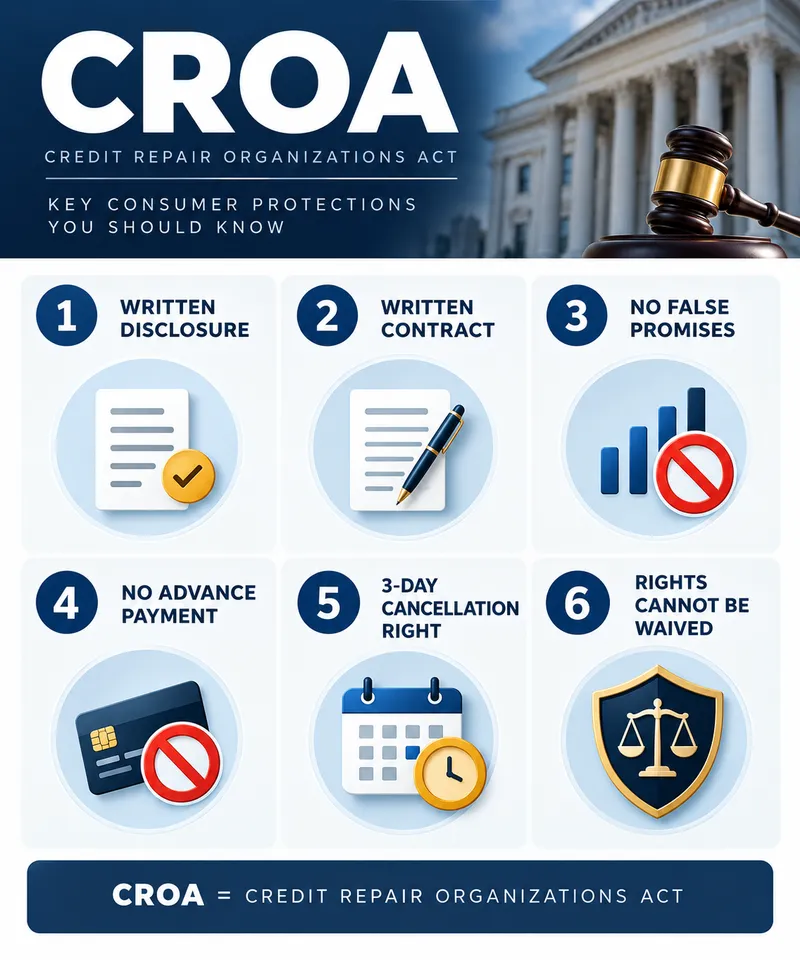
| CROA protection | What it means for you |
|---|---|
| Written disclosure | You receive information about your credit file rights before signing |
| Written contract | Services and payment terms must be documented, not just promised verbally |
| Cancellation right | You generally have three business days to cancel |
| No misleading claims | Companies cannot misrepresent what their services can do |
| Advance-payment restrictions | Payment cannot simply be collected before promised services are performed |
| Rights cannot be waived | A company cannot contract around your CROA protections |
What Must a Credit Repair Company Give You Before You Sign?
A Consumer Rights Disclosure
Before you sign anything, a credit repair organization must give you a written disclosure covering your rights, including the fact that you can dispute inaccurate information with the credit bureaus yourself, at no cost, without hiring anyone.
A Written Credit Repair Contract
The contract should clearly identify the services being provided, the payment terms, the expected timeframe for performance, and identifying information for the credit repair organization itself. Before you sign, make sure you can answer each of these:
- What the company will do
- What it will cost
- When services will be performed
- Who you are contracting with
- How to cancel
Can You Cancel a Credit Repair Contract?
The CFPB also identifies this three business day cancellation protection when warning consumers about credit repair practices, making it one of the most consistently enforced parts of the law.
How the three business day cancellation period works
The clock starts on the date you sign the contract. During that window, you can cancel for any reason, without owing a fee or facing a penalty, as long as you follow the cancellation process the company is required to provide.
What is a Notice of Cancellation?
A Notice of Cancellation is the specific document a compliant credit repair organization must give you, explaining how and by when to cancel. If a company cannot produce this document or discourages you from using it, that is a warning sign on its own.
What Credit Repair Companies Cannot Do Under CROA
Make false or misleading claims
A common example: "We guarantee a 100 point increase." A credit repair organization cannot truthfully control how every dispute, furnisher, credit bureau, scoring model, or your overall credit file will respond. The CFPB specifically warns against companies promising specific credit score increases or guaranteed results.
Lie about what they can remove from your credit report
Inaccurate information can be disputed. Accurate and timely negative information cannot legally be removed simply because you do not like it. The CFPB makes this distinction explicitly, and it is one of the most important things to understand before paying anyone for credit repair.
Tell you to create a new credit identity
A company should never tell you to hide your credit history using an EIN, a CPN, a different Social Security number, or a false identity in place of your legitimate identifying information. The CFPB specifically identifies attempts to create a "new" credit identity using an EIN instead of a Social Security number as a credit repair scam warning sign.
Misrepresent information in a credit dispute
A legitimate dispute is not the same as a false dispute. A dispute should challenge information you have a genuine reason to believe is inaccurate, incomplete, or otherwise problematic. Credit repair is not permission to falsely claim an account is not yours when you know that it is.
Ask you to give up your CROA rights
You cannot sign away your CROA protections through contract language, no matter what the agreement says. Any clause attempting to waive these rights is not enforceable against you.
Can a Credit Repair Company Charge You Upfront?
The CFPB puts it simply: do not pay upfront. Credit repair companies cannot request or receive payment before completing the services they promised, and this rule applies to monthly payment plans designed around the same idea just as much as a single lump sum.
CROA vs. the Telemarketing Sales Rule: What's the Difference?
CROA regulates covered credit repair organizations broadly. The Telemarketing Sales Rule, or TSR, can add extra restrictions when credit repair services are marketed or sold through telemarketing. Where the TSR applies, a credit repair company must satisfy additional conditions before charging, including that any consumer report used to demonstrate promised results must be generated more than six months after those results were achieved.
| CROA | Telemarketing Sales Rule | |
|---|---|---|
| Main purpose | Credit repair consumer protection | Telemarketing consumer protection |
| Applies specifically to credit repair? | Yes | Not exclusively |
| Misrepresentation restrictions | Yes | Yes |
| Payment restrictions | Yes | Yes |
| Written-contract protections | Contains them directly | Different requirements |
| Can both apply? | Yes | Yes |
How to Tell if a Credit Repair Company May Be Breaking the Rules
These warnings align closely with CFPB consumer guidance. Be cautious if a company:
- Guarantees a specific score increase
- Promises to erase accurate negative information
- Wants payment before providing promised services
- Won't explain what you're paying for
- Doesn't provide required written information
- Hides your cancellation rights
- Tells you not to contact the credit bureaus yourself
- Encourages false disputes
- Suggests creating a new credit identity
Does CROA Mean a Credit Repair Company Can Remove Anything?
The CFPB states that errors can be investigated and resolved, but a credit repair company cannot legally have information removed merely because it is accurate and timely. What you can review and potentially dispute includes:
- Account ownership
- Balances
- Payment history
- Account status
- Dates
- Duplicate reporting
- Credit limits
If you spot an error in any of these, ASAP Credit Repair's own step-by-step dispute guide walks through the process the FCRA gives you to challenge it directly.
CROA vs. FCRA: What's the Difference?
People frequently confuse these two laws. CROA regulates covered credit repair organizations and protects the consumers who purchase those services. The Fair Credit Reporting Act, or FCRA, regulates consumer reporting itself and creates rights and obligations concerning the information in your credit file.
The simple distinction
FCRA covers your credit information. CROA covers the companies that sell you services related to that information. You already have FCRA dispute rights whether or not you ever hire a credit repair company; CROA exists to keep those companies honest if you do. Our guide on disputing inaccurate accounts under the FCRA covers that side of the process in detail.
What Happens if a Credit Repair Company Violates CROA?
CROA contains enforcement and remedy provisions, and depending on the conduct, other federal or state consumer protection laws may also apply. A suspected violation does not automatically mean you are entitled to a specific amount of money; the facts and applicable laws matter. If you believe your rights were violated, consider these steps:
- Save the contract
- Save advertisements and emails
- Keep receipts and payment records
- Document any representations made to you
- Report the conduct to the appropriate consumer protection authority
- Seek legal advice when necessary
Why CROA Still Matters Today
CROA is not an old 1996 law people no longer need to understand. The CFPB's action against Credit Repair Cloud resulted in an August 2024 settlement requiring $3 million in total civil penalties over Telemarketing Sales Rule advance-fee violations. In a separate, larger case, the CFPB reached a settlement requiring Lexington Law and CreditRepair.com to return $1.8 billion to more than 4.3 million consumers harmed by illegal advance-fee billing and deceptive advertising, one of the largest enforcement actions in the agency's history.
These cases are not mentioned to single out any one company, but they show that advance-fee violations and misleading claims are still actively prosecuted at scale, which is exactly why knowing your CROA rights before you sign anything still matters.
How to Choose a Credit Repair Company That Respects Your Rights
Instead of taking a company's word for it, ask these questions first:
Red flags in the answers
Vague about what they will actually do. Wants payment before any work starts. Guarantees a specific score increase or deletion. Can't produce a written contract or cancellation notice.
Signs of a legitimate provider
Explains its process clearly. Only charges after services are performed. Avoids guaranteeing results. Gives you a written contract, disclosure, and cancellation notice upfront.
- What exactly will you do?
- When will I be charged?
- What will my total cost be?
- Can you guarantee deletions or score increases?
- How do I cancel?
- Will I receive everything in writing?
- What happens if a disputed item is verified as accurate?
A legitimate provider should be able to answer every one of those clearly and in writing.
Consumer rights should come before credit repair
At ASAP Credit Repair, nearly 20 years of experience helping consumers navigate credit report issues has taught us that good credit repair starts with realistic expectations. Not every negative item can or should be removed. The first question should always be whether the information being reported is accurate, and whether you have a legitimate basis to challenge it.
Before paying any credit repair company, understand what the service includes, what it costs, when payment is due, and what results cannot be guaranteed. CROA gives consumers important protections, but knowing those rights before you sign an agreement gives you another layer of protection on top of the law itself.
Frequently Asked Questions
What does CROA stand for?
CROA stands for the Credit Repair Organizations Act, a federal law codified at 15 U.S.C. Sections 1679 through 1679j that regulates companies offering certain credit repair services to consumers.
What is CROA in credit repair?
In credit repair, CROA is the federal law that sets the rules a credit repair organization must follow, including required written disclosures, a written contract, restrictions on advance payment, and a three business day right to cancel.
What does the Credit Repair Organizations Act do?
It prohibits untrue or misleading representations, requires written disclosures and a written contract, restricts advance payment, and gives consumers the right to cancel a covered contract within three business days.
Who does CROA apply to?
CROA applies to businesses that meet the federal definition of a credit repair organization. Not every person or company that discusses credit is automatically covered, since the statute contains specific definitions and exclusions.
What does CROA prohibit?
CROA prohibits untrue or misleading representations, charging or collecting payment before promised services are completed, and asking consumers to waive their CROA rights.
Can credit repair companies charge upfront fees?
No. A credit repair organization generally cannot request or receive payment until it has completed the services it promised, under both CROA and, where applicable, the Telemarketing Sales Rule.
Can you cancel a credit repair contract?
Yes. CROA generally gives you the right to cancel a covered credit repair contract within three business days of signing, without penalty or further obligation.
How long do you have to cancel credit repair?
You generally have three business days from the date you sign a covered contract to cancel it without penalty, using the Notice of Cancellation the company is required to provide.
Can a credit repair company guarantee results?
No legitimate company can truthfully guarantee a specific score increase or the removal of accurate information, since no company controls how every dispute, furnisher, bureau, or scoring model will respond.
Can credit repair companies remove accurate information?
No. Only inaccurate, incomplete, or unverifiable information can legally be disputed and removed. Accurate, timely negative information cannot be erased simply because it is unwanted.
What is the difference between CROA and FCRA?
CROA regulates the companies that sell covered credit repair services. The Fair Credit Reporting Act regulates consumer reporting itself, including your own dispute rights, whether or not a credit repair company is involved.
What is the difference between CROA and the Telemarketing Sales Rule?
CROA broadly regulates covered credit repair organizations. The TSR adds extra requirements when credit repair is marketed or sold by phone. Both laws can apply to the same company at the same time.
Where can you report a credit repair company?
You can file a complaint with the FTC, the CFPB, and your state attorney general's office. Keeping your contract, advertisements, receipts, and any promises made to you in writing makes a complaint far easier to support.
Know Your Rights Before You Pay Anyone
Before hiring any credit repair company, see exactly what's on your credit report and what's actually worth disputing.
Claim My Free Credit Analysis Now →Related Reads
Sources: FTC – Credit Repair Organizations Act, FTC – Fixing Your Credit FAQs, CFPB – Credit Repair Scam Warning Signs, CFPB – Action Against Credit Repair Cloud, CFPB – Lexington Law / CreditRepair.com Settlement.