
Most people assume they have one credit score. One number. One verdict.
That's not how it works.
You actually have dozens of credit scores — and the two most important scoring models producing those numbers are FICO and VantageScore. Lenders pull one. Businesses check the other. You might check a third version online and wonder why it looks nothing like what your mortgage lender saw.
If that sounds confusing, you're not alone. I talk to people every day who are working hard to rebuild their credit, doing everything right, and still getting blindsided by a number they didn't expect. Understanding the difference between FICO and VantageScore won't just clear up the confusion — it'll help you take smarter action to improve the scores that actually matter to the lenders you're trying to work with.
Let's break it all down.
FICO vs VantageScore: The Core Difference
FICO — developed by the Fair Isaac Corporation — has been the standard credit scoring model since 1989. It's the score most mortgage lenders, auto lenders, and credit card issuers rely on when they decide whether to approve you and at what interest rate. When a lender says they "pulled your credit," there's a very good chance they looked at your FICO score.
VantageScore is newer. The three major credit bureaus — Equifax, Experian, and TransUnion — created it together in 2006 as a competitor to FICO. It was designed to score more people, including those with short or thin credit histories who might not generate a FICO score at all.
Both models use the same basic score range: 300 to 850. That's worth knowing because older sources sometimes cite different ranges for VantageScore — the original VantageScore 1.0 and 2.0 models used a 501 to 990 scale, but the current models (VantageScore 3.0 and 4.0) align with FICO's 300–850 range. If you're comparing scores today, you're working with the same scale.
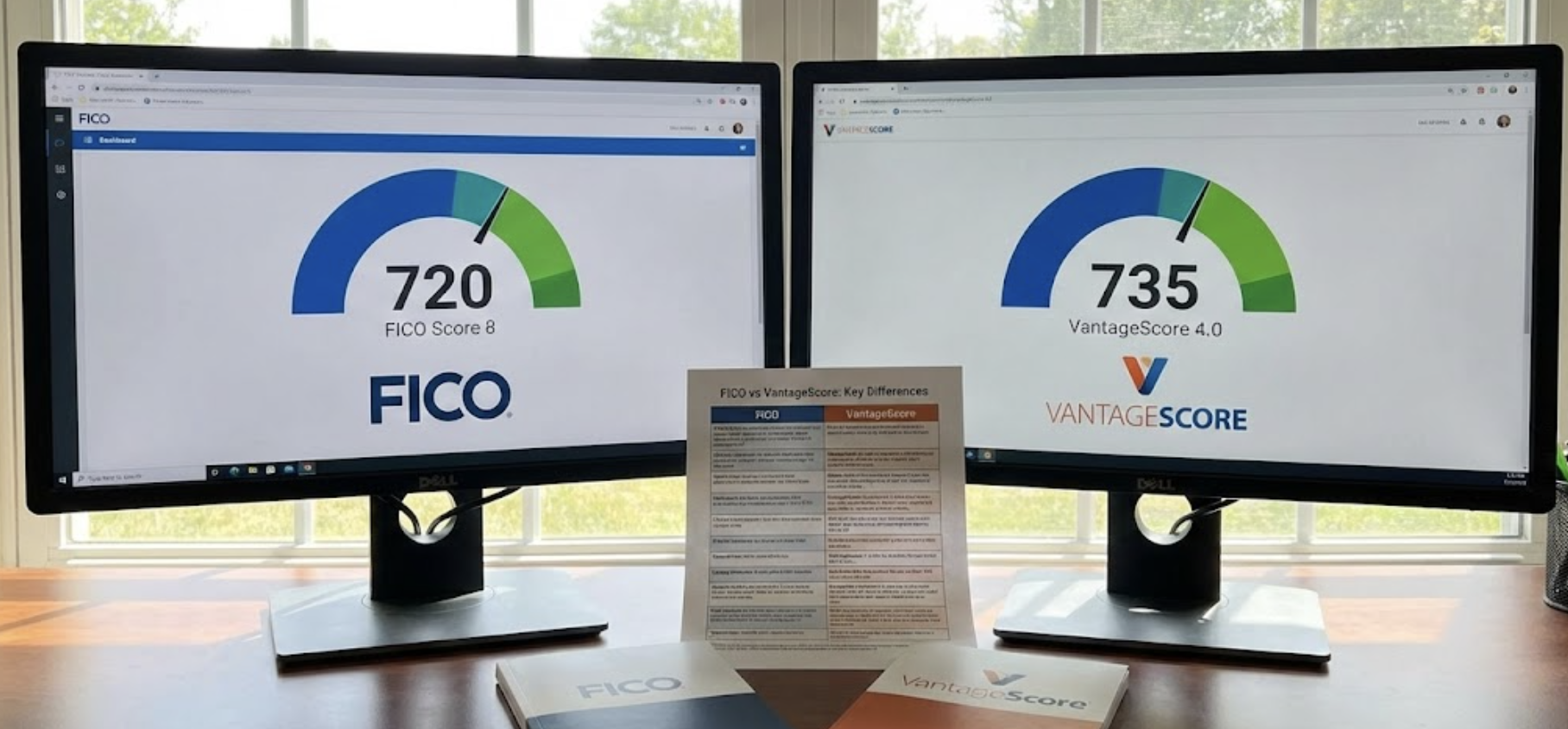
Same range, though, doesn't mean the same number. The same credit file can generate a 680 FICO score and a 710 VantageScore — or the reverse — because the two models weigh your credit information differently.
Why Your Score Looks Different Depending on Where You Check
This is the thing that trips people up most often.
You log into a free credit monitoring app, see a 720, and feel good. Then you apply for a car loan and the dealer tells you your score came back at 685. Both numbers are technically your credit score. But they're measuring different things, built on different formulas, using data that may have been pulled on different days from different bureaus.
Here's why that happens:
Each of the three credit bureaus — Equifax, Experian, and TransUnion — keeps its own file on you. Those files aren't always identical. A creditor might report your payment history to two bureaus and not the third. An error might appear on one report and not the others. So your FICO score from Equifax and your FICO score from TransUnion can be different, even using the same formula, because the underlying data is different.
Add VantageScore into the picture and you add a different formula on top of potentially different data. Free credit monitoring services — Credit Karma, Credit Sesame, and many bank apps — typically show you a VantageScore, not a FICO score. That's because VantageScore licenses its model more freely and charges less for consumer-facing use.
It's not that the free scores are wrong. They're just a different measurement. Think of it like checking your weight on two different scales in two different shoes. Both are giving you real information. Neither one is lying. But they're not the same number.
How FICO Scores Are Calculated
FICO scores use five factors, and each one carries a different weight in the calculation. Knowing these weights tells you exactly where to focus your energy when you want to move the needle.
Payment history — 35% This is the biggest factor by far. Every on-time payment you make reinforces your score. Every late payment damages it. A single 30-day late payment can drop a good score by 60 to 110 points depending on the rest of your profile. If you're rebuilding credit, making every payment on time — even minimum payments — is the single most important thing you can do.
Credit utilization — 30% This measures how much of your available revolving credit you're using. If you have a $5,000 credit card limit and carry a $3,500 balance, your utilization is 70% — which is a serious drag on your score. Most credit experts recommend staying below 30%. The borrowers with the highest scores typically stay below 10%. This is also one of the fastest factors to improve: pay down a balance, and your score can respond within one or two billing cycles.
Length of credit history — 15% The longer your accounts have been open, the better. This includes the age of your oldest account, your newest account, and the average age of all your accounts. This is why closing old credit cards — even ones you don't use — can actually hurt your score. It shortens your average account age.
Credit mix — 10% FICO rewards borrowers who can manage different types of credit responsibly: credit cards, installment loans, mortgages, auto loans. You don't need every type, but having a mix shows lenders you can handle varied obligations.
New credit — 10% Every time you apply for credit, the lender runs a hard inquiry that temporarily lowers your score by a few points. Multiple applications in a short window signal financial stress to lenders. If you're planning to apply for a mortgage or auto loan, avoid opening new credit accounts for at least 90 days beforehand.
How VantageScore Is Calculated Differently
VantageScore uses similar categories but weights them differently — and it places more emphasis on recent behavior than FICO does.
Payment history still matters most, but VantageScore also places heavy weight on your age and type of credit, treating the depth of your credit history as a more significant factor than FICO does.
Credit utilization carries significant weight in VantageScore as well, but VantageScore 4.0 — the most current model — also looks at trending data. Instead of just looking at your balance on one day, it tracks whether your balances are going up or down over time. If you've been paying down debt consistently over the past 12 months, VantageScore 4.0 may reward that trend even before your balance reaches a low utilization percentage.
VantageScore also scores thin-file consumers more effectively. If you have fewer than six months of credit history — which FICO requires to generate a score at all — VantageScore can still produce a number for you. This matters for young adults, recent immigrants, and anyone who's been away from credit for a long time.
The practical takeaway: if you're actively paying down balances, VantageScore may show improvement faster than your FICO score. If you're applying for a mortgage, your lender is almost certainly looking at FICO. Know which one matters for the decision you're trying to make.
Which Score Do Lenders Actually Use?
This question has a clear answer for most borrowing situations.
Mortgage lenders use FICO. Specifically, they typically pull FICO Score 2 from Equifax, FICO Score 4 from TransUnion, and FICO Score 5 from Experian — then use the middle of the three scores. Fannie Mae and Freddie Mac, which back the majority of conventional mortgages, require this approach. FHA loans follow similar guidelines. If you're buying a home, your FICO score from all three bureaus is what determines your approval and your interest rate.
Auto lenders often use FICO Auto Score — a specialized version of FICO designed to predict auto loan repayment specifically. It weights your auto loan payment history more heavily than the standard FICO model.
Credit card issuers use a mix. Many use standard FICO scores. Some use VantageScore. A few use proprietary models built in-house.
Landlords, utility companies, and telecom providers often use VantageScore or other alternative scoring models when deciding whether to extend you service.
Free credit monitoring tools — including Credit Karma, Mint, NerdWallet, and most bank apps — show VantageScore 3.0. These tools are genuinely useful for tracking trends and catching errors. They're just not the same number a mortgage lender will see.
How to Check Both Scores
You don't need to pay to monitor your credit — you just need to know where to look.
For your credit reports: Go to AnnualCreditReport.com. This is the federally mandated free source for your full credit reports from all three bureaus. Pull all three, not just one. Each bureau maintains a separate file, and errors on one won't necessarily show up on the others. Review every account, every collection, and every inquiry for accuracy. Anything inaccurate, outdated, or unverifiable can be disputed — and removing those items can move your score significantly.
For your FICO score: MyFICO.com offers paid access to your FICO scores from all three bureaus. Many credit card issuers also provide free FICO score access as a cardholder benefit — American Express, Discover, Citi, and others display your FICO score in their apps. Check your card benefits before paying for a separate service.
For your VantageScore: Credit Karma gives you free VantageScore 3.0 scores from Equifax and TransUnion. Many bank apps display a VantageScore as well. These are useful for ongoing monitoring even though they won't match what a mortgage lender sees.
The ideal approach is to monitor both. Use VantageScore as your ongoing pulse check — it updates more frequently and reacts quickly to changes in your behavior. When you're within 6 months of a major credit application, pull your actual FICO scores from the bureau your lender will use and focus your attention there.
Improving Both Scores: The Actions That Work Across the Board
The good news is that the actions that raise your FICO score also raise your VantageScore. The models are different, but they respond to the same healthy credit behaviors.
Pay on time, every time. Payment history is the top factor in both scoring models. Set up autopay for minimums on every account so you never miss a due date. Then pay more when you can.
Get your utilization down. This is the fastest way to see score movement. If you can pay down credit card balances before your statement closing date — the date the balance gets reported to bureaus — your utilization drops and your score responds quickly. You don't need to carry a balance to build credit. Paying in full each month is better.
Dispute errors on all three reports. Under the Fair Credit Reporting Act, credit bureaus must investigate disputes within 30 days. Inaccurate collection accounts, wrong balances, and accounts that don't belong to you are all grounds for dispute. Getting an error removed can add anywhere from 20 to 80 points depending on what the item was and how clean the rest of your report is.
Don't close old accounts. Even if you don't use a card, keeping it open preserves your average account age and your available credit limit — both of which help your score. Cut up the card if you don't trust yourself with it, but keep the account active.
Give it time. Some credit damage heals slowly. A late payment affects your FICO score for up to seven years, though its impact diminishes over time. The best thing you can do for a damaged score is layer positive history on top of the negative. Every on-time payment, every month of low utilization, every year of account age — they all add up.
The Bottom Line on FICO vs VantageScore
Two scoring models. Same goal. Slightly different math.
FICO is what most lenders use when money is on the line. VantageScore is what most free tools show you. Both respond to the same responsible behaviors, and both give you real, actionable information about where your credit stands.
The mistake isn't checking one over the other. The mistake is checking neither — and staying in the dark about a number that affects your interest rates, your housing options, your insurance premiums, and your financial future.
Pull your reports. Check both scores. Find the gaps. Fix what you can fix. And keep going — because the people who end up with great credit aren't the ones who started with it. They're the ones who paid attention and didn't stop.
This article provides general financial information and does not constitute professional financial or legal advice. For personalized credit guidance, speak with a licensed credit counselor or financial advisor.