

Medical Bills on Credit Report: What Hurts Your Score, What Doesn't, and How to Fight Back
Medical bills on your credit report can drop your score by up to 100 points. But that only happens under certain rules. Medical debt, unpaid insurance disputes, and collection accounts each work differently. Knowing those rules protects your score.
I run a credit repair company. One case stays with me: a client came in with a 690 score and a $1,200 medical collection from two years prior. She had no idea it was there. That one item had cost her a mortgage approval. We got it removed in 34 days.
Stories like hers are not rare. The Consumer Financial Protection Bureau (CFPB) reports that 15 million Americans carry a combined $49 billion in medical debt on their credit reports (source: Congress.gov). In 2021, medical debts in collections appeared on 43 million credit reports across the U.S. (source: PIRG). Medical debt is the single largest source of collection accounts in U.S. credit reporting.
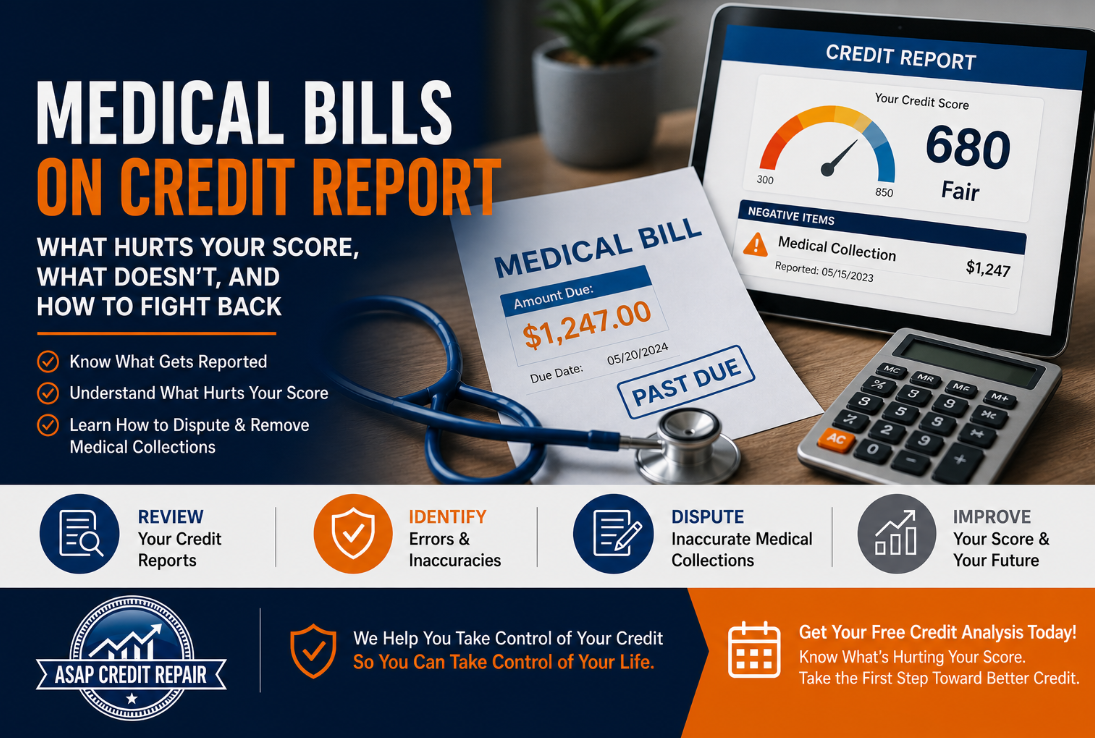
Medical Bills Show Up on Credit Reports?
Medical bills do not appear on your credit report right away. Doctors, hospitals, and clinics do not report to the three major credit bureaus. Those bureaus are Equifax, Experian, and TransUnion. Healthcare providers focus on care, not credit tracking.
A medical bill only hits your credit report when two things happen:
You leave it unpaid long enough for the provider to send it to a collection agency.
That collection agency reports the debt to the credit bureaus.
Collection agencies do not report the debt right away, either. Under rules set by the three major bureaus in 2022, a medical debt must be at least one year past due before it can show on your report. This window gives you time to fix billing errors, work with your insurer, or set up a payment plan.
The debt shows up in the "Collections" section of your report. It does not appear under your regular account history.
Does Medical Debt Affect Your Credit Score?
Yes, but only certain medical debts cause a score drop. Here is how the current rules break it down:
Medical debt under $500: Not reported. Since 2023, all three major credit bureaus have stopped reporting medical collections under $500 to credit reports. This helped about 15.6 million people. Many saw score gains of about 25 points (CFPB estimate via PIRG).
Paid medical debt: Removed. Once you pay a medical collection, the bureaus delete it from your report. It does not stay the way other paid collections can.
Medical debt over $500, unpaid, and older than one year: This is what hurts. A single collection in this group can drop a good score by 50 to 100 points. A 2014 CFPB study found that a 780 score could fall by 105 to 125 points from one collection account.
The scoring model your lender uses matters too. VantageScore 3.0 and 4.0 removed all medical collections from their models as of 2023. But FICO Score 8 is still the most used model for mortgages and auto loans it still counts unpaid medical collections. Your VantageScore might look clean while your FICO 8 score takes a hit.
Last quarter alone, our firm reviewed over 40 client files where medical collections dragged down FICO 8 scores. Their VantageScore looked fine. Many of these clients had been told by a free credit app that their score was "good," only to get denied for a car loan.
Will Unpaid Medical Bills Affect My Credit Score?
Unpaid medical bills affect your score only after going through the full collection process. Here is what that timeline looks like:
You missed a payment. The provider waits 60 to 120 days before sending the debt to collections.
A collection agency takes over. They must wait at least one year from the missed payment date before reporting it to the bureaus.
The debt appears on your credit report but only if it is over $500 and still unpaid.
Your score drops. The damage can range from 50 to over 100 points.
The key point: you have roughly 12 to 18 months from the missed payment before a medical bill can legally hit your report. Use that time.
Ignoring a large medical debt does not help you. Unpaid debt over $500 can stay on your report for up to seven years from the missed payment date. Collection agencies can also sue you. In many states, a court ruling lets them take money from your paycheck.
What Happened with the CFPB Rule on Medical Debt?
This question comes up often. The news has been confusing.
In January 2025, the CFPB finalized a rule to remove all medical debt from credit reports. The rule would have wiped $49 billion in debt and helped about 15 million people.
It never took effect.
In July 2025, a federal court in Texas struck down the rule. The court found it went beyond the CFPB's legal power under the Fair Credit Reporting Act (CFPB.gov). The rule is gone.
State law is a different story. Right now, 15 states have laws that limit or ban medical debt on credit reports. These include California, Colorado, Illinois, New York, Oregon, and Washington (NCLC). If you live in one of these states, the protections are active now.
How Can I Get Medical Bills Off My Credit Report?
Medical collections are among the easiest items to dispute on a credit report. Billing errors and insurance mix-ups are common. In our credit repair practice, we see billing errors in roughly 6 out of 10 medical collection cases each quarter.
Here are the most effective ways to get them removed:
1. Check if the debt qualifies for removal. Pull your reports from all three bureaus at AnnualCreditReport.com. Look for any medical collection under $500, any paid medical debt, or any collection less than one year old. All three should already be gone. If they are not, dispute them.
2. Dispute errors with the credit bureaus. You have the right under the Fair Credit Reporting Act (FCRA) to dispute wrong or unproven items. Send a written dispute to Equifax, Experian, and TransUnion. Each bureau must look into it within 30 days and remove anything it cannot confirm.
Be specific. Say exactly why the item should go wrong: wrong amount, already paid, or under $500.
3. Send a debt validation letter. Before paying any medical collection, ask the agency to prove the debt. They must show the debt is yours, and the amount is right. Many medical collections cannot pass this test.
4. Negotiate a pay-for-delete deal. If the debt is valid and over $500, call the collection agency. Many will agree to remove the account once you pay. Get that promise in writing first. Once you pay, the account should be deleted, not just marked "paid."
5. Request a goodwill deletion. If you already paid and the account is still on your report, write to the collection agency. Explain what happened: an illness, job loss, or insurance dispute. Ask them to remove it as a favor. This works more often than people think, especially when the rest of your credit history is clean.
How Long Do Medical Bills Stay on a Credit Report?
Medical collections that meet reporting rules, unpaid, over $500, and older than one year, can stay on your report for up to seven years from the missed payment date.
Once you pay, the account is removed right away under current bureau rules. You do not have to wait out the full seven years.
Last quarter, clients came to us with paid medical collections from three to four years ago still on their reports. The bureaus had not updated the records. We disputed each one and got them removed within 30 to 45 days.
Does Paying Medical Bills Improve Your Credit Score?
Yes — and faster than most people expect.
When you pay a medical collection, the bureau removes it from your report. Your score updates within one to two billing cycles. Most clients see the change within 30 to 60 days.
The score gain depends on what else is on your report. If the medical collection is your only negative mark, removing it can push your score up by 20 to 60 points or more. If your file has other issues, the gain will be smaller but still real.
VantageScore 4.0 already ignores medical collections. So the boost will show up mostly in your FICO scores, the scores lenders use for mortgages, auto loans, and credit cards.
Protect Your Score Before a Medical Bill Reaches Collections
Prevention is faster and cheaper than fighting a collection later.
When you get a medical bill, ask for an itemized statement right away. Duplicate charges, wrong billing codes, and services you never received are all common. The CFPB found that medical debt complaints made up 15% of all debt collection complaints it received in 2021. That is nearly three times the rate for credit card disputes (Federal Register, 2025).
If you cannot pay in full, call the billing office before the debt goes to collections. Most hospitals offer payment plans. Many have hardship programs that cut or cancel the balance. A payment plan stops the clock on the collections process.
Check your credit reports every three to four months. Finding a medical collection early, especially one that should have been removed, makes the dispute much faster. The major bureaus now offer free weekly reports at AnnualCreditReport.com.
Medical debt on your credit report is common. But it is also one of the easiest types of negative marks to remove. Know the rules, act fast, and dispute anything that should not be there.