

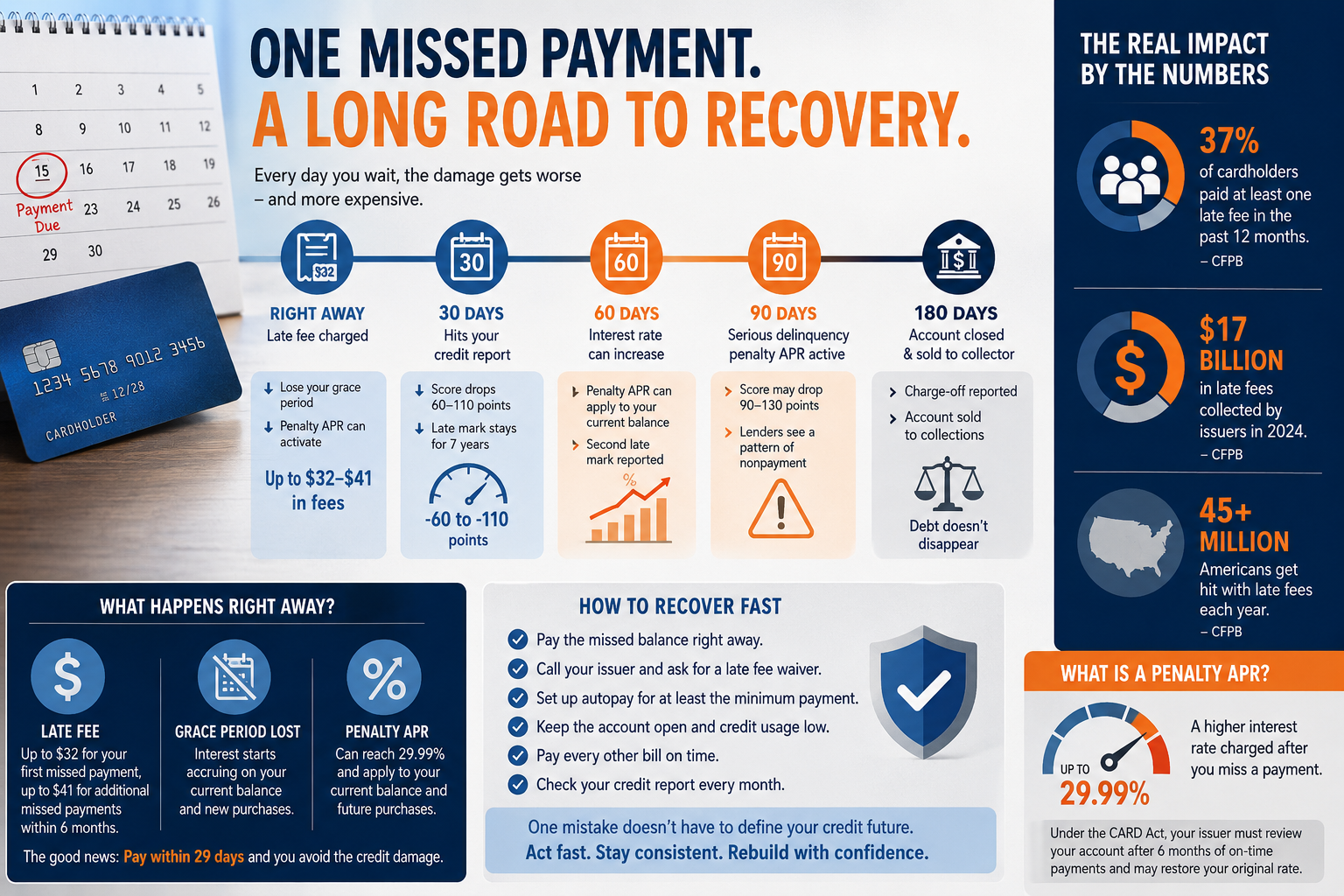
If I miss a credit card payment, my issuer charges a late fee right away. After 30 days, the missed payment hits my credit report. After 90 days, my interest rate can spike. After 180 days, my account can be closed and sold to a debt collector. Each milestone makes the damage harder and more expensive to fix.
Running a credit repair company, I see this more than any other issue. One of the most unforgettable accounts we've handled: a client missed one payment on a $1,200 balance because she changed bank accounts and forgot to update autopay. By the time she noticed, 35 days had passed. That one missed payment dropped her score from 740 to 659 and triggered a penalty APR of 29.99%. What started as a $32 mistake turned into a months-long repair process.
According to the Consumer Financial Protection Bureau (CFPB), credit card issuers collected $17 billion in late fees in 2024. More than 45 million Americans get hit with late fees each year. And 37% of American cardholders paid at least one late fee in the past 12 months. If I have missed a payment, I am far from alone.
What Happens Right Away When I Miss a Credit Card Payment?
The first thing my issuer does is charge a late fee. Under current federal law, the maximum late fee is $30 for a first missed payment and up to $41 for each one after that within six months. The average late fee from major issuers sits at $32.
Two other things happen right away:
I lose my grace period. My grace period is the window between my billing cycle end and my due date where no interest builds on new purchases. Once I miss a payment, that window closes. Interest starts piling up on my current balance and on anything I buy next.
My penalty APR can activate. Some issuers apply a higher interest rate the moment a payment is late. That rate can reach 29.99% and can apply to both my current balance and future purchases.
The good news: at this stage, nothing has gone to my credit report yet. If I pay within 29 days, I avoid the credit damage entirely.
When Does My Missed Payment Affect My Credit Score?
My missed payment hits my credit report after 30 days. Card issuers do not report a payment as delinquent until a full billing cycle has passed without payment. Before the 30-day mark, it is a fee problem, not a credit problem.
Once 30 days pass, my issuer reports the delinquency to Experian, Equifax, and TransUnion. That report can drop my credit score by 60 to 110 points, according to FICO data. The exact drop depends on three things:
My score before the missed payment. Higher scores fall harder. At 780, I could lose 90 to 110 points. At 620, I might lose 60 to 80 points.
How many other negative items are already on my report?
Whether my payment was 30, 60, or 90 days late when reported.
Payment history makes up 35% of my FICO score. It is the single biggest factor in the calculation. One missed payment at the wrong time can push me below the threshold for the best loan rates.
A late payment stays on my credit report for seven years from the date I first missed it.
What Happens to Me at 30, 60, and 90 Days Late?
The damage from a missed credit card payment does not stay the same. It grows with every milestone I pass.
30 Days Late
My issuer reports the missed payment to all three credit bureaus. My score drops. My account is still open. At this stage, I can catch up with one full payment plus any fees owed.
My first move: call my issuer right away. I can ask for a one-time fee waiver. Many issuers grant this for first-time late payments if my history with them is clean. I should get that waiver in writing.
60 Days Late
My issuer can now raise my interest rate on my current balance. Under the CARD Act, issuers must give 45 days' notice before raising a rate on an existing balance. But if I am 60 days late, that protection may not apply. My rate can jump to the penalty APR on my current balance.
A second late payment mark now appears on my credit report. Two consecutive late marks cause more damage than the first one did. My available credit line may also be cut by my issuer without any warning.
90 Days Late
At 90 days, my issuer has likely stopped sending regular statements. My account is now seriously delinquent. The penalty APR applies to both my balance and any future transactions on most accounts.
My credit score at this stage has likely fallen 90 to 130 points from where it started. Any lender who pulls my report now sees a pattern of nonpayment, not a one-time mistake.
In our office last year, we worked with 22 clients who came in after hitting the 90-day mark. Every single one had been turned down for at least one loan or credit line in the months that followed. The score drop was not the only problem. The pattern made lenders hesitant to extend any new credit at all.
At this point, I know what each late stage triggers. The bigger question is: what happens if the bill goes completely unpaid?
What Is a Charge-Off and When Could It Happen to Me?
A charge-off happens when my issuer writes my account off as a financial loss. Most issuers do this after 180 consecutive days of missed payments. My issuer closes the account and reports the full remaining balance as a loss.
A charge-off does not mean the debt disappears. I still owe every dollar. But my account is now closed to new charges, and my issuer may sell the remaining balance to a third-party debt collector.
A charge-off shows up on my credit report as a separate negative entry. It can drop my score by another 50 to 100 points on top of the damage already caused by the monthly late marks. A charge-off stays on my report for seven years from the date of my first missed payment.
The collector who buys my account may also report a new collection entry. That can appear as an additional negative item, separate from the charge-off itself.
What Happens If a Debt Collector Gets My Account?
Once a debt collector takes over, my original issuer is no longer involved. The collector contacts me to demand payment. If I ignore their attempts, the collector can file a lawsuit. A court judgment can allow the collector to garnish my wages or place a lien on my assets in many states.
Paying the collection account stops the legal risk. It does not erase the entry from my credit report. Paid collections look better to lenders than unpaid ones, but the mark stays until the seven-year window closes.
Can I Get a Late Payment Removed From My Credit Report?
Yes, in some cases. There are two ways to try.
Goodwill Letter
A goodwill letter asks my original creditor to remove the late payment mark as a one-time courtesy. This works best when the missed payment was a single mistake, and my account history before and after it is clean. I send the letter by certified mail directly to the issuer's customer service or executive office.
My creditor is not required to remove the mark. But many do, especially for long-standing customers with one incident on an otherwise clean record. The CFPB confirms that creditors can request a correction to my credit report at any time if they choose.
Dispute an Error
If the late payment was reported incorrectly, I can dispute it directly with the credit bureau. For example, if I paid on time but the payment was posted late due to a system error, I have the right to challenge that entry. The bureau must investigate within 30 days and remove any item it cannot verify.
I can file a dispute at AnnualCreditReport.com or directly through each bureau's website.
Missed a Credit Card Payment?
One late payment can hurt your credit score, increase your interest rate, and make future borrowing more expensive. Find out what negative items may be affecting your credit and discover practical steps to start rebuilding today.
Get Your Free Credit AnalysisNo obligation. See what's impacting your credit and learn your options.
How Do I Recover After I Miss a Credit Card Payment?
How fast I recover depends on how quickly I act and how far the damage has already gone.
Pay the missed balance right now. Even the minimum payment stops the clock from moving to the next late stage.
Call my issuer the same day. Ask for a late fee waiver. Ask if paying within 30 days keeps it off my credit report. Some issuers agree to first-time incidents.
Set up autopay today. Set it for at least the minimum payment. I can always pay more by hand. Autopay takes human error out of the equation.
Keep the account open. Closing the card cuts my available credit and raises my utilization ratio. I should keep the card open after I catch up.
Pay every other account on time. Missing a second card while dealing with the first one piles damage on top of damage.
Check my credit report every month. I look for errors, duplicate entries, and new collection accounts. Catching a reporting mistake early saves months of repair time.
According to CFPB data, cardholders with the lowest credit scores average 3.7 late fees per year, compared to 0.2 per year for those with the highest scores. The gap is not luck. High scorers use autopay, keep balances low, and watch their accounts closely. Those three habits make all the difference.
Frequently Asked Questions
Does missing my payment by one day hurt my credit score? No. Issuers do not report a payment as delinquent until it is 30 days past due. Being one to 29 days late may cost me a fee, but it will not appear on my credit report.
Can I negotiate with my issuer after I miss a payment? Yes. I call my issuer the same day, explain the situation, and ask for a fee waiver, a short-term payment plan, or a due date change. Most issuers have hardship programs for short-term financial setbacks.
How long will one late payment affect my credit score? The mark stays on my report for seven years. But its impact on my score shrinks as I build a new positive history. Most borrowers see meaningful recovery within 12 to 24 months of a single missed payment when all other payments stay current.
What is a penalty APR? A penalty APR is a higher interest rate that my issuer charges after I miss a payment. It can reach 29.99%. Under the CARD Act, my issuer must review my account after six months of on-time payments and may restore my original rate at that point.