
National Enterprise Systems (NES) is a third-party debt collection agency founded in 1987 and headquartered in Solon, Ohio. They collect debts on behalf of credit card companies, banks, auto lenders, telecom providers, retailers, state governments, and over 150 colleges and universities. They are a legitimate company. They are also one of the most complained-about collectors in the country.
I pulled a client's credit report last year and found a National Enterprise Systems collection sitting on it. He had been getting calls from an Ohio number for months and ignoring every one. He figured it was spam. It was not. The account had already knocked 74 points off his score, and three months of silence had done nothing to fix that.
If NES is calling you, appearing on your credit report, or showing up as an unknown number on your phone, this guide gives you the full picture and tells you exactly what to do next.
Who Is National Enterprise Systems?
National Enterprise Systems, Inc. (NES) was established in 1987 by Ernest R. Pollak. In January 1999, Pollak became President of NES, a role he continues to hold today alongside his son Jeff Pollak, who serves as Co-Chief Executive Officer.
NES is headquartered at 29125 Solon Road, Solon, OH 44139. They employ between 201 and 500 people across multiple departments and hold active debt collection licenses in all 50 states, including Texas.
The company operates in two ways. First, they collect debts on behalf of original creditors who have stopped trying to collect on their own. Second, they purchase charged-off debt portfolios outright, often for pennies on the dollar, and then attempt to recover the full balance directly from consumers. Either way, the collection appears on your credit report and affects your score.
NES is a member of ACA International, the Consumer Bankers Association, the Debt Buyers Association, and the Northern Ohio Credit Association. Membership in those organizations signals a professional operation. It does not signal that every account they report is accurate or that every tactic they use stays inside legal limits.
According to available data online, NES is not accredited by the Better Business Bureau. That distinction matters when you are evaluating how seriously to take their communications.
Who Does National Enterprise Systems Collect For?
NES collects across a wider range of industries than most collection agencies you will encounter. Their client base includes financial services companies, credit card issuers, banks, retail creditors, auto lenders, telecommunications providers, state government agencies, and over 150 higher education institutions.
That last category is why NES appears on so many credit reports for people who may not have any history of major loan defaults. An unpaid tuition balance, a dorm damage charge, or a campus fee that rolled to collections are all the types of accounts NES regularly handles.
For San Antonio residents, I most often see NES on credit reports tied to old credit card balances, auto loan deficiencies, and student or tuition accounts. When NES appears on your credit report, the original creditor listed on the account tells you exactly which type of debt they are trying to collect. That information determines your legal standing and the right strategy to use.
Recommended Read: National Credit Systems Apartment Collections in San Antonio: How to Fix Your Credit
National Enterprise Systems Reviews: What the Complaint Data Shows
Before advising any client on how to handle a specific collector, I pull the public complaint record.
Here is what the data shows on National Enterprise Systems.
The Consumer Financial Protection Bureau has received 686 complaints about NES, with 556 specifically involving debt collection practices. The CFPB complaint categories show consumers alleging failure to verify debts, continued contact after written cease requests, and reporting inaccurate information to credit bureaus.
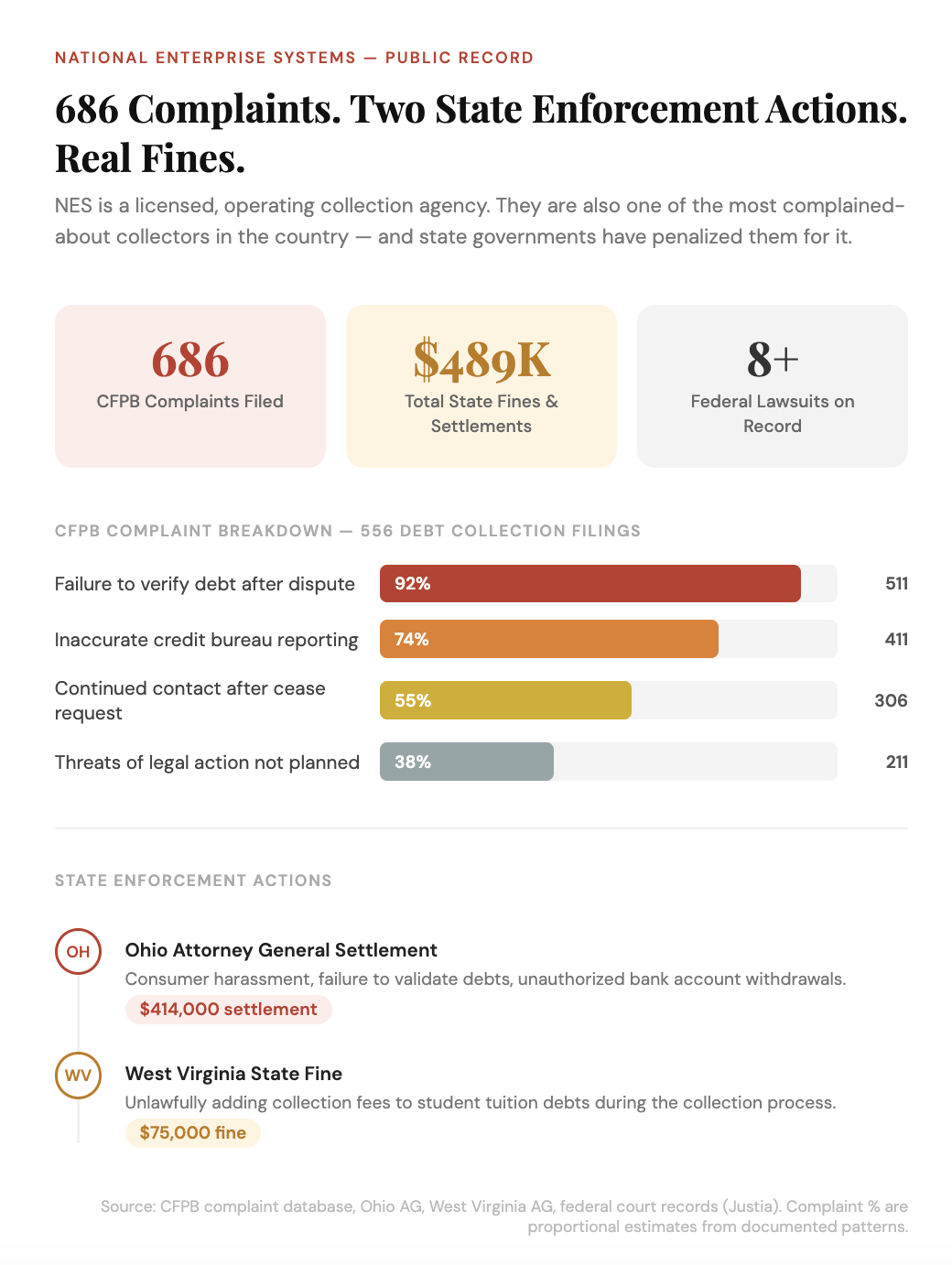
On the BBB, NES is not accredited. Consumer reviews on third-party sites consistently describe the same behaviors: multiple calls per day, representatives using threatening language, refusal to provide written documentation before demanding payment, and threats of legal action before any lawsuit had been filed.
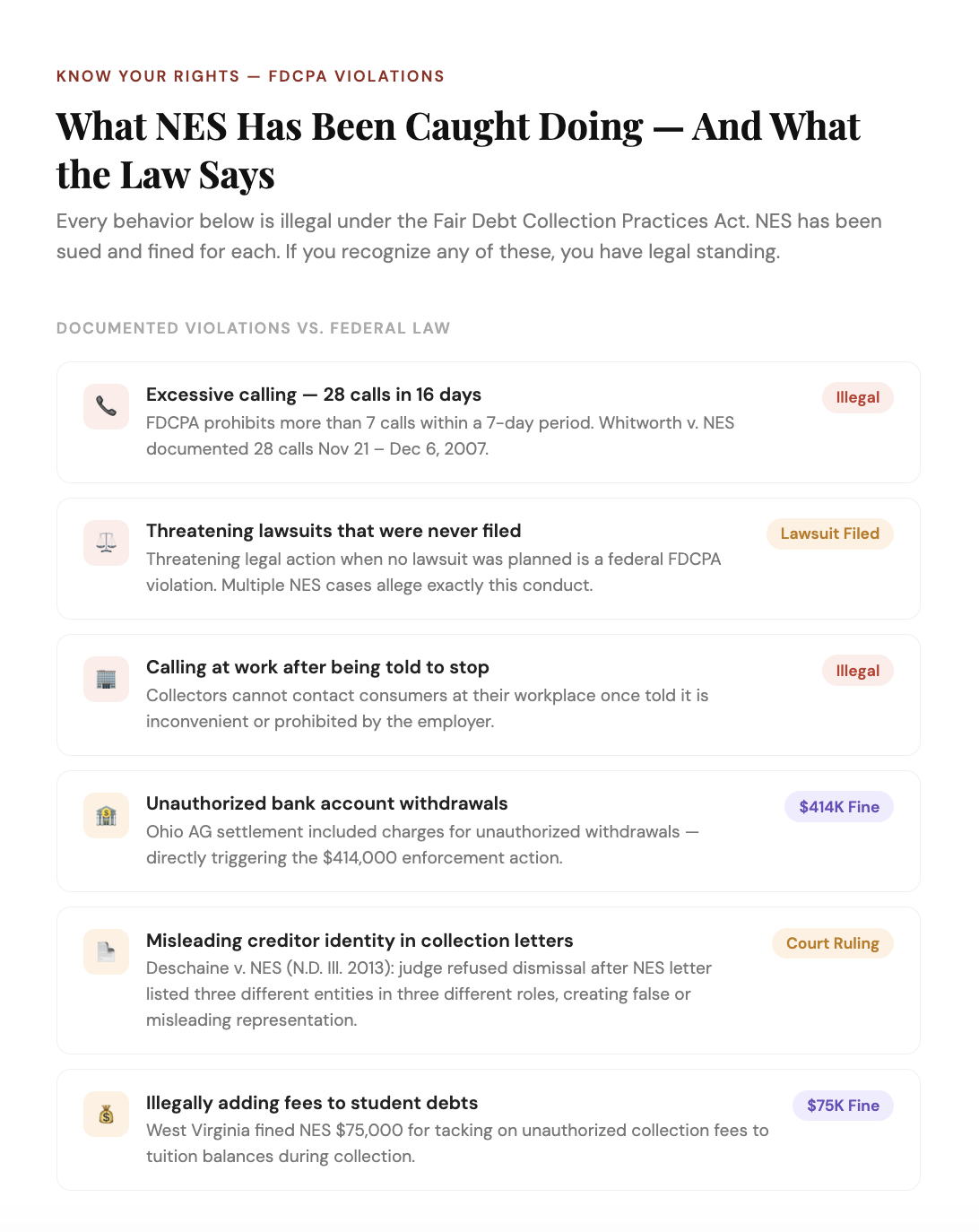
One documented complaint describes a consumer receiving 28 phone calls from NES between November 21 and December 6 of a single year, a pace of nearly two calls per day over 16 straight days. Another describes a representative continuing to contact a consumer at their workplace after being explicitly told to stop.
These are not random bad reviews. They form a consistent pattern across hundreds of consumer filings spanning more than a decade.
National Enterprise Systems Lawsuit History
NES has a real, documented legal record. These are not allegations. These are cases that proceeded through federal and state courts and enforcement agencies.
Ohio Attorney General Settlement.
The Ohio AG pursued NES for consumer harassment, failure to provide debt validation, and unauthorized withdrawals from bank accounts. NES settled that action for $414,000.
West Virginia Fine.
The state of West Virginia fined NES $75,000 for unlawfully adding collection fees to student tuition debts during the collection process.
Strom v. Nat'l Enter. Sys., 2010 U.S. Dist. LEXIS 37369 (W.D. NY 2010).
The plaintiff alleged that despite informing NES she had a cancerous brain tumor and was unable to work, NES continued to harass and verbally abuse her, threatening legal action and falsely claiming her disability benefits would be seized. The plaintiff alleged the conduct was severe enough to trigger seizures.
Whitworth v. National Enterprise Systems.
The plaintiff alleged NES contacted him at least 28 times between November 21 and December 6, 2007, demanding personal financial information, accusing him of fraud, and threatening legal action in violation of both the FDCPA and Oregon collection statutes.
TORRES v. NATIONAL ENTERPRISE SYSTEMS, INC., No. 12 C 2267 (N.D. Ill. Oct. 4, 2013).
Federal case in the Northern District of Illinois proceeding against NES for alleged FDCPA violations.
HITCHMAN v. NATIONAL ENTERPRISE SYSTEMS, INC., Case No. 12-61043 (S.D. Fla. March 10, 2014).
Federal case in the Southern District of Florida for alleged FDCPA violations.
Deschaine v. National Enterprise Systems (N.D. Ill. 2013).
A federal judge refused NES's motion to dismiss after a consumer alleged NES sent a collection letter that failed to properly identify the original lender. The letter listed three different entities across three different roles, which the court found could constitute a false or misleading representation under the FDCPA. The case was allowed to proceed.
Thalman v. National Enterprise Systems, Inc., Case No. 2:17-cv-00119 (E.D. Wis. 2017).
An FDCPA class action filed in Wisconsin alleging NES sent a settlement letter so confusingly worded that consumers could not determine how much they needed to pay to actually close the account, leaving open the possibility that a consumer would pay and still owe a remaining balance.
This record is publicly available and searchable by anyone. When NES tells you a lawsuit is imminent, you are dealing with a company that has been sued and penalized across multiple states for making exactly that kind of threat when no legal action was actually planned or warranted.
Is National Enterprise Systems a Legit Company?
Yes. National Enterprise Systems is a real, licensed debt collection agency operating legally in all 50 states. The calls are real. The accounts they report to credit bureaus are real. The debt they reference may genuinely be yours.
However, legitimate does not mean accurate, and it does not mean they always operate within the law. Their complaint volume, state enforcement settlements, and federal case history tell a consistent story. NES pushes aggressively, and that aggression has crossed legal lines often enough to produce two state enforcement actions, multiple federal lawsuits, and hundreds of CFPB filings.
Treat every communication from NES with careful skepticism. Verify the debt in writing before agreeing to anything. Confirm the balance is accurate. Check the statute of limitations before making any payment. And document every contact they make with you in case their behavior crosses into FDCPA violation territory.
Why Is National Enterprise Systems Calling Me?
There are three common reasons NES contacts someone.
First, a creditor assigned your account to NES after you fell behind on payments. NES collects on their behalf and takes a percentage of whatever they recover.
Second, NES purchased your charged-off account outright and is now attempting to collect the full original balance for itself.
Third, they have the wrong person. NES purchases large debt portfolios in bulk. Errors in name matching, address history, and account identification happen regularly. If you do not recognize the debt they are referencing, do not assume it is yours. Request full written debt validation before responding further or saying anything that could be interpreted as acknowledging the debt.
Recommended Read: IQ Data International: Who They Are and How to Remove Them
National Enterprise Systems Fraud: What Illegal Behavior Looks Like
Based on the documented complaint and case record, here is the specific conduct NES has been accused of that crosses into illegal territory under the FDCPA.
Calling a consumer more than seven times within a seven-day period is prohibited. Contacting a consumer at their workplace after being told to stop is prohibited. Threatening a lawsuit when no lawsuit has been filed or is genuinely planned is prohibited. Failing to include required disclosures about interest and fees in a collection letter is prohibited. Making misleading representations about the identity of the original creditor is prohibited. Continuing collection activity after receiving a written dispute request without first validating the debt is prohibited.
If any of those behaviors have occurred in your situation, document every call with dates, times, and what was said. Then file a complaint with the CFPB at consumerfinance.gov/complaint and with the Texas Attorney General at texasattorneygeneral.gov. An FDCPA violation entitles you to up to $1,000 in statutory damages, plus actual damages and attorney fees.
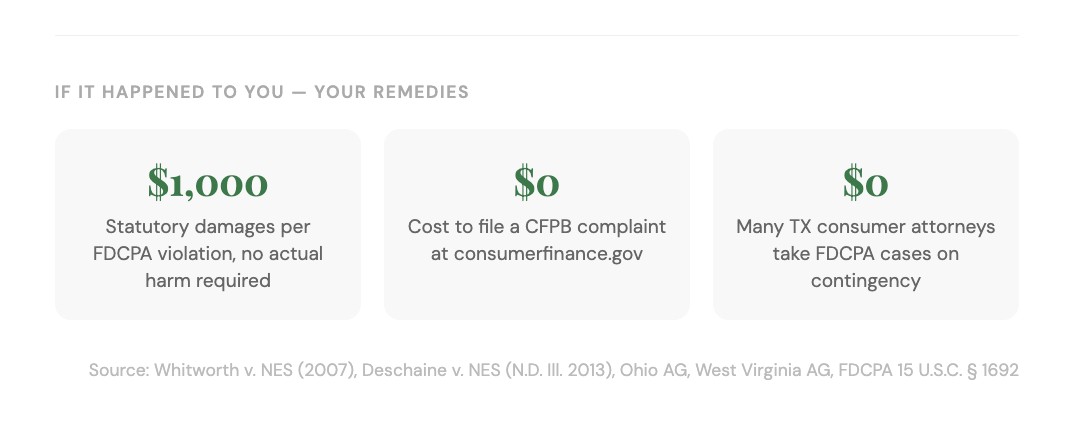
Many Texas consumer attorneys take these cases on contingency, meaning you pay nothing unless you win.
How To Handle a National Enterprise Systems Collection
I walk every client through the same process when NES appears on their credit report.
Step 1: Pull all three credit reports. Go to AnnualCreditReport.com and check Equifax, Experian, and TransUnion. Note the exact balance, the date of first delinquency, and any discrepancies between what the three bureaus show.
Step 2: Check the statute of limitations. In Texas, a collector has four years from your last payment to file a valid lawsuit. If the debt is older than four years, NES has no legal leverage in a Texas court. That changes your entire negotiating position.
Step 3: Send a written debt validation letter. Mail your request to 29125 Solon Road, Solon, OH 44139 via certified mail with return receipt. NES must provide the original contract, a complete payment history, verification of the balance, and proof they have the legal right to collect. Many NES accounts on purchased portfolios cannot be fully validated because documentation was not transferred with the account.
Step 4: Dispute directly with the credit bureaus. Send written disputes to all three bureaus if the account contains errors, cannot be validated, or is past the seven-year reporting limit. Each bureau has 30 days to investigate and must remove the item if NES cannot verify it.
Step 5: Negotiate if the debt is valid. NES purchased your account for pennies on the dollar. They regularly settle for 40-60% of the original balance. Always get a pay-for-delete agreement in writing before sending any payment. A paid collection without a deletion agreement remains on your credit report for 7 years.
If your credit report has issues beyond this single account, our full guide on how to fix your credit score in San Antonio walks through the complete dispute and rebuilding process from start to finish.