

No improvement after credit repair does not always mean the process failed. Credit scores measure more than the presence of negative accounts. According to FICO, payment history accounts for approximately 35% of a typical FICO Score, while amounts owed account for another 30%. Together, these factors represent roughly 65% of the scoring calculation. This explains why removing an inaccurate collection or correcting an account does not automatically produce a significant score increase.
Federal consumer protection laws also place limits on what credit repair can accomplish. The Federal Trade Commission states that credit repair companies cannot legally remove accurate, current negative information simply because a consumer pays for their services. Under the Fair Credit Reporting Act, credit bureaus generally have 30 days to investigate disputed information, with certain exceptions allowing additional time. However, an investigation does not guarantee deletion, and a corrected credit report does not guarantee a higher credit score.
For consumers who have spent months disputing accounts without seeing measurable progress, the next step is to identify what actually changed. This guide examines the most common reasons credit scores remain unchanged after credit repair, how to distinguish legitimate reporting corrections from ineffective services, and what actions can help address the factors still affecting creditworthiness.
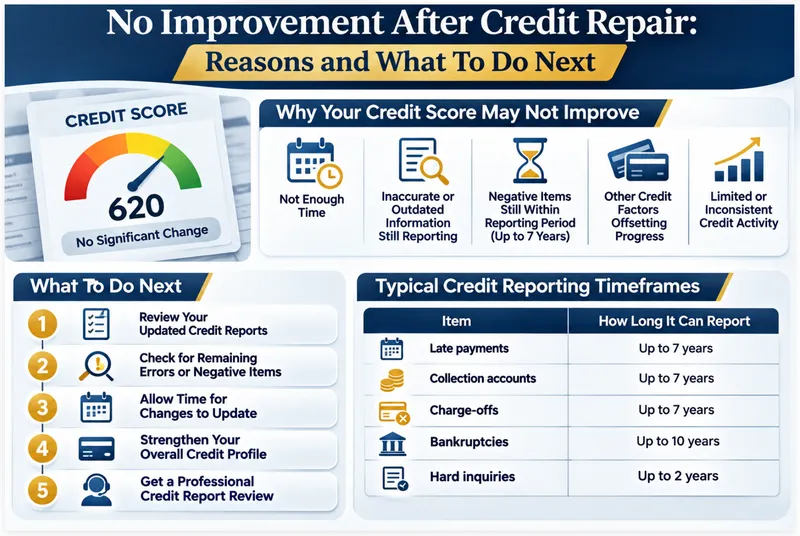
No Improvement After Credit Repair: Reasons and What To Do Next
No improvement after credit repair is frustrating, especially after you paid hundreds of dollars and waited months. You received letters from the credit bureaus, or watched a collection disappear, and your score still did not move at all.
That does not always mean credit repair failed. A corrected account carries little weight in the model you check, while high card balances or a new late payment cancel the gain. Sometimes the disputed item was accurate, the investigation found no error, or your provider has no documented work to show for your fees.
Under the Fair Credit Reporting Act, a credit bureau generally has 30 days to investigate a dispute, and 45 days in some cases, according to the CFPB. A finished investigation does not guarantee a deletion or a higher score. The FTC states that no one is legally permitted to remove information that is accurate and current.
Before you pay for another month, learn what happened to your reports. This guide covers seven reasons your credit is not improving, how to recognize genuine progress, and what to do next.
- Three different problems: an unchanged report, an unchanged score, and a score that rose but still misses a lender's terms.
- Accurate, current negatives stay. The FTC says no one is legally permitted to remove them.
- Investigation deadlines are not score deadlines. Bureaus generally have 30 days, but no source sets a date for a score change.
No Improvement After Credit Repair? Check These 3 Things First
No improvement after credit repair does not always mean the process failed. Your credit score stays unchanged because of high credit card balances, new late payments, different scoring models, or corrections with little scoring impact. If your credit reports show no changes, review the investigation results and confirm what information was disputed. Accurate negative information generally cannot be removed simply through credit repair. Before paying for additional services, compare your reports, identify unresolved errors, and request documentation of the work performed.
Start with a clean comparison. Put the report from before the disputes next to a fresh one, read each investigation result, and check both scores from the same model and bureau.
- Compare the reports. Look at the exact account you disputed, not the score.
- Read the investigation results. Each notice says whether the item was corrected, verified, or rejected.
- Match the scoring model. Compare scores of the same model, the same bureau, and similar dates.
| What Happened | What It Means | Your First Move |
|---|---|---|
| Credit report unchanged | No correction, deletion, or update occurred | Read the dispute results and check the dates |
| Report corrected, score unchanged | The correction did not change that score, or other factors offset it | Check balances and new accounts on the report |
| Score improved, loan still denied | The lender weighs other factors and uses another score model | Request the adverse action notice |
7 Reasons You're Seeing No Improvement After Credit Repair
1. Your Credit Report Changed, But Your Credit Score Didn't
Example (illustrative): A dispute removes a $300 collection from Dana's report. Her score stays at 612, because three other collections and a 92% card balance still sit on the file.
A score reads the whole report. One corrected account moves the score only when that account was a major drag, and the model you check weighs it the way you expect.
What to verify: Compare the exact account before and after, and confirm both scores come from the same model.
2. Your Credit Card Balances Are Still Too High
Example (illustrative): Marcus wins a deletion, then charges $4,200 on a card with a $5,000 limit. His utilization jumps to 84%, and the deletion gain disappears.
Amounts owed carry about 30% of a FICO Score, according to myFICO, which makes it the second-largest factor.
What to verify: Check the reported balance and limit on every card, and note each issuer's statement date.
3. The Negative Information Was Accurate
Example (illustrative): Priya disputes a 2023 charge-off. The balance, dates, and status all match her records, so the bureau verifies it.
The FTC is direct: no one promising to repair your credit is legally permitted to remove information that is both accurate and current. A late payment, charge-off, or collection that is true stays until its reporting period ends. The FTC says most negative information stays on a report for seven years, and bankruptcy information for 10.
What to verify: Compare the dates, balance, and status to your own statements.
4. Your Dispute Was Verified or Rejected
Example (illustrative): James receives a result letter that says "verified." He assumes the process failed, but the letter shows the lender confirmed its records.
Three outcomes look alike and mean different things. Verified means the furnisher confirmed the data. Corrected or removed means the information was wrong or the furnisher failed to verify it. Rejected means the bureau treated the dispute as frivolous or irrelevant, such as one that does not say what is wrong, and it must notify you within five business days.
What to verify: Read the results notice line by line. Our guide to why credit disputes fail explains the usual causes.
5. You're Comparing Different Credit Scoring Models
Example (illustrative): Your app shows 648. The lender pulls a FICO Auto Score of 671. Neither number is wrong.
FICO and VantageScore are separate model families. Each version uses different data from a different bureau on a different date, and FICO's auto and bankcard scores run on a 250 to 900 scale, per myFICO.
What to verify: Write down the score name, the bureau, and the date for every number you compare.
6. New Negative Information Is Affecting Your Credit
Example (illustrative): A disputed late payment comes off in March. In April, a medical bill goes to collections, and a card payment is 30 days late.
New problems erase old fixes. Payment history is the largest factor at about 35% of a FICO Score, per myFICO, so a fresh late payment outweighs a quiet correction.
What to verify: Review all three reports for new delinquencies, new collections, or accounts you do not recognize. Our post on credit score drops during disputes covers the other causes.
7. Your Credit Repair Company Has Not Documented Meaningful Work
Example (illustrative): A client pays for six months. When asked for records, the company sends no dispute letters.
Real work leaves a paper trail. Request copies of every dispute letter, the bureau and furnisher responses, the dates sent, and a list of the items challenged.
Federal law also requires a written contract that lists the services, the cost, and how long results take, according to the FTC. A company that cannot show documents for items it billed you for has not earned further fees.
How Long Should Credit Repair Take Before You See Results?
A credit bureau generally must investigate a dispute within 30 days, per the CFPB, and the period extends to 45 days in two cases. That deadline governs the investigation only. The date your score changes depends on when creditors update their reports and which model calculates it.
| Stage | Timeframe |
|---|---|
| Bureau investigates your dispute | Generally 30 days |
| Dispute filed after a free annual report | 45 days |
| You send extra relevant information mid-investigation | 15 more days |
| Bureau sends results after finishing | 5 business days |
| Your score changes | No set date |
Nobody has a basis to promise a 30-, 60-, or 90-day score increase. Treat any company that does as a warning sign.
What To Do Next When Credit Repair Isn't Working
Get current reports from all three bureaus, compare them with the originals, and read every investigation notice. Dispute remaining factual errors with both the bureau and the furnisher. Then review balances, payment history, and your credit repair contract.
- Obtain current reports from all three bureaus. Free weekly reports are available at AnnualCreditReport.com.
- Compare the disputed account details with the original reports. Check the balance, status, dates, and account number line by line.
- Review investigation notices and supporting documents. Note which items were corrected, verified, or rejected. See our guide to a credit dispute you lost for the follow-up options.
- Dispute remaining factual errors with both the bureau and the furnisher. The CFPB says fixing an error generally means contacting both, with copies of your evidence. Our step-by-step dispute guide walks through it.
- Review balances, payment history, and recent account changes. Look for new late payments, new collections, and rising utilization.
- Evaluate the credit repair contract and the documented services. Match each billed month to a document you hold.
- Escalate unresolved reporting errors through complaint channels. If the problem persists, submit a complaint to the CFPB. Dispute with the bureau first, since the CFPB expects it.
If the furnisher says the information is accurate, ask the bureau to add a statement describing your dispute to your file.
Still Seeing No Improvement After Credit Repair?
Before paying for another round of disputes, find out what is actually holding your credit back. Review your credit reports, check which errors remain unresolved, and identify the information that needs further attention.
Get Your Credit Report Review → ASAP Credit Repair USA helps you review your credit-report concerns and understand your available options.Should You Continue Paying for Credit Repair or Cancel?
Keep paying only if the company shows documented work and unresolved errors remain to challenge. Cancel when only accurate items are left or when you receive no records. An open investigation does not obligate you to keep paying.
| Your Situation | Your Move |
|---|---|
| Documents show real work, and errors remain | Continue with a set review date |
| No dispute letters or bureau responses | Request records in writing before the next payment |
| Only accurate negatives remain | Cancel and focus on payments and balances |
| Charged before the service was performed | Raise it in writing and file a complaint |
Federal law regulates credit repair contracts. Under 15 U.S.C. 1679b(b), a credit repair organization is barred from charging or receiving money before the service is fully performed. The FTC adds that a company must give you a written contract with the services, the cost, and a three-day right to cancel.
After the three-day window, your contract's cancellation terms apply, so read them before you decide.
How Do You Improve Your Credit Without Paying for Another Credit Repair Service?
You improve credit by disputing errors yourself for free, paying every bill on time, lowering revolving balances, and checking your reports for wrong information. None of these steps guarantees a specific score increase.
- ✓Dispute for free. The FTC says disputing mistakes on your credit report is free.
- ✓Pay on time. Payment history is the largest score factor.
- ✓Reduce revolving balances. Lower reported balances improve utilization.
- ✓Review account information. Confirm every balance, limit, and status against your statements.
When Should You Get Professional Help With an Unresolved Credit Report Error?
Get help when you have documented an error, disputed it correctly, and the bureau or furnisher still has not fixed it. The right kind of help depends on the problem: credit repair, nonprofit counseling, or a consumer-law attorney.
Credit repair assistance
Handles dispute paperwork and follow-up for inaccurate entries.
Nonprofit credit counseling
Helps with budgets and debt payment plans, not report accuracy.
Consumer-law attorney
Reviews unresolved reporting violations after valid disputes get ignored.
Not Sure What Is Holding Your Credit Back?
Start with a review of your reports. You see what is accurate, what is disputable, and what only time and payments will fix. No results are guaranteed.
Get Your Credit Report Review → Secure · No credit card requiredFrequently Asked Questions About No Improvement After Credit Repair
Why is my credit score not improving after credit repair?
Your score stays flat when balances remain high, the negative items were accurate, or a new late payment offsets the gain. Different scoring models also show different numbers. Compare your reports before and after, and confirm both scores come from the same model and bureau. That comparison shows what actually changed and what still needs attention.
Does credit repair work without increasing your score?
Yes. A report correction does not guarantee a score increase. Removing one wrong item helps your file, but other negatives or high utilization hold the score down. Judge the work by the report: check whether the disputed entries were corrected or deleted, not only by the number, and ask what else still drags the score down.
How long does it take to see credit repair results?
A bureau generally must finish a dispute investigation within 30 days, or 45 days in certain cases, according to the CFPB. Score changes follow no fixed schedule. They depend on when creditors report updates and which scoring model you check. Any company promising a set number of days is guessing.
Why did my credit score stay the same after a collection was removed?
Other negative items, a high utilization ratio, or a recent late payment keep the score flat. The model you check also weighs a single collection differently. Look at the rest of the report: if more derogatory accounts remain, one deletion barely moves the total. Tackle them in order of recency and balance.
Do credit repair companies remove accurate late payments?
No. The FTC states that no one is legally permitted to remove information that is both accurate and current. Late payments that are true stay on your report for the reporting period, which is seven years for most negative items. Credit repair addresses inaccurate, incomplete, or unverifiable entries, not accurate ones, so expect those to remain.
What should I do if my credit repair company isn't helping?
Request copies of every dispute letter, bureau response, and date in writing. Read your contract and billing terms, and compare the work shown with the fees charged. If the company cannot document its work or you were charged before services were performed, file a complaint with the CFPB and consider canceling.
Is it free to dispute credit report errors yourself?
Yes. The FTC confirms that disputing mistakes on your credit report is free. You contact both the credit bureau and the company that supplied the information, include copies of your evidence, and keep records of everything you send. The CFPB outlines each step on its dispute page, and the FTC lists the same free options.
Should I keep paying for credit repair if nothing changes?
Keep paying only if the company documents real work and actionable errors remain. Review the contract terms, the billing dates, and each result notice. If only accurate items are left, or you receive no records, stop paying and put the money toward balances and on-time payments instead, which move scores directly.
Your next step is a comparison, not another payment. Pull fresh reports, read the results, and decide with facts.
- CFPB — How long does it take to get a response to a dispute?
- CFPB — How do I dispute an error on my credit report?
- CFPB — Submit a complaint
- Federal Trade Commission — Fixing Your Credit FAQs
- 15 U.S.C. § 1679b — Credit Repair Organizations Act, prohibited practices
- myFICO — What is in your credit score
- myFICO — FICO Score types and versions
- AnnualCreditReport.com — Free credit reports