Paid Collection No Score Change · Why Paying Collections Doesn't Help Credit · Pay for Delete · FICO 8 Collections · Credit Report Dispute
You did what felt responsible. You paid the collection. You checked your score a week later. Nothing moved. This guide explains exactly why, and exactly what you should have done instead.
Updated March 2026 · Sources: myFICO.com FICO 8 scoring model, Experian credit report guidance, CFPB consumer credit complaint data, FCRA Section 611, FDCPA 15 U.S.C. 1692g
At a Glance
Why your score didn't move after paying that collection
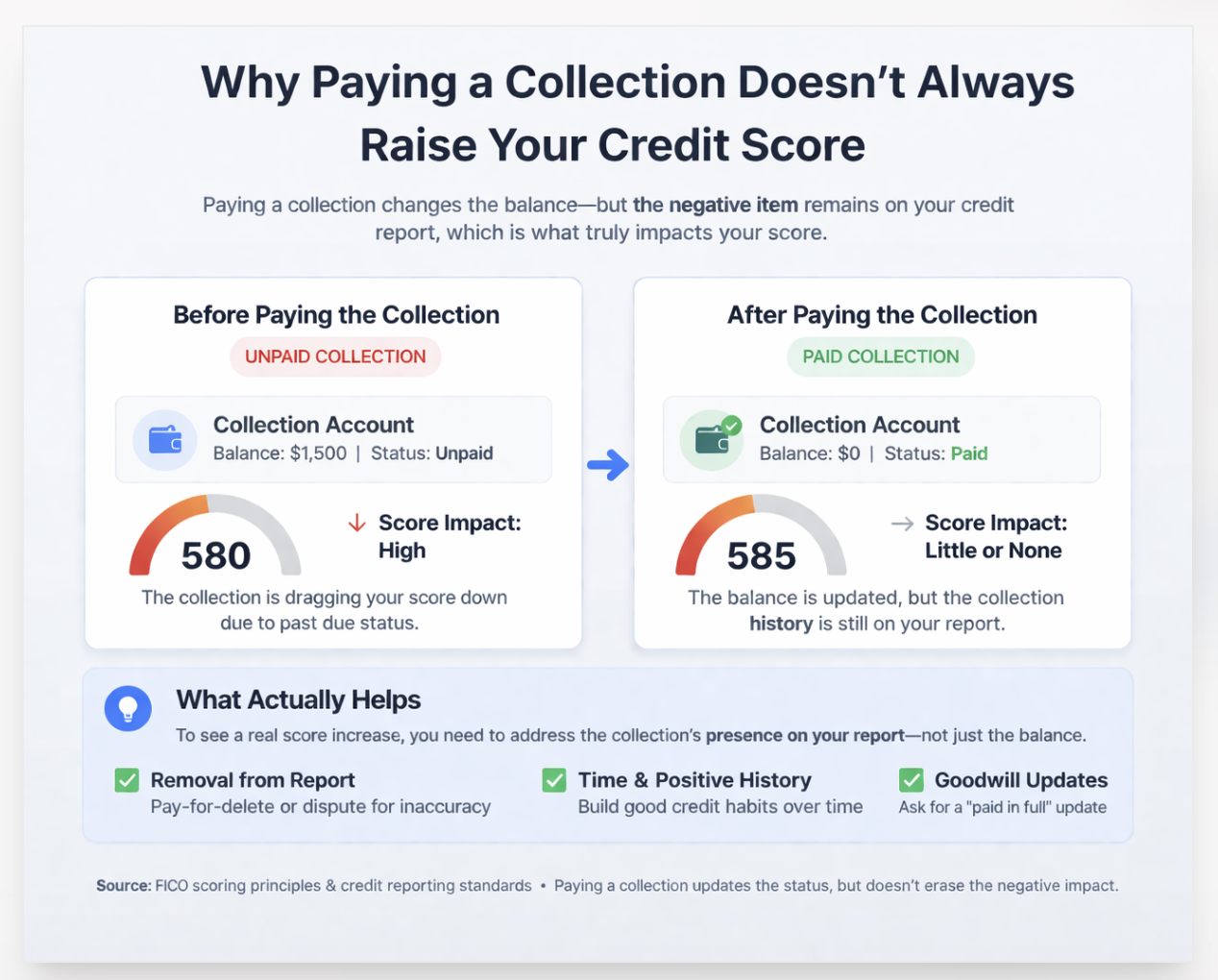
The short answer: FICO 8, the scoring model used in roughly 90% of lending decisions, does not distinguish between an unpaid collection and a paid one. Both carry the same derogatory weight on your credit report. Paying changed the account status. It did not change the account classification. Your report now says "paid collection" instead of "collection," and under FICO 8, that difference is worth approximately zero points. The collection entry, the delinquency history behind it, and its negative contribution to your score all remain intact for the remainder of the 7-year FCRA reporting window. You are not worse off. But you are not better off either, and that gap between what you expected and what happened is something most people never get a clear explanation of.
~0Score points gained from paying a collection under FICO 8 alone
7 yrsHow long the entry stays on your report regardless of paid status
90%Of lenders still use FICO 8 or older, which treats paid and unpaid collections the same
30 daysBureau investigation deadline after a specific, documented FCRA dispute is filed
Free Audit: Find What You Can Actually Do to Move Your Score →
There is a specific kind of frustration that comes from doing the right thing and getting nothing for it.
You found the collection on your report. You called. You paid. It cost you $300, or $800, or $1,400. You waited. You refreshed the credit monitoring app. The score barely moved, or did not move at all. And now you are trying to understand what went wrong.
Nothing went wrong, exactly. What happened is that you made a decision based on a very reasonable but incorrect assumption: that paying a debt removes the damage it caused to your credit. That is not how the scoring system works, and the system is designed in a way that almost nobody explains clearly before you make the payment.
This article explains the exact mechanics. Then it tells you what you can still do.
What You Expected to Happen vs. What FICO Actually Did
What you expected
What FICO 8 actually scored
✗Paying removes the collection entry from the report
▶
✓Payment updated the status field only, from "collection" to "paid collection." The tradeline, the delinquency history, and all associated negative data remain fully on the report.
✗Lenders see that I resolved the debt and treat it more favorably
▶
✓FICO 8 gives the same score weight to paid and unpaid collections. Lenders using FICO 8 see a derogatory mark either way. Manual underwriters, however, do sometimes prefer a paid status when doing individual file reviews.
✗My score should go up now that the debt is resolved
▶
✓Score improvement from a collection comes from removal of the tradeline, not from resolution of the underlying debt. Payment and removal are two entirely separate outcomes that require separate actions.
✗The collection will disappear from my report soon now that it is paid
▶
✓The collection entry stays on your report for 7 years from the date of first delinquency, regardless of when or whether you paid. Paid status does not change or shorten the 7-year FCRA reporting clock.
✗At least paying stopped the score damage going forward
▶
✓The collection was already charged off and static. It was not producing new damage each month. What it was doing was sitting in your report, aging, slowly losing scoring weight over time. Payment changed its status. It did not change its aging trajectory.
This is not a bug in the system. FICO 8 was designed to evaluate the likelihood that a borrower will pay future obligations on time. A borrower who eventually paid a collection after it went to a debt collector is, statistically, a similar credit risk to one who has not yet paid it. The payment does not change the underlying payment behavior that created the collection. That is why FICO 8 weights them the same.
People Also Ask: Direct Answers
Why didn't my credit score go up after I paid a collection?
Because FICO 8, used in approximately 90% of lending decisions, treats paid and unpaid collections the same. Payment only updates the status field on the tradeline. The derogatory classification remains, the payment history damage remains, and the entry stays on your report for the full 7-year FCRA window. Score improvement from a collection requires removal of the tradeline, which requires either a successful FCRA error dispute or a negotiated pay-for-delete agreement obtained before payment.
Does paying a collection hurt or help your credit score?
Under FICO 8, paying a collection produces approximately zero score change in most cases. In some edge cases, it can trigger a slight dip if the payment activity refreshes the "last reported" date, causing the entry to appear more recent to the scoring model than it was before. The practical benefits of paying a collection are non-score-related: stopping a running statute of limitations, satisfying manual underwriting requirements for specific loan types, and eliminating the risk of a lawsuit from a collector still within the SOL window. None of these benefit your credit score directly.
What credit scoring models do ignore paid collections?
FICO 9 and VantageScore 4.0 both exclude paid collections from their score calculations entirely. FICO 10 and FICO 10T are also more favorable to paid collections than FICO 8. However, most lenders, particularly mortgage lenders who use tri-merge reports, have not yet adopted these newer models for underwriting decisions. The mortgage industry in particular is slow to adopt new scoring models due to regulatory requirements tied to older FICO versions. Until adoption becomes widespread, paying a collection is unlikely to produce meaningful score improvement for most borrowers in most lending contexts.
Should I pay a collection or dispute it first?
Audit before either. Pull all three credit reports and check the collection entry for specific FCRA errors: wrong date of first delinquency, wrong balance, re-aging after debt sale, or duplicate reporting by both original creditor and collection agency. If errors exist, dispute them first at no cost under FCRA Section 611. If no errors exist, send a debt validation letter to the collector. If validation fails or produces incomplete documentation, the entry may be removable without payment. Only after exhausting those free options should you negotiate payment, and at that point, make written deletion a condition of any payment.
How do I actually get a collection removed from my credit report?
Three paths: (1) FCRA error dispute -- dispute specific, documented errors in the entry such as wrong dates or duplicate reporting. The bureau must investigate within 30 days and remove inaccurate information. (2) Debt validation -- send a written FDCPA validation request to the collector. If they cannot produce complete documentation, they must stop reporting. (3) Pay-for-delete agreement -- negotiate a written agreement before any payment requiring the collector to submit a deletion request to all three bureaus upon payment. The agreement must specify deletion, not status update.
How Different Scoring Models Actually Handle Paid Collections
The scoring model being used when a lender pulls your report determines what your payment accomplishes. Here is the full picture.
Scoring Model
Paid = Removed?
Treats Paid Better?
Used by Most Lenders?
FICO 8Most widely used scoring model in lending
✗
✗
✓ ~90% of lenders
FICO 9Newer, less widely adopted
✓ Ignores paid
✓ Significantly
✗ Limited adoption
FICO 10Released 2020, slow adoption
✗
~ Somewhat
✗ Very limited
VantageScore 4.0Bureau-developed alternative model
✓ Ignores paid
✓ Significantly
~ Growing, not dominant
FICO 2 / 4 / 5Older models, still used in mortgage
✗
✗
✓ Standard in mortgage
Until lenders broadly adopt FICO 9, FICO 10, or VantageScore 4.0, paying a collection produces no score benefit for the overwhelming majority of borrowers. Source: myFICO.com scoring model education; Experian FICO version guidance.
What "Paid Collection" vs. "Collection" Actually Looks Like on Your Report
Here is what each status looks like on a credit report entry, and what it means for your score.
Credit report entry: unpaid collection vs. paid collection under FICO 8
Account typeCollection
Pay statusCollection/Charge-off
Balance$1,240
Date of first delinquencyJan 2021
Estimated removal dateJan 2028
FICO 8 impact: Full negative weight. Lenders see active derogatory mark.
Account typeCollection
Pay statusPaid Collection
Balance$0
Date of first delinquencyJan 2021
Estimated removal dateJan 2028
FICO 8 impact: Same negative weight. Status updated but classification unchanged.
The account type, the date of first delinquency, and the estimated removal date are identical in both versions. Under FICO 8, those three fields are what the scoring model evaluates. The "pay status" field, which changes from "Collection" to "Paid Collection" when you pay, is not one that FICO 8 weights differently. That is why the score does not move.
What Lenders Actually See When They Pull Your Report
The scoring model is only one part of how lenders evaluate your credit file. Manual underwriting, which happens when a human reviews your full report rather than just your score, is where paid versus unpaid collections sometimes makes a practical difference.
Mortgage lendersConventional / FHA / VA
Most mortgage lenders use FICO 2, 4, or 5 (the classic mortgage models) through a tri-merge pull from all three bureaus. These older models treat paid and unpaid collections similarly in the automated underwriting score. However, FHA guidelines require manual review of collections over $2,000, and an unpaid collection can block approval entirely in some FHA underwriting scenarios even if the score qualifies. A paid collection is generally more acceptable for manual review than an unpaid one, making payment strategically relevant specifically for mortgage applicants, not for score improvement.
Auto lendersDealership finance, banks, CUs
Auto lenders typically use FICO Auto Score 8 or 9. FICO Auto Score 9 treats paid collections more favorably, but adoption varies by lender. Most traditional banks and credit unions still run FICO 8 or an auto-specific version that weights paid and unpaid collections similarly. A paid collection helps primarily when the lender does manual review on borderline applications.
Credit card issuersMajor banks and fintechs
Credit card approvals are almost entirely algorithmic at application. FICO 8 or VantageScore 3.0 are most common. VantageScore 3.0 does treat paid collections somewhat more favorably than FICO 8, but it still does not eliminate their impact. For premium rewards cards, an unpaid collection is often an automatic denial trigger in the algorithm regardless of overall score.
LandlordsApartment rental applications
Rental background checks typically use TransUnion's ResidentScore or a similar product. These models are specifically built for rental risk assessment and weight unpaid collections more heavily than paid ones, particularly for utility and rental-related collections. Paying a utility or prior-landlord collection can meaningfully improve rental approval odds even if it does not improve the standard FICO 8 score.
EmployersBackground check for hiring
Employers who run credit checks do not see credit scores. They see the full credit report. An unpaid collection is more visually prominent in a report review than a paid one. For positions involving financial responsibility, a paid collection with zero balance often reads better to a human reviewer than an unpaid one with an active balance, even though the score itself did not change.
"Payment resolved the debt. That matters legally and sometimes practically for specific loan types and landlords. But payment did not touch the credit score because under FICO 8, the scoring model that governs 9 out of 10 lending decisions, the classification that damaged your score did not change."
ASAP Credit Repair USA
If You Already Paid, the Collection Is Still on Your Report. Here Is What You Can Still Do.
Paying did not close the door on removal. A paid collection can still be disputed for FCRA errors in the entry. A paid collection can still be the subject of a goodwill deletion request. And an entry that was paid but contains an inaccurate date of first delinquency is still disputable under FCRA Section 623(a)(5). A free audit identifies which path applies to your specific entry.
Free 3-Bureau Audit
Delinquency Date Check
Paid Collection Strategy
Goodwill Letter Option
No Obligation
Get My Free Credit Audit →
Secure · Takes 2 minutes · No credit card required
What You Can Still Do After Paying
The payment is made. The score did not change. You still have options.
Your remaining paths to removal after paying a collection without a deletion agreement
1
Goodwill Letter to the Original Creditor or Collection Agency
A goodwill letter is a written request asking the creditor or collector to voluntarily delete the entry as a courtesy, citing the account's now-satisfied status and any personal circumstances that led to the original delinquency. Goodwill letters have a low but real success rate, particularly with original creditors who still own the debt (not debt buyers). They work best when you have an otherwise strong payment history and the delinquency was an anomaly. The language matters: frame it as a request for goodwill consideration, not a demand. Reference the satisfactory account history before the delinquency if one exists. Send by certified mail to the creditor's executive customer service department rather than the general customer service address.
Free to try
2
FCRA Error Dispute for Inaccuracies in the Entry (Even on a Paid Account)
Payment does not lock the entry in its current form. If the paid collection entry contains any FCRA errors, those errors are still disputable. The most common errors to check: the date of first delinquency (is it the actual first missed payment date, or has it been set to a later date that extends the 7-year window?), the balance at time of charge-off (did it continue to grow after charge-off?), the account status (is it correctly marked as paid?), and whether a second entry from the debt buyer also appears alongside the original creditor entry. Any inaccuracy in any of these fields is grounds for a specific dispute under FCRA Section 611.
Free under FCRA
3
Contact the Collector to Negotiate a Retroactive Pay-for-Delete (Less Common but Possible)
If you paid a collection agency (not the original creditor) directly, some agencies will consider a retroactive deletion request post-payment, particularly if the relationship is recent and the account is small. Send a written request citing the payment confirmation and asking whether they will submit a deletion request as a professional courtesy. This works more rarely than a pre-payment agreement, but it costs nothing to ask and occasionally succeeds. If the creditor refuses, your remaining options are the goodwill letter and FCRA error disputes.
Negotiated
4
Wait and Build: Let the Entry Age While Adding Positive History
If deletion is not achievable, the next best strategy is to minimize the remaining impact. Negative entries lose scoring weight as they age. Research shows that a charge-off or collection in Year 5 or 6 of the 7-year window has near-minimal impact on most scores when the rest of the profile is clean and positive. Every month of on-time payment on current accounts counterweights the aging negative entry. A secured credit card with consistent on-time payments, credit utilization below 30% on all revolving accounts, and no new derogatory marks will produce meaningful score recovery even while the collection ages on the report.
Time-based recovery
The Correct Order of Operations Before Paying Any Future Collection
If you have other collections on your report or expect to deal with one in the future, here is the sequence that produces the best outcome.
Step 1: Pull all three reports before contacting the collector. Go to AnnualCreditReport.com. Pull Equifax, Experian, and TransUnion. Note the date of first delinquency, the current balance, the account status, and whether both the original creditor and a collection agency are each reporting the same debt. This data governs every decision that follows.
Step 2: Check the date of first delinquency against your own records. The date reported on your credit report should match the actual first payment you missed that led to the account going delinquent. If it does not match, or if it has been reset to the date the debt was sold to a collection agency, you have an FCRA Section 623(a)(5) violation that is disputable at no cost before any payment is made. According to the CFPB's guidance on credit report disputes, a bureau must investigate any dispute of a specific inaccuracy within 30 days.
Step 3: Send a debt validation letter to the collection agency. Under the FDCPA, you can request that the collector provide complete documentation proving the debt is valid, belongs to you, and that they have the right to collect it. Send this by USPS Certified Mail with Return Receipt. All collection activity must stop until they respond. Many debt buyers who purchased old portfolio accounts cannot produce complete account-level documentation. When they cannot validate, they must stop reporting, which removes the entry without any payment.
Step 4: If validation confirms the debt is valid and errors have been addressed, negotiate pay-for-delete before paying. The agreement must be in writing, signed by an authorized representative, and must specify tradeline deletion, not status update. Send payment only after the signed agreement is in hand.
One thing that changes when there is already a court judgment involved: once a creditor wins a judgment against you in court, the collection landscape changes significantly. A judgment gives them enforcement tools that collectors without a judgment do not have, including in some states the ability to levy bank accounts and place liens on property. The credit repair strategy for a judgment-related collection differs from a standard pre-judgment collection account. If a lawsuit has already been filed or a judgment entered, read our guide on
how to settle credit card debt after a judgment before taking any action.
Written Pay-for-Delete Request: What to Say Before Paying Any Future Collection
Certified Mail Only
"I am writing regarding account number [XXXX] originally with [Original Creditor], which I understand is currently being managed by [Collection Agency]. I am prepared to resolve this account with a payment of $[X], which represents [X]% of the reported balance of $[Y]. This offer is contingent on your written agreement to: (1) accept this amount as full and final satisfaction of the balance, (2) submit a deletion request for this account to Equifax, Experian, and TransUnion within 30 days of confirmed payment. To be clear, I am requesting tradeline deletion -- complete removal of the entry -- not a status update to 'paid collection.' Please provide your response in writing, signed by an authorized representative with the authority to commit to this agreement. I will not submit any payment prior to receiving a signed written agreement."
The phrase "tradeline deletion, not status update" is the most important language in the letter. Without it, a collector may believe that updating the status to "paid" satisfies the spirit of a deletion request. It does not. A signed agreement with that specific language is enforceable if the collector accepts the terms, sends you the agreement, and then fails to follow through after payment.
State-Specific Considerations That Change Your Leverage
The credit repair strategy for a collection account is not identical in every state. Two specific variables matter most: your state's statute of limitations on debt (which determines whether the collector can still sue you) and your state's consumer protection laws (which may offer additional rights beyond the federal FDCPA).
In California, for example, consumer protection under the Rosenthal Fair Debt Collection Practices Act extends FDCPA-like protections to original creditors, not just third-party collectors. That broader coverage changes the validation letter strategy and what constitutes a collection law violation in the state. Our guide to California credit laws and credit repair covers how state-level protections interact with the federal FCRA and FDCPA for California residents dealing with collection accounts.
In states like Texas and New Mexico, wage garnishment protections significantly change a collector's enforcement leverage, which in turn changes how aggressively you can negotiate a pay-for-delete. A collector who cannot garnish your wages and cannot force the sale of your home has far less motivation to resist a settlement offer below the full balance. If you are in Albuquerque or the surrounding region, our analysis of why credit scores run lower in Albuquerque and the specific strategies that work there covers the local debt collection environment and the consumer protection framework that applies.
One rule that applies in every state: a collector threatening to sue you on a debt that has passed your state's statute of limitations is an FDCPA violation. If that threat is in writing or recorded, you may have a claim worth up to $1,000 in statutory damages plus attorney fees under 15 U.S.C. Section 1692. According to
FTC guidance on credit scores and consumer rights, collectors who misrepresent the enforceability of a debt are violating federal law regardless of what state you are in.
ASAP Credit Repair USA
Payment Is Not the End of the Road. It Is a Decision Point. Here Is What Comes Next.
If you have already paid without a deletion agreement, three options remain: goodwill letter, FCRA error dispute, and retroactive pay-for-delete request. If you have unpaid collections still on your report, the correct sequence prevents you from making the same mistake twice. A free audit tells you which path applies to each specific entry before you make any further moves.
01
Audit all three bureaus
Every collection entry reviewed for FCRA errors: wrong dates, wrong balances, re-aging, duplicate reporting by original creditor and debt buyer simultaneously
02
Free dispute + validation
Specific, documented FCRA disputes filed with all three bureaus simultaneously. FDCPA debt validation letters sent certified mail to each reporting collector
03
Pay-for-delete if needed
For valid accounts without disputable errors, written deletion agreement negotiated and signed before any payment is sent. The correct order, every time
Start My Free Credit Audit →
No obligation · Secure · First results in 30 to 45 days
Frequently Asked Questions
Why didn't my credit score go up after I paid a collection?
Because FICO 8, the scoring model used in approximately 90% of lending decisions, assigns the same score weight to paid and unpaid collections. Payment updated your account status from "collection" to "paid collection," but did not change the account classification or remove the derogatory entry. Score improvement requires deletion of the tradeline, which requires either a successful FCRA dispute of errors in the entry or a negotiated pay-for-delete agreement that was in place before payment.
Does paying a collection hurt my credit score?
Rarely, but in some cases it can cause a temporary dip. When payment activity updates the "last reported" date on a collection entry, it can cause the scoring model to treat the entry as more recent than it was, which can slightly depress the score in the short term. This is uncommon and usually temporary. In most cases, payment produces approximately zero score change under FICO 8.
Can I still get a collection removed after I already paid it?
Yes. Three options remain after payment. First, a goodwill letter requesting voluntary deletion as a courtesy since the balance is now zero. Second, an FCRA error dispute if the entry contains any inaccuracy (wrong date of first delinquency, wrong balance history, etc.). Third, a retroactive pay-for-delete request to the collection agency acknowledging the recent payment and asking them to submit a deletion request. The third option works less reliably than a pre-payment agreement, but it is worth attempting before resigning to waiting for the 7-year automatic removal.
How long does a paid collection stay on my credit report?
Seven years from the date of first delinquency, which is the first missed payment that led to the account going into default. This date does not change when you pay. It does not reset to the date of payment. The 7-year FCRA clock runs from the original delinquency date regardless of when or whether the account is paid. If the date of first delinquency on your report is wrong, you can dispute it under FCRA Section 623(a)(5) and potentially have the entry removed earlier than the incorrectly extended window would allow.
What is a goodwill letter and does it work for paid collections?
A goodwill letter is a written request asking a creditor or collection agency to delete a negative entry as a courtesy, citing the account's now-satisfied status and any circumstances that contributed to the original delinquency. Success rates are low but real, particularly with original creditors who still own the debt. Goodwill letters work best when the delinquency was an anomaly in an otherwise strong payment history and when the request is personalized, specific, and sent to the creditor's executive customer service department rather than a general address.
What if I have already been sued over the collection?
A lawsuit or judgment changes the situation significantly. If a lawsuit has been filed against you for a collection debt, the credit repair strategy must account for both the court record and the credit bureau entry simultaneously. Paying a judgment settles the legal obligation but still leaves both the collection account and the public judgment record on your credit report. See our complete guide on settling credit card debt after a judgment for the step-by-step process that addresses both tracks at once.
Related Reads and Sources
- Top 10 Consumer Mistakes When Doing Credit Repair — The complete ranked guide to every major credit repair mistake, including the pay-without-deletion error, vague disputes, closing old cards at the wrong time, and the correct sequence for the entire repair process.
- How to Settle Credit Card Debt After a Judgment — When a collection has progressed to a lawsuit and judgment, the resolution strategy is different. This guide covers the post-judgment settlement approach, Satisfaction of Judgment requirements, and the parallel credit bureau strategy.
- California Credit Laws and Credit Repair — California's Rosenthal Act extends FDCPA-like protections to original creditors. For California residents, the validation letter strategy and what constitutes a collection law violation differs from federal-only states. This guide covers what changes and how to use it.
- Why Credit Scores Run Lower in Albuquerque — The regional economic factors that drive collection account rates in smaller Southwest cities, and how the consumer protection framework in New Mexico affects debt negotiation leverage for Albuquerque residents.
- CFPB: How to Dispute a Credit Report Error — Official federal guidance on the 30-day investigation window, what happens when a dispute returns "verified," how to escalate to the CFPB directly, and what documentation to include with specific disputes.
- myFICO: FICO Scoring Model Differences — Official FICO education on how FICO 8, FICO 9, FICO 10, and other models differ in how they treat collections, medical debt, and other derogatory information, and which models are most commonly used by lender type.
- FTC: What to Know About Credit Scores and Credit Reports — Federal Trade Commission guidance on consumer rights, including the FDCPA protections that apply when a collector threatens legal action on a time-barred debt and what constitutes a reportable FDCPA violation.
Disclaimer: This article is for general informational and educational purposes only and does not constitute legal or financial advice. FICO scoring model behavior described reflects FICO 8 as of March 2026. Scoring model adoption by specific lenders varies. Credit repair strategies discussed, including debt validation, FCRA disputes, and pay-for-delete agreements, are legal rights available to all consumers at no cost under federal law. Results vary based on individual credit profile, creditor cooperation, and specific account history. ASAP Credit Repair USA is not a law firm. For disputes involving FCRA violations or active collection lawsuits, consult a licensed consumer law attorney in your state.