
A poor credit score in Mississippi can make borrowing more expensive and can limit your options when applying for a mortgage, auto loan, credit card, or other financing.
While Mississippi's average FICO Score was 677 in 2025, your individual score depends on what appears in your own credit history, not simply where you live.
Late or missed payments, high credit card utilization, collections, charge-offs, and frequent applications for new credit can all affect your credit profile. If your score has fallen into the poor range, identifying what is pulling it down is more useful than simply comparing your number with the state average.
The right next step depends on why your credit score is low and what information is currently being reported about you.
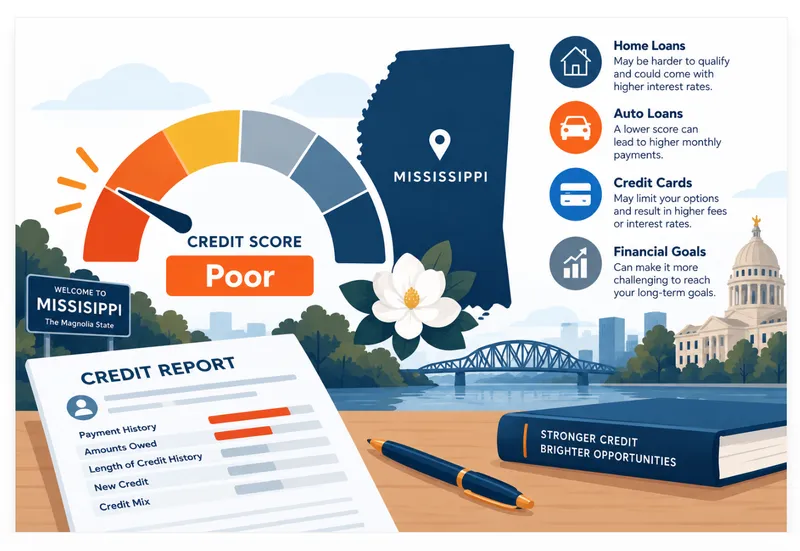
Poor Credit Score in Mississippi: Why It Matters
What causes a poor credit score in Mississippi comes down to four numbers: the lowest median household income of any state, a poverty rate near 18%, the highest debt delinquency rate in the country, and the largest share of unbanked households in America. Put together, they explain why Mississippi's average credit score of 669 ranks dead last among all 50 states, 33 points below the national average. This article walks through the real data behind that number, what it means for individual residents, and the specific moves that raise a score fastest when income is tight.
What Is the Average Credit Score in Mississippi?
Mississippi's average credit score is 669, the lowest of any U.S. state in 2026. That is 33 points below the national average of 702 and puts Mississippi just below Louisiana (673) and tied with Texas and Alabama near the bottom of the rankings.
A 669 score sits at the upper edge of the "fair" range. It is not a score that locks someone out of credit entirely, but it usually means higher interest rates, larger security deposits, and denials on the best rewards cards and mortgage terms. Compare that to Minnesota, the top-ranked state, where the average resident scores 723, deep into "good" credit territory.
Want to Know What Is Actually on Your Mississippi Credit File?
A collections account, a reporting error, or high utilization could be costing you more points than you realize. A free 3-bureau audit shows exactly what Equifax, Experian, and TransUnion currently report before you make any financial decision.
Claim My Free Credit Analysis Now → Secure · 2 minutes · No credit card requiredWhat Actually Causes Mississippi's Poor Credit Scores?
Four economic conditions drive Mississippi's low average score: the nation's highest debt delinquency rate (13.8%), the lowest median household income of any state ($56,447), a poverty rate of 17.8%, and the highest share of unbanked households in the country.
None of these show up as a line item on a credit report. They work indirectly, by making it harder to pay bills on time and keep balances low, the two factors that decide 65% of a credit score. A state does not have a credit score of its own. It has millions of individual residents, and Mississippi's economic conditions make it statistically harder for a large share of them to hit those two factors consistently.
| Economic Factor | Mississippi | Risk to Credit Score |
|---|---|---|
| Debt delinquency rate | 13.8% (highest in U.S.) | Severe |
| Median household income | $56,447 (lowest in U.S.) | High |
| Poverty rate | 17.8% | High |
| Unbanked households | Highest share in U.S. | High |
| Average credit card debt | $6,146 per cardholder | Moderate |
Higher median income means a surprise $600 expense is more likely to get paid before it becomes a missed payment or a new collections account.
Lower income and thinner savings mean the same $600 expense is more likely to go unpaid or get charged to an already-high balance.
Why Do Medical Bills Hit Mississippi Credit Scores So Hard?
Mississippi has not expanded Medicaid eligibility and carries one of the nation's highest uninsured rates, which pushes more medical costs directly onto patients. Unpaid medical bills often become collections accounts, and a single collection can drop a score 50 to 100 points.
Medical debt behaves differently than a credit card balance. A card balance builds slowly, over months of spending decisions. A medical bill can show up all at once, often for an emergency nobody planned or budgeted for, as covered in more depth in what to do if medical bills go to collections.
How Does Mississippi Compare to Its Own Cities?
Jackson, Mississippi's capital and largest city, posts an average credit score of 591, well below the already-low state average of 669. Gulfport, on the Gulf Coast, averages 602, also below the state figure.
State averages can hide a lot. Mississippi's own two largest cities score even lower than the state as a whole, which suggests the pressure is heaviest in urban areas with concentrated poverty, not spread evenly across the state.
| Location | Average Credit Score | vs. Mississippi State Average |
|---|---|---|
| Jackson, MS | 591 | 78 points below |
| Gulfport, MS | 602 | 67 points below |
| Mississippi (state average) | 669 | — |
| National average | 702 | 33 points above state |
Mississippi's low average score is not one bad habit repeated statewide. It is the compound effect of lower income, higher poverty, the nation's highest delinquency rate, and a heavy reliance on unbanked financial tools, with the impact concentrated most heavily in cities like Jackson and Gulfport.
How Can Mississippi Residents Raise a Poor Credit Score?
Pull a full credit report, dispute inaccurate or unverifiable accounts under the Fair Credit Reporting Act, open a secured credit card to build positive history, and challenge medical collections directly since many now qualify for automatic removal.
- ✓ Pull your full credit report and flag every collections account, especially medical ones
- ✓ Dispute any account that is inaccurate, outdated, or unverifiable under the Fair Credit Reporting Act
- ✓ Ask whether medical collections under $500 or already paid qualify for removal under current CFPB rules
- ✓ Open a secured credit card if a thin or damaged file is blocking approvals, and keep utilization under 10%
- ✓ Use a traditional bank or credit union account instead of prepaid cards where possible, since payment history on prepaid products is not reported to any bureau
- ✓ Work with a credit repair company if collections accounts are stalling and disputes are not resolving on their own
A low income does not automatically mean a low score, and a below-average state score does not decide any one person's outcome. What actually helps is knowing exactly which accounts are dragging the score down and fixing what is fixable first.
What is the average credit score in Mississippi?
The average credit score in Mississippi is 669, the lowest of any U.S. state, according to WalletHub's 2026 state rankings based on TransUnion data. That is 33 points below the national average of 702 and 54 points below the top-ranked state, Minnesota, at 723.
Why is Mississippi's credit score the lowest in the U.S.?
Mississippi's score is lowest mainly because of the nation's highest debt delinquency rate, a poverty rate nearly 50% above the national average, the lowest median household income of any state, and the highest share of unbanked households in the country.
Does poverty affect credit scores?
Yes, indirectly. A credit score does not measure income or wealth directly, but poverty makes it harder to pay bills on time and keep credit card balances low, which are the two largest factors in a credit score. Mississippi's poverty rate of 17.8% is one of the highest in the nation.
Why do medical bills hurt Mississippi credit scores more than other states?
Mississippi has not expanded Medicaid eligibility and has one of the highest uninsured rates in the country, which pushes more medical costs onto patients directly. Unpaid medical bills often end up in collections, and a single collection account can lower a score by 50 to 100 points.
How can Mississippi residents improve a poor credit score?
Pull a full credit report, dispute any inaccurate or unverifiable accounts under the Fair Credit Reporting Act, open a secured credit card to build positive payment history, and negotiate or dispute medical collections directly since many qualify for removal under current CFPB rules.
See Exactly What's Holding Your Score Back
Mississippi's average score is low, but individual scores are not fixed. A free 3-bureau audit shows exactly what Equifax, Experian, and TransUnion report on your file right now, and what can realistically be disputed or removed.
Claim My Free Credit Analysis Now → Secure · 2 minutes · No credit card required-
How Medical Debt Can Impact Your Credit Score Breaks down exactly how a medical bill turns into a credit-damaging collection account, and how much it costs.
-
What Is a Secured Credit Card? Full Guide to Rebuilding Credit Covers how a secured card works and how fast it can rebuild a thin or damaged credit file.
-
505 Credit Score: What It Means and Tips to Boost It A practical breakdown for residents starting from a low score, with a step-by-step path back to "fair" and "good."
-
What to Do If Medical Bills Go to Collections Walks through the exact steps to verify, dispute, or negotiate a medical collection before it does lasting damage.
-
WalletHub: States With the Highest & Lowest Credit Scores (2026) The state-by-state credit score data referenced throughout this article, including Mississippi's full ranking.
-
USAFacts: What Is the Poverty Rate in Mississippi? Government-sourced poverty rate data for Mississippi, based on U.S. Census Bureau figures.
-
Consumer Financial Protection Bureau: Debt Collection Tools Official CFPB resources on debt validation, consumer rights, and how to handle a collections account.