

In Los Angeles, a credit score can start slipping before a household looks financially distressed. A rent increase, an unexpected car repair, or one month of heavier credit card use may be enough to change what appears on a credit report.
The pressure is measurable. In 2024, 57% of Los Angeles County renters were rent-burdened, meaning more than 30% of their income went toward rent. Among renters earning under $50,000, that figure reached 92%. For households already operating with little room between housing costs and other bills, an unexpected expense can quickly turn into a higher card balance or a missed payment.
Car dependency adds another layer. A USC LABarometer survey found 45% of L.A. County residents relied solely on a car for transportation, up from 33% in 2019. That makes an auto payment, insurance, fuel, and repairs difficult expenses to avoid.
“What I see with Los Angeles consumers is rarely one huge financial mistake,” says Joe Mahlow, owner of ASAP Credit Repair USA. “It is usually several normal expenses hitting the same paycheck. Rent goes up, the car needs work, a credit card absorbs the difference, and suddenly the credit report looks very different.”
That is why the top reasons credit scores drop in Los Angeles make more sense when you look beyond the score itself. Housing costs, auto debt, credit utilization, student loans, payment history, and reporting errors can overlap, and each leaves a different trail on a credit report.
Top Reasons Credit Scores Drop in Los Angeles
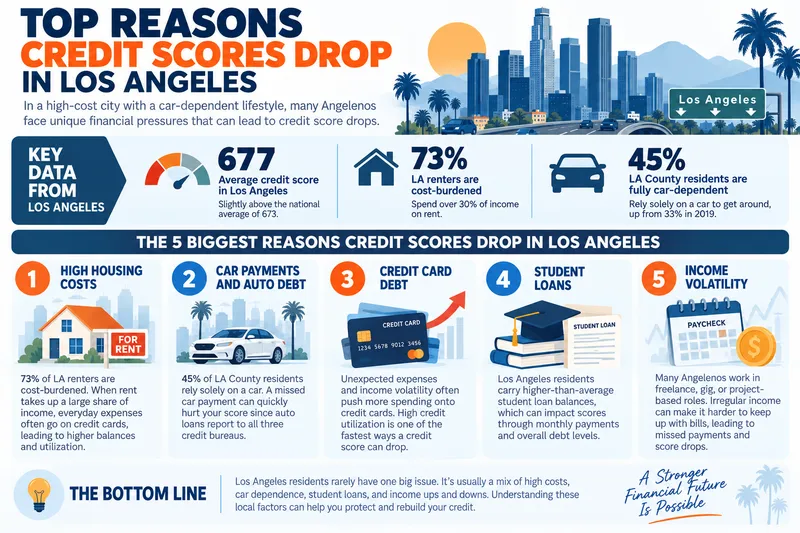
Credit scores in Los Angeles do not usually drop because people are careless with money. They drop because of how life in LA actually works, high rent competing with everything else in a budget, a car payment that is closer to mandatory than optional, and income that does not always arrive on a predictable schedule. This article walks through the top reasons credit scores fall in Los Angeles, how the city's cost of living and car culture feed into those drops, and what the local data actually shows.
What Are the Top Reasons Credit Scores Drop in Los Angeles?
The top reasons credit scores drop in Los Angeles include high rent and mortgage costs pushing everyday spending onto credit cards, heavy reliance on auto loans in a car-dependent city, above-average student loan balances, and income volatility common in freelance and project-based work. Los Angeles carries the fifth-highest average mortgage debt among major U.S. cities.
Los Angeles residents are not carrying unusually bad credit on paper. The city's average VantageScore actually sits slightly above the national average. What drives individual score drops is a specific mix of cost pressures that show up again and again in local credit data.
| Debt Category | Los Angeles Average | National Average |
|---|---|---|
| Mortgage debt | $544,641 | $235,194 |
| Student loan debt | $35,038 | $32,004 |
| Credit card debt | $6,837 | $6,469 |
| Auto loan debt | $24,104 | $24,042 |
| Overall average debt | $62,323 | — |
How Does the Cost of Living in Los Angeles Affect Credit Scores?
A USC Price Sol Center study found 73 percent of surveyed Los Angeles renters were cost-burdened, spending over 30 percent of income on rent, and 48 percent were severely cost-burdened. Cost-burdened renters were far more likely to cut back on other bills, which shows up on a credit report as missed payments and climbing balances.
That last figure matters most for a credit score. When a household cannot absorb a $400 emergency without borrowing, a car repair or a medical bill turns into a credit card balance almost automatically. Utilization climbs, and utilization is one of the fastest-moving factors in a score, sometimes dropping a score by 100 points or more after a sudden spike, as covered in why a credit score drops for no obvious reason.
Why Does Los Angeles' Car Culture Hurt Some Residents' Credit?
45 percent of Los Angeles County residents now rely solely on a car to get around, up from 33 percent in 2019, according to USC's LABarometer survey. That dependency makes an auto loan close to mandatory for many residents, and a missed car payment can drag down a score fast since auto loans report to all three credit bureaus.
Los Angeles was built around driving, and that has not changed even as public transit ridership has grown again since its pandemic low. Only 23.8 percent of county residents used public transit at all in 2024, well below the 35.1 percent who did in 2019. For most residents, that leaves a car payment as one of the few truly non-optional monthly bills, alongside rent.
Paid on time each month, it builds positive payment history and helps diversify a credit mix.
One missed payment reports to all three bureaus and can be one of the more damaging marks on a file.
Why Are Student Loans a Bigger Factor for Some LA Residents?
Los Angeles residents carry an average student loan balance of $35,038, above the national average of $32,004, according to Credit Karma data. Combined with the resumption of federal loan delinquency reporting, student loans have become a common and often unexpected source of sudden score drops.
Los Angeles draws a large number of residents into creative, entertainment, and media-adjacent fields that often require specialized private schooling, which tends to carry a higher price tag than a typical public degree. That shows up in the city's above-average student loan balances, and it collides with a national issue that resumed in late 2024, when federal loan servicers started reporting missed payments again after a multi-year pause.
What Should Los Angeles Residents Do If Their Credit Score Drops?
- ✓ Pull a full report from all three bureaus to see exactly what changed before assuming the worst
- ✓ Check credit card utilization first, since a spike from 20 percent to 60 percent alone can cost 100 or more points
- ✓ Confirm any auto loan or student loan payment posted correctly, especially after a servicer change
- ✓ Dispute anything inaccurate or unverifiable instead of assuming a drop reflects reality
- ✓ Build a small emergency cushion where possible, since covering a $400 surprise expense without new debt is one of the strongest score protections available
- ✓ Consider authorized-user tradelines only for a thin file with limited history, not as a substitute for fixing negative items, as explained in how tradelines actually work
A dropped score in Los Angeles is rarely about a single bad decision. Rent, a car payment, and a student loan are all competing for the same paycheck, and the fastest fix is usually correcting what is wrong on the report, not overhauling spending habits overnight.
Los Angeles' citywide credit score average looks healthy, but the cost of living tells a more complicated story underneath it. High rent burden, near-mandatory car ownership, and above-average student loan balances are the three forces most likely to push an individual score down, and each one leaves a specific, checkable trail on a credit report.
What are the top reasons credit scores drop in Los Angeles?
The top reasons include high rent and mortgage burden pushing more spending onto credit cards, heavy reliance on auto loans in a car-dependent city, above-average student loan balances, and income volatility common in freelance and entertainment-adjacent work. Los Angeles carries the fifth-highest average mortgage debt among major U.S. cities.
Is the average credit score in Los Angeles good or bad?
Los Angeles residents actually average a VantageScore of 677, slightly above the national average of 673. The citywide average looks healthy, but it masks wide swings between residents carrying manageable debt and those facing rent burden, high auto costs, or income gaps common in gig and entertainment work.
How does Los Angeles' cost of living affect credit scores?
A USC Price Sol Center study found 73 percent of surveyed Los Angeles renters were cost-burdened, spending over 30 percent of income on rent, and 48 percent were severely cost-burdened. Cost-burdened renters were far more likely to fall behind on other bills, which shows up on a credit report as missed payments and rising utilization.
Why does Los Angeles' car culture hurt some residents' credit?
45 percent of Los Angeles County residents now rely solely on a car to get around, up from 33 percent in 2019, according to USC's LABarometer survey. That dependency means an auto loan is close to mandatory for many residents, and a missed car payment can drag down a score fast since auto loans report to all three credit bureaus.
What should Los Angeles residents do if their credit score drops?
Pull a full credit report from all three bureaus first to see exactly what changed, since a drop is often a reporting error or a single late payment rather than a sign of overall financial trouble. Dispute anything inaccurate, then address rising utilization or a missed payment directly with the creditor.
Find Out Exactly What Dropped Your Score
A free 3-bureau review shows exactly what Equifax, Experian, and TransUnion currently report, so you know whether a drop came from a reporting error, utilization, or a missed payment before you do anything else.
Claim My Free Credit Analysis Now → Secure · 2 minutes · No credit card required-
Why Did My Credit Score Drop? 15 Common Reasons & How to Fix Them A full breakdown of the most common causes behind a sudden credit score decline and how to address each one.
-
Why Your Credit Score Drops for No Reason (And What to Do) Explains how utilization spikes, late reporting, and account errors can cause a drop that looks unexplained at first.
-
Why My Credit Score Dropped Suddenly Because of Student Loan Covers the resumption of federal student loan delinquency reporting and how it triggered widespread sudden score drops.
-
What Are Tradelines in Credit Repair? Do They Work? Explains when authorized-user tradelines actually help a thin credit file and when they are the wrong fix.
-
Credit Karma: Los Angeles Debt Scorecard Local debt and credit score data for Los Angeles, including mortgage, auto loan, and student loan averages compared to national figures.
-
NLIHC: Housing Cost-Burdened Renters in Los Angeles Research on how rent burden forces Los Angeles renters to cut back on food, health care, and emergency savings.
-
USC Schaeffer: Car Dependence in Los Angeles USC's LABarometer survey findings on rising car dependency and declining public transit use across Los Angeles County.