

Seeing Portfolio Recovery Associates on your credit report usually means one thing:
Your score already took a hit.
Most people find out after getting denied for a loan, seeing a score drop, or checking their report before applying for a mortgage or apartment.
I’ve worked with a lot of people dealing with Portfolio Recovery Associates collections. One thing that surprises people is how often they do not fully understand where the debt came from, whether the balance is accurate, or whether the account is even legally collectible anymore.
That matters because debt buyers make mistakes more often than people realize.
Sometimes the account is outdated. Sometimes the balance is wrong. Sometimes the collector cannot fully validate the debt. And sometimes the account should not still be reporting the way it is.
The good news is that collections from Portfolio Recovery Associates can sometimes be disputed, negotiated, settled, or removed depending on the situation.
This guide breaks down:
who Portfolio Recovery Associates is
why they appear on credit reports
how disputes work
what validation rights you have
how removal strategies work
what hurts your score the most
when professional help makes sense
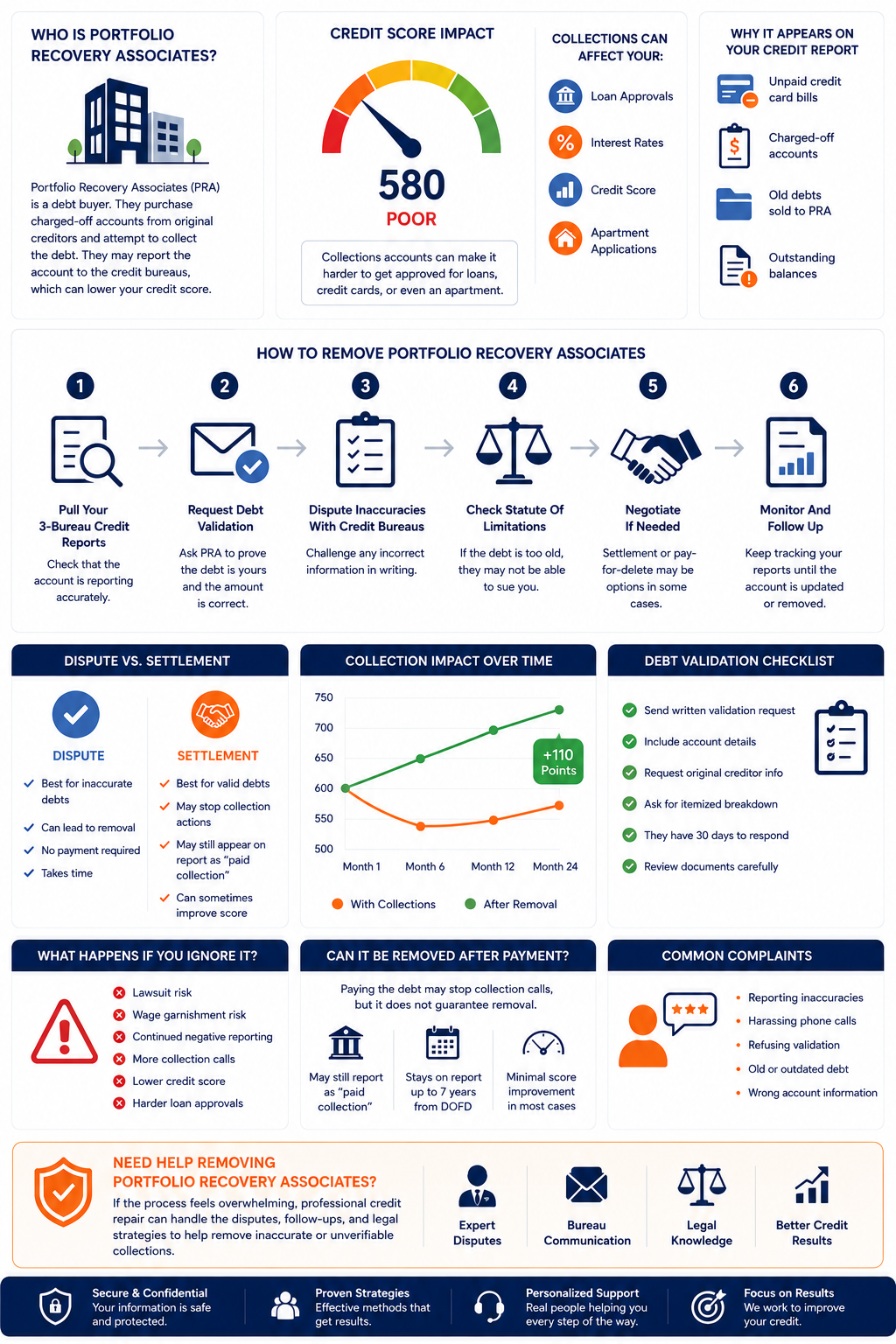
How to Remove Portfolio Recovery Associates From Your Credit Report
What Is Portfolio Recovery Associates
Portfolio Recovery Associates LLC is one of the largest debt buyers in the United States. It operates as a subsidiary of PRA Group (NASDAQ: PRAA), headquartered in Norfolk, Virginia. PRA purchases portfolios of charged-off consumer debt for pennies on the dollar and then attempts to collect the full balance. The CFPB has fined PRA more than $51 million across two major enforcement actions and placed the company under active monitoring. PRA remains one of the most-complained-about debt collectors in CFPB records.
The 2015 CFPB and FTC action resulted in a $27 million fine for FDCPA violations including collecting on unsubstantiated debt and misrepresenting debt validity. The 2023 CFPB action resulted in a $24 million fine specifically for violating the 2015 consent order , including collecting time-barred debt without disclosures, initiating lawsuits without required documentation, and failing to provide consumers with documents they requested. PRA remains under court-monitored compliance through 2025.
This history matters for one practical reason.
PRA's documented pattern of collecting on unverifiable debt, time-barred debt, and disputed debt means a validation request or dispute is not just a tactic , it is a legitimate challenge with real legal teeth. Federal regulators have confirmed PRA does exactly what consumers report.
Can Portfolio Recovery Associates Be Removed From Your Credit Report
Yes. There are three realistic removal paths. First: dispute if the debt is inaccurate, unverifiable, or not yours. Second: negotiate a pay-for-delete agreement before paying anything. Third: wait for the automatic 7-year removal from the original delinquency date. Most people have a viable dispute angle before considering payment , especially given PRA's documented inability to produce complete debt documentation.
Here is when each path applies.
| Removal Path | When It Applies | Timeline | Cost |
|---|---|---|---|
| Debt validation dispute | PRA cannot prove the debt with complete documentation | 30-45 days | $0 |
| FCRA dispute (inaccurate info) | Wrong balance, wrong date, re-aged entry, duplicate account | 30-45 days | $0 |
| Pay-for-delete | Debt is valid and you want to pay to remove the entry | 1-3 months | Settlement amount |
| FDCPA violation counterclaim | PRA violated your rights (threatened, lied, called improperly) | Variable | Can recover damages |
| Automatic aging off | 7 years from original delinquency date passed | Already happening | $0 |
How to Dispute Portfolio Recovery Associates
Start with a debt validation letter , not a call. Send it certified mail to PRA. If PRA cannot produce complete documentation, dispute the account with all three bureaus showing it. Bureaus have 30 days to investigate. If PRA cannot verify the information, the bureau must remove the account. This process costs nothing and works far more often than most people expect.
Go to AnnualCreditReport.com and request Equifax, Experian, and TransUnion. Find the PRA tradeline. Note the original delinquency date, the balance reported, and the account status. Check whether PRA appears as more than one entry , once from the original creditor and once from PRA. Duplicate entries are a common disputable error.
Free | Do this before any other stepIf the original delinquency is older than your state's SOL for credit card debt (typically 3-6 years), the debt is time-barred. PRA cannot win a lawsuit on it. You also gain FDCPA protection requiring them to disclose the time-barred status , a disclosure the CFPB fined PRA $24 million for omitting. Verify the SOL before any communication with PRA.
If time-barred: your position strengthens significantlyWithin 30 days of first contact, request full written verification. Ask for: the original creditor's name, original account number, a complete chain of assignment proving PRA owns the debt, itemized accounting of the balance, and documentation that the debt is within the statute of limitations. Send it certified mail with return receipt. Keep all receipts. PRA must stop collection activity until they respond with complete documentation.
Certified mail only | 30-day FDCPA window from first contactA printout of account history is not full documentation. PRA needs to produce a complete chain of assignment from the original creditor to themselves. Bulk purchase bills of sale that do not name your specific account number may be insufficient. Compare their response to what you requested line by line. Any gap is a disputable deficiency.
Incomplete documentation is grounds for bureau disputeFile a formal FCRA dispute with Equifax, Experian, and TransUnion. Include your documentation: the validation letter you sent, PRA's incomplete response, and any inaccuracies in the entry (wrong dates, wrong balance, re-aged delinquency date). Each bureau has 30 days to investigate. If PRA cannot verify the account information during that window, the entry must be removed or corrected.
Dispute all three bureaus separately | 30-day investigation window eachIf PRA continued collecting after your validation request, lied about the debt, failed to disclose time-barred status, or threatened legal action they could not take , those are FDCPA violations. File complaints at consumerfinance.gov and reportfraud.ftc.gov. Documented violations entitle you to sue PRA for up to $1,000 in statutory damages plus attorney fees. Given PRA's enforcement history, FDCPA attorneys regularly take PRA cases on contingency.
FDCPA claim window: 1 year from violation dateWhat Proof Must Portfolio Recovery Associates Provide
PRA buys debt in large portfolios. Original documentation frequently does not travel with the purchase.
When you request validation, PRA is supposed to provide:
- The name of the original creditor and original account number
- The amount owed with an itemized breakdown of principal, interest, and fees
- Complete chain of assignment from the original creditor to PRA , proving they legally own the debt
- Documentation that the balance is accurate and matches the original contract terms
- Disclosure that the debt is time-barred if the statute of limitations has passed
A printout of a final balance is not sufficient validation. A generic bill of sale that does not identify your specific account by number is not sufficient. A screen capture of internal account data is not the original contract.
As the CFPB's 2023 enforcement action confirms, PRA was fined specifically for "collecting on debt without offering to provide necessary documentation to consumers" and "misrepresenting that it would provide the offered documents within thirty days." These are real, documented patterns , not hypothetical risks.
Portfolio Recovery Associates , Settlement vs Dispute
Dispute when the debt is inaccurate, unverifiable, not yours, or past the statute of limitations. Settle when the debt is valid, within the SOL, and you want to resolve it and potentially remove the tradeline. PRA pays 2-4 cents per dollar for debt and routinely settles for 25-50% of the balance. Either way, get everything in writing before paying a cent.
- Debt is not yours (wrong account, identity theft)
- Balance is wrong or inflated
- PRA cannot produce complete ownership documentation
- Debt is past the statute of limitations in your state
- Entry contains re-aged dates or inaccurate information
- PRA violated your FDCPA rights
- Debt is verified and genuinely yours
- Within the statute of limitations
- You want the account resolved, not just disputed
- PRA is threatening or filing a lawsuit
- You can negotiate a pay-for-delete agreement in writing
- Budget allows partial payment (25-50% is often accepted)
PRA paid 2-4 cents on the dollar for your debt. A $2,000 balance cost them roughly $40-80. Settling for $600 still gives them a significant return. This math is why PRA accepts settlements well below face value and why consumers hold real negotiating power.
Does Portfolio Recovery Associates Violate the FDCPA
Frequently. And federal courts have ruled against them repeatedly.
The FDCPA prohibits debt collectors from misrepresenting debt validity, collecting amounts not authorized by the original agreement, failing to disclose time-barred debt status, and threatening legal action they do not intend to take. Federal courts found PRA guilty of each of these.
- 2023 CFPB action: Fined $24M for collecting time-barred debt without disclosures, initiating lawsuits without required documentation, and violating the 2015 consent order
- Lutz v. PRA (3rd Circuit, 2022): PRA collected illegal interest on Pennsylvania debt , violating FDCPA prohibitions on collecting amounts not authorized by law
- Paz v. PRA (7th Circuit, 2019): PRA failed to disclose a consumer's dispute when reporting to credit bureaus , FDCPA and FCRA violation
If PRA has contacted you and you believe they crossed a line, document every interaction with dates, times, and exact statements. FDCPA attorneys frequently take PRA cases on contingency. A successful claim against PRA entitles you to statutory damages up to $1,000, actual damages, and attorney fees. PRA's track record makes these cases attractive to consumer protection attorneys.
As NerdWallet's guide on time-barred debt warns, making even a partial payment on a disputed debt can reset the statute of limitations clock in some states. Act on the dispute process first. As the FTC's debt collection guide confirms, consumers have the right to sue for FDCPA violations within one year of the violation date. Given PRA's history, if they overstepped , document everything immediately.
How Portfolio Recovery Associates Affects Your Credit Score
A PRA collection account typically drops a credit score by 50-100 points. The damage is highest in the first 12-24 months. It decreases as the account ages.
PRA may also add their own tradeline to your report separate from the original creditor's charge-off entry. This can mean two negative entries from one debt. Both the original charge-off from the lender AND the PRA collection account appear simultaneously. Disputing the PRA tradeline separately from the original charge-off is appropriate.
Watch for re-aging. PRA sometimes reports collection accounts with a recent date rather than the original delinquency date. The 7-year reporting clock starts from the original delinquency , not from when PRA purchased the account. If PRA's entry shows a newer date than the original delinquency on your credit report, dispute it as re-aging under the FCRA. The CFPB has acted against PRA specifically for FCRA violations in credit reporting.
An accurate PRA collection on a file that is otherwise clean hurts less each year. A borrower with a 3-year-old PRA collection and 30 months of clean payment history since often scores 660-700 while actively rebuilding. The collection does not end the financial story , it delays part of it.
Can Portfolio Recovery Associates be removed from my credit report?
Yes. Three paths exist. If the debt is inaccurate, unverifiable, or not yours, dispute it with the credit bureaus. If PRA cannot verify the account information during the 30-day investigation, the entry must be removed. If the debt is valid, negotiate a pay-for-delete agreement before any payment. The entry also ages off automatically seven years from the original delinquency date. With nearly 30% of CFPB complaints against PRA alleging debt not actually owed, a validation request is always the right first step.
What happens if I ignore Portfolio Recovery Associates?
The collection entry stays on your credit report and suppresses your score. PRA may file a lawsuit if the debt is within the statute of limitations. If they get a default judgment , which happens when you do not respond to a court summons , they can pursue wage garnishment and bank account freezes. The collection also ages off after seven years, but that is a long time for the score damage to persist. Engaging the process early gives you more options, not fewer.
How much will Portfolio Recovery Associates settle for?
PRA typically settles for 25-50% of the stated balance, though this varies by account age, balance size, and how close the debt is to the statute of limitations. PRA paid 2-4 cents per dollar to acquire the debt, so even a 30% settlement produces profit for them. The older and closer to the SOL the debt is, the stronger your position to negotiate below 25%. Always negotiate in writing and never send payment without a written settlement agreement confirming the terms and any pay-for-delete agreement.
Can Portfolio Recovery Associates sue me?
Yes, if the debt is within your state's statute of limitations. PRA was specifically fined in 2023 for initiating lawsuits without required documentation and for suing to collect time-barred debt , so they do sue, and they sometimes sue improperly. If you receive a court summons from PRA or their law firm, always respond with a written answer before the deadline. A default from not responding gives PRA a judgment even on legally questionable debts. Assert the statute of limitations as a defense if applicable.
-
Debt Validation , When Collectors Must Prove You Owe The debt validation letter is the first move against any collection account , including Portfolio Recovery Associates. This covers exactly what collectors must provide when you request validation, what happens if they fail to deliver, and the specific FDCPA protections that pause collection activity while your request sits open. The most important step before any payment decision.
-
Statute of Limitations on Credit Card Debt , What Collectors Will Not Tell You PRA's $24 million CFPB fine in 2023 was specifically for collecting time-barred debt without required disclosures. This guide covers the statute of limitations by state for credit card debt, how to calculate whether your PRA account is past the legal window, and why this single check determines the entire strategy , dispute, settle, or ignore.
-
Will Responding to a Debt Collector Restart the Statute of Limitations? Making a small payment, acknowledging the debt verbally, or agreeing to a settlement can restart the SOL clock in some states , giving PRA a renewed window to sue. This covers what specific actions restart the clock, which states allow it, and why a validation letter is the only communication that protects your position without creating new legal exposure.