

What are the requirements to buy a house for the first time?
Most people think it starts with saving for a down payment. It actually starts with qualifying for financing.
Lenders want proof that you can handle a mortgage payment consistently, not just today, but for years. That means reviewing income, credit, debt, employment history, savings, and the overall strength of your financial file.
The good news is first-time buyers often qualify sooner than they think. Many assume they need perfect credit, 20 percent down, and a high income. Loan programs exist for buyers with smaller down payments, moderate credit scores, and limited buying history. The challenge is knowing which requirements matter most before you apply.
I have reviewed many files where buyers focused only on credit score while ignoring debt ratio, reserves, or reporting errors that lenders cared about more. Home approval is rarely about one number. It is about the full financial picture.
Across first-time buyer forums, one theme repeats often.
Buyers who prepare six to twelve months before applying usually qualify on stronger terms than buyers who rush into preapproval without cleaning up their file first.

What Do You Need to Buy a House for the First Time?
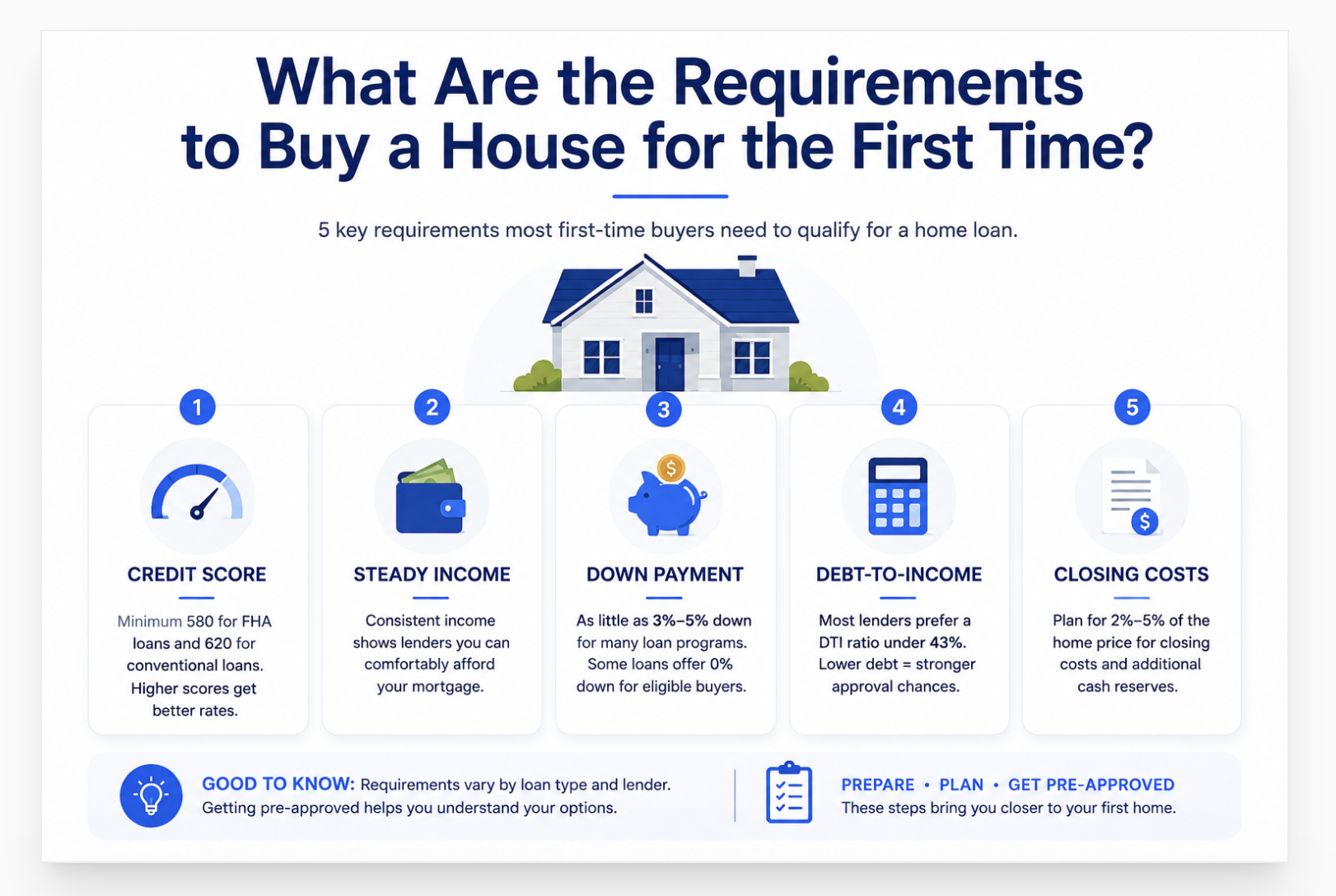
Most first-time buyers need five core things to qualify for a home loan:
1) Qualifying Credit Score
Typical ranges:
580+ for FHA
620+ for conventional
680+ stronger approval odds
740+ top tier mortgage pricing
Higher scores usually mean:
✅ lower interest rates
✅ lower monthly payments
✅ easier approval
✅ better lender options
2) Stable Income
Lenders want consistent earnings.
Commonly accepted:
salary / W2 income
commission income with consistency
retirement income
disability / qualifying benefits
What matters:
Can income reliably support the mortgage payment?
3) Manageable Debt
Lenders calculate debt to income ratio (DTI).
This includes:
car loans
credit card minimums
student loans
personal loans
child support / obligations
future mortgage payment
Most lenders prefer:
under 43% DTI
lower is stronger
4) Down Payment Funds
Many first-time buyers put down:
FHA
3.5%
Conventional
3% to 5%
VA / USDA
0% eligible borrowers
20% down
avoids PMI on conventional loans
5) Cash Reserves / Closing Costs
Buyers often forget this.
Need funds for:
appraisal
inspection
escrow setup
title fees
lender fees
moving costs
emergency reserve cushion
Forum buyers repeatedly say:
Closing costs surprised us more than down payment.
What You Do Not Need
Many buyers think they need:
❌ perfect credit
❌ 20 percent down
❌ huge salary
❌ zero debt
❌ years of homeownership history
Usually false.
You need:
a financeable profile lenders trust
That is different.
Credit Score Requirements for First Time Buyers
Let’s start with the number most people obsess over first: credit score.
And honestly, I get it. It feels like your score decides everything. But here is what lenders actually see. They do not look at your score and automatically say yes or no. They look at your score as a risk signal.
For most first time buyers:
- 580+ can open FHA financing
- 620+ is usually the floor for conventional loans
- 680+ starts putting you in stronger territory
- 740+ is where lenders often reserve their best pricing
That gap matters more than people realize. On a $400,000 mortgage, even a 1 percent rate difference can mean hundreds more per month and well over $100,000 in extra interest over the life of the loan.
That is real money.
The surprising part is this: buyers often think they have one score because a free app shows it, then learn their mortgage FICO score is lower when the lender pulls credit.
The takeaway is simple: Do not check what score you think you have. Check what score lenders actually use.
Know What Lenders See Before You Apply
A free 3-bureau credit review can help you spot errors, collections, high balances, and score issues before they hurt your mortgage approval.
Get My Free Credit ReviewIncome Requirements to Buy Your First House
Here is the truth most first time buyers do not hear enough: lenders care more about consistency than flashy income.
A person earning $65,000 steadily for three years often looks safer to underwriters than someone who made $120,000 last year but has inconsistent commission or self-employment income.
Mortgage lenders want proof that income is:
- Consistent
- Documentable
- Likely to continue
Most lenders ask for recent pay stubs, W2s or tax returns, bank statements, and employment verification. Income matters, but income compared to debt matters even more.
Big income does not automatically equal approval if your debt is already heavy.
Down Payment Requirements
This is where people panic. They think, “I need 20 percent down.”
Usually, no. That is one of the biggest myths in home buying.
FHA
3.5% down
Conventional
3% to 5% down
VA / USDA
0% down for eligible buyers
For a $400,000 home, 3.5 percent down is $14,000. Five percent down is $20,000. Twenty percent down is $80,000. Huge difference.
Many first time buyers find out the bigger surprise is not the down payment. It is everything around it.
Debt to Income Ratio Requirements
This is the silent killer of approvals.
Your debt to income ratio, or DTI, tells lenders how stretched you already are. It includes car payments, credit card minimums, student loans, personal loans, child support, and the projected mortgage payment.
Example:
Monthly gross income: $6,000
Monthly debt: $2,400
Debt to income ratio: 40%
That is getting tight. Why? Because if your budget is already stretched, one emergency can make mortgage payments harder.
Many buyers say the same thing after being denied: “I had the credit score, but my DTI killed the approval.”
Employment and Income Verification
This is not just paperwork. This is lenders asking: Can this borrower keep earning?
Typically, lenders want a two-year employment history, but that does not always mean the same employer. Career changes happen. Moving companies in the same field often counts. Graduating into a stable profession can also count.
What creates concern is frequent job hopping, large income swings, recent self-employment with limited history, or undocumented cash income.
The cleaner your income story, the smoother underwriting becomes.
Cash Needed for Closing Costs
This is where buyers get blindsided. Everyone saves for the down payment. Then closing costs hit.
Typical closing costs often run 2 percent to 5 percent of the purchase price. On a $400,000 house, that is roughly $8,000 to $20,000.
Closing costs may include:
- Appraisal
- Title insurance
- Escrow funding
- Lender fees
- Recording fees
- Prepaid property taxes
- Homeowners insurance setup
That is why the best move is to budget beyond the down payment. You need room for closing costs, moving costs, and emergency cash after closing.
Buying Soon? Check Your Credit First
Before a lender pulls your report, find out what may be lowering your approval odds.
Start My Free 3-Bureau ReviewWhat Lenders Actually Look At
Here is what lenders really evaluate:
Do you pay bills on time?
Can your income support the payment?
Do you have reserves?
Is the home worth the loan risk?
How risky does your full report look?
Notice something? It is not just score. It is the whole file.
That is why someone with a 640 can get approved while someone with a 700 can get denied. The stronger story wins.
Common First Time Buyer Mistakes
The biggest mistakes are usually avoidable.
- Opening new credit before applying: Furniture financing can damage approval odds.
- Maxing out cards: High utilization can crush mortgage scores.
- Changing jobs suddenly: This creates underwriting questions.
- Spending savings: Lower reserves can weaken the file.
- Ignoring collections: Negative reporting stays visible to lenders.
One mistake can cost months of delay. Sometimes years.
How to Prepare Before Applying
If you are preparing to buy in the next 6 to 12 months, here is the cleanest plan:
- Pull all three credit reports.
- Lower card balances below 30 percent utilization.
- Avoid new debt.
- Build emergency savings.
- Keep income stable.
- Fix reporting errors early.
- Get preapproved before shopping homes.
The strongest first time buyers do one thing differently: they prepare before they apply, not after they get denied.
That is what changes outcomes.