
Santander auto loan repossession can seriously damage your credit score, especially when missed payments, repossession records, and unpaid loan balances appear on your credit report. According to FICO, payment history accounts for 35% of your credit score, making loan defaults one of the most damaging credit events. When Santander Consumer USA repossesses a vehicle, the borrower may still owe money after the vehicle is sold. For example, if you owe $14,000 and the vehicle sells for $8,000, you could face a $6,000 deficiency balance before applicable fees and adjustments. That remaining debt may also appear as a collection account, creating additional credit problems. Most repossession-related negative information can remain on your credit report for approximately seven years, making accurate reporting essential.
At ASAP Credit Repair USA, our nearly 20 years of experience helping consumers address credit reporting problems highlight the importance of reviewing repossession records for errors. Incorrect delinquency dates, outdated loan balances, and inaccurate collection information can create problems long after a vehicle is repossessed. Under the Fair Credit Reporting Act (FCRA), consumers have the right to dispute inaccurate or incomplete information reported to Equifax, Experian, and TransUnion. This guide explains how Santander auto loan repossession affects your credit score, what happens to the remaining loan balance, and how long negative information stays on your credit report. You will also learn how to identify reporting errors, dispute incorrect repossession records, and take practical steps toward rebuilding your credit.
What Does a Santander Auto Loan Repossession Do to Your Credit Score?
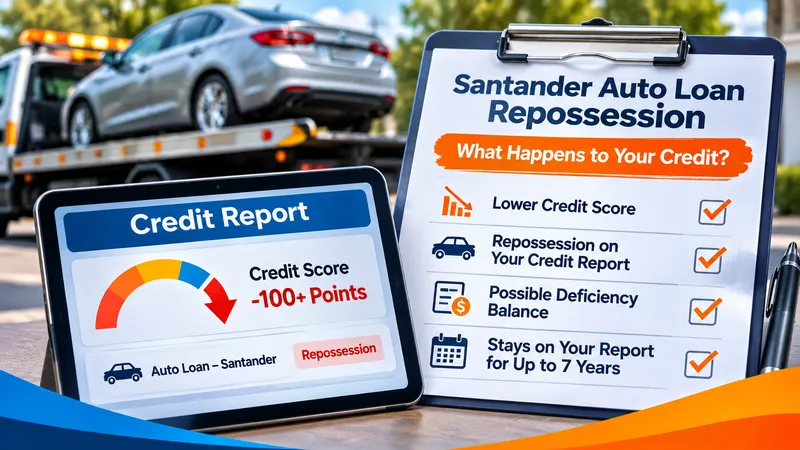
A Santander repossession typically drops a credit score between 100 and 150 points. The damage does not come from one entry it stacks across several. Each missed payment before repossession is a separate derogatory mark. The repossession notation itself is a major derogatory item. If Santander sends the remaining deficiency balance to a collection agency, that collection appears as a third entry. All three layers stack on the same credit file.
The score impact of a Santander repossession is severe because of how FICO and VantageScore weight different account events. Payment history carries the highest scoring weight 35% of FICO 8. Every 30-day, 60-day, and 90-day late notation on the account contributes independently to that damage before the repossession notation ever appears. By the time the vehicle is taken, most borrowers have already absorbed multiple late payment hits.
The repossession status itself reported as "repossession" or "involuntary repossession" in the account status field is a major derogatory entry equivalent in severity to a charge-off. If the borrower was current on payments and Santander repossessed for another reason (such as a lapse in required insurance), the late payment history may be shorter or absent, but the repossession notation still carries full derogatory weight.
| Entry Type | When It Appears | Scoring Impact | 7-Year Clock Starts |
|---|---|---|---|
| 30-day late payment | After first missed payment | Moderate — first late is the most damaging | Date of that missed payment |
| 60-day late payment | Second missed payment | Incremental damage on top of 30-day | Date of that missed payment |
| 90+ day late payment(s) | Each additional missed payment | Progressively heavier | Date of each missed payment |
| Repossession notation | After vehicle is taken | Major derogatory 100 to 150 pt drop from baseline | Date of first delinquency on the loan |
| Deficiency balance collection | After auction, if balance unpaid | Second major derogatory on the same debt | Must match original first delinquency date |
The score recovery timeline after a Santander repossession depends on what else is on the credit file. For a borrower with no other negatives, scores can recover into the mid-600s within two to three years if new positive accounts are added. For a borrower whose file also carries the deficiency collection, recovery is slower because two separate major derogatory entries are suppressing the score simultaneously.
How Does Santander Report a Repossession on Your Credit File?
Santander reports the auto loan account to all three bureaus Experian, TransUnion, and Equifax with an account status of "repossession" or "involuntary repossession." The entry includes the original loan amount, the date of first delinquency, the payment history showing each missed payment, and the balance remaining at repossession. Common reporting errors include an incorrect first delinquency date, a balance that does not reflect the auction sale proceeds, and the account appearing as both "repossession" and "charge-off" simultaneously.
The repossession entry uses Metro 2 format the standard data format all major furnishers use to send information to the credit bureaus. Within that format, Santander reports a specific Account Status code (97 for repossession), a Date of First Delinquency, the original loan amount, and the current balance. Each of those fields is a potential source of error.
The Date of First Delinquency
This is the most consequential field on the repossession entry. It controls when the account must come off the credit report. The legal deadline under FCRA Section 605 is seven years from the date of first delinquency. Santander is required to report the date of the first missed payment that led to the repossession — not the date the vehicle was taken, not the auction date, and not any date that appears later.
When Santander reports a first delinquency date that is later than the actual first missed payment, the seven-year clock runs longer than it legally should. That is re-aging an FCRA violation. It is one of the most common disputable errors we find in Santander repossession files.
The Balance After Repossession
After Santander takes the vehicle, it sells it at auction. The auction proceeds are applied to the remaining loan balance. If the entry continues to show the full pre-repossession balance without reflecting the auction sale, the balance is inaccurate. The reported balance should reflect either zero (if the auction proceeds covered the remaining loan amount) or the remaining deficiency (if they did not).
Some Santander accounts appear on credit reports as both "repossession" and "charge-off" two separate derogatory designations on the same account. They are not the same event. A repossession is the physical recovery of the vehicle. A charge-off is an accounting action Santander takes when it writes off the remaining loan balance as a loss. An account that is repossessed may also be charged off, but showing both designations simultaneously can be a reporting error that inflates the apparent severity of the entry. If the same Santander account appears with both notations in a way that looks like two separate derogatory events, that is worth disputing.
What Is a Deficiency Balance After Santander Repossession, and Does It Appear on Your Credit Report?
After Santander auctions the repossessed vehicle, the auction proceeds are applied to the remaining loan balance. If the auction price falls short of the balance owed, the difference is the deficiency balance. Santander sends a deficiency notice as required under state law. If the borrower does not pay, Santander typically sells the debt to a collection agency, which then reports a separate collection account. That collection entry must carry the original first delinquency date from the auto loan not the date the collection agency purchased the debt.
The deficiency balance is where many borrowers first realize the repossession is not over when the vehicle is gone. A vehicle worth $8,000 at auction against a $14,000 remaining loan balance leaves a $6,000 deficiency. That $6,000 becomes a separate debt that Santander can pursue directly or sell to a third-party collector.
How the Deficiency Collection Affects Your Credit Report
When a collection agency buys the Santander deficiency balance and reports it to the bureaus, a new collection entry appears on the credit report. This creates two major derogatory entries on the same underlying debt: the original Santander repossession account and the collection account for the deficiency balance. FICO 8 and VantageScore 3.0 both penalize collection accounts regardless of balance, so even a small deficiency collection suppresses the score.
The Re-Aging Problem on Deficiency Collections
Collection agencies that purchase Santander deficiency balances sometimes report the account with the date they purchased the debt as the first delinquency date — not the date of the original missed payment on the auto loan. This extends the collection account's appearance on the credit report beyond the legal seven-year window. Under FCRA Section 623 and the Fair Debt Collection Practices Act, the collection entry must reflect the original date of first delinquency on the Santander loan — the same date that governs the repossession entry itself.
See Exactly What Santander Is Reporting on Your File, Including the Deficiency Collection
A free 3-bureau audit pulls your current reports from Experian, TransUnion, and Equifax so you can see every Santander entry, every late payment notation, and any collection account tied to the deficiency balance and identify which entries contain correctable errors.
Claim My Free Credit Analysis Now → Secure · 2 minutes · No credit card requiredHow Long Does a Santander Repossession Stay on Your Credit Report?
A Santander repossession stays on your credit report for seven years from the date of first delinquency on the original auto loan the first missed payment that led to the repossession. It does not restart when the vehicle is taken, when the auction occurs, or when a collection agency purchases the deficiency. If Santander or a collection agency reports a first delinquency date later than the actual date of first missed payment, the seven-year clock runs longer than it legally should. That is re-aging an FCRA violation, and it is disputable.
FCRA Section 605(a)(4) sets the seven-year removal deadline for most negative information, anchored to the date of first delinquency on the account. That anchor date is what every downstream entry, including the collection for the deficiency, must use. Santander is legally required to report that date accurately and to send it to any collection agency that purchases the deficiency balance.
When to Expect the Repossession to Fall Off
If your first missed Santander payment was in January 2021, all entries connected to that loan the late payment notations, the repossession status, and any deficiency collection must come off your credit reports by January 2028. If the repossession entry is still showing after the seven-year deadline, file a dispute with each bureau citing the original first delinquency date and FCRA Section 605(a)(4). Entries that remain beyond the legal window are deleted without any requirement that Santander verify them.
What "Active" vs. "Inactive" Looks Like After Repossession
After repossession, the Santander account status shows as repossession or involuntary repossession. The balance field may continue to show the deficiency amount until it is sold to a collector or settled. The payment history section of the account preserves the full record of missed payments those are part of the same entry and fall off at the same time as the repossession notation. No portion of the repossession entry has a different or longer reporting period under federal law.
How Do You Dispute Inaccurate Santander Repossession Reporting?
Pull all three credit reports and document the first delinquency date, balance shown, and account status on each. Gather your loan documents and payment history from Santander's online portal or by written request. File a dispute directly with Santander Consumer USA in writing under FCRA Section 623, citing the specific inaccuracy. File simultaneously with each bureau where the error appears under FCRA Section 611. If a deficiency collection shows the wrong first delinquency date, dispute that entry with the collection agency and the bureau using the original loan's first delinquency date as the basis.
The dispute works because the specific inaccuracy you are challenging is factual and verifiable. You are not asking Santander to remove accurate information — you are pointing to a specific field (a date, a balance, a status code) and showing it does not match the underlying loan record. When the documentation is in hand before the dispute is filed, the investigation is straightforward.
- ✓ Pull all three credit reports and document every Santander entry. Go to AnnualCreditReport.com and pull Experian, TransUnion, and Equifax. For each Santander entry, record the date of first delinquency reported, the account status, the balance shown, and the payment history. Also check whether the same account appears more than once — either as two separate Santander entries or as a Santander entry and a separate entry from a transferred servicer.
- ✓ Obtain your Santander account history in writing. Log in to your Santander Consumer USA online account to download your payment history. If the account is closed and you cannot access it online, send a written request to Santander for your complete account history, including the date of the first missed payment. This document is the primary evidence for your dispute. The date on that record is what should appear on your credit report.
- ✓ Identify the specific error before filing. The most common disputable errors are: a first delinquency date reported later than your actual first missed payment (re-aging); a remaining balance that does not reflect the auction proceeds; the account appearing as both repossession and charge-off when only one designation applies; and a deficiency collection account showing a first delinquency date different from the original loan's first delinquency date.
- ✓ File a written dispute directly with Santander Consumer USA. Under FCRA Section 623, file your dispute in writing — not by phone. Address it to Santander's credit reporting dispute department and state the specific inaccuracy, the correct information, and the evidence you have. Keep the letter and send it by certified mail so you have a delivery record.
- ✓ File simultaneously with each bureau where the error appears. Dispute the entry with Experian, TransUnion, and Equifax at their online dispute portals or by certified mail. Include the same evidence you sent to Santander. Each bureau has 30 days under FCRA Section 611 to reinvestigate. An item that cannot be verified within that window must be deleted under Section 611(a)(5)(A).
- ✓ If a deficiency collection is showing the wrong date, dispute it separately. File a dispute with the collection agency under FCRA Section 623 and simultaneously with the bureau under Section 611. Cite the original Santander first delinquency date as the correct date that must govern the collection account's reporting window. Include your Santander payment history showing when the first missed payment occurred.
- ✗ Do not pay a deficiency collection without understanding how payment affects the reporting. Paying a collection does not remove it from your credit report — it only changes the status to "paid collection." A paid collection is still a derogatory mark. If the collection account has an incorrect first delinquency date that extends its reporting window illegally, paying it does not fix the date error. Resolve the reporting inaccuracy through the dispute process first. A consumer law attorney can advise on whether a pay-for-delete agreement is achievable in your specific situation.
- ✗ Do not assume the repossession entry will simply age off without checking the date. If Santander reported a first delinquency date that is later than your actual first missed payment, the entry will stay on your report longer than it legally should. Check the date on your credit report against your actual payment history. If there is a discrepancy, the entry needs to be corrected — it will not automatically fall off on the right date if the wrong date is in the system.
When you file a dispute with the bureau, the bureau contacts Santander and asks it to verify the specific information you disputed. If Santander cannot provide verification or if Santander has sold the account and no longer has the records, the bureau is required under FCRA Section 611(a)(5)(A) to delete the item. Santander's disposition of its subprime loan portfolios means that in some cases the furnisher no longer has the loan records needed to verify an entry. That inability to verify is not a stalemate — it is a deletion trigger.
Escalating When the Dispute Is Rejected
If Santander and the bureau reject the dispute and confirm the entry as accurate, you have several escalation options. File a complaint with the Consumer Financial Protection Bureau at consumerfinance.gov/complaint, attaching your payment history and the bureau's investigation result. Under FCRA Section 611(a)(7), request the method of verification from the bureau and a written description of exactly how the entry was confirmed and what source verified the specific field you disputed. If the inaccurate reporting caused financial harm, FCRA Sections 616 and 617 give you the right to sue Santander and the bureau in federal court for actual damages, statutory damages, and attorney's fees.
A Santander repossession creates multiple negative entries: the missed payments, the repossession notation, and potentially a deficiency collection. Each is disputable when the specific data is inaccurate. The most common and most correctable errors are re-aging (a first delinquency date that is later than the actual first missed payment) and a deficiency collection running on the wrong clock. Document the actual first missed payment date before filing anything; that date is the anchor for every entry connected to the Santander loan.
What does a Santander auto loan repossession do to your credit score?
A Santander repossession typically drops a credit score between 100 and 150 points. The damage stacks across several entries: each missed payment before repossession is a separate derogatory mark, the repossession notation is a major derogatory item, and if Santander sends the deficiency balance to a collection agency, that collection appears as a third entry. All three layers stack on the same credit file simultaneously.
How does Santander report a repossession on your credit file?
Santander reports the auto loan account to all three bureaus — Experian, TransUnion, and Equifax with an account status of "repossession" or "involuntary repossession." The entry includes the original loan amount, the date of first delinquency, the payment history showing each missed payment, and the balance remaining at repossession. Common reporting errors include an incorrect first delinquency date, a balance that does not reflect the auction sale proceeds, and the account appearing as both "repossession" and "charge-off" simultaneously.
What is a deficiency balance after Santander repossession, and does it appear on your credit report?
After Santander auctions the repossessed vehicle, the auction proceeds are applied to the remaining loan balance. If the auction price falls short of the balance owed, the difference is the deficiency balance. If the borrower does not pay, Santander typically sells the debt to a collection agency, which then reports a separate collection account. That collection entry must carry the original first delinquency date from the auto loan, not the date the collection agency purchased the debt.
How long does a Santander repossession stay on your credit report?
A Santander repossession stays on your credit report for seven years from the date of first delinquency on the original auto loan the first missed payment that led to the repossession. It does not restart when the vehicle is taken, when the auction occurs, or when a collection agency purchases the deficiency. If Santander or a collection agency reports a first delinquency date later than the actual date of first missed payment, the seven-year clock runs longer than it legally should. That is re-aging an FCRA violation — and it is disputable.
How do you dispute inaccurate Santander repossession reporting?
Pull all three credit reports and document the first delinquency date, balance shown, and account status on each. Obtain your Santander payment history showing the actual date of first missed payment. File a dispute directly with Santander Consumer USA in writing under FCRA Section 623, citing the specific inaccuracy. File simultaneously with each bureau under FCRA Section 611. If a deficiency collection shows the wrong first delinquency date, dispute it separately with the collection agency and the bureau using the original loan's first delinquency date.
Find Out Which Santander Entries on Your Report Are Disputable
A free 3-bureau audit reviews your Experian, TransUnion, and Equifax reports for re-aging, duplicate entries, incorrect balances, and status code errors on Santander accounts so you know exactly what is worth disputing before you start the process.
Claim My Free Credit Analysis Now → Secure · 2 minutes · No credit card required-
Canceled GAP Insurance but Auto Loan Balance Is Still Wrong? Here's Why Covers how GAP insurance cancellation refunds and total-loss payouts fail to reach the loan balance on your credit report and how to dispute the inaccurate balance under FCRA Section 623.
-
Car Lease Extended but Shows Past Due on Credit Report? What to Do Same category of lender reporting failure — an account status error that makes a performing or resolved account look delinquent. Covers lease extensions and holdover periods.
-
How to Dispute Credit Report Errors: A Step-by-Step Guide The complete FCRA dispute process: what to include, what the bureaus are required to do, and what happens when a dispute is rejected, or the error is not corrected.