
Student loan rehabilitation vs consolidation is a critical decision if your loans are already in default, and choosing the wrong option can cost you months of unnecessary damage to your credit.
Default doesn’t just mean missed payments. It can trigger wage garnishment, tax refund offsets, and a steep drop in your credit profile. The moment that happens, the priority shifts from repayment to damage control—and that’s where rehabilitation and consolidation come in.
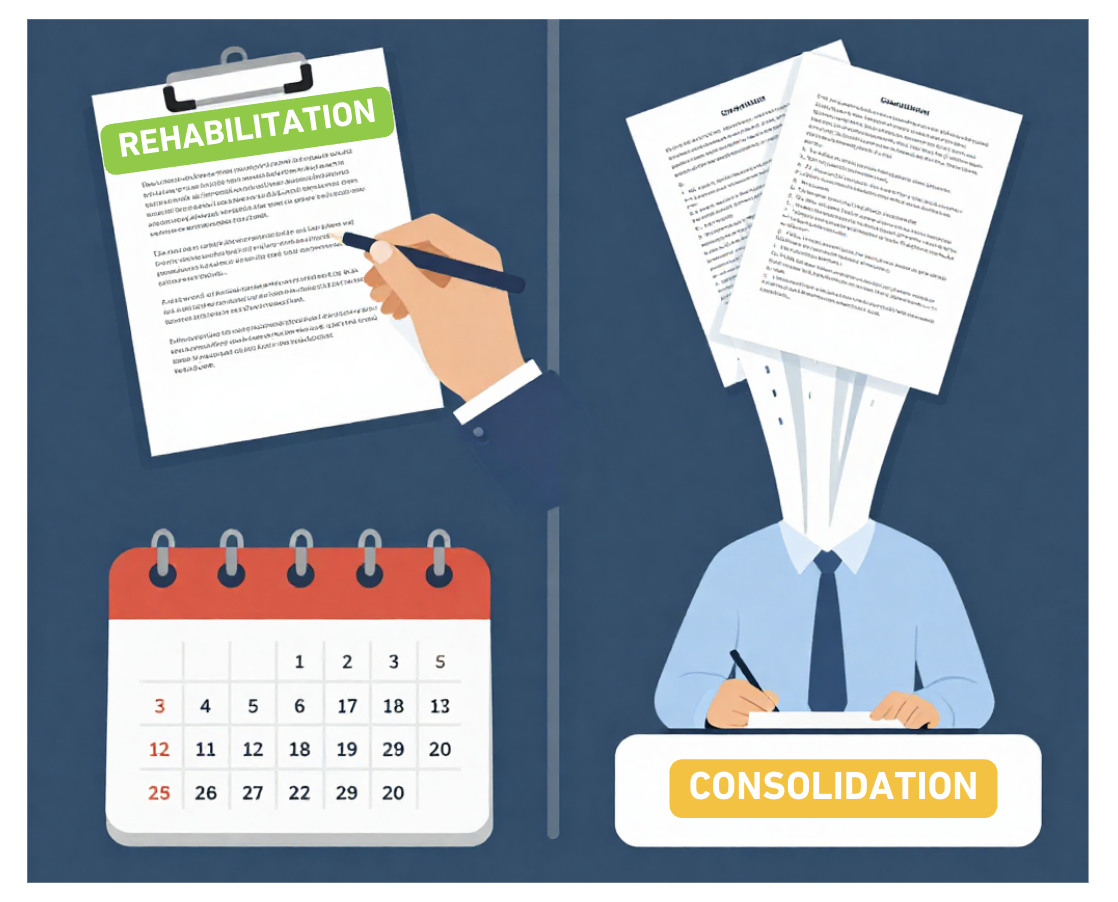
Both options are designed to get you out of default, but they work very differently. Rehabilitation focuses on rebuilding your payment history over time, while consolidation resets the loan entirely with a new repayment structure. More importantly, only one of these options can remove the default status from your credit report.
If your goal is to recover as quickly as possible, timing matters. Some borrowers can resolve default in as little as a few weeks, while others may be locked into a process that takes close to a year.
In this guide, we’ll break down student loan rehabilitation vs consolidation, how each option works, and which one removes default faster. So you can make the smartest move for your financial recovery.
Student Loan Default · Rehabilitation vs Consolidation · Remove Default Credit Report · Federal Student Loan Default Options
Two paths out of student loan default. One removes the default from your credit report. One does not. The faster one is not always the better one.
Updated March 2026 · Sources: U.S. Department of Education StudentAid.gov, One Big Beautiful Bill Act (Public Law 119-21, July 4 2025), CFPB, Credible, NOLO Legal Encyclopedia
There are currently more than 5 million federal student loan borrowers in default in the United States as of April 2025, according to the U.S. Department of Education. Millions more are delinquent. And as of May 5, 2025, the Department of Education resumed active collections on defaulted accounts after a multi-year pause, meaning wage garnishments, tax refund offsets, and Treasury offsets are back in effect.
Default is not a permanent state. Two federal programs exist specifically to remove loans from default without requiring full immediate repayment: rehabilitation and consolidation. Most borrowers in default have access to one or both options. The question is not whether these programs work. They do. The question is which one is right for your specific situation, because choosing the wrong one can cost you the only credit-repair opportunity you will ever get with this loan.
At ASAP Credit Repair USA, we work with clients who have student loan defaults sitting on their credit reports, sometimes for years, while they waited for information they never received. This guide gives you the complete decision framework so you choose the path that serves your actual financial goals.
The Core Difference: One Clears the Record, One Does Not
This single distinction drives every decision in this guide and it cannot be overstated.
Rehabilitation cures the default. When you complete rehabilitation, the default classification is removed from your Equifax, Experian, and TransUnion credit reports entirely. The loan returns to good standing as if the default never occurred from a credit reporting perspective. Late payment marks from before the default remain, but the default entry itself disappears.
Consolidation replaces the loan. The original defaulted loan is paid off and closed with a new Direct Consolidation Loan. The new loan is current. But the credit history of the original loan, including the default classification, remains on your report for seven years from the original delinquency date. The default is not removed. It is archived.
This means consolidation cannot fully repair the credit damage from default. It stops the forward damage. It does not undo what is already there. Every future lender, landlord, and employer who runs a credit check will still see that the loan defaulted before being resolved through consolidation. Rehabilitation is the only path that removes that record.
How Rehabilitation Works: The 9-Payment Rule Explained
Rehabilitation requires nine consecutive voluntary on-time monthly payments within ten consecutive months. Payments must arrive within 20 days of the due date. The payment amount is based on your income and household expenses, with the minimum at $5 per month under current rules. Payments made through wage garnishment do not count. After the ninth payment, the default is removed from your credit report and the loan returns to regular servicing.
Three facts about rehabilitation that most guides skip over:
Rehabilitation is a one-time opportunity per loan under current rules. If you default again after completing rehabilitation, you cannot rehabilitate the same loan a second time. You would have to use consolidation or full repayment to exit default, neither of which removes the new default from your credit report. This makes the choice to rehabilitate consequential: once it is done, it is done.
Missing a single payment voids the agreement. You do not get to miss one and pick up where you left off. A missed or late payment restarts the nine-payment requirement from zero. If your income situation is uncertain or your payments are unreliable, that instability creates real risk in the rehabilitation process.
Garnishment continues until payment five. If wage garnishment is already in progress when you begin rehabilitation, it continues until you make five qualifying voluntary payments and request it stop. The garnishment payments do not count toward your nine. This means during the first five months, some borrowers are effectively making both the garnishment amount and the rehabilitation payment amount simultaneously.
How Consolidation Works: Default Exit in Weeks, Not Months
Direct Consolidation replaces your defaulted loan by paying it off with a new loan called a Direct Consolidation Loan. The new loan is in good standing from day one. Default status on the original loan ends because the original loan no longer exists as an active account. It is closed, marked paid in full, and the new loan takes its place.
To qualify for consolidation on a defaulted loan, you must do one of two things: either agree that the new Direct Consolidation Loan will be repaid under an income-driven repayment plan, or make three consecutive voluntary on-time payments on the defaulted loan before consolidating. If you already have a wage garnishment order in place, that must be addressed before most consolidation applications will process.
Consolidation applications are processed at studentaid.gov and typically resolve in 30 to 90 days from application, with many borrowers seeing completion in four to six weeks. That is significantly faster than the minimum nine months rehabilitation requires.
One exception exists for FFEL (Federal Family Education Loan) borrowers. Consolidating FFEL loans into a Direct Consolidation Loan makes them eligible for PSLF and certain income-driven repayment plans that were not previously available on FFEL loans. For these borrowers, consolidation sometimes adds more value than it loses, even accounting for the reset of prior payment counts.
The Head-to-Head Comparison: Every Factor That Matters
Before You Choose Between Rehabilitation and Consolidation, Know Exactly What Is on Your Credit Report
The default entry on your report may contain FCRA errors including wrong delinquency dates that extend the seven-year window, incorrect balances, or reporting violations from the collection process. A free audit identifies these before you choose a resolution path, because errors can sometimes be disputed independently of whichever option you select.
Which Path Is Right for You: The Decision Framework
What Happens After Rehabilitation or Consolidation
Getting out of default is not the finish line. The choices you make immediately after determine whether the recovery lasts or leads to a second default.
Enroll in income-driven repayment immediately. As student loan expert Mark Kantrowitz notes in Credible's analysis, borrowers who rehabilitate and then do not enroll in income-driven repayment are at significantly higher risk of redefault. The standard repayment plan calculates payments based on your balance, not your income. If that payment was unaffordable before default, it will be unaffordable after. Income-Driven Repayment plans like SAVE, PAYE, or IBR calculate your payment as a percentage of your discretionary income, which can be as low as $0 per month for very low incomes.
Do not miss the first post-rehabilitation payment. Your loan returns to regular servicing after rehabilitation. The servicer sends payment instructions. The first payment due after rehabilitation must be on time. Missing it immediately after exiting default signals exactly the payment behavior pattern that makes redefault more likely.
Monitor your credit reports to confirm the default removal. After rehabilitation completion, pull all three reports at 30 days and again at 90 days. Confirm that the default entry has been removed. If it has not, file a dispute with the bureau citing the rehabilitation completion date and your servicer's confirmation letter. The servicer is legally required to instruct bureaus to remove the default upon completion.
The Mistakes That Extend Default and Damage Credit Longer Than Necessary
Getting Out of Default Is the First Step. Repairing What Default Did to Your Credit Report Is the Second.
Rehabilitation removes the default from your credit report automatically. But the late payment marks from before the default remain for seven years. The FCRA errors that sometimes appear in default entries, like incorrect delinquency dates or wrong balances, are disputable independently. Running a full credit audit alongside your rehabilitation or consolidation process compresses the timeline for full credit recovery.
Frequently Asked Questions
What is the difference between student loan rehabilitation and consolidation?
Rehabilitation removes the default record from your credit report after nine consecutive on-time monthly payments over ten months. Consolidation resolves default faster, in four to eight weeks, by replacing the defaulted loan with a new Direct Consolidation Loan, but the default remains on your credit history for seven years. Rehabilitation fixes the credit damage. Consolidation stops the collections more quickly.
How long does student loan rehabilitation take?
At least nine months. You make nine consecutive voluntary on-time monthly payments within ten consecutive months, each within 20 days of the due date. After the ninth confirmed payment, the servicer notifies the credit bureaus to remove the default. That removal typically appears on your reports 30 to 90 days after completion, putting total timeline at roughly 10 to 12 months from start to credit report update.
Does student loan consolidation remove default from credit report?
No. Consolidation closes the original defaulted loan as paid in full, but the default classification remains visible on your credit report for seven years from the original delinquency date. Only rehabilitation removes the default record. If credit repair is your primary goal, consolidation is the wrong choice.
Can I rehabilitate my student loan more than once?
Under current rules, no. Rehabilitation is a one-time opportunity per loan. If you complete rehabilitation and then default again on the same loan, you cannot rehabilitate it a second time. The One Big Beautiful Bill Act signed July 4, 2025, changes this starting July 1, 2027, allowing up to two rehabilitations for loans originated on or after that date. Loans taken before that date retain the one-time limit.
What happens to wage garnishment during rehabilitation?
Garnishment continues during the first five months of rehabilitation. After five qualifying voluntary payments, you can request that garnishment stop. Importantly, payments made through garnishment do not count toward your nine required rehabilitation payments. You must make nine separate voluntary payments on top of any garnishment that is occurring.
How much are rehabilitation payments?
Rehabilitation payments are calculated based on your income and household expenses. The current minimum is $5 per month. Most borrowers qualify for payments significantly below the standard repayment amount. If the payment you are initially quoted feels unaffordable, you have the explicit right to request a re-evaluation. Ask the loan holder to recalculate based on your documentation of income and necessary expenses.
Does consolidation affect Public Service Loan Forgiveness progress?
Yes, significantly. Consolidation resets your qualifying payment count to zero for the new Direct Consolidation Loan. If you have made 80 qualifying payments toward the 120 required for PSLF, consolidation erases that progress entirely. Rehabilitation preserves your payment count on the original loan. If you are working toward PSLF, rehabilitation is almost always the correct choice.
Related Reads and Sources
- How to Clean Your Credit Report — The complete step-by-step process for disputing student loan errors, late payment marks, and default entries including the bureau investigation timelines and what to do when a furnisher fails to correct verified errors.
- How to Remove Collections Without Paying — FCRA disputes, debt validation letters, statute of limitations defenses, and FDCPA violations as tools for removing negative credit entries, applicable to student loan collection accounts.
- How Debt Affects Your Credit Score — How collection accounts and default entries affect each component of your FICO score, which scoring models treat them differently, and the score recovery timeline after negative entries are removed.
- StudentAid.gov: Get Out of Default — Official Department of Education guidance on rehabilitation, consolidation, and full repayment options for federal student loans in default, including how to contact your loan holder and begin the process.
- NerdWallet: Student Loan Rehabilitation Guide — Independent breakdown of the nine-payment process, income-based payment calculations, and what borrowers should do immediately after completing rehabilitation to prevent redefault.
- Investopedia: Student Loan Rehabilitation vs. Consolidation — Financial analysis of the cost implications, credit score impacts, and long-term repayment consequences of each default resolution path.