
Tradeline credit repair starts with understanding what a tradeline actually is: an individual credit account that a creditor, collector, or other furnisher reports to a consumer credit bureau. A legitimate tradeline correction is not the same thing as purchasing an authorized-user account from a stranger.
Correcting a tradeline means fixing information that is wrong. Those are incorrect balance, a false late payment, a duplicate account, the wrong owner attached to a debt, or an incorrect delinquency date. Buying a tradeline means paying a third party for authorized-user status on an account the buyer never used, a different practice with its own risks, covered later in this guide.
Credit repair addresses information that is inaccurate, incomplete, or unverifiable under federal law. It does not erase accurate negative history simply because a consumer disputes it.
This guide covers how to identify a tradeline error, what evidence supports each dispute, the federal dispute process, and where authorized-user accounts and purchased tradelines fit in.
Tradeline Credit Repair: How It Works and What You Can Fix
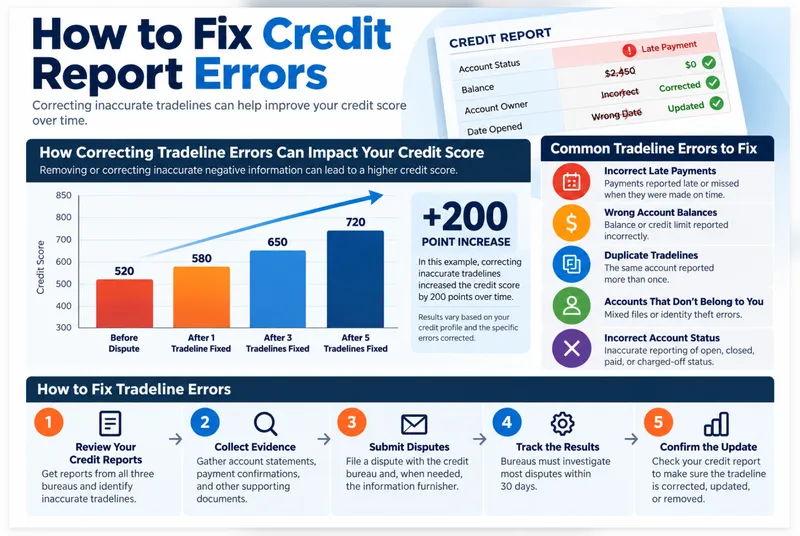
Tradeline credit repair means correcting inaccurate, incomplete, or unverifiable information on an existing account reported to Equifax, Experian, or TransUnion. It is a separate activity from building new credit history and from buying authorized-user tradelines from a third party. The image below shows how it works.
What Is Tradeline Credit Repair?
Tradeline credit repair is the process of disputing and correcting inaccurate information reported on a specific credit account. It is different from adding new tradelines to build credit history, which involves opening legitimate new accounts rather than fixing existing ones.
Repairing a tradeline means identifying a specific wrong field, such as a payment status or balance, and disputing it with the bureau or furnisher that reported it. Adding a tradeline means opening a new account, such as a secured credit card, and letting it report fresh, accurate history over time. Both affect a credit report, but they solve different problems.
A concrete example: a credit card issuer reports a payment as 60 days late for a month the cardholder actually paid on time, confirmed by a bank statement showing the payment cleared before the due date. That is a reporting error eligible for a dispute. A cardholder who simply wants a better credit mix, with no error on the account, needs a new account instead, not a dispute.
What Are Tradelines on Your Credit Report?
A tradeline is a single credit account entry on a credit report, submitted by the creditor, lender, or collection agency that owns or services the account. Equifax, Experian, and TransUnion each maintain separate files, so the same account sometimes appears differently across the three.
Not every creditor reports to all three bureaus, and some report to only one or two. A furnisher, the company supplying the account data, decides which bureaus receive its reporting, on what schedule, and in what format. That is why a consumer's Experian report sometimes shows an account that is missing entirely from the TransUnion file.
Types of Tradelines
- Revolving accounts. Credit cards and lines of credit with a credit limit and a balance that changes month to month.
- Installment accounts. Auto loans, personal loans, and mortgages with a fixed payment schedule and a set number of payments.
- Collection accounts. Unpaid debts transferred or sold to a collection agency, usually reported separately from the original creditor's tradeline.
- Authorized-user accounts. Accounts opened and owned by one person, with a second person added as an authorized user who did not open the account and generally does not owe the balance.
What Information Does a Tradeline Include?
A tradeline includes the furnisher's name, account type, ownership role, date opened, balance, credit limit, payment status, payment history, and closure status. Each field is a separate place where a reporting error turns up.
| Field | What It Shows | Example of an Inaccurate Entry |
|---|---|---|
| Creditor/Furnisher Name | Who reported the account | A debt reported under a collection agency the consumer never dealt with |
| Account Type | Revolving, installment, or collection | An installment loan coded as a revolving account, changing utilization math |
| Account Ownership | Individual, joint, or authorized user | An authorized user coded as jointly responsible for the balance |
| Date Opened | When the account began | A reopened or refinanced account showing an incorrect, much older open date |
| Current Balance | Amount owed as of the reporting date | A paid-off loan still showing a balance after payoff |
| Credit Limit / Original Amount | Ceiling for revolving accounts, original loan size for installment accounts | A missing or zero credit limit inflating reported utilization |
| Payment Status | Current, late, charged off, in collection | A current account coded as 30 or 60 days late |
| Payment History | Month-by-month record, usually 24 to 84 months | A single missed payment that actually posted on time due to a processing delay |
| Date of Last Payment | Most recent payment received, where reported | A date that does not match the consumer's own payment records |
| Date of First Delinquency | When the account first became delinquent, where applicable | A reinserted collection showing a new, later delinquency date |
| Account Closure Status | Open, closed by consumer, or closed by creditor | A voluntarily closed account coded as closed by the creditor |
| Remarks/Dispute Notation | Codes noting a prior dispute or special circumstance | A resolved dispute notation that was never removed after correction |
Find Out Which Tradeline Errors Are Hurting Your Credit
Review your credit reports with ASAP Credit Repair USA and identify inaccurate account information, unresolved disputes, and the next steps for correcting your file.
Get My Free Credit Evaluation → Secure · 2 minutes · No credit card requiredWhich Tradeline Errors Qualify for Credit Repair?
A tradeline error qualifies for credit repair when it is inaccurate, incomplete, or unverifiable, not simply unfavorable. Common qualifying errors include wrong late payments, incorrect balances, duplicate accounts, misattributed ownership, incorrect status, and wrong delinquency dates.
Incorrect Late Payments
Compare the billing statement and payment confirmation against the reporting date on the credit report. A payment posted before the due date but reported late due to a creditor processing delay is a documentable error.
Wrong Account Balances
A balance that looks temporarily out of date is not automatically an error, since reporting cycles update monthly. A balance that stays wrong across multiple cycles, especially after a payoff, is.
Duplicate Tradelines
The same obligation sometimes legitimately appears twice: once under the original creditor marked closed, and once under the collection agency now handling it. That pairing alone is not an error. It becomes one only when both entries report an active balance at once, overstating the debt.
Accounts That Do Not Belong to You
Mixed credit files and identity theft both produce accounts never opened by the person they are attached to. A mixed file happens when a bureau merges data from two people with similar names or Social Security numbers.
Incorrect Account Status
Paid, closed, charged-off, transferred, and collection are distinct statuses. A paid collection still showing as unpaid, or a transferred account still showing a balance with the original creditor, is a status error.
Wrong Delinquency Dates
Under 15 U.S.C. § 1681c, the seven-year reporting period for most negative items starts 180 days after the account first became delinquent, not from the later charge-off or collection date. A collection agency reporting a new, later delinquency date restarts a clock federal law does not allow it to restart.
Incorrect Authorized-User Responsibility
Individual accounts belong to one person, joint accounts create shared legal responsibility, and authorized-user accounts generally create no payment obligation at all. A report coding an authorized user as jointly responsible is an ownership-field error.
| Error Type | Supporting Evidence |
|---|---|
| Incorrect late payment | Billing statement, bank payment confirmation, processing date records |
| Wrong balance | Payoff letter, final statement, bank transaction history |
| Duplicate tradeline | Original creditor statement plus collection notice showing the same debt reported twice as active |
| Account not yours | Identity theft report, police report, affidavit of fraud, or proof of mismatched personal information |
| Incorrect status | Settlement letter, payoff confirmation, or account transfer notice from the creditor |
| Wrong delinquency date | Original account statements showing when the delinquency actually began |
| Wrong authorized-user coding | Original account agreement showing the authorized-user designation |
How to Dispute an Inaccurate Tradeline
Disputing a tradeline means identifying the exact wrong field, gathering supporting documents, and submitting a specific written dispute to the bureau or the furnisher. Federal law generally gives the bureau 30 days to investigate, with limited extensions.
- Obtain current reports from Equifax, Experian, and TransUnion through AnnualCreditReport.com, since the same account sometimes reports differently at each bureau.
- Identify the precise inaccurate field: balance, payment status, date, or ownership, rather than disputing the account in general terms.
- Collect supporting documentation, such as statements, payoff letters, or proof of identity theft, that speaks directly to that field.
- Submit a specific written dispute to the reporting bureau, naming the account, the field, and the correct information.
- Consider submitting a parallel dispute directly to the information furnisher, since furnishers have their own duty under 15 U.S.C. § 1681s-2 to investigate and correct inaccurate reporting.
- Review the investigation results and escalate unresolved or re-verified errors with additional evidence or a direct furnisher dispute.
Under 15 U.S.C. § 1681i(a)(1), a credit reporting agency generally must complete its reinvestigation within 30 days, extendable by 15 days if the consumer submits new information during that window. A furnisher receiving a direct dispute has its own 30-day duty under § 1681s-2. A dispute resolves one of several ways: verified as accurate, corrected, deleted because it cannot be verified, or, rarely, reinserted after the furnisher certifies it is accurate.
I am disputing the following item on my credit report: Account [creditor name], account number ending in [last 4 digits]. This account is being reported with a payment status of [reported status] for [month/year]. This is inaccurate. My records, including [supporting document], show the correct status was [correct status]. I am requesting that this item be corrected or removed.
How Do Tradelines Affect Your Credit Score?
Tradelines affect credit scores through payment history, amounts owed and utilization, account age, credit mix, and new credit activity. Not every tradeline contributes equally to every scoring model, and correcting an inaccurate tradeline is a different action from building a new one.
Payment history and utilization generally carry the heaviest weight across major scoring models, with account age, credit mix, and recent activity contributing smaller shares. These weights vary between models, and a tradeline's actual effect depends on the full file, not the tradeline alone.
Example A: A credit card reports an incorrect 60-day late payment. Once disputed and corrected, that negative mark is removed from the payment-history factor, which carries the most weight in most models.
Example B: A borrower with a thin file opens a legitimate secured card and uses it responsibly for a year, building new payment history and account age, a slower process than correcting an error but one that adds information the file never had.
Correcting inaccurate history removes something that should never have been there. Building new history adds something accurate that was not there before.
Do Authorized-User Tradelines Help With Credit Repair?
Authorized-user status is a credit-building tool, not a credit-repair dispute. It adds an existing account's history to a new user's file, while a dispute corrects inaccurate information already on a report. The two address different problems.
Being added as an authorized user on a well-managed account sometimes adds positive history and account age to a thin file, per myFICO's scoring education, which notes length of credit history is a meaningful share of a FICO Score. How much it matters depends on issuer reporting practices, the scoring model, and the authorized user's own existing file. It does not promise a specific number of points.
Primary Tradelines vs. Authorized-User Tradelines
| Factor | Primary Account Holder | Authorized User |
|---|---|---|
| Ownership | Opens and owns the account | Added to an account they did not open |
| Legal Payment Responsibility | Legally responsible for the balance | Generally not legally responsible for the balance |
| Reporting | Reported to bureaus the issuer uses | Reported only if the issuer reports authorized-user data, which not all issuers do |
| Credit-Building Role | Builds history directly tied to the account holder's own use | Inherits the account's existing history and standing, for better or worse |
What Happens When an Authorized User Is Removed?
Removing an authorized user changes the information scoring models consider for that person, since the account's history no longer appears on their file going forward. Whether the account's prior history disappears immediately or lingers for a reporting cycle depends on the issuer's own removal process and how quickly the bureau processes the update.
Is Buying Tradelines Worth It?
Buying tradelines from a third party means paying for temporary authorized-user status on a stranger's account. It carries fees, uncertain score effects, underwriting scrutiny, and fraud risk, and it is not an endorsed credit-repair method.
Third-party tradeline rental and credit-piggybacking services charge a fee to add a buyer as an authorized user on a stranger's account, purely to post that account's history onto the buyer's file. This differs from a genuine authorized-user relationship, such as a parent adding a teenager, where the two people actually know each other.
- ✗ Fees. Rental services typically charge hundreds to over a thousand dollars per account, with no refund if the score effect is minimal.
- ✗ Temporary status. The buyer is removed after a set period, and the associated history stops helping once removed.
- ✗ Uncertain score effects. Newer scoring models and underwriting systems increasingly flag patterns consistent with purchased authorized-user activity.
- ✗ Underwriting scrutiny. Mortgage underwriters frequently disregard authorized-user tradelines that do not match the applicant's documented history.
- ✗ Fraud and deceptive marketing risk. The FTC has pursued credit-repair operations for false promises about removing information and improving scores, including similar fee structures.
- ✗ No guaranteed approval. A higher score from a purchased tradeline does not guarantee approval, since lenders review income, debt, and the full application.
Not every authorized-user arrangement is illegal. A paid tradeline purchased to manipulate a credit file for an unrelated financial transaction differs from a family member adding another family member to a real account, and lenders have treated the two differently in practice. Either way, a purchased tradeline is not a credit-repair service and does not correct an inaccurate item on a report.
What Happens When You Close or Pay Off a Tradeline?
A paid or closed account continues appearing on a credit report for years after the balance reaches zero. Paying off a collection or charge-off clears the balance; it does not erase the accurate history already attached to that account.
An account's balance and its reporting status are two separate pieces of data. A closed account with a zero balance still shows its full payment history, open date, and closure status for as long as federal law allows. Paying a collection in full settles the debt, but the fact that it went to collection remains part of the accurate history, generally for up to seven years from the date of first delinquency.
How Long Do Tradelines Stay on Your Credit Report?
Most negative tradeline information, including late payments, collections, and charge-offs, stays on a credit report for about seven years from the date of first delinquency under 15 U.S.C. § 1681c. Positive accounts in good standing generally remain longer, and identity-theft-related items follow a different removal process.
| Tradeline Type | General Reporting Period |
|---|---|
| Positive closed accounts | Up to 10 years from closure, at the bureau's discretion |
| Late payments | About 7 years from the date of first delinquency |
| Collections | About 7 years from 180 days after the original delinquency began |
| Charge-offs | About 7 years from the date of first delinquency |
| Accounts tied to identity theft | Removable through a blocking process once theft is documented, regardless of age |
Should You Repair Existing Tradelines or Add New Credit Accounts?
The right action depends on the underlying condition of the credit file. An inaccurate entry calls for a dispute; a thin file calls for a legitimate new account; a purchased-tradeline offer calls for close scrutiny of fees and underwriting risk.
| Credit Report Condition | Recommended Action |
|---|---|
| Inaccurate negative entry | Review supporting evidence and file a formal dispute with the bureau or furnisher |
| Accurate late payment | Bring the account current and establish consistent future on-time payments |
| High revolving utilization | Evaluate paying down balances relative to credit limits |
| Thin credit file | Consider a suitable legitimate credit-building account, such as a secured card |
| Incorrect authorized-user designation | Request correction of the account responsibility field through a dispute |
| Purchased-tradeline offer | Review the fees, legitimacy, and underwriting risks before paying for the service |
When Professional Tradeline Credit Repair Makes Sense
Professional help tends to add the most value with repeatedly unresolved errors, inconsistencies across multiple bureaus, mixed credit files, identity theft, incorrect account ownership, and complex disputes involving an uncooperative furnisher.
A single, clear-cut error on one bureau's report is often manageable through a direct dispute. A case involving the same account reporting differently across all three bureaus, a mixed file, or a furnisher that keeps re-verifying information despite new evidence is where ASAP Credit Repair USA's work on escalated disputes becomes relevant.
ASAP Credit Repair USA does not promise deletions, a specific score increase, or loan approval. What it provides is a review of the credit report for the specific errors most likely to qualify for a dispute, and support through the escalation process when a first dispute does not resolve the issue.
Find Out Which Tradeline Errors Are Hurting Your Credit
Review your credit reports with ASAP Credit Repair USA and identify inaccurate account information, unresolved disputes, and the next steps for correcting your file.
Get My Free Credit Evaluation → Secure · 2 minutes · No credit card requiredWhat is tradeline credit repair?
Tradeline credit repair is the process of disputing and correcting inaccurate, incomplete, or unverifiable information on a specific credit account reported to one or more bureaus. It is distinct from opening new accounts or buying authorized-user status.
Do tradelines remove bad credit?
Disputing and correcting an inaccurate tradeline removes that specific wrong entry. Accurate negative history, such as a genuine late payment, generally remains reportable for the applicable legal period regardless of a dispute.
What tradeline errors should I dispute?
Dispute errors such as incorrect late payments, wrong balances, duplicate accounts, accounts that do not belong to you, incorrect status codes, and wrong delinquency dates, supported by documentation where available.
How long does a tradeline dispute take?
Credit reporting agencies generally have 30 days to investigate a dispute under 15 U.S.C. § 1681i, extendable by 15 days if new information is submitted during that window. Furnisher-direct disputes follow a similar 30-day timeline.
Does removing a tradeline improve your credit score?
Removing an inaccurate negative tradeline sometimes improves a score, since it eliminates a factor the scoring model was weighing against the file. The size of any change depends on the rest of the credit file and is never guaranteed.
Is buying a tradeline legal?
Authorized-user status itself is a legitimate account feature, but paid tradeline rental services carry legal and underwriting risk, and the FTC has pursued credit-repair operations over deceptive practices tied to similar fee structures. It is not an endorsed credit-repair method.
Do authorized-user tradelines work?
Authorized-user status sometimes adds positive history to a thin file, depending on issuer reporting practices and the scoring model used. It does not produce a guaranteed or specific point increase, and effects vary by individual file.
How much does tradeline credit repair cost?
Filing a dispute directly with a bureau or furnisher is free. Professional credit-repair assistance has its own fee structure, which varies by provider and the scope of work, separate from the free dispute process itself.
Why is a paid account still on my credit report?
Paying off a collection or charge-off clears the balance but does not erase the accurate history of the delinquency. The account generally remains visible for the applicable reporting period, typically about seven years from the date of first delinquency.
What happens if a credit bureau verifies an incorrect tradeline?
If a bureau verifies disputed information as accurate, the entry stays on the report. The next step is submitting new supporting documentation, disputing directly with the furnisher, or adding a consumer statement to the file.
How do I remove a tradeline that is not mine?
Document the mismatch with identifying information, file an identity theft report if applicable, and submit a dispute to the bureau identifying the account as not belonging to you, including any supporting affidavit or police report.
What is the difference between tradeline credit repair and credit building?
Tradeline credit repair corrects inaccurate information already on a report. Credit building adds new, accurate history through legitimate accounts over time. The two are separate activities that address different conditions in a credit file.
Tradeline credit repair comes down to one question for each account on a report: is this information accurate, and if not, what evidence proves it. Correcting a genuine error, building new history through a legitimate account, and considering a purchased tradeline are three different paths that solve three different problems. Review each tradeline field by field before deciding which path applies.
-
Authorized User Tradelines: Build Credit Safely A closer look at how authorized-user status works and the risks of purchased tradelines.
-
Authorized User Debt: Fix Credit Report Errors What to do when an authorized-user account is incorrectly reported as your own debt.
-
What Is Credit Repair Service and How Can It Help You How the dispute process works and how to choose between DIY credit repair and professional help.
- Consumer Financial Protection Bureau — How to dispute a credit report error
- Federal Trade Commission — Credit repair enforcement action and consumer guidance
- 15 U.S.C. § 1681i — Procedure in case of disputed accuracy
- 15 U.S.C. § 1681s-2 — Responsibilities of furnishers of information
- 15 U.S.C. § 1681c — Reporting period requirements
- Experian — Tradeline definitions and account reporting
- Equifax — Dispute filing process
- TransUnion — Dispute filing process
- AnnualCreditReport.com — Free credit reports from all three bureaus
- myFICO — Length of credit history and authorized-user scoring factors