
Types of credit generally describe how you borrow money and how you are expected to repay it, with revolving and installment accounts making up the two major categories commonly found on consumer credit reports. You may also hear about open credit, which works differently because the amount owed can vary and may be due in full rather than repaid over a fixed loan term.
Knowing the difference matters because the accounts on your credit report do not all affect your credit profile in the same way. FICO reports that credit mix accounts for 10% of a FICO Score, while payment history carries substantially more weight. Revolving accounts also introduce another important factor: credit utilization, or how much of your available revolving credit you are using.
At ASAP Credit Repair, we have nearly 20 years of experience helping consumers overcome credit-report problems. One issue we regularly see is confusion about how different accounts are reported. A mortgage, auto loan, and credit card may all appear on the same credit report, but they work differently and affect a credit profile in different ways. Knowing whether an account is installment, revolving, or another type of credit can help you understand its balance, payment history, credit limit, and what information you should review for accuracy.
This guide breaks down installment, revolving, and open credit with real examples. We'll explain how different accounts can affect your credit, and shows why responsible account management matters more than opening new debt simply to create a diverse credit mix.
Types of Credit: How Each Type Works and Affects Your Credit
What Are the Three Types of Credit?
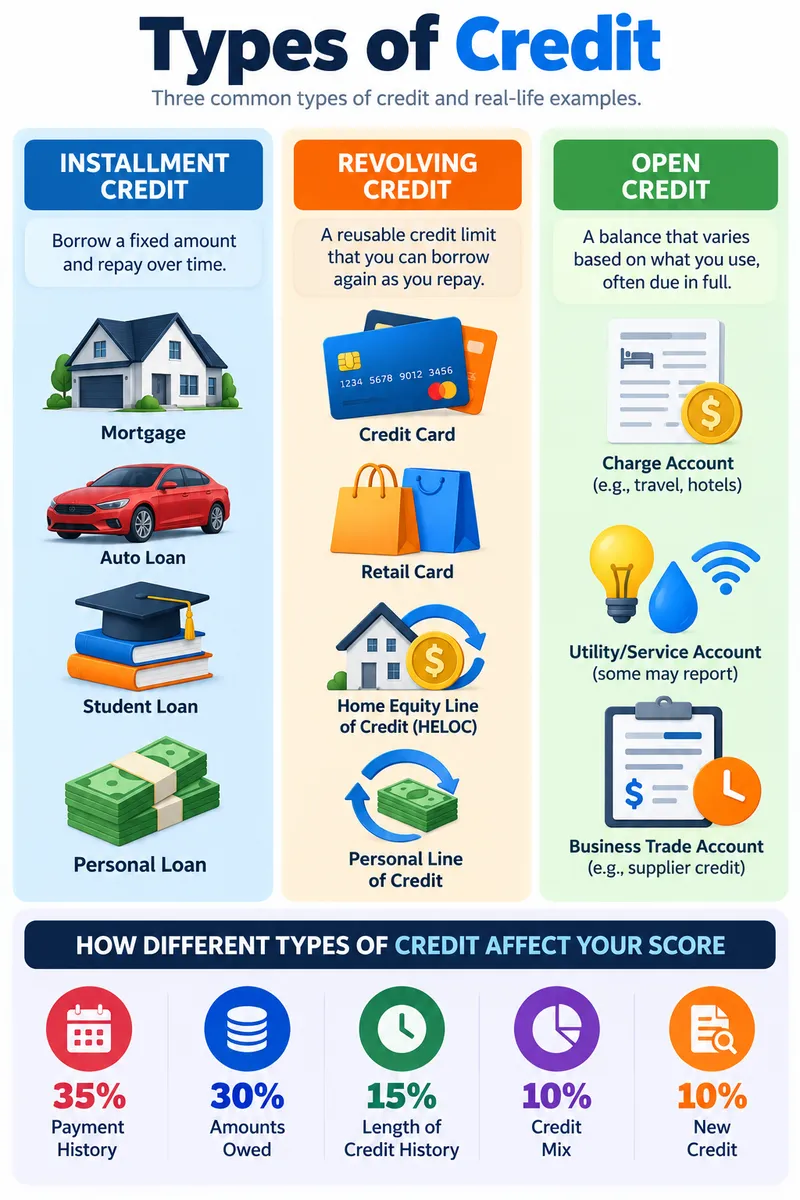
Credit is commonly divided into installment and revolving accounts, although open credit is also used as a third category when explaining repayment structures. Current Experian guidance describes two common types of credit accounts, revolving and installment, and FICO's own credit mix material focuses on categories including credit cards, retail accounts, installment loans, finance company accounts, and mortgages.
| Feature | Installment | Revolving | Open |
|---|---|---|---|
| Borrowing structure | Fixed amount | Reusable limit | Varies by use |
| Payment | Scheduled | Varies | Typically based on amount used |
| Fixed payoff date | Usually | No | Usually no traditional loan term |
| Credit limit | Not typically reusable | Yes | Structure varies |
| Common example | Auto loan | Credit card | Certain charge/service accounts |
| Utilization factor | Not revolving utilization | Yes | Depends on account/reporting |
Not Sure What's Actually on Your Credit Report?
Get a free breakdown of every account type, balance, and payment status on your report before you decide what to do next.
Get My Free Credit Analysis Now →1. Installment Credit
Common examples of installment credit include mortgages, auto loans, student loans, and personal loans. FICO likewise categorizes mortgages, auto loans, and student loans as installment accounts.
How installment credit works
Say you borrow $20,000 for a vehicle with a 60 month repayment term. Unlike a credit card, paying $5,000 toward the balance does not normally give you $5,000 to borrow again under that same auto loan. That establishes a straightforward relationship: fixed principal, a set repayment term, scheduled payments, a declining balance, and an eventual payoff.
How installment credit can affect your credit
Installment accounts influence your credit profile through several factors: payment history, account age, the outstanding debt still owed relative to the original loan, credit mix, and any new-credit inquiry generated when you applied. On-time payments over the life of the loan build a long, positive history. Missed payments do the opposite, and the impact tends to be significant since a large loan balance stands out on a report. You do not need an installment loan to build good credit; a well managed revolving account can do the same job.
2. Revolving Credit
Common examples include credit cards, retail or store cards, gas cards, HELOCs, and personal lines of credit. These align with the account types FICO lists as revolving.
How revolving credit works
Consider a card with a $5,000 credit limit and a reported balance of $1,000. That leaves $4,000 in available credit and an individual utilization rate of 20%. This connects several concepts at once: revolving credit, credit limit, balance, available credit, and utilization, all of which feed into your FICO Score. FICO specifically states that revolving utilization is considered in scoring, and that higher utilization is associated with greater repayment risk.
Do you need to carry a balance to build credit?
3. Open Credit
This category needs particular care, since it is easy to misunderstand. Ordinary unsecured credit cards are not open credit; credit cards are generally revolving accounts. Open credit is instead defined by its repayment structure, and terminology and credit reporting for it can vary by provider.
Possible examples of open credit can include certain charge accounts, some utility or service arrangements, and business trade accounts. Not every utility or service account automatically appears as a positive tradeline on your three major credit reports, so paying an electricity bill does not necessarily build credit in the same way managing a reported credit card does.
How Do the Different Types of Credit Affect Your Score?
Payment history
This matters regardless of whether the account is installment or revolving. Payment history represents 35% of a typical FICO Score, compared with just 10% for credit mix, which gives useful perspective on where to focus first.
Credit utilization
Utilization connects primarily to revolving accounts. Revolving utilization falls within the amounts owed category, which can represent about 30% of a typical FICO Score, making it the second most influential factor after payment history.
Credit mix
Credit mix accounts for about 10% of a typical FICO Score. Credit mix does not mean permission to open unnecessary accounts; it is a small factor that reflects experience managing different account types, not a target to chase.
Length of credit history
Different accounts, both installment and revolving, contribute to the overall age of your credit file, which makes up about 15% of a typical FICO Score. Closing your oldest account can shorten your average account age and work against you.
New credit
Opening accounts merely to create a mix can produce hard inquiries and new, younger accounts, both of which fall under the new credit category, about 10% of a typical FICO Score.
Installment vs. Revolving Credit: What's the Difference?
| Feature | Installment Credit | Revolving Credit |
|---|---|---|
| Amount borrowed | Usually fixed initially | Changes as you use it |
| Reuse after repayment | No | Yes |
| Repayment term | Usually fixed | Open-ended |
| Monthly payment | Usually scheduled | Can vary |
| Credit limit | Not reusable | Reusable |
| Utilization | Different scoring treatment | Revolving utilization matters |
| Examples | Mortgage, auto loan, personal loan | Credit card, HELOC |
What Types of Credit Appear on Your Credit Report?
Having a financial obligation is not the same thing as having a tradeline reported to a credit bureau. A creditor extends credit, the account becomes a furnisher relationship, and only if that furnisher reports to a credit bureau does the account become a tradeline on your credit report. That distinction is why some accounts you pay every month, like certain utility or subscription services, never show up as a positive account at all, while others, like a credit card or auto loan, almost always do.
What Is the Best Credit Type to Have?
Having experience managing different types of credit can contribute to your credit mix, but you should not take out a loan or open another credit card solely to diversify your credit report. FICO itself notes that credit mix accounts for only about 10% of a typical FICO Score and specifically cautions against opening credit simply for the sake of improving credit mix.
| If you need... | Credit commonly used |
|---|---|
| Financing for a car | Installment |
| Home purchase | Installment |
| Everyday flexible purchasing | Revolving |
| Reusable emergency credit | Revolving |
| Home equity access over time | Revolving / HELOC |
Common myth
"You need a mix of loans and credit cards to get a good score." In reality, credit mix is worth about 10% of a typical FICO Score. A single well managed revolving account, paid on time with low utilization, can support a strong score without ever taking out a loan.
Where Can You Learn More About the Types of Credit?
The most useful next step is examining your own credit reports account by account.
Identify each account on your credit reports
- Account type
- Creditor or furnisher
- Date opened
- Current balance
- Credit limit or original loan amount
- Payment status
- Payment history
- Account status
Compare information across all three reports
Not every lender necessarily reports exactly the same information to every bureau. You can request your free reports from Equifax, Experian, and TransUnion through AnnualCreditReport.com, the federally authorized source for obtaining them.
Check for inaccurate account information
Once you can see each account clearly, look for signs that something is wrong:
- An account that isn't yours
- The wrong account type listed
- An incorrect balance
- An incorrect credit limit
- Incorrect late-payment history
- Duplicate accounts
- An incorrect account status
If you spot any of these, you have the right to dispute them directly with the credit bureaus. ASAP Credit Repair's own step-by-step dispute guide walks through exactly how that process works.
Frequently Asked Questions
What are the three types of credit?
The three commonly discussed types of credit are installment credit, revolving credit, and open credit. Installment credit provides a set amount that you repay over time. Revolving credit lets you repeatedly borrow up to a limit. Open credit generally involves a balance that varies based on use and may need to be paid in full.
What are examples of each type of credit?
Installment credit examples include mortgages, auto loans, student loans, and personal loans. Revolving credit examples include credit cards, retail store cards, gas cards, HELOCs, and personal lines of credit. Open credit examples can include certain charge accounts and business trade accounts, though not every account type reports the same way to the credit bureaus.
Is a credit card revolving or installment credit?
A credit card is revolving credit. You are given a credit limit you can borrow against repeatedly as you make purchases and pay down the balance, rather than a fixed amount repaid over a set term.
Is a mortgage installment credit?
Yes. A mortgage is installment credit. You borrow a fixed amount and repay it through scheduled payments over an agreed term, and the loan does not replenish as you pay it down.
Is a car loan installment credit?
Yes. An auto loan is installment credit. You borrow a set amount for the vehicle and repay it in fixed scheduled payments over a defined term.
What type of credit is a HELOC?
A home equity line of credit is revolving credit. It gives you a reusable credit limit secured by your home's equity, similar in structure to a credit card.
What is the difference between revolving and installment credit?
Installment credit gives you a fixed amount repaid on a set schedule that does not replenish. Revolving credit gives you a reusable credit limit you can borrow against repeatedly, with a balance and payment that can vary.
Does having different types of credit help your credit score?
It can contribute a small amount. Credit mix accounts for about 10% of a typical FICO Score, far less than payment history at 35% or amounts owed at 30%.
Do you need an installment loan to build credit?
No. Responsibly managing any reported account, including a single credit card with on-time payments and low utilization, can build a solid credit history.
How many types of credit should you have?
There is no required number. The right accounts are the ones you actually need, can afford, and can manage responsibly.
Does paying utilities build credit?
Not always. Not every utility or service account automatically appears as a positive tradeline on your three major credit reports.
Should you open a loan just to improve credit mix?
No. FICO specifically cautions against opening credit accounts simply to improve credit mix, since it accounts for only about 10% of a typical FICO Score.
Do Your Credit Accounts Look Right?
Knowing your types of credit makes it easier to understand what you're seeing on your credit reports. If an account has an incorrect balance, payment history, credit limit, status, or other information, don't assume you have to leave it there.
Claim My Free Credit Analysis Now →Related Reads
Sources: myFICO – What's in a FICO Score, Experian – Installment vs. Revolving Credit, AnnualCreditReport.com.