

Philadelphia debt often starts before a missed payment ever reaches a credit report. A medical bill goes unpaid, a collection notice gets missed, or a household uses credit to cover the gap between income and essential expenses.
The local numbers show why that gap matters. Philadelphia's poverty rate was 19.7% in 2024, while the city's average credit score was 632.84 in WalletHub's 2026 analysis, about 72 points below Pennsylvania's average. Philadelphia residents also pay a 3.735% city Wage Tax as of July 2026, reducing take-home pay before rent, utilities, medical bills, or debt payments are covered.
“When we review Philadelphia credit reports, the problem is rarely just overspending,” says Joe Mahlow, owner of ASAP Credit Repair USA. “We often see several problems stacked together: a medical collection, high card balances, or an account that went unpaid when the household was already stretched.”
That overlap helps explain why people in Philadelphia are in debt. Medical collections, credit card debt, collection lawsuits, and limited disposable income can compound, turning one unpaid obligation into a much larger credit problem.
Why Are So Many People in Philadelphia in Debt?
Philadelphia residents are not in debt because they spend recklessly. Most of the debt we see out of Philadelphia traces back to three specific, repeatable causes: a medical bill that turned into a collections account, a credit card lawsuit nobody answered, and a paycheck that shrinks further in Philadelphia than almost anywhere else because of the city's own wage tax. This article breaks down exactly why so many Philadelphia residents end up in debt, where Philadelphia's credit score actually stands today, and what tends to work once the debt is already there.
What Are the Most Common Reasons People in Philadelphia Are in Debt?
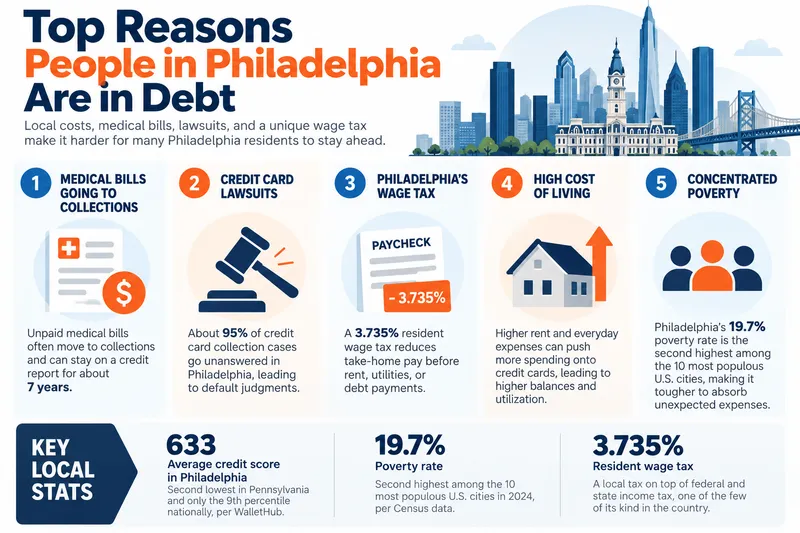
The most common reasons people in Philadelphia are in debt include medical bills going to collections, credit card lawsuits that go unanswered and turn into court judgments, and a local wage tax that shrinks take-home pay before rent or bills are paid. Philadelphia's poverty rate of 19.7 percent, the second highest among the 10 most populous U.S. cities, compounds all three.
Debt in Philadelphia rarely comes from one bad decision. It builds through a sequence, and that sequence tends to repeat across a lot of the Philadelphia credit files we review.
| Common Cause | How It Shows Up in Philadelphia |
|---|---|
| Medical debt | Unpaid bills move to collections and stay on a report for about seven years |
| Unanswered lawsuits | About 95% of credit card collection cases go uncontested, leading to default judgments |
| Wage tax burden | Philadelphia's 3.735% resident wage tax reduces disposable income before bills are paid |
| Concentrated poverty | 19.7% poverty rate, the second highest among major U.S. cities, per 2024 Census data |
| Wage garnishment | A default judgment allows garnishment of up to 25% of disposable income |
What Is the Average Credit Score in Philadelphia?
Philadelphia's average credit score is 632.84, the second lowest of any city in Pennsylvania and only the 9th percentile nationally among more than 2,500 U.S. cities studied by WalletHub. That is roughly 72 points below Pennsylvania's state average of 705 and 69 points below the national average of 702.
That gap is notable because Pennsylvania as a whole is not a low-scoring state. Nearby Pennsylvania suburbs like Newtown and Collegeville post some of the highest average scores in the country, which makes Philadelphia's citywide number stand out even more sharply against its own state.
Does Philadelphia's Wage Tax Make Debt Worse?
Philadelphia charges residents a 3.735 percent city wage tax on top of federal and state income tax, one of the few local wage taxes of its kind in the country. That extra deduction comes out of every paycheck before rent, utilities, or debt payments, leaving less room to absorb a missed bill before it becomes a collections account.
Most U.S. cities do not tax wages separately from state income tax. Philadelphia does, and it applies to income earned in Philadelphia regardless of where an employee lives. That extra percentage sounds small, but for a household already stretched by rent and Philadelphia's cost of living, it is one more fixed deduction competing with a credit card payment or a medical bill for the same paycheck.
A household with room in the budget can cover a medical bill or a missed paycheck without it becoming a collections account.
The same surprise bill has less room to be absorbed, since a larger share of income is already committed before bills are paid.
How Common Is Medical Debt in Philadelphia?
Nationally, 43 percent of Americans have medical debt listed on a credit report, according to a Kaiser Family Foundation analysis. Philadelphia's higher-than-average poverty rate and lower rate of employer-sponsored insurance make medical debt one of the most frequent issues Philadelphia clients bring to a credit review.
Medical debt behaves differently from other debt. It rarely comes from a spending choice, and a Philadelphia household can go from a clean credit file to a collections account after a single emergency room visit. Once that account is reporting, it can drop a score by 30 to 60 points, and sometimes more than 100, as covered in how medical debt actually impacts a credit score.
Federal reporting rules changed recently in a way that helps somewhat. Medical debt under $500 is no longer supposed to appear on a credit report at all, though billing and notice errors still happen often enough that medical bills sometimes reach collections without proper notice, which is worth checking before assuming a balance is accurate.
Find Out What Is Really on Your Philadelphia Credit Report
A free 3-bureau review shows exactly what Equifax, Experian, and TransUnion currently report, including medical collections that may be inaccurate or past the reporting threshold entirely.
Claim My Free Credit Analysis Now → Secure · 2 minutes · No credit card requiredWhat Happens If a Philadelphia Debt Collection Lawsuit Is Ignored?
Around 95 percent of credit card collection lawsuits go uncontested, which allows the creditor to win an automatic default judgment. That judgment can add 20 to 40 percent in fees and interest to the original balance and allow wage garnishment of up to 25 percent of disposable income, even when the lawsuit itself contains an error.
This is the step that turns a manageable Philadelphia debt into a much bigger problem. A debt collector files suit, the notice goes to an old address or gets set aside, and Philadelphia's Municipal Court enters a default judgment because nobody showed up to respond. From there, a creditor can pursue wage garnishment or a bank account levy, and that judgment can sit on record for 10 to 20 years, accruing interest the entire time.
Philadelphia residents who receive a collections lawsuit and cannot afford an attorney can also reach out to Community Legal Services of Philadelphia, a nonprofit that represents low-income residents in exactly these cases, often at no cost.
What Can Philadelphia Residents Do About Existing Debt?
- ✓ Open and respond to any court papers immediately, even if the debt looks familiar or small
- ✓ Pull a full credit report and check every medical and collection account for accuracy
- ✓ Confirm any medical debt under $500 has actually been removed under current reporting rules
- ✓ Dispute inaccurate or unverifiable accounts under the Fair Credit Reporting Act before paying anything
- ✓ Rebuild with a secured credit card if collections activity has limited access to a standard card
- ✓ Work with a CROA-registered credit repair company or a legal aid group if court judgments are already in place
A low Philadelphia credit score almost never means someone did everything wrong. It usually means a medical bill, a wage tax squeeze, and one missed court notice landed at the same time, and each of those is fixable once it is identified.
Philadelphia's average credit score sits well below both Pennsylvania's state average and the national average, and the gap traces back to a repeatable pattern: medical debt, unanswered lawsuits, a local wage tax, and concentrated poverty all compounding on the same households. None of those causes are unusual on their own. In Philadelphia, they tend to happen together.
What are the most common reasons people in Philadelphia are in debt?
The most common reasons include medical bills going to collections, credit card lawsuits that go unanswered and default into judgments, and a local wage tax that shrinks take-home pay before rent or bills are even paid. Philadelphia's poverty rate of 19.7 percent, the second highest among the 10 most populous U.S. cities, compounds all three.
What is the average credit score in Philadelphia?
Philadelphia's average credit score is 632.84, the second lowest of any city in Pennsylvania and only the 9th percentile nationally among more than 2,500 U.S. cities studied by WalletHub. That is roughly 72 points below Pennsylvania's state average of 705 and 69 points below the national average of 702.
Does Philadelphia's wage tax make debt worse?
Philadelphia charges residents a 3.735 percent city wage tax on top of federal and state income tax, one of the few local wage taxes of its kind in the country. That extra deduction comes out of every paycheck before rent, utilities, or debt payments, leaving less room to absorb a missed bill before it becomes a collections account.
How common is medical debt in Philadelphia?
Nationally, 43 percent of Americans have medical debt listed on a credit report, according to a Kaiser Family Foundation analysis. Philadelphia's higher-than-average poverty rate and lower rate of employer-sponsored insurance make medical debt one of the most frequent issues Philadelphia clients bring to a credit review.
What happens if a Philadelphia debt collection lawsuit is ignored?
Around 95 percent of credit card collection lawsuits go uncontested, which allows the creditor to win an automatic default judgment. That judgment can add 20 to 40 percent in fees and interest to the original balance and allow wage garnishment of up to 25 percent of disposable income, even when the lawsuit itself contains an error.
Don't Let a Philadelphia Judgment Sit on Your Report for 20 Years
A free 3-bureau audit shows exactly what is dragging your score down, medical collections, an old judgment, or a reporting error, so you know what you are actually dealing with before you act.
Claim My Free Credit Analysis Now → Secure · 2 minutes · No credit card required-
How Medical Debt Can Impact Your Credit Score Covers how much a medical collection can cost a score and what recent reporting rule changes mean for smaller balances.
-
How Ignoring a Credit Card Lawsuit Wrecks Your Finances Explains what happens when a collections lawsuit goes unanswered and why responding preserves your options.
-
Can Medical Bills Go to Collections Without Notice? Breaks down the notice requirements collectors have to follow before a medical bill can hit your credit report.
-
What Is a Secured Credit Card? Full Guide to Rebuilding Credit Walks through how a secured card rebuilds credit history once collections activity has limited standard card options.
-
Philadelphia Has the Second Worst Credit Score in Pennsylvania Coverage of the WalletHub city credit score study behind Philadelphia's 632.84 average and its statewide ranking.
-
Philadelphia Poverty Rate Drops, No Longer Poorest Big U.S. City The Philadelphia Inquirer's reporting on the city's 2024 poverty rate and how it compares to other major U.S. cities.
-
Community Legal Services of Philadelphia: Debt Collection Help Free legal assistance for Philadelphia residents facing debt collection lawsuits, wage garnishment, or account levies.