

Getting denied for a credit card stings. But if you're asking why my credit card application was denied, the answer is almost always one of a handful of fixable reasons. Most people guess wrong. They assume one big problem, like a bankruptcy or a missed payment. In reality, most denials come from a combination of smaller factors that add up quietly over time.
I run a credit repair company. This month alone, our team reviewed over 60 denied credit card applications from clients who had no idea what triggered the rejection. In almost every case, the issue was something they could have caught and corrected before applying.
The problem is widespread. The average credit card rejection rate climbed to 20.2% in 2024, according to the Federal Reserve Bank of New York's Survey of Consumer Expectations. And according to Bankrate's 2025 Credit Denials Survey, 48% of Americans who applied for any financial product in the past year faced at least one rejection.
You are not alone. But you do need to understand exactly what happened and what to do next.
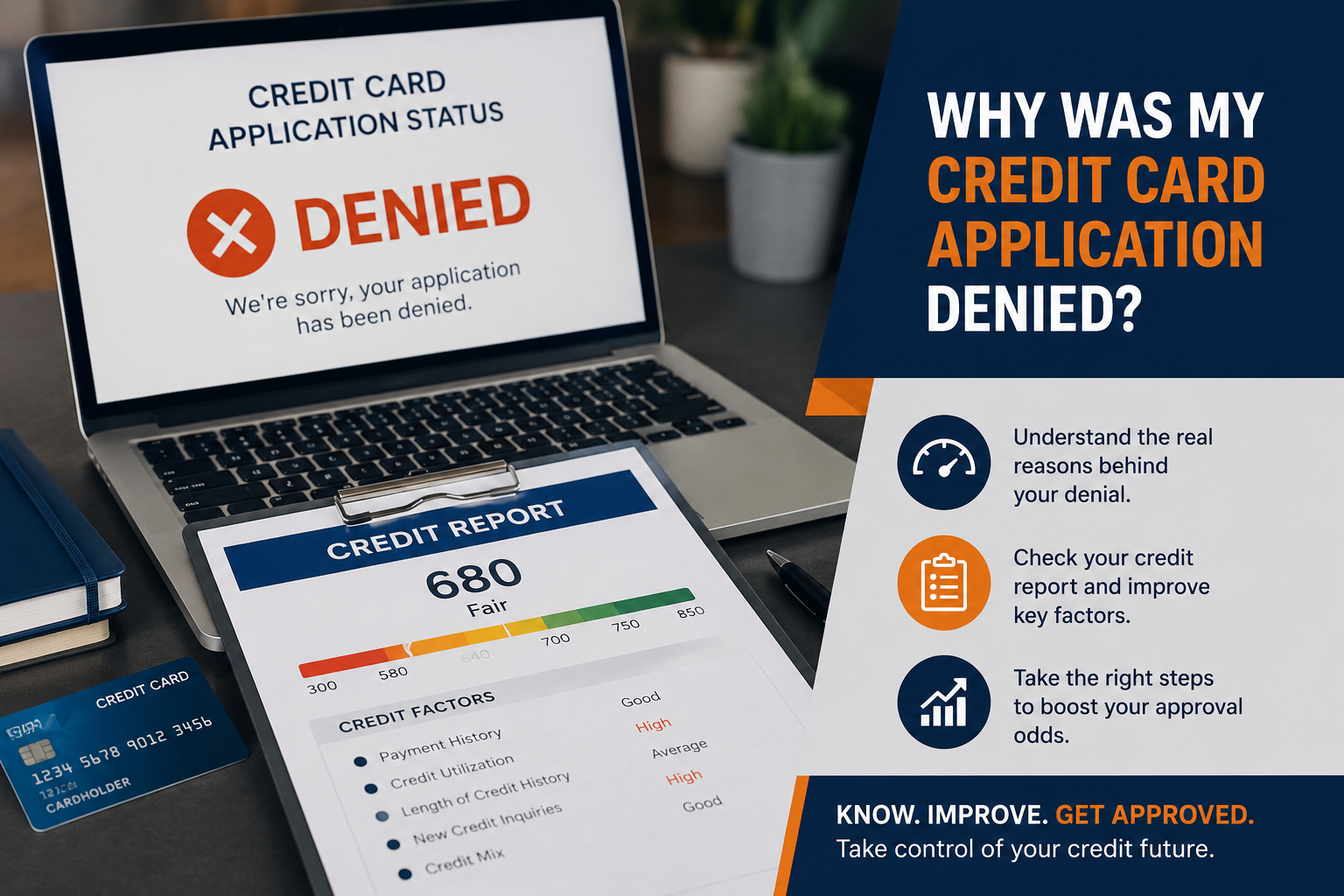
Why Was My Credit Card Application Denied?
Card issuers review several factors at once when you apply. A denial does not always mean your credit is bad. It means something in your financial profile did not meet the card's requirements at the time you applied.
Federal law requires every card issuer to send you an adverse action notice within 30 days of denying your application. This letter must explain the specific reasons for the denial. If you have not received it yet, check your email and mail. It is coming.
The most common reasons a credit card application gets denied:
Credit score below the card's minimum requirement
A debt-to-income ratio that is too high
Too many recent credit applications in a short period
Limited or thin credit history
Income that does not meet the card's minimum
Errors or inconsistencies on the application itself
Each one of these is fixable. But you need to know which one applies to you before you act.
What Are the Most Common Reasons for Credit Card Denial?
Low Credit Score
Every credit card has a target credit score range. Premium rewards cards typically require scores of 720 or higher. Standard unsecured cards may accept scores starting around 630. Secured cards often have no minimum at all.
If your score falls below a card's threshold, the issuer rejects the application automatically. The system does not make exceptions.
A score below 670 puts you in the fair or poor range. Most major card issuers will not approve applicants below that level for their standard products. Knowing your score before you apply saves you a hard inquiry and a denial on your record.
High Debt-to-Income Ratio
Your debt-to-income ratio (DTI) compares your monthly debt payments to your monthly gross income. Card issuers use this number to judge whether you can handle new monthly payments.
The CFPB recommends a DTI below 36% for homeowners and below 15% to 20% for renters. A DTI above 43% to 50% will likely trigger a denial at most major issuers.
Your income does not appear on your credit report. But you report it on the application, and card issuers take it seriously. If your monthly debt load is high relative to what you earn, even a good credit score may not save you.
Too Many Recent Credit Applications
Every credit card application you submit creates a hard inquiry on your credit report. One hard inquiry is normal. Four or five within a few months signals something different to lenders.
Multiple recent applications suggest you may be in financial distress or seeking credit urgently. Issuers flag this as a risk. The CFPB notes that a pattern of recent inquiries can lead to a denial even when your score is solid.
Hard inquiries stay on your report for two years. They typically affect your score for about 12 months.
Thin or Limited Credit History
A thin credit file means you have too few accounts or too short a history for lenders to assess your reliability. This happens most with young borrowers, recent immigrants, or people who have used only cash and debit for years.
Lenders want to see at least a few years of credit history with consistent on-time payments. Without that data, approving you is a risk they may not be willing to take.
Income Below the Card's Minimum
Some cards, especially premium travel and rewards cards, carry minimum income requirements. You may not see this requirement listed publicly, but issuers factor it into their approval criteria.
If your declared income does not meet the card's internal threshold, the issuer may deny the application regardless of your credit score. A good score is not enough on its own.
Errors on Your Application
A typo in your Social Security number, an address that does not match your credit report, or an employment status listed incorrectly can all flag your application for rejection.
Automated systems compare your application details against the information in your credit file. Any mismatch can stop the process. Always double-check every field before you submit.
Most credit card denials come down to one of those six factors. The adverse action notice the issuer sends you will tell you which one triggered yours. Read that letter carefully before you take your next step.
How Do I Find Out Exactly Why I Was Denied?
The adverse action notice is your starting point. This notice arrives by mail or email within 30 days. It lists the specific reasons for the denial, not just a vague explanation.
Common denial reasons listed on adverse action notices include:
Insufficient credit history
Too many delinquencies or late payments on file
High credit card balances relative to limits
Too many recent applications for credit
Insufficient income
After you read the notice, pull your free credit report at AnnualCreditReport.com. Check it for errors, outdated negative items, or accounts you do not recognize. Any of those can show up in a reason for denial.
You can also call the card issuer directly and ask to speak with a reconsideration line. Some issuers offer a review process where a human agent can override an automated denial. This works best when the denial was based on something you can explain clearly, like a one-time late payment during a medical event.
Does a Denied Credit Card Application Hurt Your Credit Score?
The denial itself does not affect your score. It does not appear on your credit report. However, the hard inquiry from the application does show up, and it can lower your score by a few points.
The impact of a single hard inquiry is usually small, between two and five points. It fades after about 12 months and disappears from your report entirely after two years.
The bigger risk is applying for multiple cards in a short window. Each application adds another inquiry. Several inquiries stacked together signal risk to future lenders and can drag your score down more meaningfully.
If a card issuer runs a soft inquiry during a pre-approval check, that never affects your score. Only hard inquiries from actual applications count.
Can I Appeal a Credit Card Denial?
Yes. Most major card issuers have a reconsideration line specifically for this purpose. Call the number on the denial notice and ask to have your application reviewed by a credit analyst.
Come prepared. Know which reason caused the denial. Have a clear explanation ready if the issue was a specific negative item, like a late payment due to job loss. Bring any documentation that supports your case, such as proof of current employment or evidence of an error in your report.
Reconsideration calls work most often when:
Your denial was based on a single issue rather than a pattern of problems
Your credit score is close to the card's minimum requirement
You have a good explanation for any negative items on your record
Not every reconsideration call succeeds. But it costs you nothing to ask, and it does not create a new hard inquiry on your report.
How Long Should I Wait to Reapply After Being Denied?
Wait at least three to six months before applying again for any credit card, including the same one. Use that time to fix whatever triggered the denial.
If the denial was due to too many recent applications, wait until some of those inquiries age off. If the cause was high credit utilization, spend two to three months paying balances down before reapplying.
Applying again too quickly without fixing the root issue almost always results in a second denial. That adds another hard inquiry to your report without any benefit.
What Credit Score Do You Need to Get Approved for a Credit Card?
It depends on the card, but here are the general thresholds most issuers follow:
300 to 579 (Poor): Very limited options. Secured cards and credit-builder cards are your main paths.
580 to 669 (Fair): Some unsecured cards are available, usually with higher fees and lower limits.
670 to 739 (Good): Most standard credit cards become accessible at this range.
740 to 799 (Very Good): Strong approval odds across most cards, including many rewards cards.
800 and above (Exceptional): Qualifies for nearly any card on the market.
According to data compiled by Experian, keeping your credit utilization below 30% and your DTI below 36% gives you the strongest combined profile for approval, regardless of which score tier you fall in.
Denied for a Credit Card? Don’t Guess What Went Wrong.
ASAP Credit Repair can review your credit report, identify what may be hurting your approval odds, and create a clear plan to help you qualify with confidence.
Get Your Credit Report ReviewedNo pressure. Just clear answers and a step-by-step credit repair plan.
How Can I Improve My Chances Before Applying Again?
Start with your credit report. Dispute any errors you find at all three bureaus: Experian, TransUnion, and Equifax. Removing a single inaccurate late payment can lift your score by 20 to 50 points in some cases.
Then work on these in order:
Pay down balances. Get your credit utilization below 30% on every card. Below 10% is even better.
Stop applying for new credit. Let existing inquiries age before you add more.
Pay every bill on time. Payment history makes up 35% of your FICO score. One recent late payment can block you from many cards.
Consider a secured card. A secured card reports to the three bureaus just like a regular card. Used correctly, it builds your score within six to twelve months.
Become an authorized user. If a trusted family member has a strong credit card account, being added as an authorized user lets their history work in your favor.
Last year, clients who worked through this checklist with our team went from denied applicants to approved cardholders within an average of eight months. The process is not instant. But it is straightforward when you know exactly what to fix.
A denied application is not a closed door. It's a report card that tells you exactly where to focus. Pull your adverse action notice, check your credit report, and address the specific issue before you apply again. If you want help mapping out that process, ASAP Credit Repair can review your report and build a step-by-step plan to get you approved.