

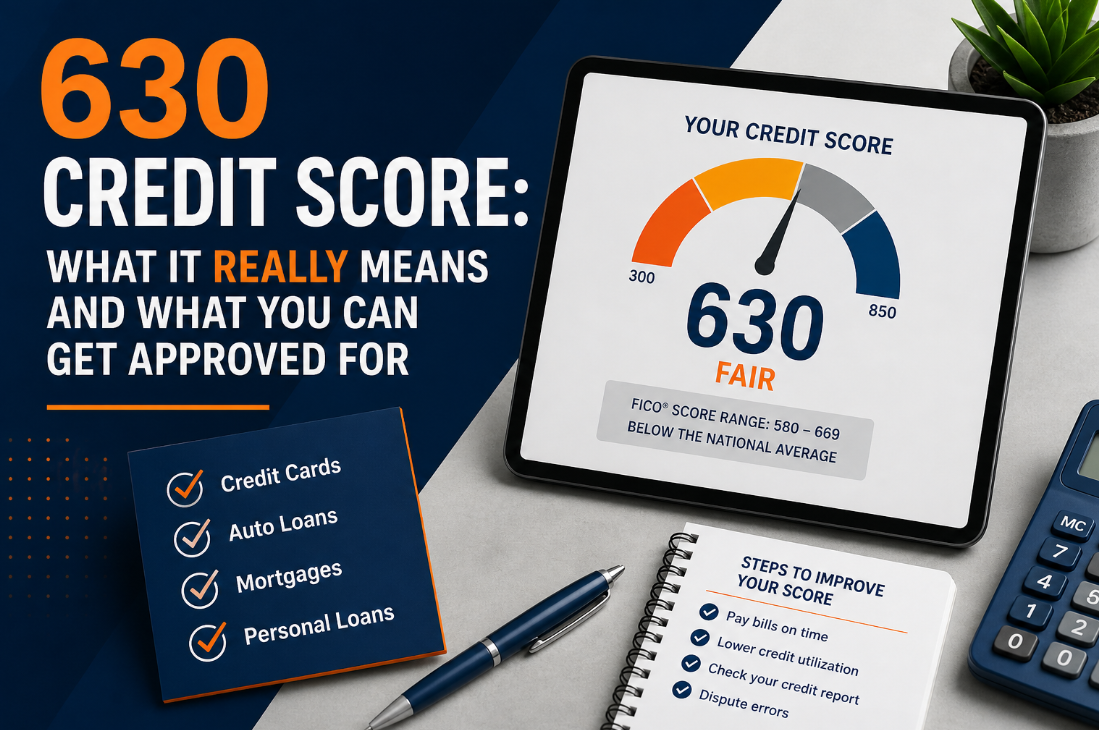
A 630 credit score is not a good credit score. FICO classifies it as "fair," sitting in the 580–669 range, below the national average of 715. Lenders see this score as a higher-risk profile. That means higher interest rates, tighter loan terms, and some outright denials. Your debt-to-income ratio, income, and employment history will carry extra weight in every application you submit.
I run a credit repair company. One of the most common cases we see is someone with a 630 score who got denied for a car loan, only to find out a single 30-day late payment from two years ago is holding their score back. These situations are almost always fixable, but you need to know exactly what you are dealing with first.
A Consumer Financial Protection Bureau (CFPB) borrower risk report classifies scores in the 620–659 range as "near prime." This group sees noticeably lower loan approval rates and higher fees than borrowers above 660. The CFPB tracks this data monthly, and the gap between near prime and prime borrowers has stayed consistent for years.
What Is a 630 FICO Score?
A 630 FICO score sits in the middle of the "fair" credit tier on FICO's 300–850 scale. FICO is the scoring model used in over 90% of U.S. lending decisions.
The five FICO score tiers run from poor (300–579), to fair (580–669), to good (670–739), to very good (740–799), and finally exceptional (800–850). A 630 score places you 40 points below the "good" threshold and 85 points below the national average. According to Experian, 80% of U.S. consumers have FICO scores higher than 630.
VantageScore, the second most widely used model, uses the same 300–850 scale. Under VantageScore, a 630 falls in the "poor" tier, not fair. This distinction matters because some lenders use VantageScore instead of FICO, which means your score can look worse depending on which model the lender pulls.
What Does a 630 Credit Score Mean?
A 630 credit score means lenders view you as a subprime or near-prime borrower. You can still get approved for credit, but not on the best terms.
Experian data shows that 87% of people with a 630 FICO score have at least one 30-day late payment on their credit report. The average credit utilization rate for this group is 52.8%, well above the recommended 30% threshold. Payment history makes up 35% of your FICO score, and amounts owed account for another 30%. These two factors are the main reason scores stall in the 630 range.
A 2025 LendingTree analysis found that consumers with fair credit pay roughly $183,000 more in interest over their lifetime compared to those with exceptional scores. That gap compounds across mortgages, auto loans, credit cards, and personal loans over time.
Is a 630 Credit Score Bad Credit?
A 630 score is not technically bad credit. Bad credit refers to scores below 580, which FICO classifies as "poor." But a 630 score is still below average, and many lenders treat fair credit borrowers with nearly the same caution as bad credit borrowers.
Approximately 17% of all U.S. consumers fall in the fair range of 580 to 669. Around 27% of consumers with fair scores become seriously delinquent on a debt within two years, according to Experian. This default risk is exactly why lenders charge more when they approve borrowers at this level.
So "not bad" does mean no consequences. A 630 score costs real money on every loan product you use.
Can I Get a Credit Card With a 630 Credit Score?
Yes. You can get a credit card with a 630 credit score, but your options are limited. Most premium rewards cards require a 670 or higher. At 630, you have two realistic paths.
Unsecured Cards for Fair Credit
Cards like the Credit One Bank Platinum Visa are available at this score range. Expect annual fees of $75 to $99, APRs often in the 28–30% range, and low credit limits starting around $300 to $500. These cards are functional but expensive if you carry a balance.
Secured Credit Cards
Secured cards require a refundable deposit, usually equal to your credit limit. They report to all three bureaus and are one of the most reliable tools for building your score. The Capital One Secured Mastercard and Discover it Secured are both accessible at 630. Using a secured card responsibly, paying in full every month, and keeping utilization below 30% typically moves scores 20 to 40 points within six months.
Can I Buy a Car With a 630 Credit Score?
Yes, but you will pay more. Experian data for Q1 2025 shows that borrowers with scores between 601 and 660 paid an average of 9.83% APR on new cars and 13.74% APR on used cars. Borrowers with scores between 661 and 780 paid 6.70% on new cars and 9.06% on used cars. On a $30,000 loan over 60 months, that rate difference adds up to over $2,500 in extra interest.
Last year alone, dozens of clients came to our office after being denied by a dealership's in-house financing. In most of those cases, a single collections account under $500 was pulling their score below the lender's minimum. Paying off or disputing that one item moved their score above 660 within 45 days.
How to Improve Your Approval Odds at 630
Get pre-approved through a credit union before visiting a dealership.
Offer a larger down payment of 20% or more to reduce lender risk.
Use a co-signer with a score above 700.
Check your credit report for errors at annualcreditreport.com before applying.
Can I Get a Mortgage With a 630 Credit Score?
A 630 score qualifies you for certain mortgage types, but not all.
FHA Loan
The Federal Housing Administration allows scores as low as 580 with a 3.5% down payment. A 630 score clears this threshold. FHA loans come with mandatory mortgage insurance premiums, which add to your monthly cost.
Conventional Loan
Fannie Mae's minimum is 620. At 630, you qualify, but expect stricter terms. To get a conventional loan with a 630 score, you typically need a debt-to-income ratio below 36% and may need a down payment of 25% to avoid PMI.
VA and USDA Loans
These government-backed programs have no official minimum score, but most lenders set their own overlays at 580 to 620. Veterans and rural borrowers at 630 generally qualify.
MyFICO's mortgage calculator shows that borrowers in the 620–639 range pay roughly 1.5 to 2% more in mortgage APR compared to borrowers above 760 on a 30-year fixed loan. On a $400,000 mortgage, that difference exceeds $59,000 in total interest paid over the life of the loan.
What Factors Are Holding a 630 Score Back?
Most 630 scores share the same pattern. The five FICO scoring factors are payment history at 35%, amounts owed at 30%, length of credit history at 15%, new credit at 10%, and credit mix at 10%.
At 630, the most common problems are a 30-day late payment in the past two years, credit utilization above 50%, a collection account under $1,000 that has not been addressed, and a thin file with fewer than three open accounts.
Fixing payment history takes time because late payments stay on your report for seven years. But reducing utilization can raise your score within 30 days. Paying card balances down to below 30% of each card's limit is the fastest way to gain points without waiting.
How Long Does It Take to Go From 630 to 700?
Moving from 630 to 700 requires gaining 70 points. For most people, this takes six to eighteen months with consistent effort.
Our office tracks client progress monthly. Over the past 12 months, clients who paid down utilization below 30%, disputed one inaccurate item, and made zero late payments gained an average of 57 points in six months. Clients who also added a secured card and kept it active reached 700 in under a year.
The Steps That Move Scores Fastest
Pull your credit report from all three bureaus at annualcreditreport.com and dispute any inaccurate items in writing.
Pay down revolving balances to below 30% of each card's credit limit.
Set up autopay on all accounts to eliminate future late payments.
Avoid applying for new credit unless necessary, as each hard inquiry drops your score 5 to 10 points temporarily.
If you have no open accounts, open a secured card and use it for one small purchase per month.
630 Credit Score vs. 670 Credit Score: The Real Cost Difference
The 40-point gap between 630 and 670 is one of the most impactful jumps in the entire credit score range. Crossing 670 moves you from fair to good, which changes how lenders categorize you entirely.
In Q1 2025, this gap meant the difference between 9.83% and 6.70% on a car loan. On a mortgage, the difference is even wider. For credit cards, moving above 670 unlocks 0% intro APR offers, cash back rewards, and cards with no annual fees — none of which are available at 630.
Getting to 670 should be the first goal, not 700 or 750. That single-tier jump delivers the biggest improvement in loan terms for the least amount of effort.
Can a Credit Repair Company Help a 630 Score?
Credit repair companies can help if your 630 score contains inaccurate, outdated, or unverifiable negative items. The Fair Credit Reporting Act gives you the legal right to dispute anything on your report that is not 100% accurate.
Credit repair can dispute inaccurate late payments, collections, or charge-offs, send debt validation letters to collection agencies, and help negotiate pay-for-delete agreements on valid collections. What it cannot do is remove accurate, verified negative items before their legal expiration date, guarantee a specific score increase, or create a new credit identity.
If your 630 score comes entirely from accurate negative history, credit repair offers limited value. Focus instead on reducing utilization and building positive payment history over time.
Stuck With a 630 Credit Score?
A 630 credit score can still get you approved, but it may cost you more in interest, fees, and limited loan options. See what is hurting your score and find out what steps may help you move from fair credit to good credit faster.
Get Your Free Credit Report ReviewNo pressure. Just a clear look at what may be holding your score back.
Your Next Step With a 630 Score
A 630 credit score is not permanent. Most people move from fair to good credit in under 18 months. The key is identifying the specific items holding your score back, not guessing.
Get your free reports from annualcreditreport.com, review each negative item, and decide which ones are accurate and which are worth disputing. Start with utilization because it is the fastest lever. Then work on the longer-term items like payment history and account age.
Every 10 points gained saves money on the next loan you take out. The math is in your favor.