

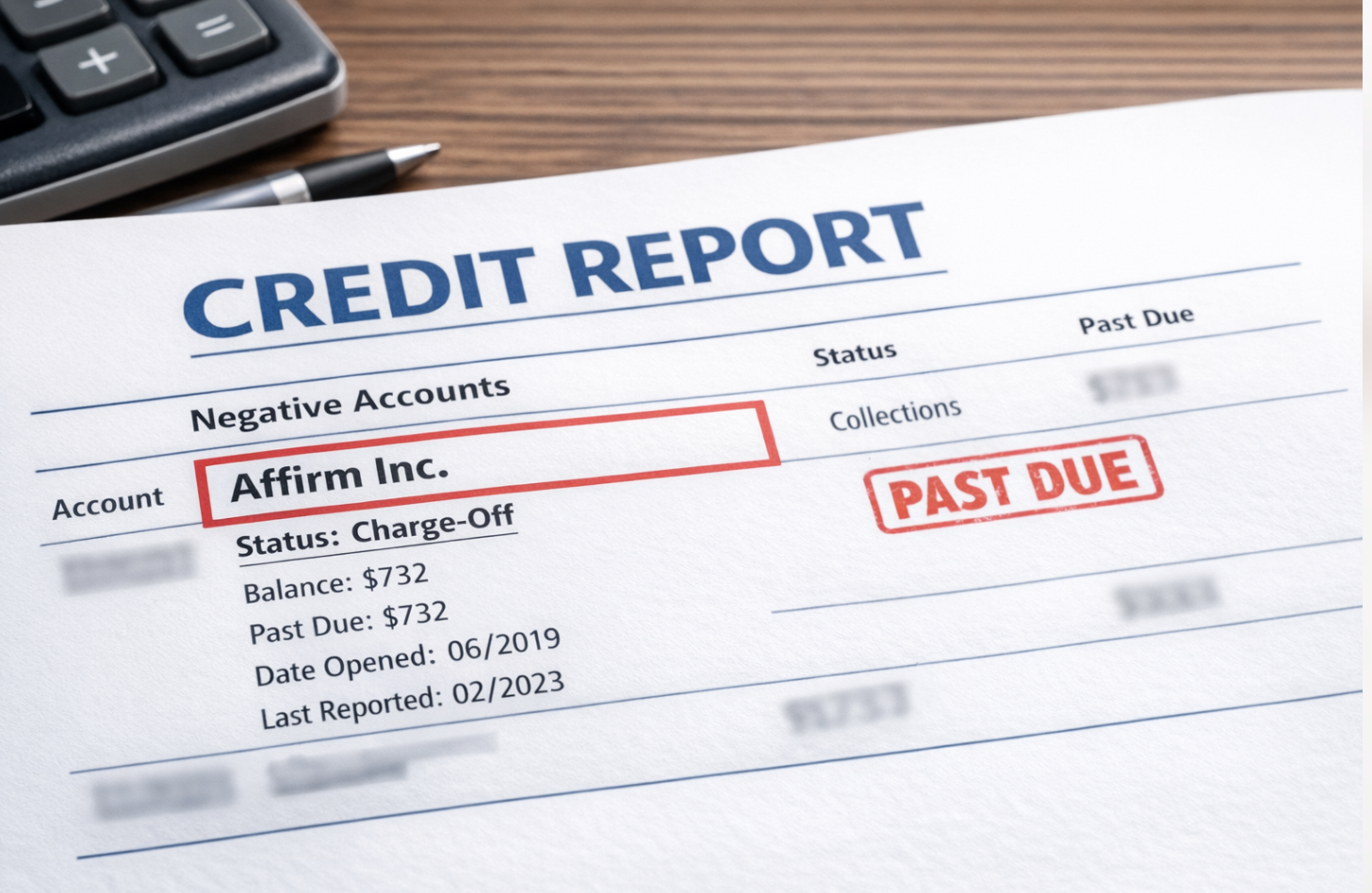
Why is Affirm Inc showing up on your credit report, and what does it mean if it’s listed as a charge-off?
Affirm Inc. is not a traditional bank, which is why many people don’t immediately recognize it when it appears on their credit report. It’s a buy now, pay later lender that turns everyday purchases into installment loans. The problem starts when those payments are missed.
We’ve reviewed credit reports where Affirm Inc accounts started as small balances. Sometimes under $500, but ended up reported as charge-offs after months of missed payments. In several cases, those accounts were still being reported inaccurately or inconsistently across credit bureaus, continuing to drag down scores long after the original purchase.
That’s where most people get stuck.
They see Affirm Inc listed, assume they just need to pay it, and don’t realize they may have other options depending on how the account is being reported.
Here’s the reality.
An Affirm Inc charge-off can significantly impact your credit, but like many negative items, it’s not always as straightforward as it looks. How you deal with it depends on the account status, reporting accuracy, and whether the debt has been transferred or remains with the original creditor.
In this guide, we’ll break down who Affirm Inc is, why it shows up on your credit report, and how these accounts turn into charge-offs. Most importantly, what you can actually do to handle it the right way.
Affirm Inc · BNPL Charge-Off · Affirm Credit Report · Buy Now Pay Later · TrueAccord Debt Collection
Affirm Inc. shows up on credit reports more than most borrowers expect. Here is who they are, how charge-offs happen, what the Affirm credit reporting rulebook actually says, and what real borrowers have done to deal with it.
Updated March 2026 · Sources: Affirm SEC filings (FQ3'25 Shareholder Letter), Affirm.com NMLS disclosure, myFICO Forums, CFPB BNPL research, FCRA Section 611, FDCPA 15 U.S.C. 1692
Affirm Inc. is a publicly traded buy now, pay later (BNPL) lender that originated nearly $130 billion in loans to about 60 million consumers since 2012. It is not a bank. It partners with Cross River Bank and Celtic Bank to issue loans. Affirm reports monthly installment loans to Experian and TransUnion (not Equifax as of early 2026). If Affirm shows a charge-off on your report, a loan went 120 days or more past due. Your score likely dropped 50 to 100 points. The debt is still owed and may have been referred to TrueAccord, Affirm's third-party collector.
What Affirm Inc. actually is and how it works as a lender
The four PAA questions answered directly with sourced data
How Affirm charge-offs happen and what triggers them
What real borrowers report from myFICO, Reddit, and Quora
FCRA errors specific to Affirm entries that are disputable
The TrueAccord situation and how to deal with their collection
Step-by-step dispute and pay-for-delete strategy for Affirm accounts
You used Affirm to split a purchase into payments. The payments stopped. Or maybe you never even opened an account with them, and Affirm is sitting on your credit report anyway.
Either way, you typed their name into a search bar and landed here. That puts you in good company. Affirm Inc. is one of the fastest-growing consumer lenders in America, and complaints about inaccurate Affirm credit reporting have stacked up across myFICO forums, Reddit's r/CRedit, and CFPB complaint databases.
This guide does not hedge. It gives you sourced data, real borrower experiences, and a specific action plan.
What Does Affirm Inc. Do?
Affirm was co-founded by Max Levchin, who also co-founded PayPal. The company went public in January 2021 at a valuation of around $12 billion. Today it processes billions of dollars in monthly loan originations through partnerships with major retailers, and its loan products touch credit reports across the country.
The core business is straightforward: Affirm takes on the lending risk that a retailer would otherwise have to carry. The merchant pays Affirm a fee. The borrower gets a structured payment plan, sometimes at 0% APR, sometimes at rates up to 36% depending on the loan type and the merchant agreement. According to CFPB research, BNPL borrowers defaulted on about 2% of BNPL loans compared to 10% of credit cards during the same period, reflecting shorter loan terms and smaller loan amounts rather than better borrower profiles.
Is Affirm a Legit Company?
Why Is Affirm Inc. on My Credit Report?
| Loan Product | APR Range | Reports to Bureaus? | Charge-Off Risk | Which Bureaus |
|---|---|---|---|---|
| Pay in 44 biweekly payments, typically for smaller purchases | 0% | Sometimes | Lower (short term) | Experian (varies) |
| Monthly Installment Loan3 to 36-month fixed payment plans | 0% to 36% | Yes, always | Higher (longer term) | Experian + TransUnion |
| Affirm Card (virtual Visa)Revolving/BNPL hybrid via Visa network | 0% to 36% | Yes | Moderate | Experian + TransUnion |
| Charged-Off Account120+ days delinquent, written off as loss | N/A | Yes, as charge-off | Already occurred | Experian + TransUnion, stays 7 years |
What Bank Is Behind Affirm?
The bank-partner model matters for one important reason: when you borrow through Affirm, the legal lender on your loan documents may be Cross River Bank or Celtic Bank, not Affirm Inc. directly. This is why some credit report entries say "Affirm" while others reference the bank partner. For dispute purposes, the furnisher of record on your credit report is what determines who you send dispute letters to, which is almost always Affirm even when a bank partner technically originated the loan.
How Affirm Charge-Offs Actually Happen
Affirm's own SEC filings give us the clearest data on charge-off rates. From the FQ3'25 Shareholder Letter filed with the SEC: recent cohorts of monthly installment loans are tracking toward approximately 3.5% ultimate net charge-offs as a percent of cohort GMV, consistent with historical loan performance. Pay in 4 loans track to loss rates of less than 1% of GMV.
Those percentages represent real accounts. At $130 billion in total originations, even a 3.5% charge-off rate on installment loans translates to billions of dollars in accounts that went delinquent and were written off, all of which reported to credit bureaus as charge-offs.
Affirm Frequently Reports Wrong Delinquency Dates. That Single Error Can Keep a Charge-Off on Your Report Longer Than the Law Allows.
A wrong date of first delinquency is one of the most common FCRA errors in Affirm entries, documented across dozens of myFICO forum threads. A free credit audit checks the exact date reported on your Affirm tradeline against the FCRA 7-year removal deadline and identifies every other error in the entry before you decide on a strategy.
What Real Borrowers Report: myFICO, Reddit, and Consumer Complaints
Generic advice about disputing Affirm charge-offs is not enough. Here is what borrowers who have actually dealt with Affirm credit issues report from real community threads.
TrueAccord: What It Is and How to Handle It
The important distinction: TrueAccord typically does not add a separate collection tradeline to your credit report. The original Affirm charge-off entry usually remains as the only negative mark on your report, unlike the more common pattern where both the original creditor and a collection agency each report separately. This means disputing the Affirm entry itself (not a TrueAccord entry) is the primary credit repair target.
Under the FDCPA, you can send TrueAccord a written debt validation letter within 30 days of their first contact. They must stop all collection activity until they provide documentation proving the debt is valid, the amount is correct, and they have the right to collect. Given that Affirm sells or assigns debt portfolios with digital records, there are cases where validation documentation is incomplete. Keep all emails from TrueAccord as documentation of their first contact date.
The FCRA Errors Specific to Affirm Entries
Based on the myFICO forum threads, consumer complaint records, and the pattern of disputes we see at ASAP Credit Repair, Affirm entries have a specific and recurring set of FCRA errors that are worth checking before any other action.
Error 1: Wrong Date of First Delinquency
This is the most documented Affirm-specific error. Multiple myFICO forum users report their Affirm charge-off entries show a date of first delinquency that is several months later than the actual first missed payment. Under FCRA Section 623(a)(5), the date of first delinquency must reflect the actual first missed payment, not the charge-off date, not the sale date, and not any other administrative date. A wrong date artificially extends the 7-year reporting window.
How to check it: Pull your Experian and TransUnion reports. Find the Affirm entry. Note the "Date of First Delinquency" field. Compare it against your own payment records or any billing statements you retained from when you first missed a payment. If the date is later than your actual first missed payment by even one month, it is disputable under FCRA Section 611.
Error 2: Duplicate or Overlapping Entries for the Same Debt
Some borrowers find both an Affirm charge-off entry and an Affirm collection entry on the same bureau for the same underlying account. myFICO users describe the tradeline "reporting as collection each month" under Affirm's name even though TrueAccord is handling the collection. This dual-status reporting doubles the visible derogatory marks from a single debt. If both entries appear simultaneously for the same account, the duplicate is disputable as inaccurate under FCRA Section 611.
Error 3: Charged-Off Account Continuing to Update With New Balances
A charge-off entry should reflect the balance at the time of charge-off, frozen. Some Affirm entries continue to update the "current balance" field monthly after charge-off, which suggests either ongoing interest accrual being reported or a system error. A balance that continues to grow after charge-off is reportable if it exceeds what the original loan agreement permits and if interest is accruing without a basis to report it.
Error 4: Pay in 4 Loans Reporting When Policy Did Not Require Reporting at the Time
Affirm's reporting policy for Pay in 4 loans has changed over time. If a Pay in 4 loan from an earlier period is appearing on your report and you have documentation that Affirm's policy at the time of the loan did not include reporting that product, this discrepancy may be disputable.
How to Dispute an Affirm Charge-Off: Step by Step
Go to AnnualCreditReport.com and download both reports. Affirm does not report to Equifax. For each Affirm entry, document: the account number, original balance, current reported balance, date opened, date of status (charge-off date), and -- most importantly -- the Date of First Delinquency. Screenshot or print each entry. You will use this as your baseline when the bureau confirms investigation results later.
Compare the same Affirm account across both bureaus. Different dates on the same account indicate a reporting inconsistency worth disputing.Vague disputes have low success rates. A dispute that says "I dispute this Affirm account as inaccurate" gives the bureau and Affirm nothing specific to investigate. The strongest disputes cite a specific field, a specific error, and the FCRA section it violates. Example: "The Date of First Delinquency on this Affirm account is reported as [Month Year]. My payment records show the first missed payment was [Month Year, X months earlier]. This violates FCRA Section 623(a)(5), which requires the furnisher to report the actual date of first delinquency. I am requesting correction of this date and removal if Affirm cannot verify the accurate date within the investigation window."
According to the CFPB's credit report dispute guidance, including supporting documentation increases investigation outcomes significantly.File disputes online at Experian.com and TransUnion.com or send certified mail to both bureaus on the same day. Simultaneously, send a written dispute directly to Affirm under FCRA Section 623(a)(8), which allows you to dispute directly with the furnisher. Affirm's address for written disputes is: Affirm, Inc., 650 California Street, 12th Floor, San Francisco, CA 94108. Send this by USPS Certified Mail with Return Receipt.
The bureau has 30 days to investigate (45 days if you submit additional documentation). Affirm as a furnisher must conduct its own reasonable investigation of your direct dispute. Document both filing dates.
A direct furnisher dispute under FCRA 623(a)(8) runs parallel to the bureau dispute and creates additional paper trail if Affirm verifies an error they should have corrected.If TrueAccord has emailed or contacted you about the balance, their first contact email is the starting point for your 30-day FDCPA validation window. Send a written debt validation request to TrueAccord at their mailing address (TrueAccord Corp, 16011 College Blvd, Suite 130, Lenexa, KS 66219) by certified mail. Request: confirmation that they have the right to collect, the original creditor's name (Affirm, Inc.), the account number, the original balance, and an itemized breakdown of how the current claimed balance was calculated. All collection activity must stop until they provide this documentation.
Save all TrueAccord emails and note the date of each. The first contact date starts the 30-day FDCPA validation window.Affirm has stated in writing to multiple borrowers that their policy is not to remove charge-offs, only to update status to "paid." This means negotiating pay-for-delete directly with Affirm is unlikely to succeed. TrueAccord, as a third-party collector, is a different entity and may have different authority over the tradeline. Ask TrueAccord specifically in writing: "As the current holder of this account, do you have the authority to request deletion of the Affirm tradeline from Experian and TransUnion upon settlement? If so, please provide your settlement terms and deletion commitment in writing before any payment is made."
If they say yes and provide a written agreement naming a specific settlement amount and committing to tradeline deletion (not just status update), that agreement is enforceable. If they say no, your remaining options are waiting for the 7-year FCRA expiration or successfully disputing errors in the original entry.
Common Mistakes Affirm Borrowers Make
You Should Know Your Options Before You Pay Affirm or TrueAccord a Single Dollar
Affirm's stated policy is no pay-for-delete -- only a status update to "paid charge-off." That is not the same as removal. A free audit first tells you whether errors in the entry give you a free dispute path. Then if settlement is necessary, we negotiate the written deletion agreement before any payment is made. Both tracks run simultaneously to compress the timeline.
Frequently Asked Questions
What does Affirm Inc. do?
Affirm Inc. is a buy now, pay later (BNPL) installment lender that allows consumers to split purchases at checkout into weekly or monthly payments. Founded in 2012 by PayPal co-founder Max Levchin, Affirm has originated nearly $130 billion in loans to about 60 million consumers. Affirm is not a bank -- it partners with Cross River Bank, Celtic Bank, and others to originate and issue loans. It offers Pay in 4 plans at 0% APR and monthly installment loans at 0% to 36% APR.
Is Affirm a legitimate company?
Yes. Affirm is publicly traded (Nasdaq: AFRM), registered with the NMLS (ID 1883087), and licensed as a consumer lender in applicable states. In January 2026 it applied for a Nevada banking charter. If Affirm appears on your credit report or TrueAccord contacts you about an Affirm balance, these are real regulated entities. However, Affirm has accumulated hundreds of consumer complaints in the CFPB database, most relating to credit reporting errors and disputed charges. Legitimate does not mean error-free.
Why is Affirm on my credit report?
Affirm reports monthly installment loans to Experian and TransUnion (not Equifax). As of mid-2025, Affirm expanded its reporting to include TransUnion, which caught many borrowers off guard. If Affirm shows a charge-off on your report, the account went 120 or more days past due. If you see Affirm on your Equifax report, that is worth investigating immediately as Affirm does not report to Equifax in standard practice.
What bank is behind Affirm?
Affirm is not a bank itself. Its primary originating bank partners are Cross River Bank (Fort Lee, NJ, Member FDIC) and Celtic Bank (Salt Lake City, UT, Member FDIC). Affirm also works with Lead Bank, Sutton Bank, Stride Bank, and Evolve Bank for specific products. The Affirm Money savings account is held with Cross River Bank. In January 2026, Affirm applied for its own Nevada industrial loan company charter to become Affirm Bank directly.
Can I remove an Affirm charge-off from my credit report?
Yes, through disputes for FCRA errors (Affirm frequently reports incorrect dates of first delinquency, which is disputable under FCRA Section 623(a)(5)) or through a negotiated pay-for-delete agreement. Affirm's stated policy is not to remove entries, only to update status to "paid." TrueAccord as a separate entity may have more flexibility. Any deletion agreement must be in writing, signed by an authorized representative, and obtained before any payment is made.
What is TrueAccord and what do I do if they contact me?
TrueAccord is Affirm's primary third-party debt collector. Unlike traditional collectors who call by phone, TrueAccord communicates primarily by email. If TrueAccord contacts you, they are covered by the FDCPA. Within 30 days of first contact, send a written debt validation request by certified mail asking them to prove the debt is valid, the amount is correct, and they have the right to collect. TrueAccord typically does not add a separate collection tradeline to your credit report -- the Affirm charge-off entry remains as the primary negative mark to address.
Does Affirm report to all three credit bureaus?
No. Affirm reports to Experian and TransUnion. It does not report to Equifax as of March 2026. If you see an Affirm entry on your Equifax report, that is worth investigating immediately as it may be a mixed-file error or identity theft rather than standard Affirm reporting. As of mid-2025, Affirm expanded reporting to include TransUnion in addition to Experian, which surprised borrowers who had only seen Affirm on Experian previously.
Sources and References
- How to Settle Credit Card Debt After a Judgment — When Affirm or TrueAccord files a lawsuit and a judgment is entered, this guide covers your post-judgment settlement leverage, the Satisfaction of Judgment requirement, and the credit bureau strategy that must run alongside any court resolution.
- Student Loan Rehabilitation vs. Consolidation — The same pay-for-delete vs. status-update distinction that matters for Affirm charge-offs also applies to federal student loan defaults. Rehabilitation removes the default record; consolidation leaves it visible. Understanding this distinction clarifies why written deletion agreements matter in any debt resolution.
- CFPB: Consumer Use of Buy Now, Pay Later — The CFPB's comprehensive research report on BNPL lending, including default rates compared to credit cards (2% BNPL vs. 10% credit card), borrower profiles, and the credit reporting implications of BNPL delinquency.
- American Banker: Affirm Applies for Banking Charter (January 2026) — Primary source reporting on Affirm's application for a Nevada industrial loan company charter as Affirm Bank, its current bank partner network, and what the charter application means for its regulatory status going forward.
- myFICO Forums: Charge-Off Reporting as a Collection Under Affirm — Community discussion documenting the TrueAccord + Affirm dual-reporting pattern, Affirm's written policy on pay-for-delete, and user strategies for dealing with the charge-off-plus-collection reporting structure.