

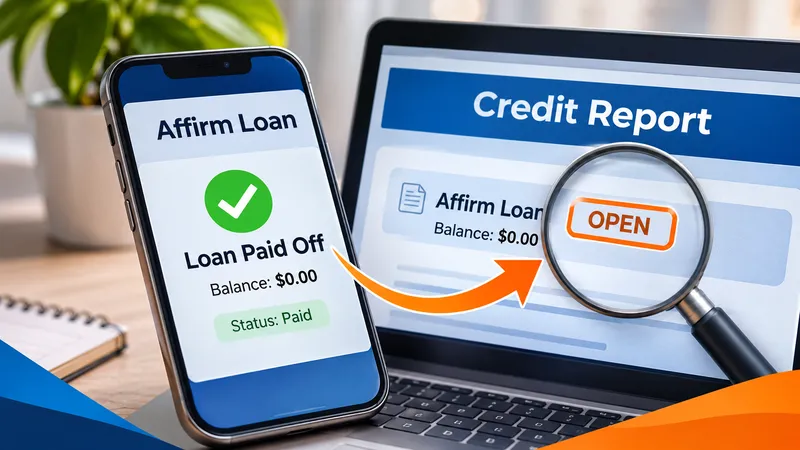
Affirm loan paid off but still showing as open on your credit report? Paying off a loan should reduce your outstanding debt, but your credit report may not reflect the payment immediately. Affirm reports loan information to credit bureaus, and updates can take 30 to 60 days to appear, depending on the reporting cycle. If your Affirm app confirms a $0 balance while your credit report still shows an active loan with an outstanding balance, the discrepancy deserves attention. Inaccurate loan balances can affect how lenders assess your existing debt, particularly when you apply for a mortgage, auto loan, or other financing.
At ASAP Credit Repair USA, our nearly 20 years of experience helping consumers address credit reporting problems highlight the importance of checking account balances and payment records for accuracy. Under the Fair Credit Reporting Act (FCRA), consumers have the right to dispute inaccurate or incomplete information on their credit reports. This guide explains why a paid-off Affirm loan may still appear open, how to distinguish a normal reporting delay from an error, and how to request corrections from Affirm and the credit bureaus to protect your credit history.
Does Affirm Report to Credit Bureaus?
Yes. Affirm reports loan activity primarily to Experian and, in some cases, to TransUnion. It does not currently report to Equifax for most loan products. Not every Affirm loan is reported; shorter-term interest-free loans are sometimes excluded. When Affirm does report, the loan appears as an installment account. The status should update to paid and closed within 30 to 60 days after the final payment clears.
Affirm entered the credit reporting ecosystem more fully in recent years, and its reporting practices are not uniform across all loan types. A short-term 0% APR loan, a "pay in 4" product split across six weeks, is treated differently than a longer-term installment loan with interest. Longer-term loans with interest are more consistently reported to Experian and sometimes TransUnion.
This inconsistency creates its own problem. Some borrowers discover Affirm loans on their credit report that they did not know were being reported. Others paid off a loan they assumed was being reported and later find out it never appeared. For this article, the issue is the opposite: a loan that is being reported, and that is not updating after payoff.
When an Affirm loan does appear on your credit report, the entry looks like any other installment loan. It shows the original loan amount, the payment history, the current balance, and the account status. All of those fields are supposed to update when the loan is paid off. When they do not, the problem is in Affirm's reporting pipeline, not in your credit history.
Why Is My Paid-Off Affirm Loan Still Showing Open on My Credit Report?
Affirm reports to the bureaus on a monthly cycle. If your final payment posted after Affirm's most recent reporting cutoff, the update will not appear until the next cycle, up to 60 days after payoff. If more than 60 days have passed and the loan still shows open with a balance, Affirm has not sent the updated data, and that is a reporting error under FCRA Section 623. You are entitled to dispute it and have it corrected.
The 30-to-60-day window is legitimate. Monthly reporting cycles mean there is always a lag between when something changes on a loan and when it appears on a credit report. If you paid off your Affirm loan two weeks ago, the report has likely not yet updated. Wait until after the next full billing cycle before treating it as an error.
Beyond 60 days, the lag is no longer a timing issue. It is a reporting failure. Affirm's system did not send the payoff data to Experian or TransUnion on its next reporting cycle, and the stale data continues sitting on your report as though the loan is still active and carrying a balance.
| Time Since Payoff | What It Means | What to Do |
|---|---|---|
| Under 30 days | Normal reporting lag — update likely not sent yet | Wait for the next monthly reporting cycle |
| 30 to 60 days | Borderline may still be in the reporting pipeline | Check the Affirm app for payoff confirmation; monitor your report |
| 60 days or more | Reporting error Affirm did not send the update | File a formal dispute with Affirm and the bureau immediately |
| Multiple months, loan shows delinquent | Serious reporting error may show late payments that did not occur | Dispute with Affirm and bureau; file CFPB complaint if unresolved |
several specific scenarios cause the open-after-payoff error. An early payoff paying the loan off before its scheduled end date sometimes does not trigger the same automatic reporting update as a final scheduled payment. A payoff made through a third-party method, such as a bank transfer rather than the standard Affirm payment flow, can be recorded differently in Affirm's system and may not trigger a status update. Multiple concurrent Affirm loans create another risk: a payoff on one loan sometimes gets linked to the wrong account in the reporting data, leaving the paid loan showing open and the still-active loan showing incorrect payment history.
How Does an Open Affirm Loan Affect My Credit When It Is Actually Paid Off?
An Affirm loan reported open with a balance raises your total reported debt load and affects your installment utilization, the ratio of remaining balance to original loan amount. For mortgage underwriting, an open Affirm account with any balance requires the underwriter to include that monthly payment in your debt-to-income calculation even when no payment is owed. If the loan shows late payments it did not actually have, the score damage is severe and immediate.
Affirm loans are classified as installment accounts, not revolving accounts. That means they do not affect your credit card utilization ratio directly. But they do affect installment utilization: the aggregate balance remaining on all installment loans relative to their original amounts. A paid-off Affirm loan that still shows 60% of its original balance remaining pulls that ratio in the wrong direction.
The Debt-to-Income Problem for Mortgage Borrowers
This is where the Affirm open-after-payoff error causes the most immediate financial harm. Mortgage underwriters for both conventional loans and FHA/VA loans are required to count every open account with a minimum monthly payment in the borrower's debt-to-income ratio. An Affirm loan showing an open balance of $400 with a minimum monthly payment of $50 adds $50 to your monthly debt obligations in the underwriter's calculation. That $50 reduces how much mortgage you qualify for.
More critically, mortgage processors spot open BNPL accounts on credit reports and flag them for explanation. Even if the underwriter accepts a letter of explanation, the flag slows the loan process and, in some cases, requires Affirm to provide written verification of the payoff directly to the lender, a step that takes time and creates closing risk.
The Score Impact of a Stale Open Balance
Scoring models use the ratio of an installment loan's current balance to its original amount as a signal of how far along the borrower is in repaying it. A loan that is 90% paid off scores better than a loan that is 10% paid off. An Affirm loan that is fully paid but still reporting a balance scores as though it is not paid. The difference between a $0 balance and a $200 remaining balance on a $600 loan is the difference between a loan the model treats as closed and one it treats as 33% remaining, a meaningful scoring distinction when multiple installment loans are in the profile.
When the Open Loan Also Shows Late Payments
The most damaging version of this error is when Affirm not only fails to close the account after payoff but also generates a late payment notation in a subsequent month when no payment was due. If you paid off the loan in full and Affirm's system still expected a monthly payment the following month, it may have reported a missed payment — even though the account was paid in full. That late mark is a derogatory notation that carries significant scoring weight and demands an immediate dispute.
See Exactly What Affirm Is Reporting on Your Credit File
A free 3-bureau audit pulls your current Experian and TransUnion reports so you can see the exact balance and status Affirm is reporting and identify whether your paid-off loan is still showing open before it delays a mortgage or affects your next loan application.
Claim My Free Credit Analysis Now → Secure · 2 minutes · No credit card requiredHow Do I Dispute an Affirm Loan That Is Showing Open After I Paid It Off?
Start by confirming payoff in the Affirm app and saving your documentation. Pull Experian and TransUnion reports and document the balance and status shown on each. File a dispute directly with Affirm and simultaneously with each bureau where the error appears. Affirm has 30 days under FCRA Section 623 to investigate and correct the data it sends to the bureaus. The bureaus have 30 days under FCRA Section 611 to reinvestigate any item you dispute with them directly.
The dispute works because Affirm's own system shows the loan is paid. When you force a formal investigation through a dispute with Affirm, the bureaus review the account, confirm the zero balance, and send updated data. The problem is that this does not happen automatically. You have to initiate it.
- ✓ Confirm and document the payoff in the Affirm app. Open the Affirm app and locate the paid-off loan under your loan history. Take a screenshot or download the payoff confirmation showing the final payment date and a zero balance. If Affirm offers a payoff confirmation email, request or locate it in your inbox. This documentation is your primary dispute evidence.
- ✓ Pull your Experian and TransUnion credit reports. Go to AnnualCreditReport.com and pull your current reports from both bureaus. Find the Affirm account and note the exact balance shown, the account status (open or closed), and the payment history. Document any discrepancy between what Affirm's app shows and what appears on your credit report.
- ✓ File a dispute directly with Affirm. Go to affirm.com/help and use the credit reporting dispute option in the app or on the website. Submit the dispute in writing and attach your payoff confirmation. Affirm's credit reporting team is separate from general customer service; use the designated dispute channel, not general chat support.
- ✓ File simultaneously with Experian and TransUnion. Dispute the Affirm account online at Experian.com and TransUnion.com, or mail certified written disputes to each bureau. Include your payoff documentation with both filings. The 30-day investigation window starts from the date each bureau receives your dispute.
- ✓ Keep all confirmation records. Save your dispute confirmation numbers from Affirm and from each bureau, the date you submitted each dispute, and all responses you receive. These records are essential if the error is not corrected and you need to escalate.
- ✗ Do not rely on Affirm's general customer support to fix a credit reporting error. Front-line Affirm support agents handle payment questions and account issues. Credit reporting corrections are handled by a separate internal team that processes formal disputes, not chat conversations. A chat agent telling you "it will update soon" does not constitute a formal dispute and does not start the FCRA investigation clock.
Under FCRA Section 623(a)(2), a furnisher that knows or has reasonable cause to believe that information it previously furnished is no longer accurate must promptly notify the consumer reporting agency and provide corrected information. When an Affirm loan is paid off, Affirm knows the balance is zero. Continuing to report a balance after that payoff is a failure to meet the obligation that the FCRA places on every data furnisher — regardless of whether the borrower has filed a dispute.
What Do I Do If Affirm Says the Account Is Reporting Correctly?
File a CFPB complaint at consumerfinance.gov/complaint and attach your payoff confirmation. The CFPB contacts Affirm directly and requires a formal response within 15 days. You can also request the method of verification from the bureau in writing under FCRA Section 611(a)(7). If the inaccurate reporting caused financial harm, such as a mortgage denial or a higher rate, you have the right to sue Affirm or the bureau under FCRA Sections 616 and 617.
Affirm's dispute team determined the account is reporting accurately. That conclusion is not final and does not close your options. You move to the next level of regulatory and legal pressure.
File a CFPB Complaint
A complaint at consumerfinance.gov/complaint creates a federal regulatory record. The CFPB routes the complaint to Affirm and requires a written response, typically within 15 days. BNPL lenders, including Affirm, are under heightened CFPB scrutiny for credit reporting practices. A CFPB complaint after a rejected dispute is the most effective escalation step available without taking legal action. Attach your payoff confirmation screenshot from the Affirm app and your credit report showing the error. The case is straightforward: Affirm's own system shows zero balance; the credit report shows otherwise.
Request the Method of Verification from the Bureau
Under FCRA Section 611(a)(7), after a bureau completes a dispute investigation, you have the right to request a written description of the procedure it used to verify the item. Send this request to Experian or TransUnion after they confirm the account is "verified as accurate." Ask specifically: what source confirmed the current balance and open status? If Affirm responded to the bureau's investigation by confirming the balance when their own app shows zero, that is evidence of an internal inconsistency within Affirm's systems. That inconsistency is the basis for a follow-up dispute or CFPB complaint naming the specific discrepancy.
Add a 100-Word Consumer Statement
Under FCRA Section 611(b), you have the right to add a brief statement to your credit file. The statement appears every time a lender pulls your report. If you are applying for a mortgage or other credit while the dispute is pending, that statement tells the underwriter you dispute the Affirm account's accuracy and have documentation of the payoff, which helps your case during manual underwriting review.
Your Right to Sue Under the FCRA
FCRA Sections 616 and 617 give consumers the right to sue furnishers and bureaus in federal court for violations. If the open Affirm account caused documented harm a mortgage denial, a higher rate, a lost purchase contract you are entitled to actual damages, statutory damages, and attorney's fees. BNPL lenders are not exempt from FCRA liability, and courts have treated them as furnishers with the same legal obligations as traditional banks and credit card companies.
A 30-to-60-day reporting lag after payoff is normal. Beyond that window, an Affirm loan still showing open with a balance is a reporting error that Affirm is legally required to correct. Document the payoff in the app before you do anything else. File the dispute with both Affirm and the bureaus where the error appears — the FCRA gives you the right to force the investigation and require the correction. If you have a mortgage application in progress, file the dispute and submit a letter of explanation to the underwriter at the same time.
Does Affirm report to credit bureaus?
Yes. Affirm reports loan activity primarily to Experian and, in some cases, to TransUnion. It does not currently report to Equifax for most loan products. Not every Affirm loan is reported; shorter-term interest-free loans are sometimes excluded. When Affirm does report, the loan appears as an installment account. The status should update to paid and closed within 30 to 60 days after the final payment clears.
Why is my paid-off Affirm loan still showing open on my credit report?
Affirm reports to the credit bureaus on a monthly cycle. If your final payment posted after Affirm's most recent reporting date, the update will not appear until the next cycle, which can take 30 to 60 days. If more than 60 days have passed since your payoff and the account still shows open with a balance, Affirm has not sent the updated data to the bureau, and that is a reporting error under FCRA Section 623. You are entitled to dispute it and have it corrected.
How does an open Affirm loan affect my credit when it is actually paid off?
An Affirm loan reported open with a balance raises your total reported debt load, which affects debt-to-income calculations lenders use during manual underwriting for mortgages and auto loans. For credit scoring, the balance on an installment loan relative to its original amount affects the installment utilization factor; a loan showing 80% of its balance remaining when it is actually paid off suppresses your score. For mortgage applications specifically, an open Affirm account requires the underwriter to include that monthly payment in your debt-to-income calculation even when no payment is owed.
How do I dispute an Affirm loan that is showing open after I paid it off?
Start by confirming your payoff in the Affirm app — download the payoff confirmation or final payment receipt. Then pull your credit reports from Experian and TransUnion at AnnualCreditReport.com and document the balance and status shown on each. File a dispute directly with Affirm through their app or at affirm.com/help, and simultaneously file disputes with Experian and TransUnion. Affirm has 30 days under FCRA Section 623 to investigate and correct the reporting. The bureaus have 30 days under FCRA Section 611 to reinvestigate any item you dispute with them directly.
What do I do if Affirm says the account is reporting correctly, but my loan is paid off?
File a complaint with the Consumer Financial Protection Bureau at consumerfinance.gov/complaint. Attach your payoff confirmation from the Affirm app and your credit report showing the error. The CFPB contacts Affirm and requires a formal response within 15 days. You can also request the method of verification from the bureau in writing under FCRA Section 611(a)(7). If the inaccurate reporting caused documented financial harm, such as a mortgage denial or a higher rate, you have the right to sue Affirm or the bureau under FCRA Sections 616 and 617.
Find Out What Every Open Account on Your Credit Report Is Actually Showing
A free 3-bureau audit pulls your current Experian, TransUnion, and Equifax reports so you can see every account — including any Affirm loan that may still be showing a balance after payoff. Know exactly what is on your file before your next credit application.
Claim My Free Credit Analysis Now → Secure · 2 minutes · No credit card required-
Capital One Closed My Account Without Warning: Will It Hurt My Credit? Covers what a surprise account closure does to your utilization ratio and credit score and how to dispute any inaccurate information left behind on the closed account.
-
Canceled GAP Insurance but Auto Loan Balance Is Still Wrong? Here's Why Same category of error as a lender's reporting system showing a higher balance than what is actually owed. Covers GAP refunds and total-loss payouts that never make it to the credit report.
-
How to Dispute Credit Report Errors: A Step-by-Step Guide The complete FCRA dispute process: what to include, what the bureaus are required to do, and what happens when a dispute is rejected or the error is not corrected.