

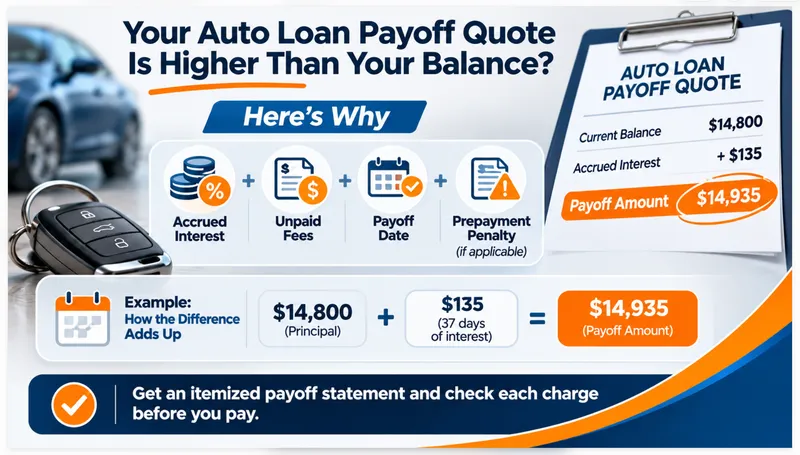
Your lender's app says you owe $14,800 on your car loan, but the payoff quote shows $14,935. That's an extra $135 just to pay off a loan you've been making payments on. Why is your auto loan payoff higher than your balance, and are you actually required to pay the difference? In most cases, the difference comes from interest that continues to accumulate between payments. However, unpaid fees, prepayment penalties, or payments that haven't posted can also affect the final amount.
Here's how quickly the numbers add up. On a $14,800 auto loan with a 9% annual interest rate, daily interest costs approximately $3.65. If 37 days of interest are included in the payoff calculation, that's roughly $135 added to your principal balance. The Consumer Financial Protection Bureau (CFPB) explains that a loan payoff amount includes interest owed through the payoff date and any applicable charges. A higher payoff quote isn't automatically a mistake, but every additional charge should have a clear explanation.
Before sending your final payment, request an itemized payoff statement showing your principal, accrued interest, fees, and quote expiration date.
This guide explains how to calculate your auto loan payoff.
We'll talk about checking a 10-day payoff quote, identify questionable charges, and correct errors before refinancing or trading in your vehicle. You'll also learn why paying off your loan doesn't immediately update your credit report and when an incorrect reported balance deserves a dispute.
Your Auto Loan Payoff Quote Is Higher Than Your Balance: How to Check the Difference
An auto loan payoff higher than your balance is normal, because the lender adds interest accrued through the payoff date. Your app shows $14,800. Your 10-day payoff quote shows $14,935. The $135 gap is a number you verify, not a number you assume is wrong. The quote date explains most of what you see.
The CFPB states that your payoff amount differs from your current balance and includes interest due through the day you pay off the loan. It also covers fees you were charged but have not paid, and a prepayment penalty if your contract includes one.
Some quotes carry real errors, such as a missing payment, a fee your contract does not allow, or an expired date. This guide shows how to calculate the difference with a worked $15,000 example and a calculator. You also learn which charges to question, how to audit the quote in six steps, and what to do before you send the final payment.
- Payoff = principal + accrued interest + valid charges − credits. The result is a price for one date.
- Daily interest is legitimate. Fees need a basis in your contract and the law.
- Get the quote in writing. Ask for the issue date, expiration date, and per diem.
- A complaint does not pause interest. Keep your sale or refinance deadline in view.
Why Is My Auto Loan Payoff Higher Than My Balance?
An auto loan payoff quote is often higher than the displayed principal balance because the lender includes interest accrued through the payoff date and any applicable charges. To verify the difference, compare the principal balance, daily interest, unpaid fees, payment history, and quote expiration date. Request an itemized payoff statement if the amounts do not match.
Interest drives most of the gap. A simple-interest loan accrues interest every day, so the days between your last payment and your payoff date add dollars to the total.
Take the opening example: $14,800 at 9% APR costs $3.65 a day. If your last payment posted 27 days ago and the quote runs 10 days forward, that is 37 days, or $135.02 in interest. The full $135 difference needs no fee at all.
What Is the Difference Between an Auto Loan Balance and a Payoff Quote?
A loan balance is the principal you owe as of your last posted payment. A payoff quote is the total needed to close the loan on a specific future date. The two numbers differ because interest and charges keep accruing between those dates.
The balance in your lender's app reflects activity through its last update. It leaves out interest that has built up since then.
The payoff quote adds that interest through a stated date, along with unpaid fees. The CFPB states that a servicer must give you an accurate statement of the total amount needed to pay off a secured loan as of a specified date. After that date, the quote no longer holds.
What Charges Increase an Auto Loan Payoff Quote?
Four items increase a payoff quote: interest accrued since your last payment, late fees and other unpaid charges, a prepayment penalty if your contract includes one, and pending payments that have not posted. Only the first is certain. Verify each of the others against your contract.
Daily Interest Accrued Since Your Last Payment
Daily interest is your balance times your annual rate divided by 365. On a $15,000 balance at 9%, that is $3.70 a day. The CFPB explains that simple interest is calculated on the outstanding balance, either daily or monthly, so each day adds to your payoff.
Late Fees and Unpaid Charges
Late fees raise the payoff only if the lender charged them and you have not paid them. The CFPB states that a monthly payment is generally applied first to fees due, then to interest, then to principal. An unpaid $25 fee therefore reduces how much of your payment lowers principal.
Prepayment Penalties
A prepayment penalty applies only if your contract includes one. The CFPB states that your contract and state law determine whether early payoff is allowed without a fee, and some states prohibit prepayment penalties for certain loans. Read the clause before you accept the quote.
Pending Payments or Unposted Credits
A payment that has not posted does not reduce your balance yet. If you paid two days before the quote, ask the servicer whether it counted that payment, and bring the confirmation number. A refund from a canceled product, such as a warranty, belongs in the quote as a credit.
How Do You Calculate Your Auto Loan Payoff Amount?
Add the principal, the interest accrued for the days until payoff, and any valid fees, then subtract credits. For a simple-interest loan on a 365-day basis, daily interest equals principal times the annual rate divided by 365. Your lender's official quote controls the amount you pay.
Estimated payoff = Principal + (Daily interest × Days) + Fees − Credits
Consider a common question: "My lender's app says I owe $15,000, but the payoff quote is almost $15,100. Where did that extra money come from?" The table breaks down a $15,000 loan at 9% over 20 days.
| Line Item | Amount |
|---|---|
| Outstanding principal | $15,000.00 |
| Annual interest rate | 9.00% |
| Daily interest (365-day basis) | $3.70 |
| Accrued interest for 20 days | $73.97 |
| Illustrative unpaid late fee | $25.00 |
| Estimated payoff amount | $15,098.97 |
The $98.97 difference is not automatically an error. Confirm the $73.97 interest calculation, then decide whether the $25 fee is valid.
Credit Acceptance publishes the same five-step method: find the principal, calculate daily interest, count the days since your last payment, multiply, and add fees. It also advises you to request an official quote, because the formula only estimates.
Precomputed loans work differently. The CFPB explains that a precomputed loan adds interest to the principal at the start, and your contract decides whether early payoff earns a partial rebate of unearned interest. Check which type you have.
What Does a 10-Day Auto Loan Payoff Quote Include?
A 10-day payoff quote includes your principal, interest through the last day of the quote window, unpaid charges, and a valid-through date. If you pay on day 4 instead of day 10, you owe less interest. Many quotes list a per diem so you adjust the amount.
The quote assumes you pay on the final day. Each day earlier removes one day of interest. On a $14,800 loan at 9%, six days earlier saves about $21.90.
The valid-through date matters more than the amount. If your funds arrive after that date, the lender recalculates, and the payoff rises by the per diem for each extra day. Ask for the per diem in writing so you adjust the payment.
How Do You Check Whether Your Payoff Quote Is Correct?
Audit the quote in six steps: get it in writing, compare balances from the same date, recalculate interest, identify every fee, check recent payments and credits, and request a corrected quote before you pay. The audit takes about an hour and uses your contract and payment history.
- Get the payoff quote in writing. Ask the lender for the amount, issue date, expiration date, daily interest, and payment instructions.
- Compare principal balances from the same date. An old monthly statement and a quote calculated weeks later differ by the activity in between.
- Recalculate accrued interest. Check the contract's interest method, the rate, the unpaid principal, and the number of days.
- Identify each fee. Ask the servicer to explain late charges, returned-payment fees, and any prepayment penalty. Check the contract and your state's law.
- Check recent payments and credits. Confirm the lender posted your latest payment, any extra principal payment, and any refund from a canceled product.
- Request a corrected quote. Name the disputed line, send your records, and ask for a written reconciliation before the final payment.
A lender legitimately includes daily interest. It still needs a contractual and legal basis for every additional fee.
What Should You Do if the Payoff Quote Contains an Error?
Match your first action to the exact discrepancy, send the servicer your records in writing, and ask for a corrected quote. If a documented error stays unresolved, file a complaint through the CFPB portal. A complaint does not pause interest or your sale deadline.
| Problem | First Action |
|---|---|
| Interest exceeds your calculation | Ask for the per diem rate, day-count method, and interest start date |
| Recent payment is missing | Send the payment confirmation and posting details |
| Late fee appears incorrect | Compare the due date, payment receipt, and contract |
| Prepayment penalty is unexpected | Review the agreement and state-law restrictions |
| GAP or warranty refund is missing | Request the cancellation and refund-allocation records |
| Quote has expired | Request an updated payoff amount |
| Dealer payoff differs from lender quote | Compare the same payoff dates and confirm the amount sent |
Submit a complaint at the CFPB complaint portal if the servicer does not fix a documented error. The complaint does not suspend your payment obligation or interest accrual, so keep your sale or refinance date in mind and pay the undisputed amount on time.
The lender or servicer controls the official payoff calculation. ASAP Credit Repair USA helps consumers review credit report inaccuracies, and it does not set or change a lender's payoff figure.
Does a Higher Payoff Amount Affect a Car Trade-In or Refinance?
Yes. A higher payoff lowers your trade-in equity and raises the amount a new lender must send to close your old loan. Use the lender's written payoff quote, not the balance in your app, for both.
On a trade-in, compare the lender's current payoff to the dealer's offer. If the payoff exceeds the car's trade-in value, you have negative equity. The CFPB warns that rolling negative equity into a new loan makes the new loan more expensive.
For a refinance, the new lender needs the amount that satisfies the old loan, not the principal in your app. Confirm the good-through date before closing, because a late closing adds per diem interest. If a thin credit file is holding back your options, read our guide to bad credit car loans.
Does Paying Off Your Auto Loan Update Your Credit Report Immediately?
No. Lenders report to the credit bureaus on their own schedules, so a paid-off loan appears after the lender's next reporting cycle. Experian states that issuers report roughly every 30 to 45 days. A delayed update is different from a wrong balance or account status.
Wait through one full billing cycle, then pull your reports from AnnualCreditReport.com. Our guide on how often your FICO Score updates explains the timing.
If the loan still shows a balance after that, or reports a late payment you did not have, file a dispute. See our guide to an incorrect auto loan balance on your credit report and our page on auto loan late payments and credit reporting.
Paid Off Your Auto Loan but Still See the Wrong Balance?
Your lender's payoff quote and your credit report balance serve different purposes. A higher payoff quote does not automatically mean your credit report contains an error. If your credit report shows an incorrect auto loan balance, payment history, or account status, ASAP Credit Repair USA helps you review the information and understand your dispute options.
Review Your Credit Report → Credit report corrections do not guarantee a score increase or the removal of accurate information.Frequently Asked Questions About an Auto Loan Payoff Higher Than the Balance
Why is my auto loan payoff $200 higher than my balance?
Accrued interest and unpaid charges explain the gap. At 9%, a $15,000 loan adds $3.70 a day, so 54 days of interest equals about $200. Ask your lender for an itemized quote that lists interest, fees, and the valid-through date, then compare each line to your contract and payment history.
Does interest accrue daily on a car loan?
On a simple-interest loan, yes. The CFPB states that simple interest is calculated on the outstanding balance, daily or monthly. Multiply your balance by the annual rate and divide by 365 to find the daily amount: a $15,000 balance at 9% accrues $3.70 a day. Precomputed loans work differently, so read your contract.
What is included in a 10-day payoff quote?
A 10-day payoff quote includes your principal, interest through the last day of the quote window, unpaid fees, and a valid-through date. Paying earlier lowers the interest by one per diem for each day. Paying after the date voids the quote, and the lender recalculates the amount, so ask for the per diem in writing.
Is it possible for my auto loan payoff to increase after I make a payment?
Yes, in specific cases. The CFPB states that payments go first to fees, then to interest, then to principal, so a payment that mostly covers fees and interest lowers principal only slightly. Interest also keeps accruing each day, and a quote for a later date adds more days of it.
Is an auto lender allowed to charge a prepayment penalty?
Yes, if your contract includes one and your state permits it. The CFPB states that your contract and state law determine whether early payoff carries a fee, and some states prohibit prepayment penalties for certain loans. Read the clause in your agreement, then ask the servicer to cite it in writing.
How do I get an itemized auto loan payoff statement?
Contact your lender or servicer and request it in writing. The CFPB states that you request a payoff amount from your lender or servicer, and the statement lists the total as of a specified date. Ask for the issue date, expiration date, per diem, and each fee, and keep the reply for your records.
What happens if I pay less than the payoff quote?
The loan stays open and you still owe the remainder. Interest continues to accrue on the unpaid balance, and the lender holds the lien on your title until the loan is paid in full. Ask for an updated quote and send the exact amount, or confirm in writing how the lender applied your payment.
How long does it take for a paid-off car loan to show on my credit report?
Allow at least one full billing cycle. Lenders report on their own schedules, and Experian states that issuers report roughly every 30 to 45 days. Pull your reports from AnnualCreditReport.com after that window. If the balance or status is still wrong, file a dispute with the bureau and the lender.
A higher payoff quote is a price for one day, and the math behind it is yours to check. Request the itemized quote, recompute the interest, and challenge only the lines your contract does not support.
- Dispute Credit Report Errors GuideSteps to dispute a wrong balance or status.
- Late Payments on Credit Report: Removal GuideHow late payments get reported and corrected.
- How Often Does Your FICO Score Update?Why a payoff takes time to appear.
- Bad Credit Car Loans: How To Get ApprovedAuto loan options when your credit is thin.
- Consumer Financial Protection Bureau — What is a payoff amount and is it the same as my current balance?
- Consumer Financial Protection Bureau — Should I trade in my car if it's not paid off?
- Consumer Financial Protection Bureau — Interest and principal on auto loans
- Consumer Financial Protection Bureau — Can I prepay my loan at any time without penalty?
- Consumer Financial Protection Bureau — Simple interest vs. precomputed interest
- Consumer Financial Protection Bureau — Submit a complaint
- Credit Acceptance — Calculating your payoff amount
- Experian — Statement balance vs. current balance (reporting cycles)
- AnnualCreditReport.com — Free credit reports