

Bank merger credit report errors deserve a closer look when your lender changes names and your account details no longer match your records. You paid on time, kept your balance under control, and never requested a new account. Now, your report shows an unfamiliar lender, a closed account, or a balance that looks wrong. The first step is identifying which changes reflect the transfer and which contain inaccurate information.
The distinction matters because payment history represents 35% of a typical FICO® Score, while amounts owed account for 30%. The weight varies by credit profile, but these figures explain why incorrect late payments and balances deserve attention. A transferred account marked closed is not automatically negative, and a score change alone does not prove a reporting error.
Start with the records that establish what happened: your last statement from the old bank, the transfer notice, and your first statement from the new lender. Compare opening dates, balances, payment status, and account numbers across all three credit reports.
Does a Bank Merger Affect Your Credit History?
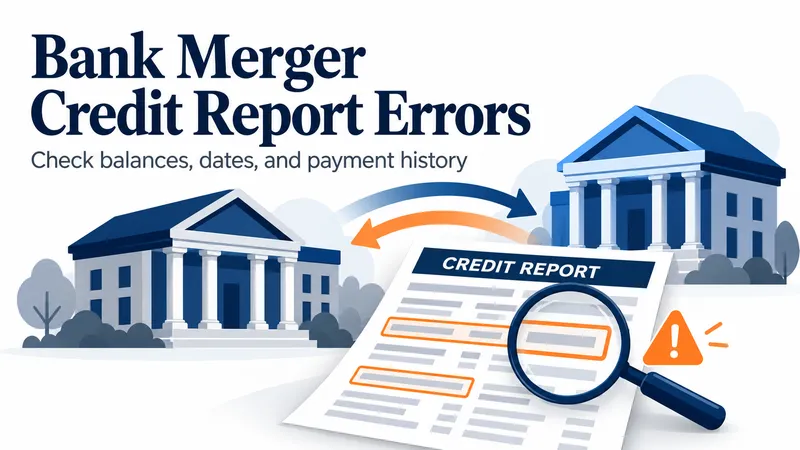
A bank merger does not erase your credit history by design, but it frequently causes credit report errors during the transition. New account numbers, system migrations, and data transfers between banks create reporting gaps that show up as closed accounts, missing payment history, duplicate entries, and balance misreports, all of which can lower your credit score even though your account was never mismanaged.
When two banks merge, the acquiring institution absorbs the accounts of the purchased bank. The legal obligation to report accurately transfers with the account. Your payment history, account age, and balance should move with it. In practice, the data migration does not always execute cleanly.
The FDIC approved 123 bank mergers in 2024, and deal activity through Q3 2025 surpassed the prior three combined years. That means a large and growing number of consumers are experiencing account transitions right now, many of them without realizing the effect it has on their credit report until they apply for a loan and see a score they did not expect.
Why Does a Bank Merger Change Your Credit Report?
A bank merger changes your credit report because the acquiring bank typically issues a new account number. The old account is closed in the system, and a new one is opened. When that data is reported to the bureaus, the old account shows as closed by the creditor, and the new account appears as a brand new account with no payment history, even though you have been paying the same debt for years.
This is the core problem. A new account number is a new tradeline on your credit report. The bureaus may not automatically connect it to the old one. Without that connection, your credit file ends up with two entries for the same account: a closed account with years of positive history, and a new account with zero history and a zero-month age. The same problem appears in balance transfers, a topic covered in detail in why a balance transfer shows double debt on your credit report.
The closed account drops your average account age because closed accounts eventually age off. The new account pulls your average age down further because it starts at zero months. Your available credit line may briefly disappear from utilization calculations, temporarily spiking your reported ratio. All of this from a merger you had no control over.
What Credit Report Errors Are Common After a Bank Merger?
The most common credit report errors after a bank merger are: an account wrongly shown as closed by the creditor, missing or truncated payment history on the new account, a duplicate entry for the same debt inflating your total reported balance, a balance transferred incorrectly to the new account, and a new account number treated as a brand new account with no prior history.
| Error Type | What It Looks Like | FICO Factor Affected |
|---|---|---|
| Account marked closed by creditor | Old account number shows "closed" on all three bureaus | Credit age (15%), available credit/utilization (30%) |
| Missing payment history | New account shows fewer on-time payments than the actual account history | Payment history (35%) |
| Duplicate entry | Both old and new account numbers report a balance simultaneously | Utilization (30%), total debt |
| Balance misreport | New account shows wrong balance or zero on the transfer date | Utilization (30%) |
| New account with no history | New account number appears with a 0-month age and no payment record | Credit age (15%), new credit (10%) |
Can a Bank Merger Lower Your Credit Score?
Yes. A bank merger lowers your credit score when the transition creates reporting errors. An account wrongly shown as closed reduces available credit and drops average account age. Missing payment history reduces the positive weight of that account. A duplicate entry inflates reported debt and raises utilization. A new account number with no history adds a zero-month account to your file. Each of these is a scoring event, and several can happen from a single merger.
The accounts most affected are credit cards and lines of credit, where utilization reporting is immediate. A credit card that shows as closed in a merger transition removes that card's credit limit from your utilization calculation. If you carry balances on other cards, your overall utilization ratio spikes without you spending a single additional dollar.
At ASAP Credit Repair, we regularly audit files where a single bank merger created three or more separate credit report errors. Each error is fixable, but not automatically. They require individual disputes with each bureau that is reporting the error. Closed-lender errors specifically follow a pattern worth understanding — how to fix closed lender credit report errors covers that dispute process in full.
Does the Acquiring Bank Have to Transfer Your Payment History?
The acquiring bank takes on all the legal obligations of the accounts it absorbs, including the obligation to report accurately under the FCRA. Your payment history is part of accurate reporting. If the new bank reports your account without that history, they are reporting incomplete information, which is a dispute ground under FCRA Section 611.
FCRA Section 623 (15 U.S.C. 1681s-2) requires furnishers to report complete and accurate information. A new account number does not release the bank from that obligation. The payment history attached to your account is part of the accurate record. Reporting the new account as if it were brand new, with no prior history, is an inaccuracy you have the right to dispute.
The bank may argue that their systems only captured history from the migration date forward. That is an internal limitation, not a legal excuse. The CFPB's FCRA guidance is clear that furnishers cannot report information they know or have reason to believe is inaccurate or incomplete.
How to Fix Credit Report Errors After a Bank Merger
Fix credit report errors after a bank merger by pulling all three credit reports immediately, documenting every error by account number and description, and filing separate disputes with each bureau reporting the error. Include your old and new account numbers, a written description of each error, and any confirmation from the bank of the account transfer. The bureau must investigate within 30 days and correct anything the bank cannot verify.
1. Pull Your Reports From All Three Bureaus Right Away
Get your full credit reports from Equifax, Experian, and TransUnion through AnnualCreditReport.com. Each bureau receives reporting independently. One bureau may show the error while another shows the account correctly. You need to check all three and file disputes with each one that shows an error.
2. Document the Old and New Account Numbers
Your old bank's account number and your new account number are both critical pieces of documentation. Locate both before you file any dispute. Your new bank's welcome letter or online account portal shows the new number. Any old statements or correspondence from the acquired bank show the original number. You need both to explain the connection to the bureau.
3. Identify Each Specific Error and Its FICO Impact
Do not file a vague dispute. Name the exact error on each bureau report: the account is wrongly shown as closed, the payment history is missing, a duplicate entry exists with an inflated balance, or the new account shows no history. A specific dispute gives the bureau a clear target to investigate and makes it harder for the furnisher to respond with a generic verification.
4. File Disputes With Each Bureau Showing the Error
- ✓ Address separate dispute letters to Equifax, Experian, and TransUnion for each error on their report
- ✓ Include your full name, address, and last four digits of your Social Security number
- ✓ State both the old account number and the new account number in the dispute
- ✓ Describe the specific error: closed status, missing history, duplicate entry, or balance error
- ✓ Include any written confirmation from the acquiring bank of the account transfer
- ✓ Send by certified mail with return receipt requested and keep a copy of everything
5. Contact the New Bank Directly
File the bureau dispute and contact the bank at the same time. Ask the bank's credit reporting department to issue a corrected data file to all three bureaus. Request written confirmation of the account transfer date, original account opening date, and full payment history. Some banks resolve the reporting error faster when you approach them directly alongside a formal bureau dispute.
6. Request a Goodwill Adjustment if a Late Payment Appeared
If the system transition caused a missed or late payment that hit your report, send a goodwill letter to the new bank after the merge errors are corrected. Explain that the late payment resulted from the account transition, not from failure to pay. Some banks remove one-time merger-related late marks for customers with otherwise clean payment history. Results vary, but it costs nothing to ask and removes the mark permanently if approved.
What Happens to Your Credit if the Bank Merger Causes a Late Payment?
A late payment caused by a bank merger through a changed due date, a new payment portal, or a billing disruption is reported the same way as any other late payment. It stays on your credit report for seven years from the first date it was reported late. Payment history accounts for 35% of your FICO score, so even one merger-related late mark can drop a score significantly.
This is one of the most damaging and least obvious effects of a bank merger. The acquiring bank changes the payment portal, the mailing address, and sometimes the due date. Customers who were on autopay often find that their old autopay did not transfer. The first bill under the new system goes unpaid because the customer did not know to set up a new payment method.
If the late payment resulted from a transition in the bank's payment portal, a changed due date, or a failed autopay transfer, you have grounds for a goodwill removal request and potentially a CFPB complaint if the bank refuses.
If the bank provided clear notice of the new portal and due date, and the payment was still missed, the late mark is accurate. A goodwill letter is still worth sending, but the bank has no obligation to remove it.
Check your bank's merger communication history. Banks are required to notify customers of material changes. If you can show the bank failed to provide adequate notice of a payment system change that led to the late mark, that strengthens your position in both a dispute and a goodwill letter. For a deeper look at how late marks persist even after you start paying on time, see why late payments still show after catching up.
The acquiring bank steps into the shoes of the old bank entirely. Every obligation to report accurately, including the obligation to correct errors the transition created, belongs to the new bank from the moment the merger closes. You do not have to wait for them to fix it on their own. You have the right to dispute and force a response within 30 days.
Bank mergers create credit report errors regularly: closed accounts, missing history, duplicates, and balance misreports. None of these require you to have done anything wrong. All of them are fixable through the FCRA dispute process. The key steps are pulling all three reports immediately after a merger, documenting every error with both account numbers, and filing specific disputes with each bureau that is reporting the problem. Vague disputes get vague responses. Specific disputes, backed by documentation, force the bank to verify or correct.
Does a bank merger affect my credit history?
A bank merger can affect your credit history when the acquiring bank assigns a new account number. The merger itself does not erase your payment history or reset your account age, but reporting errors during the transition often do. Duplicate entries, accounts wrongly marked closed, missing payment history, and balance misreports are the most common problems that appear on credit reports after a bank merger.
Why did my account show as closed after a bank merger?
When a bank merges and issues new account numbers, the old account is technically closed in the system and a new one is opened. The bureau receives two data points: a closure on the old number and an opening on the new one. If the new account does not carry over the full payment history, your credit report ends up with a closed account holding years of history and a brand new account with zero history. Both entries damage your score.
Can a bank merger lower my credit score?
Yes. A bank merger lowers your credit score through several reporting errors: an account wrongly shown as closed drops your available credit and reduces average account age; missing payment history reduces the positive weight of that account; a duplicate entry inflates your reported debt; and a balance misreport distorts your credit utilization. None of these are required to happen, but all are common during transitions between banking systems.
How do I dispute credit report errors caused by a bank merger?
File a dispute with each bureau showing the error. Include your old and new account numbers, a description of the specific error, and any documentation from the bank confirming the merger and account transfer. The bureau must investigate within 30 days. If the new bank cannot verify the accuracy of what they reported, the bureau must correct or delete the entry.
Will my payment history transfer to the new account after a bank merger?
It should, but it does not always happen automatically. The new bank is required under the FCRA to report accurate information. If your payment history is missing or truncated on the new account, you can dispute the incomplete record with the credit bureaus and provide documentation of your actual payment history from the old account.
Not Sure What Changed on Your Report After a Bank Merger?
A free 3-bureau audit shows exactly what Equifax, Experian, and TransUnion are currently reporting. We identify every account, every status, and every error that has grounds for dispute before a single letter goes out.
Get My Free 3-Bureau Audit → Secure · 2 minutes · No credit card required-
Closed Lender Credit Report Errors: How to Fix Them Covers the full dispute process for accounts that show incorrect closed-lender status, the most common error created by bank mergers and account transfers.
-
Balance Transfer Shows Double Debt? Causes and Fixes Explains why duplicate entries appear for the same debt after an account transfer and how to dispute them before they inflate your utilization ratio.
-
Late Payments After Catching Up: Why They Still Show Details why a late mark from a payment disruption — including merger-related billing changes stays on your report and what you can do to remove it.