
Your lender went out of business, but the wrong information on your credit report is still very much alive. A missed payment that never happened, a balance that was never corrected after the account transferred, a closed account still showing as open these errors follow you to every loan application, every apartment, every employer background check. The Fair Credit Reporting Act gives you specific rights in exactly this situation. You do not need the original lender to still be in business to fix what they reported incorrectly
The FDIC recorded five bank failures in 2023, involving approximately $548.7 billion in assets. These failures show the scale of financial institutions whose accounts require handling after closure. They don't show how many borrowers experienced reporting errors, but they highlight why it matters to know who now manages your loan.
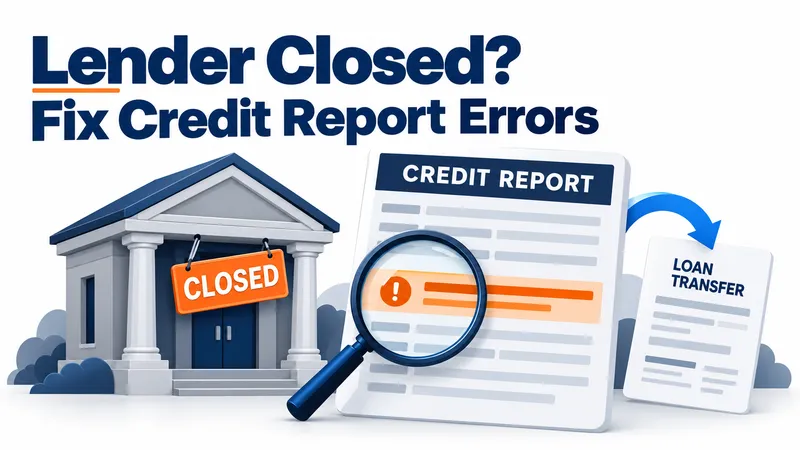
What Happens to My Loan When My Lender Goes Out of Business?
When a lender closes, its loan portfolio is almost always sold to or assumed by another financial institution. The FDIC steps in as receiver for failed banks and arranges a purchase-and-assumption agreement with an acquiring bank. The borrower still owes the same debt, just to a new owner. That new owner becomes the furnisher legally responsible for accurate credit reporting under the FCRA.
A lender shutting down does not cancel any debt. It transfers it. For bank failures, the Federal Deposit Insurance Corporation (FDIC) takes control as the receiver. It typically arranges a purchase-and-assumption agreement within days, where a healthy bank acquires the failed institution's deposits and loan portfolio. For failed credit unions, the National Credit Union Administration (NCUA) plays the same role.
Voluntary shutdowns work differently. When a lender chooses to wind down, it sells its loan portfolio sometimes in pieces, to multiple buyers. A mortgage might go to one servicer. A personal loan might go to another. In either case, the borrower receives a notice of transfer, though those notices sometimes arrive late, go to old addresses, or simply get missed.
The credit reporting responsibility shifts with the loan. Whoever owns the debt now is the furnisher. Under FCRA Section 623, that entity is legally required to report accurate information and to investigate any dispute within 30 days.
Who Is Legally Responsible for Fixing Credit Reporting Errors from a Closed Lender?
The entity that acquired the loan is the furnisher and is legally responsible for correcting errors under FCRA Section 623. If no successor entity exists and the item cannot be verified, the credit bureau must delete it under FCRA Section 611. The original lender being out of business does not give anyone permission to leave inaccurate data on your report.
This is where most consumers get stuck. The old phone number is disconnected. The website is gone. There is no one to call at the original lender. But the FCRA does not let reporting errors sit on a file simply because the company that created them closed.
If the Loan Was Acquired by Another Institution
The acquiring bank or servicer is now the data furnisher. It inherited the account and, with it, the obligation to report accurately. File your dispute directly with that institution. Under FCRA Section 623(b), it has 30 days to investigate and either correct, delete, or certify the accuracy of the disputed item.
If the Lender Went Out of Business With No Acquirer
Some lenders close without a clean portfolio transfer, particularly smaller non-bank mortgage lenders or fintech lenders that wind down abruptly. In those cases, there is no furnisher to contact. The credit bureaus still bear the verification responsibility. Under FCRA Section 611, Equifax, Experian, and TransUnion must investigate any dispute within 30 days. If they cannot verify the item because the original furnisher no longer exists to confirm it, they must delete it.
| Scenario | Who Holds the Furnisher Obligation | Where to File Your Dispute |
|---|---|---|
| Bank failed — acquired by another bank | The acquiring institution | Acquiring bank + all 3 bureaus |
| Bank voluntarily closed — sold loan portfolio | The purchasing servicer or lender | New servicer + all 3 bureaus |
| Credit union failed — NCUA receivership | NCUA or the assuming credit union | NCUA receiver + all 3 bureaus |
| Non-bank lender shut down with no successor | No active furnisher — bureaus bear the burden | All 3 bureaus only |
| Partial portfolio sale — account in limbo | Whoever currently holds servicing rights | Check your last payment statement, then dispute |
Not Sure Who Is Reporting the Error on Your File?
A free 3-bureau audit shows every account currently reporting on your Equifax, Experian, and TransUnion reports — including accounts from lenders that have been acquired, renamed, or closed. Find out exactly what is on your report before you file anything.
Claim My Free Credit Analysis Now → Secure · 2 minutes · No credit card requiredHow Do I Dispute a Credit Error When the Original Lender No Longer Exists?
Start by identifying who acquired the original lender using the FDIC BankFind Suite or NCUA's Credit Union Locator. Then file disputes simultaneously with the acquiring institution and all three credit bureaus. Include documentation that shows the error. The bureaus have 30 days to investigate, and any item they cannot verify must be removed.
The dispute process follows a clear sequence. Skipping steps or filing with only one bureau leaves errors in place on the other two reports. Work through this in order.
- ✓ Identify the acquiring institution. Search the FDIC BankFind Suite by your original lender's name. For credit unions, use the NCUA merger and liquidation history. Write down the acquiring institution's name and the date of transfer.
- ✓ Pull your current credit reports. Get reports from all three bureaus at AnnualCreditReport.com. Identify every account tied to the closed lender — look for the original creditor name and any successor servicer name.
- ✓ Document the specific error. Note the incorrect information precisely: a balance that does not match your records, a payment marked late that you made on time, a duplicate account entry, or an account showing open after it was transferred and closed.
- ✓ File with the acquiring institution. Write a formal dispute letter to the acquiring bank or servicer. Include your account number, the exact error, and copies of any supporting documents — payment confirmations, payoff letters, transfer notices.
- ✓ File simultaneously with all three bureaus. Dispute online at Equifax.com, Experian.com, and TransUnion.com, or mail written disputes via certified mail. Include the same supporting documentation with each bureau. The 30-day investigation clock starts when they receive your dispute.
- ✓ Keep copies of everything. Save your dispute confirmation numbers, the date filed, and any response you receive. You need these records if a follow-up complaint becomes necessary.
What Happens If the Credit Bureau Cannot Verify the Item?
Under FCRA Section 611(a)(5)(A), if the bureau cannot verify a disputed item within 30 days, it must delete that item from your report. This outcome is common when the original furnisher no longer exists, and the acquiring institution's records are incomplete. Filing a dispute forces the verification process to run — which is why disputing is always the right first step.
This is one of the most important pieces of consumer protection in the FCRA, and it applies directly to closed-lender situations. The bureau must contact the furnisher and verify the item. If the furnisher no longer exists, the bureau has no source to confirm the information. If it cannot verify within 30 days, the item must come off.
Acquiring institutions sometimes inherit accounts without complete payment history, original loan documents, or full servicing records. That gap in documentation benefits the consumer in a dispute. An item the acquiring institution cannot verify because they only received partial records is an unverifiable item under the FCRA.
FCRA Section 611(a)(5)(A) states that if a reinvestigation does not resolve the dispute, the bureau "shall promptly delete that item of information from the file of the consumer." The law does not require the bureau to prove the information is wrong. It requires them to verify that it is correct. If they cannot, it must go.
What the Bureau's Investigation Actually Involves
The bureaus send an Automated Consumer Dispute Verification (ACDV) form to the furnisher. The furnisher reviews it and responds, confirming, correcting, or deleting the disputed item. If the original furnisher is gone and the acquiring institution does not respond within 30 days, the bureau must treat the item as unverified and delete it.
Some bureaus use a process called "frivolous dispute" screening to reject disputes without investigation. A dispute that includes specific documentation, the account number, the nature of the error, and supporting records is much harder to classify as frivolous. Always be specific and always include documentation.
What If the Error Is Still There After the 30-Day Investigation?
File a CFPB complaint at consumerfinance.gov/complaint. The CFPB contacts the bureau or furnisher and requires a formal response. If the error caused documented financial harm, such as a higher interest rate or a denied loan, you have the right to sue under FCRA Sections 616 and 617. You can also add a 100-word consumer statement to your credit file.
If the bureau investigated and kept the item on your report, it believes the furnisher verified it. That result does not mean you are out of options.
File a CFPB Complaint
A complaint at consumerfinance.gov/complaint puts federal regulatory pressure on the bureau or furnisher. The CFPB forwards the complaint and requires a response, typically within 15 days. In our experience reviewing client files, a CFPB complaint following a rejected dispute resolves the error in a meaningful portion of cases, particularly when the furnisher is an acquiring institution that took on accounts without complete original records.
Request the Method of Verification
Under FCRA Section 611(a)(7), you have the right to request a description of the procedure the bureau used to verify the disputed item. Ask for it in writing. If the bureau cannot describe what source confirmed the item or cannot produce documentation, that is evidence for a follow-up dispute or a complaint.
Add a 100-Word Consumer Statement
If the dispute is not resolved in your favor, you have the right under FCRA Section 611(b) to add a brief statement to your credit file explaining your position. The statement appears every time a lender pulls your report. It does not remove the item, but it tells every future reviewer that you dispute the accuracy of what they are seeing.
Your Right to Sue Under the FCRA
FCRA Sections 616 and 617 give consumers the right to sue both bureaus and furnishers in federal court for failing to meet their FCRA obligations. If the error caused actual financial harm a loan denial, a rate increase, or lost housing you may be entitled to actual damages, statutory damages, and attorney's fees. This is not a step for every situation, but it is a real legal remedy when the violation is clear, and the financial consequences are documented.
A closed lender does not erase your right to accurate credit reporting. Whoever acquired the loan is now the furnisher. If no one did, the bureaus cannot verify the item and must delete it. The dispute process: bureau disputes first, CFPB complaint second, legal action if documented harm exists, gives you a clear path forward regardless of whether the original lender picks up the phone.
What happens to my loan when my lender goes out of business?
When a lender closes, its loan portfolio is almost always sold to or assumed by another financial institution. The FDIC steps in as receiver for failed banks and arranges a purchase-and-assumption agreement with an acquiring bank. The borrower still owes the same debt, just to a new owner. That new owner becomes the furnisher legally responsible for accurate credit reporting under the Fair Credit Reporting Act.
Who is responsible for fixing credit reporting errors from a closed lender?
The entity that acquired the loan is responsible for correcting any reporting errors. Under FCRA Section 623, data furnishers, including banks that purchased a closed lender's portfolio, must investigate disputes and correct inaccurate information. If no successor entity can be identified, the credit bureaus bear the verification burden. An item the bureau cannot verify must be deleted under FCRA Section 611.
How do I dispute a credit error when the original lender no longer exists?
Start at the FDIC BankFind Suite at bankfind.fdic.gov to identify which institution acquired your closed lender's accounts. Once you have the acquiring institution's name, file a dispute directly with that institution and simultaneously with all three credit bureaus: Equifax, Experian, and TransUnion. The bureaus have 30 days to investigate. Include documentation showing the error: the incorrect balance, wrong payment history, or duplicate account.
What happens if the credit bureau cannot verify an item from a closed lender?
Under FCRA Section 611(a)(5)(A), if the bureau cannot verify a disputed item within 30 days, it must delete that item from your credit report. Closed-lender accounts are particularly vulnerable to this outcome because records are frequently incomplete after a bank failure, acquisition, or portfolio sale. This means a legitimate dispute strategy is to file with all three bureaus simultaneously and let the verification process run its course.
What can I do if the error from a closed lender is still on my report after 30 days?
File a complaint with the Consumer Financial Protection Bureau at consumerfinance.gov/complaint. The CFPB contacts the bureau or furnisher and requires a response. If the error caused actual financial harm, such as a denied loan or a higher interest rate, you have the right to sue the bureau or furnisher under FCRA Sections 616 and 617. You can also add a 100-word consumer statement to your credit file that appears every time a lender pulls your report.
Find Out Exactly What Is on Your Three Credit Reports
A free 3-bureau audit shows every account currently reporting on your Equifax, Experian, and TransUnion files, including accounts from acquired or closed lenders that may be reporting inaccurate information. See the full picture before you start disputing.
Claim My Free Credit Analysis Now → Secure · 2 minutes · No credit card required-
I Paid My Mortgage, but the Money Is "Unapplied": Why Am I Reported Late? Covers the mortgage suspense account problem and how to fix a late mark that appeared even though you made your payment on time.
-
How to Dispute Credit Report Errors: A Step-by-Step Guide The full FCRA dispute process explained — what to include, how the bureaus are required to respond, and what to do when a dispute is rejected.
-
Why Credit Is Important: What Your Score Really Controls Shows what accurate credit reporting protects and what inaccurate reporting costs in real dollars across loans, housing, and insurance rates.