

The best credit card no interest offer is one that gives you enough time to repay your balance without paying more in fees than you save in interest. A 21-month 0% APR promotion may look attractive, but the right choice depends on your existing debt, credit profile, transfer fees, and monthly payment capacity.
Best Credit Cards With No Interest in 2026: Compare 0% APR Offers
Americans carried $1.26 trillion in credit card debt in the second quarter of 2026, according to the Federal Reserve Bank of New York. Balances increased by $21 billion from the previous quarter. For consumers paying high interest rates, a 0% introductory APR can reduce borrowing costs, provided they repay the balance before the promotional period ends.
In nearly 20 years of credit repair work, I've learned to evaluate credit card offers by looking beyond the advertised rate. When reviewing clients' credit reports, I focus on revolving balances, credit utilization, payment history, and inaccurate information that may affect their ability to qualify.
My approach is simple:
“A 0% interest offer is only valuable if the repayment plan works before the promotional rate expires.”
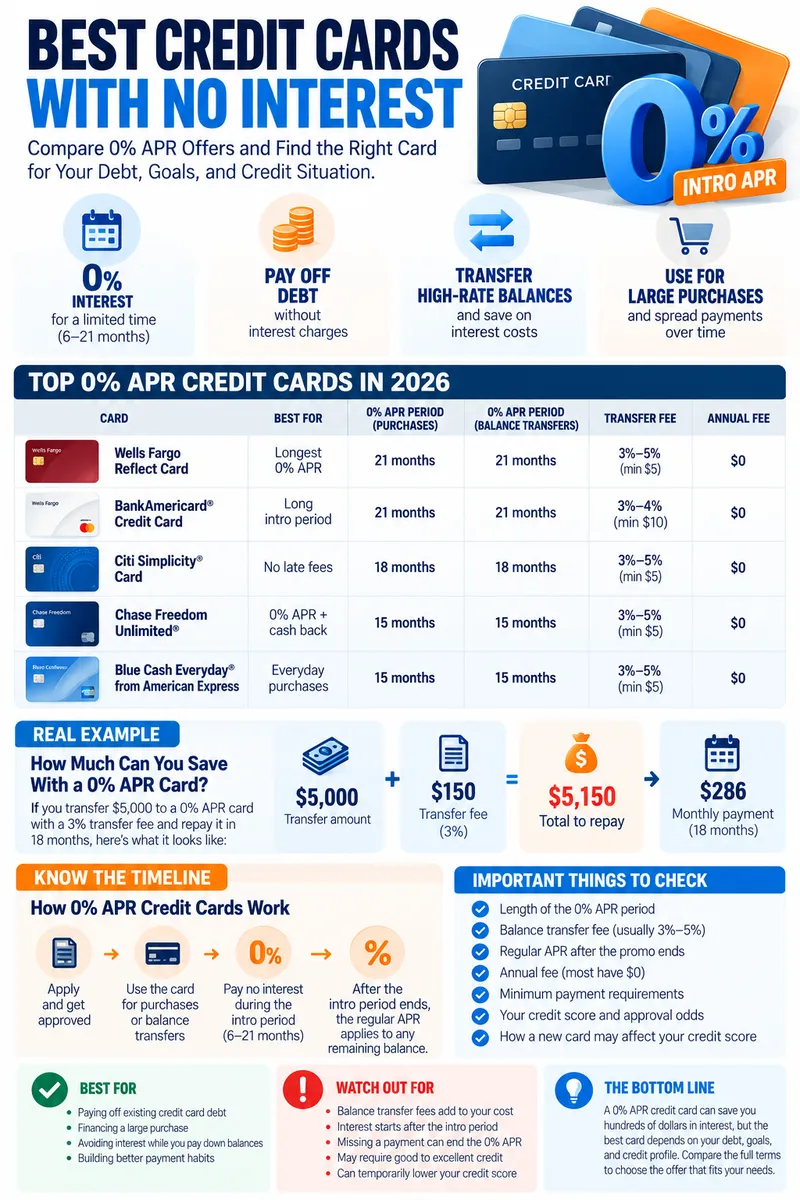
Consider a $5,000 balance transferred to a card with an 18-month 0% APR period and a 3% transfer fee. The fee adds $150, bringing the total to $5,150. Paying approximately $286.12 per month would clear that balance within the promotional period, assuming no additional charges.
This 2026 comparison examines the best 0% APR credit cards based on introductory periods, balance transfer fees, ongoing interest rates, credit requirements, and repayment costs.
We'll also explains when opening another credit card may help or complicate your credit goals.
Best Credit Cards With No Interest in 2026: Compare 0% APR Offers
The best credit card no interest offer depends on your goal. The Wells Fargo Reflect Card leads with 0% APR for 21 months on purchases and balance transfers, Citi Simplicity pairs 0% with no late fees ever, and Chase Freedom Unlimited and Blue Cash Everyday combine a shorter 0% period with ongoing cash-back rewards. Compare the intro period, transfer fee, ongoing APR, and your credit profile before applying.
The best credit card no interest offer isn't always the one with the longest 0% APR period. A 21-month promotion gives you more time to pay off debt, but the transfer fee, your starting credit limit, and the interest rate after the promotion change how much you save.
For example, transferring $5,000 with a 3% fee adds $150 to your balance. To repay $5,150 within 18 months, you'd need to pay about $286 a month. The 0% offer removes interest on the qualifying balance during the promotion - it doesn't remove the transfer fee.
After nearly 20 years in credit repair, I evaluate these offers by looking at the credit profile first. A new card lowers overall utilization if it raises your available credit, but the application also creates a hard inquiry, and a low starting limit sometimes prevents you from transferring the full balance you're carrying.
This comparison examines 0% APR credit cards available in October 2026, including promotional periods, transfer costs, repayment requirements, and credit-score considerations, to help you decide whether applying now makes financial sense.
Key Takeaways
- The Wells Fargo Reflect Card and BankAmericard both offer 0% APR for 21 months - the longest on this list.
- A balance transfer fee of 3% to 5% applies even on 0% offers.
- Rewards cards like Chase Freedom Unlimited trade a shorter 0% period for ongoing cash back.
- A new card changes your credit utilization and triggers a hard inquiry - both affect your score.
What Is the Best Credit Card With No Interest Right Now?
There's no single best card - it depends on your goal. For the longest payoff runway, the Wells Fargo Reflect Card and BankAmericard both offer 21 months at 0%. For simplicity, Citi Simplicity pairs 0% with no late fees, ever. For ongoing value after the intro period, Chase Freedom Unlimited and Blue Cash Everyday add cash-back rewards most pure 0% cards skip.
Best 0% APR Credit Cards Compared for October 2026
Terms below are reported by each issuer and third-party verification as of October 2026. Confirm current terms directly with the issuer before applying - rates and promotions change.
| Card | 0% Intro APR | Transfer Fee | Ongoing APR | Annual Fee |
|---|---|---|---|---|
| Wells Fargo Reflect | 21 months | 5% (min $5) | 17.74%-28.49% | $0 |
| BankAmericard | 21 billing cycles | 5% (min $5) | 15.24%-26.24% | $0 |
| Citi Simplicity | 18 months | 3% then 5% | 17.74%-28.49% | $0 |
| Chase Freedom Unlimited | 15 months | 5% (min $5) | 18.24%-27.74% | $0 |
| Blue Cash Everyday (Amex) | 15 months | N/A for transfers | 19.74%-28.74% | $0 |
Best No-Interest Credit Cards by Financial Goal
How Do 0% Interest Credit Cards Work?
A 0% intro APR card charges no interest on qualifying purchases, balance transfers, or both, for a set number of months starting when the account opens. Purchase APR and transfer APR are sometimes set separately - check both. Once the intro period ends, the card's ongoing variable APR applies to any remaining balance going forward, not retroactively.
Thinking About a 0% APR Card but Concerned About Your Credit?
A no-interest offer reduces borrowing costs, but approval depends on your credit profile. Review your reports for inaccurate information and outstanding collections before you apply.
Start With a Free Credit Report Review →How Much You Save With a 0% APR Credit Card
Here's a worked example for a $5,000 transfer with a 3% fee and an 18-month 0% window, assuming no new charges:
| Item | Amount |
|---|---|
| Existing balance | $5,000.00 |
| Transfer fee (3%) | $150.00 |
| Total to repay over 18 months | $5,150.00 |
| Required monthly payment | $286.11 |
Compare that $150 fee against the interest you'd pay keeping the balance on a card charging 22% APR - on $5,000, that's over $900 a year. The transfer saves money in most cases; the fee is the cost of avoiding that interest.
Is a 0% Balance Transfer Worth the Fee?
Run the math before transferring. Add up the interest you'd pay on your current card over the time you'd need to pay it off, then compare that total to the transfer fee alone. If the interest total is higher, the transfer is worth it. If you'd pay off the balance within a month or two anyway, the fee sometimes costs more than the interest you'd save.
Read what to check if a balance transfer shows as double debtWhat Credit Score Do You Need for a No-Interest Card?
Issuers don't publish exact score cutoffs, and approval depends on income, existing debt, and credit history, not score alone. In practice, the longest 0% offers - 18 to 21 months - typically go to applicants with good to excellent credit, generally 670 and above. Shorter promotions and secured alternatives exist for lower scores.
Does Opening a 0% APR Card Hurt Your Credit Score?
A new application triggers a hard inquiry, which generally costs a few points and fades within months. A new account also lowers your average account age temporarily. On the other side, a new credit limit lowers your overall utilization if you don't run up new charges - and FICO weighs amounts owed at 30% of the score, second only to payment history at 35%. The net effect depends on how you use the card.
What Happens When the 0% APR Period Ends?
Any balance still remaining starts accruing interest at the card's standard ongoing APR - generally 15% to 29% depending on the card and your credit profile. A true 0% intro APR card doesn't charge interest retroactively on the months that already passed; it only applies going forward.
0% Intro APR vs. Deferred Interest: What's the Difference?
These sound alike and work differently. Offer wording reading "0% intro APR for 12 months" means no interest accrues during the window - if a balance remains after, interest applies only from that point forward. Wording reading "no interest if paid in full in 12 months" is deferred interest: miss that full payoff and the issuer charges interest retroactively from the original purchase date, not just going forward.
Should You Apply for a No-Interest Card While Rebuilding Credit?
It depends on timing and the rest of your profile. If inaccurate information or old collections are suppressing your score, fixing those first often improves both approval odds and the terms you're offered. If you're applying for a mortgage or auto loan within the next several months, most lenders prefer no new credit accounts opened during underwriting - wait until after closing.
How We Ranked These Cards
Each card is weighted across six criteria, published here for transparency:
Figures above come from issuer pages and third-party card data as of October 2026 and are checked monthly. Most comparison guides list card names and intro periods without separating purchase and balance-transfer APR, calculating actual transfer costs, or scoring eligibility - the gaps this guide's table and worked examples are built to close.
Match the Card to the Math, Not the Headline Number
Nearly 20 years of credit repair work at ASAP Credit Repair has shown that the longest 0% window helps only if the transfer fee, starting limit, and ongoing APR still work in your favor. Run the numbers for your specific balance before applying.
Want Your Credit Ready Before You Apply?
Inaccurate information or old collections affect both approval odds and the terms you're offered. Our team reviews your reports and flags what needs attention first.
Get My Free Credit Analysis Now →Frequently Asked Questions
What is the best credit card with no interest?
There's no single best card - it depends on your goal. The Wells Fargo Reflect Card offers the longest 0% window at 21 months, Citi Simplicity pairs 0% with no late fees, and Chase Freedom Unlimited and Blue Cash Everyday add rewards on top of a shorter 0% period.
Which credit card offers 0% interest for 21 months?
The Wells Fargo Reflect Card and the BankAmericard credit card both offer 0% intro APR for 21 months (billing cycles for BankAmericard) on purchases and qualifying balance transfers.
Is a 650 Credit Score Enough for a 0% APR Card?
Approval at a 650 score is possible but not guaranteed. Issuers weigh income, existing debt, and credit history alongside your score, and the longest 0% offers generally go to applicants with good to excellent credit.
Is 0% APR Interest-Free?
On purchases and transfers made during the promotional window, yes - no interest accrues. But a balance transfer fee of 3% to 5% typically still applies, and any balance left after the promotion ends starts accruing interest at the card's standard rate.
Does transferring a balance hurt your credit score?
A balance transfer itself doesn't directly lower your score. The application triggers a hard inquiry, and a new account temporarily lowers your average account age - but spreading debt across more available credit often reduces utilization, which tends to help more than it hurts.
Is a 3% balance transfer fee worth paying?
Compare the fee to the interest you'd otherwise pay. A 3% fee on $5,000 costs $150. If that same balance would accrue more than $150 in interest at your current APR before payoff, the transfer saves money.
What happens if I don't pay off my balance before 0% APR ends?
Any remaining balance starts accruing interest at the card's standard ongoing APR, typically 15% to 29% depending on the card and your credit profile. Unlike deferred-interest offers, a true 0% intro APR card doesn't charge interest retroactively on the period that already passed.
What's the Maximum Balance I'm Allowed to Transfer?
Only up to your approved credit limit, minus the transfer fee in some cases. A new cardholder with a lower starting limit often lacks room to move the full $10,000 in one transfer.
Is a No-Interest Card Available With Bad Credit?
Long 0% promotional periods are generally reserved for good to excellent credit. With bad credit, approval odds are lower and the intro period, if offered, is usually shorter - correcting credit-report errors first often improves approval odds.
Should I open a 0% APR card before applying for a mortgage?
Generally no. A new account and its hard inquiry temporarily affect your score and debt-to-income calculation. Most mortgage lenders require no new credit accounts in the months immediately before and during underwriting.
Related Reads
- CFPB - A credit card company is permitted to charge a balance transfer fee on a zero percent rate offer
- CFPB - How to Understand Special Promotional Financing Offers
- Federal Reserve - G.19 Consumer Credit Report (October 2026)
- myFICO - What's in Your FICO Score (factor weights)
- Card terms verified via issuer pages and third-party card data (NerdWallet) as of October 2026