
What is the fastest way to repair my credit? It's a question we get everyday.
Start with the problem that is doing the most damage. If high credit card balances are the issue, lowering the balances that get reported can produce a faster change than opening a new account. If your credit report contains an incorrect late payment, balance or account, disputing that specific error may be the priority. If you are about to fall 30 days behind on a payment, preventing the late payment can matter more than either.
There is no legitimate overnight credit repair method. The Federal Trade Commission warns that accurate, current negative information cannot legally be removed simply because it hurts your credit. The CFPB also says credit reporting companies generally have 30 days to investigate a credit-report dispute, although some investigations can take up to 45 days.
That is why speed depends on what is actually wrong with your credit file.
At ASAP Credit Repair, nearly 20 years of credit repair experience has shown us that consumers often lose time working on the wrong problem first. Paying an old account will not correct an unrelated reporting error. Disputing accurate information will not replace the need to build positive payment history. And opening new credit will not fix a card that is already close to maxed out.
This guide ranks the fastest legitimate credit-repair actions by the problem they address. We'll explain when a change can realistically appear, and shows what to do first when you need better credit as soon as possible.
What Is the Fastest Way to Repair My Credit? Start Here
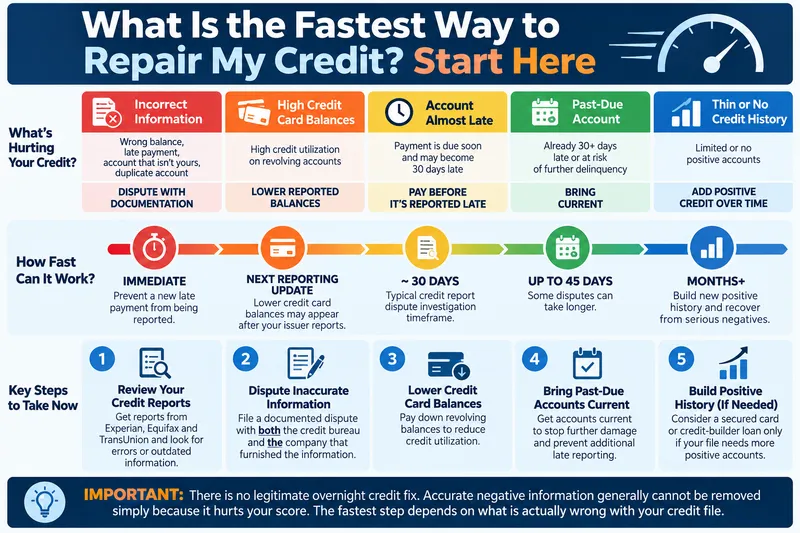
The fastest way to repair credit depends on what is lowering it. Correct inaccurate negative information, lower high credit card balances, and prevent current accounts from becoming late. Credit-report disputes must be investigated within 30 days, and a lower card balance can affect a score once the new balance is reported. Accurate negative information cannot legally be removed just because it lowers a score.
| What's Hurting Your Credit | First Action | Earliest Practical Change |
|---|---|---|
| High credit card balances | Lower the reported balance | Next time the issuer reports |
| Incorrect account, balance, or late payment | File a documented dispute | Investigation runs up to 30 days |
| Identity-theft account | Use the official identity-theft process | Depends on documentation submitted |
| Account nearing 30 days late | Pay before it reports late | Immediate — prevents new damage |
| Already past due | Bring the account current | Stops further delinquency |
| Thin or no active credit | Add appropriate positive history | Months, not days |
| Accurate collection or charge-off | Address the debt, rebuild history | Gradual |
| Bankruptcy, repossession, foreclosure | Build new positive history | Months to years |
First, Find Out What Is Actually Hurting Your Credit
Credit repair starts with diagnosis, not a checklist. Pull all three reports through AnnualCreditReport.com — the FTC confirms consumers get a free copy from each nationwide bureau once every 12 months. Read every line.
Check specifically for:
- Incorrect late payments
- Wrong balances
- Accounts that aren't yours
- Duplicate debts
- Incorrect account status
- Wrong credit limits
- Incorrect dates
- Closed accounts reported open
- Identity-theft accounts
- High revolving balances
- Past-due accounts
Treat each problem as its own line item: which bureau has it, who furnished it, what evidence you have, what action it needs, when you submitted it, and what the deadline is. That structure turns credit repair into an operation instead of a guess.
See What's Actually on Your Credit Report
Before deciding what to fix, see exactly what's reporting across all three bureaus — free — so you're working from facts, not guesswork.
Get My Free Credit Analysis Now →The Fastest Credit Repair Steps, Ranked by Situation
Not eleven generic steps. Five ranked actions, ordered by how fast each one prevents or reverses damage.
1. Stop a New Late Payment Before It Hits Your Reports
This comes before disputing anything. Sometimes the fastest credit repair action is damage prevention, not damage reversal.
If an account is approaching delinquency, getting it current before it reports late outranks working on an old negative item. This does not promise a score increase. It prevents a solvable situation from becoming a much harder one.
2. Dispute Credit Report Errors That Can Affect Your Score
The CFPB directs consumers to dispute inaccuracies with both the credit reporting company and the company that furnished the information, to fully protect their rights. That means two parallel paths: a credit bureau dispute and a direct furnisher dispute.
Supportable disputes include:
- An account that doesn't belong to you
- An incorrect late payment
- An incorrect balance
- A wrong account status
- A duplicate account
- An incorrect credit limit
- A wrong date
- Identity theft
Do not dispute information you have no documented reason to question. A credit bureau can decline to investigate a dispute it determines is frivolous — including one that doesn't provide enough information to identify the problem.
How Fast Can a Credit Report Dispute Work?
- Typical investigation: 30 days
- Extended cases: up to 45 days — for example, when you dispute after requesting your free annual report, or submit new information mid-investigation
- Result notice: within five business days after the investigation closes
30 days is an investigation deadline. It is not a guaranteed score-increase deadline. An investigation can end in a correction, a deletion, an update, verification as accurate, or a request for more information — and a correction only moves your score if the corrected data affects the model being used.
3. Lower High Credit Card Balances
This is the fastest realistic score lever available to most consumers. "Amounts Owed" makes up 30% of a FICO Score, and revolving utilization — the balance-to-limit ratio on credit cards — carries more weight within that category than installment-loan balances.
That gives a concrete example without promising a specific point increase, which no legitimate source can give you.
How Soon Can Paying Down Credit Cards Help?
A score cannot react to a lower balance until the updated balance reaches the credit report used to calculate it. The chain runs: pay the card, the issuer updates the bureau, the credit report changes, the scoring model recalculates. That update happens on your statement cycle, not the day you submit payment.
Should You Keep Credit Utilization Below 30%?
Lower is better, but 30% is not a magic cutoff. FICO's scoring process treats utilization as a continuum across the full credit profile — there is no universal rule declaring 29% "good" and 30% "bad." Pay balances down as far as practical; don't fixate on one exact number.
4. Bring Past-Due Accounts Current
This is a separate action from "pay bills on time." An account that is already late needs to be brought current. An account that is still current needs its payment history protected going forward — those are two different problems requiring two different responses.
If you cannot catch up, contact the creditor about hardship or payment options before the account falls further behind. Catching up does not delete a late payment that already reported. An accurate historical late payment can remain on the report even after the account is brought current.
5. Fix Identity-Theft Accounts Immediately
Verify the account first. If it is genuinely unrecognized, use the official identity-theft dispute process to block the fraudulent information and consider a credit freeze.
The FTC warned in January 2026 that influencers are pushing a scheme encouraging people to file false identity-theft reports about debts they owe. Filing a false identity-theft report is a crime that can carry a fine, imprisonment, or both. Credit repair companies promoting this tactic are breaking the law, not finding a loophole.
6. Stop Applying for Credit You Don't Need
New applications create hard inquiries and new accounts, both of which change your average account age, your newest-account age, your total available credit, and your credit mix. Opening several new tradelines while trying to repair credit works against the file you're trying to fix.
7. Keep Older Credit Cards Open When It Makes Sense
Closing an unused card reduces your available revolving credit, which raises utilization if balances remain on other cards. That is a real trade-off, not a blanket rule — a card charging a costly annual fee with no other benefit is not automatically worth keeping open. Weigh the utilization impact against the actual cost of the account.
8. Add Positive Credit Only If Your File Needs It
This separates repairing credit from building credit. A consumer with five active, well-managed accounts gains little from a new secured card. A consumer with no active positive tradelines benefits from one — a secured credit card or a credit-builder loan — specifically because it fills a gap the file doesn't already have. Add a tool because it solves a weakness, not by default.
Which Credit Problem Can Be Fixed Fastest?
| Credit Problem | Act Today? | Report Changes Quickly? | Realistic Expectation |
|---|---|---|---|
| High utilization | Yes | Yes, after reporting | One of the faster changes available |
| Wrong balance | Yes | Yes, if corrected | Dispute investigation required |
| False late payment | Yes | Yes, if corrected | Typically a 30-day investigation |
| Identity-theft account | Yes | Yes, with documentation | Specific legal process applies |
| Account nearing 30 days late | Yes | Preventive | Stops additional damage |
| Accurate late payment | Yes | Not by dispute | Rebuild over time |
| Accurate collection | Yes | Not automatically | Depends on account and future history |
| Charge-off, repossession, bankruptcy | Yes | Not an instant fix | Long-term rebuilding |
What Cannot Be Repaired Quickly?
Accurate late payments, charge-offs, collections, repossessions, foreclosures, and bankruptcies cannot be fast-tracked. The FTC states plainly that credit repair companies cannot legally remove accurate and current negative information simply because it hurts a score. Most negative information stays on a report for seven years; bankruptcy can stay for ten.
Can You Repair Your Credit in 30 Days?
Some information can change within 30 days. A full credit repair in 30 days is not a legitimate guarantee.
- Possible faster change: a high reported balance decreases.
- Possible 30-day resolution: a documented reporting error gets investigated and corrected.
- Not a 30-day repair: years of accurate delinquencies, collections, charge-offs, or bankruptcy.
How Many Points Can My Credit Score Increase in 30 Days?
There is no reliable fixed number of points your score gains after any credit-repair action. Starting scores differ, credit files differ, scoring models differ, the severity and recency of each item differs, and bureau data can differ from one report to the next. Anyone promising a specific point increase is guessing or selling something.
Should I Pay Collections First or Credit Cards First?
There is no universal answer. For an immediate score effect, a high-utilization credit card is usually the more actionable lever. For a collection, determine ownership, balance, status, age, and reporting before paying — and weigh the interest-rate and legal-risk side of the decision too. Each situation calls for its own order of operations.
Can Paying Off Debt Hurt Your Credit Score?
A score can move in an unexpected direction after an account changes, because scoring evaluates the entire credit profile at once, not one account in isolation. Paying off debt does not guarantee a fixed point increase, and in rare cases a score can dip briefly before recovering as the file adjusts.
Can a Credit Repair Company Repair Credit Faster?
A credit repair company cannot change the legal investigation deadlines, erase accurate negative information, or guarantee a score increase. No company can.
What a credit repair company can do differently is organize your reports, identify potentially inaccurate information, prepare disputes correctly, track responses against deadlines, review results, and flag reporting issues a consumer working alone can miss. The FTC confirms consumers can legally dispute credit report errors themselves at little or no cost — professional help speeds up the process; it does not replace the legal timeline.
Start With the Problem That Can Actually Be Changed
The fastest credit-repair plan is rarely the one with the most disputes filed. It is the one that identifies the right problem first.
Nearly 20 years of credit repair work at ASAP Credit Repair has shown us that two consumers with similar scores often need completely different plans. One has high revolving balances on an otherwise accurate report. Another has a collection that doesn't belong to them. A third has accurate late payments that cannot be disputed away — only outlasted.
Those three situations should not get the same response. Separate inaccurate information from accurate negative information first. Then identify which current balances, past-due accounts, or missing positive history can realistically be addressed now. That order keeps you from spending months fixing the wrong part of your file.
A 30-Day Credit Repair Priority Plan
Call this a priority plan, not a guarantee. The CFPB's standard dispute timeline is what this structure is built around.
Credit Repair Mistakes That Waste Time
- Disputing everything. Not every negative account is inaccurate, and blanket disputes slow down the ones that are legitimate.
- Filing a false identity-theft claim. The FTC specifically warned against this in January 2026. It is a crime, not a loophole.
- Opening several accounts at once. Multiple new inquiries and accounts work against the file you're repairing.
- Closing a paid-off card immediately. This can raise utilization on your remaining accounts.
- Paying a collection without checking it first. Verify ownership, amount, and reporting before sending money.
- Expecting accurate negative information to disappear. It generally cannot legally be removed just because it's negative.
- Focusing only on the score. The score is the output. The report data is the input — fix the input.
Not Sure What Is Holding Your Credit Back?
Start with the information on your credit reports. Look for accounts that aren't yours, incorrect balances, wrong payment statuses, duplicate debts, and anything else that's inaccurate or incomplete — separate from negative information that's accurate. ASAP Credit Repair can help you examine your reports, identify reporting problems, and understand your next steps. The goal isn't to dispute everything. It's to focus on what needs attention.
Get My Free Credit Analysis Now →Frequently Asked Questions
What is the fastest way to repair my credit?
The fastest way to repair credit depends on what is lowering it. Correct inaccurate negative information, lower high credit card balances, and prevent current accounts from becoming late. Credit-report disputes must generally be investigated within 30 days, and lower card balances can affect scores once the new balance is reported. Accurate negative information cannot legally be removed just because it lowers a score.
Can I repair my credit in 30 days?
Some credit information can change within 30 days, including corrected reporting errors and lower reported card balances. There is no legitimate guarantee that an entire credit file gets repaired in 30 days, especially when it involves accurate delinquencies, collections, or bankruptcy.
How can I raise my credit score 100 points?
There is no fixed action that raises a score by exactly 100 points. The impact of any single action depends on your starting score, the rest of your credit file, and which scoring model is used. Correcting a major reporting error or sharply lowering utilization produces the largest realistic swings.
How fast does credit repair work?
Speed depends entirely on the underlying problem. A corrected balance can appear at the next reporting cycle. A dispute investigation takes up to 30 or 45 days. Rebuilding a thin file or recovering from a collection, charge-off, or bankruptcy takes months to years.
How quickly can paying off credit cards raise my score?
A score cannot change until the lower balance is reported to the bureau by your card issuer. That typically happens once per billing cycle, so the earliest realistic change appears at your next statement date, not the day you make the payment.
Is it better to pay off collections or credit cards first?
For an immediate score change, high-utilization credit cards are usually more actionable. For a collection, verify ownership, balance, status, and age before paying anything, since payment does not guarantee removal and does not always help your score.
Can I remove late payments from my credit report?
An inaccurate late payment can be disputed and corrected. An accurate late payment can remain on the report even after the account becomes current, and it is not removable through a dispute.
Can accurate negative information be removed?
No. The FTC states that accurate, current negative information cannot legally be removed from a credit report simply because it hurts a score.
How long does a credit dispute take?
A credit reporting company generally must investigate a dispute within 30 days of receiving it, extending to 45 days in specific circumstances such as disputes filed after requesting a free annual report or when new information is submitted mid-investigation.
Does paying collections improve your credit?
Not automatically. Paying a collection does not guarantee score improvement and does not guarantee the account comes off your report. Confirm who owns the debt and who is reporting it before paying.
Should I dispute every negative account?
No. Disputing accurate information wastes time and can be flagged as frivolous by a credit bureau. Dispute only accounts, balances, or statuses you have a documented reason to believe are inaccurate, incomplete, or not yours.
What credit utilization is best when repairing credit?
Lower utilization is better for scoring, but 30% is not a fixed line separating good from bad. The FICO formula treats utilization as a continuum within the full credit profile, not a pass/fail threshold.
Can I repair my credit myself?
Yes. The FTC confirms consumers can dispute credit report errors directly with the credit bureaus and with the company that furnished the information, at no cost.
Is hiring a credit repair company faster?
No company can change the legal investigation deadlines, erase accurate negative information, or guarantee a score increase. Professional help can speed up the process of organizing reports, identifying inaccurate information, and preparing disputes correctly the first time.
What should I fix first on my credit report?
Fix whatever is actively causing the most damage: a reporting error, a high balance close to its limit, or an account about to go late. Fixing the wrong problem first wastes the time you're trying to save.
How long does bad credit take to rebuild?
Rebuilding after a collection, charge-off, repossession, or bankruptcy takes months to years of consistent positive payment history. There is no shortcut around the time required to build a new track record.