
A single late payment can follow you long after you've caught up on your bills. You might have paid the overdue amount, kept the account current for another 18 months, and still see that missed payment every time you check your credit report. According to Experian, payment history accounts for approximately 35% of a FICO Score, and a reported late payment can remain on your credit report for seven years. Can Claude write a goodwill letter for late payments that convinces your creditor to remove the mark?
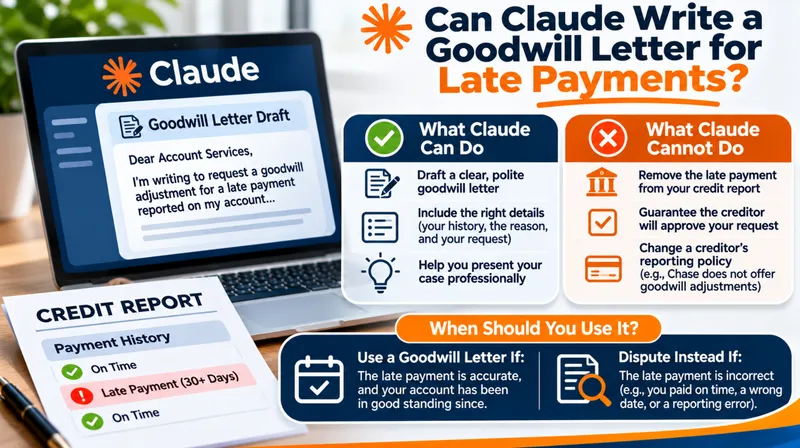
Claude can write a goodwill letter that explains why you missed a payment, documents your record since then, and asks the creditor to make a one-time exception. But a well-written letter is not a legal demand. Creditors decide whether to grant goodwill adjustments, and some, including Chase, have policies against removing accurately reported late payments. Claude can improve how you present your request. It cannot change the creditor's reporting policy or guarantee a deletion.
The distinction matters when you're deciding what to send. Suppose you missed a payment during a temporary financial emergency, brought the account current, and made every payment on time for the next two years. A goodwill letter gives you a way to explain those circumstances without claiming the late payment was reported incorrectly. If the creditor reported a payment late when you actually paid on time, however, you should dispute the inaccurate information rather than ask for forgiveness.
This guide shows how to use Claude to draft a goodwill letter without inventing excuses or overstating your payment history. You'll find a copyable AI prompt, a fictional sample letter, and a decision table explaining when a goodwill request makes sense and when a formal credit report dispute is the better step.
You'll also learn what to include in your request, why creditors reject some letters, and what to do when the first answer is no.
Can Claude Write a Goodwill Letter for Late Payments?
- Goodwill is a favor. A creditor removes an accurate late payment only if it chooses to.
- Honest reasons win. One true, specific cause plus a clean record since is the strongest letter.
- Errors need a dispute. If you paid on time, the late mark is wrong and you dispute it instead.
- Never pay for a guarantee. No company guarantees removal of an accurate late payment.
What Does Claude Write in a Goodwill Letter, and What Can It Not Promise?
Claude writes a goodwill letter well because the task is writing. It cannot send the letter, contact the creditor, or change your report. The creditor decides, and Chase states plainly that creditors are not obligated to fulfill the request.
A goodwill letter is a written request asking a creditor to remove a negative mark from your credit report as a courtesy. Chase describes it as a request the creditor has no duty to grant, and the Ginsburg Law Group says the same: an accurate late payment comes off only if the lender chooses to remove it. Claude fits this job because the letter is short, personal, and structured. Chase lists the parts that matter: your name, account number, and the date; a plain explanation of why you missed the payment; what you changed so it does not happen again, such as automatic payments; and why you want the mark gone, such as an upcoming mortgage or car loan. Claude assembles those four parts in a polite tone faster than most people draft them, and it tightens a rambling story into 150 words. Claude does not know whether your lender accepts goodwill requests, and it cannot see your account. Chase, for example, has a policy against goodwill letters because of a credit reporting requirement, so confirm your creditor's position before you write anything.
The letter works best for a mostly clean record. Chase states these letters are often used when the late payment came from a genuine mistake or unforeseen circumstance, and that people who habitually miss payments are less likely to have a letter honored. A single 30-day late payment on a card you have paid on time for months since is the strongest case. Three late payments in one year is the weakest. Give Claude your real facts and ask it to write nothing you did not tell it, because an invented hardship story is the fastest way to lose credibility and the wrong thing to put your name on. Use the prompt below, then compare the sample letter to your own draft.
What Should a Goodwill Letter Include?
A strong goodwill letter fits on half a page and holds six items. Chase lists the core parts, and the last two make the request specific enough for a representative to act on.
- ✓The account. Your name, the creditor, and the last four digits of the account number.
- ✓The exact late payment. The month and year the creditor reported.
- ✓One true reason. A single cause you can document, such as a delayed deposit.
- ✓Your record since. The number of on-time payments and the account's current status.
- ✓What changed. Automatic payments or a calendar alert that prevents a repeat.
- ✓A specific ask. Remove the March late payment from all three bureaus, and say why it matters now, such as a mortgage application.
Copyable Prompt and Sample Letter
Write a polite goodwill letter to [Creditor Name] asking them to remove one accurate 30-day late payment from [Month Year] on my account ending [XXXX]. The true reason was [one short, true reason]. Since then I have paid on time for [number] months and set up automatic payments. I am applying for [mortgage / car loan] and want my record to reflect that this was a one-time event. Do not claim the late payment was an error. Do not add facts I did not give you. Keep it under 150 words.
[Your Name]
[Your Address]
[Date]
Sample Bank, Customer Service
[Address from your statement]
Re: Goodwill request, Mastercard ending 0000
I am writing to ask for a goodwill adjustment to one late payment reported for March 2026. My employer's payroll deposit arrived four days late that month, and I missed the due date. I have paid on time every month since, eight payments in total, and I now use automatic payments so it does not happen again.
I am applying for a mortgage and want my record to show this was a single event on an account I have held for years. I would appreciate it if you would remove the March 2026 late payment from my credit reports.
Thank you for your time and consideration.
Sincerely,
[Your Name]
Claude drafted the structure of this sample from a fictional account, and every date and detail is invented for the example. Replace each one with your own true facts before you send anything. Remove any sentence you cannot support, and keep the tone grateful instead of demanding.
When Does a Goodwill Letter Work, and When Should You Dispute Instead?
Send a goodwill letter when the late payment is accurate and you have a clean record since. Dispute instead when the late payment is wrong. The CFPB states you generally cannot have accurate negative information removed, so the two paths never overlap.
Is the Late Payment Accurate?
The deciding question is whether the late payment is accurate. The CFPB states that you generally cannot have negative information removed from your credit report if it is accurate, and it states that most negative information stays for seven years. That is why a goodwill letter is a request for a favor and not a legal demand. If the report shows a late payment you actually made on time, a wrong due date, a payment the bank misapplied, or an account that is not yours, the item is inaccurate and the Fair Credit Reporting Act gives you dispute rights. The CFPB recommends disputing with both the credit reporting company and the company that furnishes the information. Chase gives the same advice: if the mark is an error and not a missed payment, file a dispute and skip the goodwill letter. Our guide to late payments on your credit report explains how to tell the two apart.
| Your Situation | Best Move | Why |
|---|---|---|
| One accurate 30-day late, clean record since | Goodwill letter | Strongest case for a courtesy removal |
| You paid on time, but the report shows late | Dispute | The entry is inaccurate, and the law covers it |
| Payment misapplied or posted to the wrong account | Dispute with proof | Statements show the bank's error |
| Several late payments in a year | Low odds, build on-time history | Chase notes habitual late payers are less likely to succeed |
| Creditor has a no-goodwill policy | Skip the letter | Chase, for example, has such a policy |
| Someone sells guaranteed removal | Walk away | No legitimate company guarantees removal of an accurate item |
Why Do Creditors Reject Goodwill Letters?
Creditors reject goodwill requests for five documented reasons. The first is policy: Chase states it has a policy against goodwill letters because of a credit reporting requirement, so no letter changes the answer there. The second is history: Chase notes that people who habitually miss payments are less likely to have a letter honored. The third is framing: the CFPB states you generally cannot have accurate negative information removed, so a letter that calls a true late payment an error invites a denial. The fourth is a vague or unsupported reason, and the fifth is timing, since Ginsburg Law Group warns that paying first removes your bargaining point.
| Why It Gets Rejected | What to Do Instead |
|---|---|
| Creditor policy forbids goodwill adjustments | Skip the letter and build on-time history |
| Several late payments on the account | Wait for a longer clean record before asking |
| Letter calls an accurate mark an error | Ask for a courtesy, or dispute only if the mark is wrong |
| Vague or unsupported reason | Give one true, documented cause |
| Balance paid first, no agreement in writing | Raise the reporting before or while you pay |
Why Does Paying First Cost You Leverage?
Timing and leverage matter too. The Ginsburg Law Group warns that paying off a balance without addressing the credit reporting removes your main bargaining point, because any later request becomes a favor the lender can decline. If you owe a past-due amount, ask about the reporting before or while you pay, and get any agreement in writing.
What Do You Do If the Answer Is No?
A no does not end your options, and it does not make the late payment permanent. Chase describes responses as approval, denial, a request for more information, or silence, so treat each one differently. If the creditor asks for more information, send it within days. If the creditor says no, read the reason: a policy denial means stop asking, while a denial that cites your record means wait.
- Ask once more, politely. Follow-up requests are generally acceptable when they stay courteous and do not become excessive.
- Add months of on-time payments. Experian states a late payment's effect on your score lessens over time as you build good habits, so twelve more clean months strengthens a second request.
- Recheck the entry. Pull your free reports and confirm the late payment is accurate. If it is wrong, dispute it with the bureau and the creditor.
- Plan around the seven-year limit. The late payment drops off seven years from the missed due date, and its weight fades along the way.
- Refuse paid guarantees. No legitimate company promises removal of an accurate late payment for a fee.
How Do You Send a Goodwill Letter, and What Happens Next?
Send one letter per account to the creditor's customer service address, keep a copy, and wait about 30 days before you follow up once. Pull your free report afterward at AnnualCreditReport.com to confirm whether the late payment changed.
Here's how to do it:
- Confirm the late payment is accurate. Compare the report to your statements. If the payment was on time, switch to a dispute.
- Ask Claude for a draft. Use the prompt above with your real month, reason, and on-time count.
- Edit every fact. Delete anything untrue or unprovable, and keep the letter under 150 words.
- Send it where the creditor asks. Use the address on your statement or the creditor's secure message center, and keep proof of what you sent.
- Wait about 30 days, then follow up once. Keep the second message short and polite.
- Verify the result. Pull all three reports at AnnualCreditReport.com and check each bureau.
A goodwill letter targets one account at a time, so send a separate letter for each creditor and do not bundle requests. Keep every response in a folder with the date it arrived. If the creditor agrees, it reports the correction to the bureaus, and the change shows up on your reports on the creditor's reporting schedule, not the day you get the reply. A removed late payment does not guarantee a score jump, since your score also depends on balances, account age, and new inquiries. Our guide to credit score mistakes lists the habits that undo the gain.
What Mistakes Sink a Goodwill Request?
Four mistakes sink a goodwill request: claiming a true late payment was an error, inventing a reason, pasting private data into the chat, and paying a company for a guaranteed removal. Each one costs you credibility, privacy, or money.
Do You Claim a True Late Payment Was an Error?
The first mistake is blurring the line between a favor and a dispute. A letter that calls an accurate late payment an error invites a denial, and disputing accurate information is not what the CFPB recommends.
Do You Invent a Reason?
The second is an invented story. Tell Claude only what is true, and cut every line you cannot back up.
What Should You Keep Private?
The third is privacy. Redact your name, address, Social Security number, and full account number before you paste anything into an AI tool, and give Claude only the last four digits and the month. Anthropic's help page recommends being thoughtful about sharing financial information such as SSNs, card numbers, and bank account details, and an Incognito chat is not used to improve Claude.
Should You Pay for a Guaranteed Removal?
The fourth is paying for a promise. The Ginsburg Law Group states that no legitimate company guarantees an accurate late payment will be removed for a fee, and the CFPB states credit repair companies cannot request or receive payment until they complete the promised services. A company that sells guaranteed goodwill removal breaks both rules.
The right move depends on whether the late payment is accurate. ASAP Credit Repair USA helps you review your three-bureau reports, separate the errors worth disputing from the accurate items worth a goodwill request, and build a plan around your real file.
Review Your Credit Report → Credit report corrections do not guarantee a score increase or the removal of accurate information.Frequently Asked Questions About Claude and Goodwill Letters
Does a goodwill letter remove a late payment?
Only if the creditor chooses to remove it. Chase states creditors are not obligated to fulfill the request, and the Ginsburg Law Group calls it a discretionary change. Responses include approval, denial, a request for more information, or silence. A clean record since the late payment helps your odds.
Is Claude good at writing goodwill letters?
Yes. Goodwill letters are short, polite, and structured, which suits Claude. Give it your true reason, the month, and your on-time payments since, then edit every fact. Claude cannot send the letter or predict the creditor's answer, so treat its output as a first draft.
How long does a late payment stay on my credit report?
A late payment stays for seven years from the date you missed it, according to Experian. The CFPB states most negative information remains for seven years. The score effect lessens over time as you add on-time payments, so each clean month weakens the late mark.
Should I send a goodwill letter or dispute the late payment?
Dispute if the late payment is wrong, such as a payment you made on time or one posted to the wrong account. Send a goodwill letter if the late payment is accurate. The CFPB states you generally cannot have accurate negative information removed, which is why goodwill is a request.
Is it safe to give Claude my account details for a goodwill letter?
Share the minimum. Use the creditor name, the last four digits, and the month, and leave out your SSN and full account number. Anthropic recommends caution with SSNs, card numbers, and bank details. Incognito chats are not used to improve Claude. Add private details offline.
Do credit repair companies guarantee goodwill removals?
No legitimate company does. The Ginsburg Law Group states none can guarantee removal of an accurate late payment for a fee. The CFPB states credit repair companies cannot collect payment before finishing the promised services. Disputing errors is free, and a goodwill letter costs only a stamp.
- Late Payments on Your Credit ReportHow long they stay and how to handle them.
- Dispute Credit Report Errors GuideHow to dispute a wrong balance or status.
- DIY Credit Repair: Fix Your Credit Like a ProA step-by-step guide to disputing on your own.
- Consumer Financial Protection Bureau — Is it possible to remove accurate negative information from my credit report?
- Consumer Financial Protection Bureau — How can I tell a credit repair scam from a reputable credit counselor?
- Chase — What are goodwill letters and do they help your credit score?
- Experian — Can one 30-day late payment hurt your credit?
- Ginsburg Law Group — Goodwill credit adjustments
- Anthropic Help Center — Inputting sensitive data into chats with Claude
- AnnualCreditReport.com — Free credit reports