

Car Accident Settlements and Your Credit Score. The waiting period does. A car accident settlement credit score problem starts the moment medical bills go unpaid while your case is pending. The crash itself never appears on your credit report. But the debts that pile up before the settlement arrives can stay on your report for seven years.
Running a credit repair company, I can say this is one of the most common cases we handle. One of the most unforgettable accounts I've seen: a client came in with a credit score that dropped from 720 to 660 after a rear-end crash. She had no missed loan payments. No new credit cards. Just three unpaid ER bills in collections. Her settlement was still nine months away.
The Consumer Financial Protection Bureau (CFPB) found that as of June 2023, 15 million Americans had medical bills on their credit reports. In 2021, medical debts made up 58% of all bills in collections. Car accidents feed directly into both numbers.
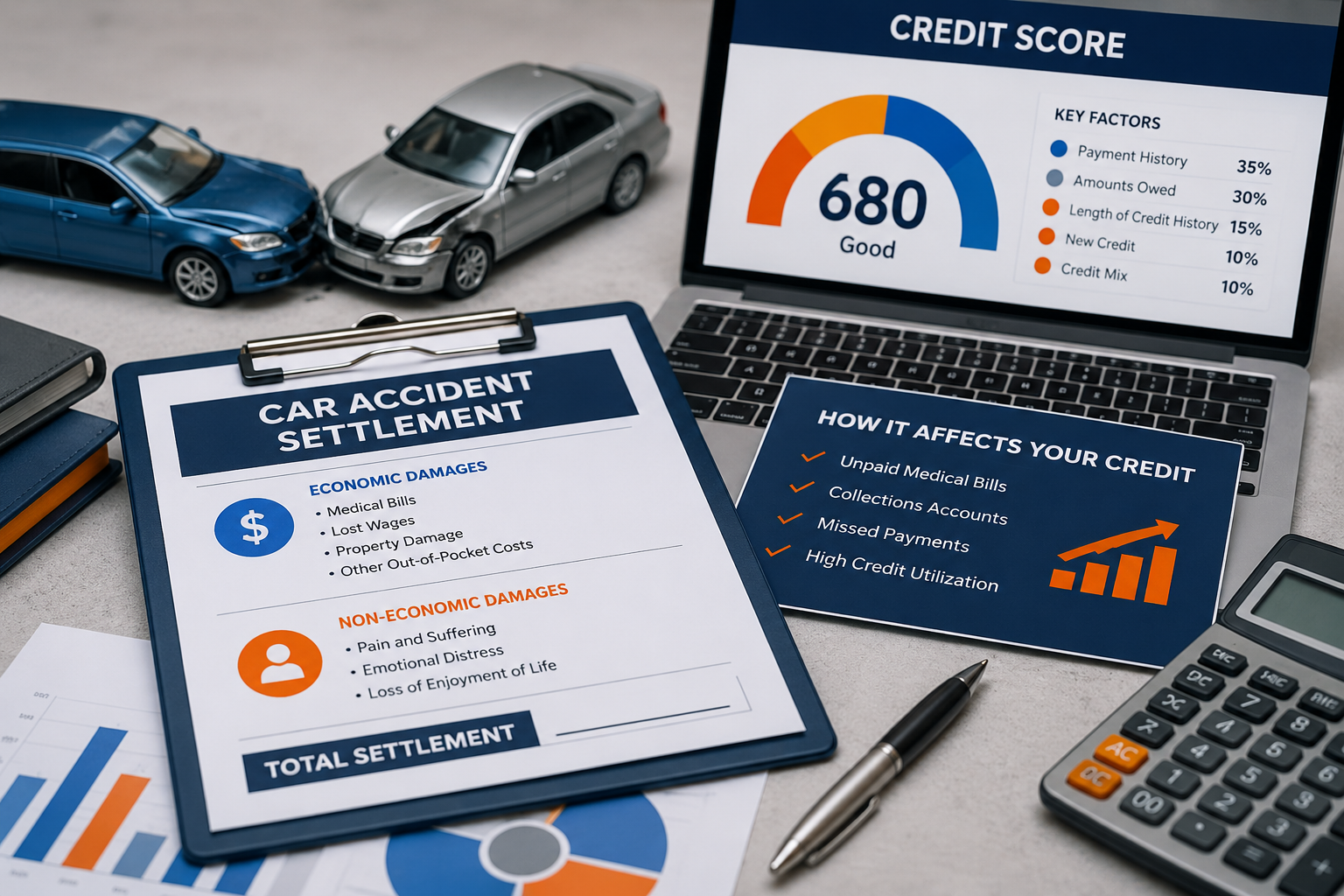
Does a Car Accident Directly Affect Your Credit Score?
No. A car accident does not directly affect your credit score. Credit bureaus do not track police reports, accident claims, or insurance filings. Your credit file only holds debt data.
The damage happens through three indirect paths:
Medical bills go unpaid and move to a collection agency.
You miss payments on credit cards or loans while you're out of work.
You charge accident costs to a credit card and push up your balance.
Payment history makes up 35% of your FICO score. A single collection account can drop your score by 50 to 100 points. That account stays on your report for seven years.
Car accident settlement calculation? (And Why It Affects Your Credit)
Many people first notice a car accident settlement credit score problem when they see how long cases take. Most settlements close in 6 to 18 months. During that time, bills don't wait.
Settlements cover two types of damages.
Economic Damages
Economic damages are your real, countable losses. They include:
Medical bills already paid
Future medical costs for ongoing care
Wages lost while you were hurt
Lost earning capacity if your injury affects future work
Vehicle repair or replacement
Out-of-pocket costs tied to the crash
According to the Insurance Information Institute (III), the average bodily injury claim from a car accident was $26,501 in 2023. Property damage claims averaged $5,313 that same year. Those numbers give you a baseline for most standard cases.
Non-Economic Damages and the Multiplier Method
Non-economic damages cover pain, suffering, and reduced quality of life. There is no receipt for these. So insurers use a formula called the multiplier method.
The formula works like this:
Settlement = (Total Economic Damages x Multiplier) + Other Economic Losses
The multiplier runs from 1.5 to 5. Minor injuries like sprains get a 1.5 to 2 multiplier. Severe injuries like spinal damage or brain trauma can reach 4 or 5.
Here is a simple example. You have $20,000 in medical bills and $10,000 in lost wages. The adjuster uses a multiplier of 3.
($20,000 x 3) + $10,000 = $70,000 estimated settlement
Some attorneys use a per diem method instead. This sets a daily dollar rate for pain and suffering. It then multiplies that rate by the number of days you suffered. This method works well when recovery takes a long time.
At this point you know how Car accident settlement calculation get built and why the accident itself never touches your credit. Now let's look at what actually moves the settlement number up or down.
What Factors Affect a Car Accident Settlement Amount?
Injury Severity
Injury severity drives the multiplier. Serious injuries mean higher medical costs, longer recovery, and a bigger number. Gaps in your medical care let insurers argue the injury wasn't that bad. See a doctor right after the crash and follow through on treatment.
Fault Percentage
Most states use comparative negligence rules. If you are 20% at fault, your settlement drops by 20%. A few states cut off your right to recover entirely if you share any fault. Know your state's rule before you negotiate.
Insurance Policy Limits
Your settlement cannot go above the at-fault driver's policy cap. Most states set a minimum of $25,000 per person. If your damages exceed that, you may need to use your own underinsured motorist coverage.
Lost Future Earnings
Injuries that keep you from doing your old job can add a large amount to your claim. A work expert will compare what you earned before the crash to what you can earn now. That gap becomes part of your settlement.
In our office last year, we worked with 27 clients whose credit scores dropped 40 to 90 points during their settlement wait. Their average wait ran 8 to 14 months. The money was coming. The credit damage happened while they waited.
How Car Accident Medical Bills Hurt Your Credit Score
Medical bills don't hurt your score the day they arrive. They have to go unpaid long enough for your provider to send them to a collection agency. That collection account is what hits your credit.
Here is what the rules look like today:
Bills under $500: Removed from all three credit bureau reports as of April 2023. They no longer affect your score.
Bills over $500: Can still appear on your report. They stay there for seven years.
FICO scores (used by more than 90% of lenders) still count unpaid medical collections over $500.
VantageScore removed all medical debt from its model in January 2023.
Newer FICO models (9 and 10) weigh medical debt less. But most lenders still use older models.
The CFPB found that medical debt may overpenalize credit scores. The scoring penalty is often bigger than the actual repayment risk. But the damage still shows up while your case is open.
Does a Car Accident Settlement Show Up on Your Credit Report?
No. A settlement payment does not appear on your credit report. It is not a loan. It is not a credit event. Equifax, Experian, and TransUnion do not track settlements.
What appears on your report is the unpaid debt that built up before the settlement arrived. If bills went to collections, those accounts stay on your report even after the case closes.
Paying a collection off can help. FICO 9 and VantageScore 3.0 ignore paid collections. But older FICO models still count them after payment. The best move is to keep bills out of collections in the first place.
Can a Car Insurance Claim Affect Your Credit Score?
Filing a claim does not touch your credit score. Insurance companies do not report claims to credit bureaus.
What can hurt your credit is what comes after. If your premium goes up and you miss a payment, the insurer can send that balance to collections. Unpaid insurance premiums follow the same seven-year rule as any other collection account.
The settlement you receive stays off your credit report. It is not income in the credit system and never gets reported to a bureau.
How to Protect Your Credit Score After a Car Accident
Acting fast in the first 30 to 60 days keeps bills out of collections. Here is what works:
Ask your attorney for a letter of protection. This is a formal letter telling your medical providers that a case is pending. Many providers agree to pause collection while the case is open.
Call your providers directly. Most hospitals accept a small monthly payment during the wait. Even $25 a month keeps the account out of collections.
Keep paying your existing bills. Credit cards, car loans, and rent must stay current. Missing those payments does more damage faster than most medical bills.
Check your credit reports monthly. Go to AnnualCreditReport.com and pull all three bureaus. Catch any errors early. Billing mistakes are common after accidents.
Do not put accident costs on a credit card. Running up balances raises your credit use rate and lowers your score even without any missed payments. Keep card use below 30% of your limit.
Did a Car Accident Hurt Your Credit Score?
Medical collections, missed payments, and high credit card balances can damage your credit long before a settlement arrives. If your score has dropped after an accident, you may have options to recover faster.
✔ Free Credit Analysis
✔ Review Accident-Related Collection Accounts
✔ Personalized Credit Improvement Plan
✔ No Obligation Consultation
Find out what's hurting your credit and discover the fastest path to recovery.
Get Your Free Credit Report Review →ASAP Credit Repair • Helping Americans rebuild stronger credit one step at a time.
What to Do If Your Car Accident Settlement Credit Score Dropped
Credit damage from a car accident can be fixed. Here is the order to follow:
Pull all three credit reports. Find every collection tied to the accident.
Pay off medical collections over $500 first. Those carry the most weight under current FICO models.
Send a goodwill letter after you pay. Ask the creditor to remove the entry. Some agree, especially if your record was clean before the accident.
Ask your attorney to cut your medical liens before the settlement closes. Lower liens mean more money to clear collections faster.
Pay down any credit card balances you built up during the wait. Getting below 30% use adds points back quickly.
Most clients we help with post-accident credit repair see real score gains within three to six months. The key is clearing the collections as soon as the settlement funds arrive.