

Leasing a car is often easier to get approved for than financing because it involves lower risk for the lender and shorter repayment terms. Approval depends on credit profile, income, and how lenders assess risk.
Both leasing and financing use systems that evaluate borrower reliability, such as the credit score. A car lease focuses on the vehicle’s value during the lease term, while an auto loan focuses on full repayment over time. Because of this difference, leasing may allow approval with lower credit compared to financing, which requires stronger credit and repayment history.
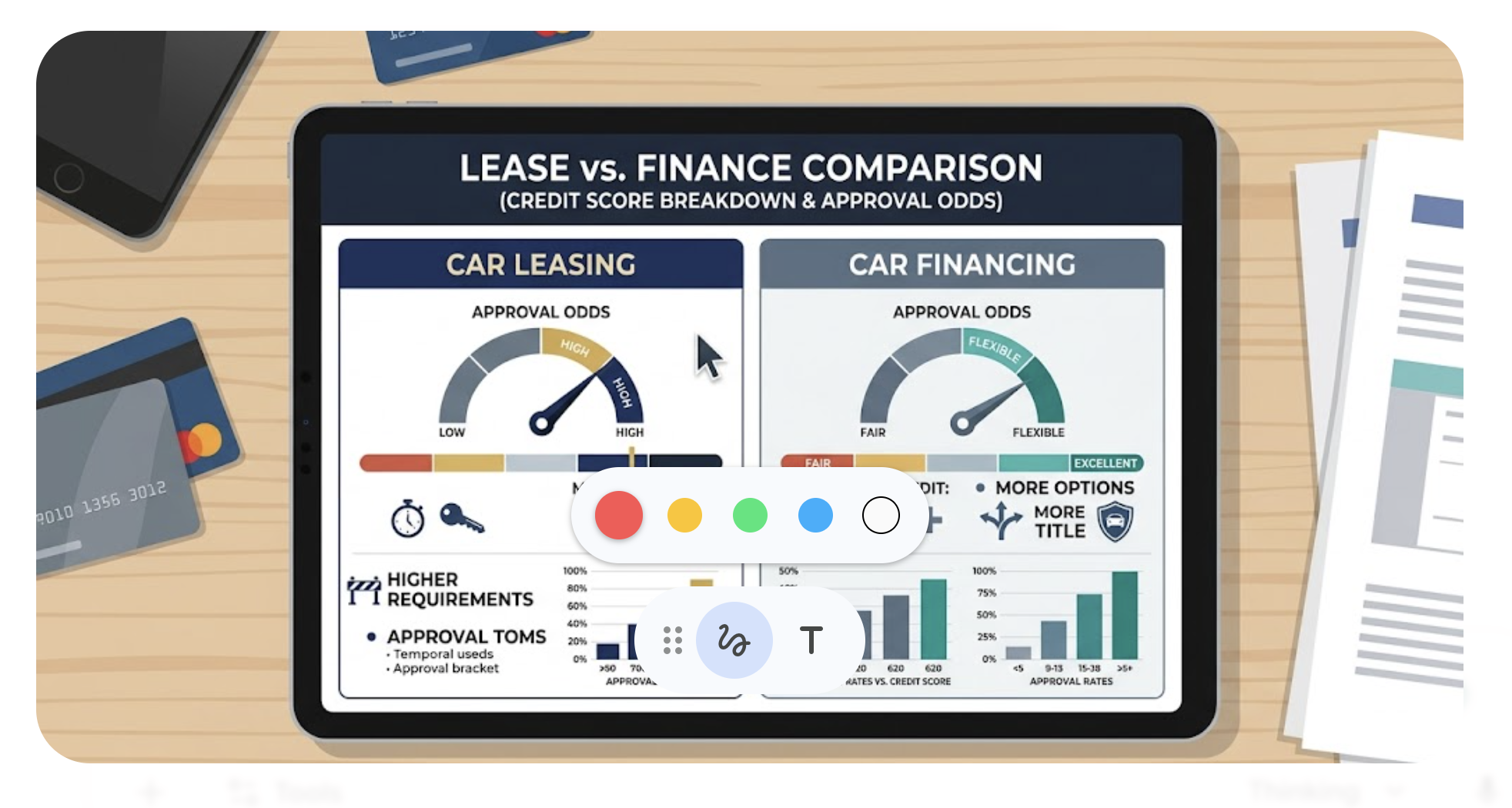
Auto Financing · Car Lease vs. Loan · Approval Odds · FICO Auto Score · Credit Tiers · Bad Credit Car Options
The answer depends on your credit score. At 700 and above, both are accessible. Below 660, financing beats leasing for approval odds by a wide margin. Here are the exact numbers and real lender behavior explained.
Updated April 2026 · Sources: Experian State of the Automotive Finance Market Q4 2025, NerdWallet auto credit research, Kelley Blue Book leasing data, myFICO Forums auto loan threads, Reddit r/personalfinance car financing threads
The question most people are actually asking is not "which is cheaper?" It is "which one will approve me?" Those are completely different questions with completely different answers depending on your credit score. This article is built around the second one.
Is It Easier to Lease or Finance a Car? The Approval Odds Answer
Here is the simplest way to understand why. When you finance a car, the lender holds the title. If you stop paying, they repossess a physical asset they can resell. That collateral reduces their risk. When you lease, the leasing company is betting on your payment behavior for the entire lease term, after which they get back a car that has depreciated to a specific residual value they projected. Any credit risk they absorb affects both whether you pay and whether you treat the car well. Leasing companies want certainty on both. That is why their credit requirements are stricter.
Is Leasing a Car Easier to Get Approved For?
The myFICO Forums confirm this consistently. Users ask "is it easier to get approved for a lease?" and the community answer is always the same: no, you typically need better credit for a lease. Acura Financial, BMW Financial, and Audi Financial tend to be the most rigid — either you qualify at Tier 1 or you are declined. Ford, Toyota, Honda, Hyundai, Nissan, and Chrysler Capital are known in the community as more forgiving captive lenders. GM Financial also has broader approval tolerance on certain models.
Why Captive Lenders Are Stricter on Leases Than Banks
A captive lender is the financing arm of a car manufacturer: Toyota Financial Services, Ford Motor Credit, GM Financial. They control the leased vehicle's residual value projection, which is how much they expect the car to be worth at lease end. If you miss payments and they repossess the vehicle early in the lease, they lose both the expected payment stream and potentially have to absorb the gap between the early-repossession sale price and the projected residual value.
That is a more complex risk than a simple secured loan. It is why captive lenders tier their credit requirements aggressively and why someone at a 650 FICO who could finance a Toyota Camry through a credit union gets declined by Toyota Financial Services for a lease on the same car.
Credit Score for Leasing vs Financing: What Each Tier Gets You
| Score Range | Lease Approval | Finance Approval | What to Expect |
|---|---|---|---|
| 750 + (Tier 1) | Yes — best money factor, $0 down offers | Yes — lowest APR, prime rates | Advertised lease deals are built for this tier. Finance APRs at or below manufacturer promotional rates. Negotiate from strength. |
| 700-749 (Tier 2) | Yes — slightly higher money factor | Yes — competitive APR | Most mainstream brands approve here. Money factor may be marginally higher. Finance terms are still strong. Tier 2 is a "prime" designation at most lenders. |
| 660-699 (Tier 3) | Maybe — depends on brand and dealer | Yes — near-prime rates available | Lease approval is inconsistent at this tier. Toyota, Honda, Hyundai more forgiving. BMW, Audi, Mercedes typically decline. Finance is accessible at 7 to 10% APR range. Tier 3 for leasing can add $50-$100/month vs Tier 1 on the same vehicle. |
| 620-659 (Tier 4) | No — most captive lenders decline | Yes — subprime rates, higher down payment | Lease through captive lenders nearly impossible. Some subprime lease programs exist through independent dealers but payments are high. Finance through subprime lenders at 10-18% APR. Used car financing most realistic path. |
| 580-619 (Tier 5) | No — lease not a realistic option | Yes — used car, higher rates and deposit | Finance only. Used cars through Capital One, Westlake, DriveTime. APRs of 16-24%+ are common. Large down payment (20%+) helps approval and reduces monthly payment. Lease is not accessible at this tier. |
| Below 580 | No | Buy-here-pay-here or BHPH programs | BHPH dealers report to credit bureaus and can help rebuild. Interest rates are very high. Focus on getting approved, making all payments on time, and refinancing after 12-18 months of positive payment history. |
Which Credit Score Do Auto Lenders Actually Pull?
Auto lenders use FICO Auto Score 8 or FICO Auto Score 9. These are industry-specific versions of the FICO model that weight your history of auto loan and lease payments more heavily than the generic model. If you made every payment on time on a previous auto loan, your FICO Auto Score may be significantly higher than your generic FICO 8. The reverse is also true: if you have a repossession on your record, your auto score will be hit harder than your generic score.
The score shown on Credit Karma is VantageScore 3.0. The score shown on Experian's free app is generic FICO Score 8. Neither is what your lender pulls. Your FICO Auto Score is available through a paid myFICO subscription. It is worth $20 to check it before applying if you are near a tier boundary, because a 10-point difference in your auto score can move you from a declined lease application to an approved one, or from a 12% finance APR to a 7% one.
Bad Credit Car Lease vs Loan: Which Gives You a Better Shot?
The core difference comes down to how lenders handle risk when you cannot pay. With a financed vehicle, the lender repossesses and resells the car. They know roughly what they will recover. With a lease, the situation is messier: early termination fees, condition charges, gap between early-sale price and residual, and a lease contract that is harder to unwind than a loan default. Leasing companies know this and price out subprime borrowers at the door.
This is why the myFICO community consistently tells people with below-average credit to finance first, build payment history, and then lease on their next vehicle. A single auto loan paid on time for 12 to 24 months can move your FICO Auto Score significantly — sometimes 40 to 70 points — because payment history on installment accounts weights heavily and prior auto history is specifically valued.
What About Co-Signers for a Bad Credit Car Lease?
A co-signer with a 720+ score is the most effective workaround for a bad credit lease application. The lender evaluates the strongest credit profile on the application. If the co-signer qualifies for Tier 1, the deal is often structured at Tier 1 rates regardless of your score. However, the co-signer is equally and fully responsible for every payment. A missed payment affects both of your credit reports. Make this arrangement only when you are confident in your ability to make every payment on time.
How to Improve Your Approval Odds Before Applying for a Lease or Loan
Know Exactly Which Credit Tier You're In Before You Walk Into a Dealership
A free 3-bureau credit audit identifies every item suppressing your FICO Auto Score, from inaccurate late payments to re-aged collection dates. Moving from Tier 3 to Tier 2 on a 36-month lease can save $1,800 to $3,600 over the lease term. On a 60-month auto loan, the difference between a 10% and 7% APR on a $28,000 car is over $2,200 in total interest.
Get My Free Credit Audit → Secure · 2 minutes · No credit card required| Entity | Attribute | Value |
|---|---|---|
| New car lease | Average credit score (Q4 2025) | 749 — Experian State of the Automotive Finance Market Q4 2025 |
| New car finance | Average credit score (Q4 2025) | 745 — Experian Q4 2025 data |
| Used car finance | Average credit score (Q4 2025) | 689 — Experian Q4 2025 data; subprime borrowers pull average down significantly |
| New car lease borrowers | Score distribution 2024 | 86% had scores above 660; 48% had scores above 740 (KBB / Experian 2024 data) |
| FICO Auto Score 8/9 | How it differs from generic FICO 8 | Weights prior auto loan and lease payment history more heavily. Difference: 20 to 50 points in either direction. Available at myFICO.com. |
| Captive lender | Examples + lease tier minimum | Toyota Financial, Honda Financial, BMW Financial. Practical Tier 1 floor: 720+. Many decline below 660 for leases entirely. |
| Money factor | Lease equivalent of APR | Multiply by 2,400 to convert to approximate APR. Tier 1 money factor (0.0020) = ~4.8% APR. Tier 3 money factor (0.0045) = ~10.8% APR. |
| Tier 1 lease | Score threshold (most captive lenders) | 720+. Advertised lease deals (the $299/month spots) are built for this tier. Below this, the advertised payment does not apply to you. |
| Lease vs finance: approval floor | Practical minimum (major lenders) | Lease: 660 to 680 minimum at most captive lenders. Finance: No absolute minimum — subprime and BHPH cover down to 500 and below. |
| Repossession | Impact on FICO Auto Score | Most damaging single item for auto lending. Causes severe FICO Auto Score drop. Most major captive lenders decline any applicant with a repossession in the past 2 to 5 years. |
| Rate-shopping window | Auto loan inquiry de-duplication | 14 days (FICO 8 and mortgage models). All auto loan inquiries within this window count as one. Does not apply to credit card applications. |
| Down payment (lease) | Effect on approval odds | Reduces monthly payment but does NOT improve approval odds at captive lenders. Approval is credit-profile-based. If declined, more money down does not change the decision. |
| Co-signer (lease) | Effect on approval tier | Lender uses the strongest credit profile on the application. Co-signer at 720+ qualifies the deal at Tier 1 even if primary applicant's score is lower. |
Frequently Asked Questions: Lease vs Finance Approval
Is it easier to lease or finance a car?
Financing is easier to get approved for, especially below a 700 credit score. The average credit score for a new car lease in Q4 2025 was 749, compared to 689 for used car financing. Captive lenders restrict lease approvals to prime borrowers, typically 660 and above. Subprime auto financing exists down to 500 and below through credit unions, Capital One, Westlake Financial, and buy-here-pay-here dealers. If your score is below 660, financing a used car is almost always your most realistic path.
Is leasing a car easier to get approved for?
No. Leasing requires better credit than financing in most cases. The myFICO community and auto industry data consistently show that captive lenders set stricter floors for leases than banks or credit unions set for auto loans. A borrower at 640 who cannot get a lease from Toyota Financial Services may qualify for a Toyota Camry loan through a credit union or directly through Toyota's own financing on a used vehicle. Approval odds are lower for leasing across nearly every credit tier below 700.
What credit score do I need to lease vs finance a car?
To lease a new car, most captive lenders require a minimum FICO Auto Score of 660 to 680. Tier 1 rates, which are what advertised lease deals are built on, typically require 720 or above. The Q4 2025 average for lessees was 749. To finance a new car, the average borrower scored 745 — similar to leasing — but used car financing drops to an average of 689, and subprime lenders approve well below that. Finance approval is accessible at scores where lease approval typically is not.
Can I lease a car with bad credit?
It is possible but difficult below 620. Most captive lenders decline lease applications at this score level. Some independent lease programs exist through subprime dealers, but the combination of high security deposit, elevated money factor, and high monthly payment often makes the total cost exceed what you would pay to finance the same vehicle. A co-signer with a 720+ score is the most effective workaround. If no co-signer is available, financing a used car is the more practical and less expensive path.
Does leasing or financing build credit faster?
Both report to the credit bureaus monthly and contribute to payment history at the same rate. Neither is faster than the other for building credit. The installment account from auto financing and the lease account from a car lease both satisfy the credit mix factor. Since financing is accessible at lower credit scores, it is the more practical first step for rebuilding. Once 12 to 24 months of on-time payments have been established through financing, your FICO Auto Score often improves enough to qualify for a lease on the next vehicle.
What do lenders check when you apply for a car lease or loan?
Auto lenders and leasing companies review your FICO Auto Score 8 or 9, which weights prior auto loan and lease payment history more heavily than your generic FICO score. They also evaluate your debt-to-income ratio (most prefer below 43%), income stability and employment history, and any repossessions on your record, which are the most damaging single item for auto approval. A repossession in the past 2 to 5 years will disqualify you from most captive lender lease programs regardless of your current score.
-
What Credit Score Do You Need to Buy a Car? The specific FICO Auto Score ranges that trigger approvals at major lenders, how repossessions affect your auto score differently than other negative items, and steps to take 90 days before your next auto application to improve your tier placement.
-
Can Bad Credit Stop a Car Loan? What to Do Which subprime lenders approve at the lowest credit scores, how to structure your application to maximize approval odds, the difference between a dealer-arranged loan and a direct bank or credit union loan, and whether a co-signer arrangement is worth the risk.
-
Can You Get a Car Loan With Bad Credit and No Down Payment? Which lenders approve zero-down auto loans with scores below 620, how income and debt-to-income ratio compensate for the lack of a down payment, and whether a no-down-payment auto loan is the right move depending on your financial situation.
-
What's the Fastest Way to Rebuild Credit After Collections? The rebuild sequence for recovering from collection damage, how FICO 8 and FICO Auto Score treat collections differently, and why an auto loan financed now can be the fastest path to a lease-eligible credit score within 12 to 24 months.
-
Which Credit Score Do Landlords Use? (FICO vs VantageScore) Covers the same FICO vs VantageScore gap that affects auto applications — the score you see on Credit Karma is not what lenders pull, and the difference can change whether you qualify for prime or subprime terms.
-
What Assets Can Be Taken If I Lose a Debt Lawsuit? If a prior debt judgment or wage garnishment is on your record, this explains what it means for future financing — how judgment liens affect vehicle title, what the lender sees during an auto credit check, and whether a judgment prevents you from getting approved for a car loan.
-
NerdWallet: Credit Score Needed to Lease a Car (Updated March 2026) NerdWallet's research-backed breakdown of what credit score lease applications require, citing Experian Q4 2025 State of the Automotive Finance Market data showing the average lease score of 749, how the 700 score dividing line affects what terms you can expect, and practical advice from Swapalease's executive vice president on what prime borrowers can negotiate that subprime borrowers cannot.
-
Experian: What Credit Score Do I Need for a Car Lease? Experian's official guide to lease credit requirements, drawing on their own Q1 2024 automotive finance data showing a 751 average score for new car lessees, how the money factor relates to your credit tier, why leasing may require better credit than buying the same vehicle, and how to improve your score before applying for a lease.
-
Kelley Blue Book: Car Leasing Guide (Updated April 2025) KBB's authoritative leasing guide covering the statistical breakdown that 86% of new car leases in 2024 went to borrowers with scores above 660 and nearly 48% to borrowers above 740, why leasing requires better credit than financing, how one-pay leases work as a bad-credit workaround, and the key differences between leasing terms that consumers often misread when comparing monthly payment advertised deals.
Closing
Leasing is easier to get approved for than financing in many cases due to lower risk and shorter terms. However, approval still depends on credit profile and lender requirements. Understanding how lenders assess risk helps determine which option is more accessible.