

Landlords use credit scores to assess how reliably a renter is likely to pay, but not all credit scores are the same. The model they use in checking can affect your approval odds.
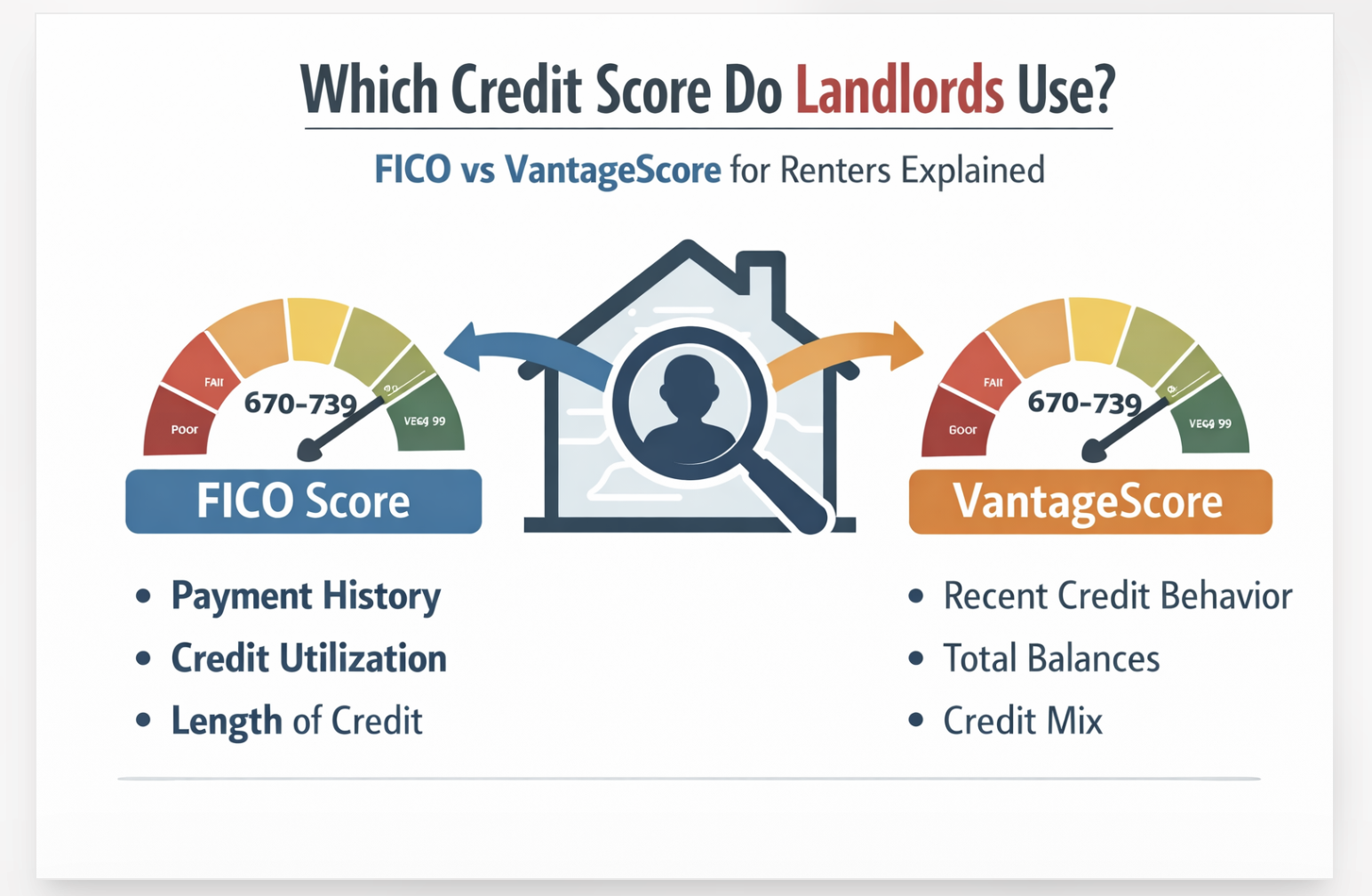
In most cases, landlords rely on a version of the FICO Score, especially when screening through major tenant screening services. However, some platforms and independent landlords may use VantageScore, which can produce slightly different results depending on how your credit data is interpreted.
The difference matters. A renter could appear more qualified under one scoring model and riskier under another due to variations in how payment history, credit utilization, and collection accounts are weighted.
From analyzing thousands of credit reports tied to rental applications, one pattern is consistent: landlords are less focused on your exact score number and more focused on specific risk indicators, such as recent late payments, active collections, and overall credit stability.
This guide explains which credit scores landlords actually use, how FICO and VantageScore differ in a rental context, and what parts of your credit profile matter most when your application is being evaluated.
Rental Credit Score · FICO vs VantageScore · Tenant Screening · Credit Bureau Rental Check · Apartment Approval
The score on your Credit Karma app and the score your landlord pulls are often different numbers from different models. Knowing which one your landlord uses, and which bureau they pull it from, changes how you prepare your rental application.
Updated April 2026 · Sources: Apartment List renter credit survey, Experian State of Credit 2024, TransUnion ResidentScore research, RentSpree bureau comparison data 2025, myFICO Forums renting with bad credit threads, Reddit r/personalfinance apartment application threads
Most renters check their score on Credit Karma before applying for an apartment and assume that number is what the landlord will see. That assumption is frequently wrong. Credit Karma shows VantageScore 3.0. Many landlords pull FICO Score 8 through a tenant-screening platform. The two models can produce scores that differ by 30 to 80 points on the same person at the same moment. Knowing this in advance changes what you do before you apply.
Which FICO Score Do Landlords Use?
FICO Score 8 has been the industry standard for consumer lending decisions since its release in 2009. Most property management software, background screening services, and leasing platforms default to it. FICO Score 9, a newer version released in 2014, treats paid collections as ignored entirely and weighs medical debt less heavily. A renter with settled medical collections will typically score higher on FICO 9 than on FICO 8. If you are choosing between two units at different companies, it is worth asking which FICO version their screening service uses.
Which Credit Score Do Apartments Look At — TransUnion or Equifax?
Experian is the most commonly used bureau for rental credit checks, accounting for approximately 70% of tenant screening pulls according to 2023 Apartment List screening survey data. TransUnion is used for roughly 20% of screenings, largely through its SmartMove product. Equifax handles about 10% of rental credit checks, typically for larger property management companies that run supplemental pulls or use Equifax's Work Number database for income verification.
Your score can look different across the three bureaus because creditors do not always report to all three, and the bureaus update at different times. A collection entry appearing on your TransUnion report but not Experian means a landlord who pulls Experian will see a higher score than one who pulls TransUnion. Checking all three before applying gives you the complete picture.
Do Apartments Look at Credit Score or FICO Score?
These two terms refer to different things. A "credit score" is a broad category that includes both FICO and VantageScore models. A "FICO score" specifically refers to a score produced by Fair Isaac Corporation's formula.
When apartments say they check your credit score, they almost always mean FICO Score 8 or the bureau's own report-embedded score, which is often VantageScore 3.0. The practical consequence is that the score you see on Credit Karma, which displays VantageScore, may be significantly different from what the landlord sees. This is not a mistake. The two models weigh factors differently, and VantageScore can generate a score with as little as one month of credit history, while FICO requires six months.
What Kind of Credit Score Do Landlords Look For?
| Score Range | FICO Rating | Rental Approval Likelihood | Typical Outcome |
|---|---|---|---|
| 740 to 850 | Very Good to Exceptional | Near-certain approval | Approved at luxury, mid-range, and budget properties. May qualify for waived application fees or reduced deposits. |
| 670 to 739 | Good | Strong approval odds | Approved at most properties. Standard security deposit. Houston's average score of 688 falls here. |
| 620 to 669 | Fair | Borderline — depends on property type | Approved by many private landlords and budget properties. Large management companies may require co-signer or higher deposit. Luxury units typically deny at this range. |
| 580 to 619 | Poor | Difficult — extra requirements usually required | Denied by most large property managers. Some small landlords approve with 2 to 3 months extra deposit, proof of income at 4x rent, or a co-signer at 700+. |
| 300 to 579 | Very Poor | High denial risk | Denied by corporate properties. Independent landlords may approve with multiple compensating factors. Requires strong income documentation, references, and upfront deposit. |
What Credit Score Do You Need for a Luxury Apartment vs. a Budget Rental?
Property type and market create significant differences in what score is required. Luxury apartment communities in Houston's Midtown, River Oaks, and Uptown neighborhoods routinely require 700 or above. These properties run automated screening through large platforms and reject below-threshold applications before a human ever reviews them.
Budget and mid-range rentals in Houston's outer neighborhoods, including Alief, Acres Homes, and Southeast Houston, typically have lower thresholds in the 600 to 650 range. Private landlords who own individual homes or duplexes are often the most flexible, with 67% of independent landlords in a 2022 survey reporting they approved tenants with scores below 600 when other factors were strong.
Does Your Credit Score Affect Your Security Deposit Amount?
Yes. Many landlords use a sliding deposit structure: stronger credit scores qualify for the standard one-month deposit, while borderline scores trigger a requirement of two or three months upfront. This is legal in most states as long as it is applied consistently to all applicants in the same score range. Texas has no statutory cap on security deposits for residential leases, meaning landlords here can require any amount as a condition of approval for a lower-credit applicant.
Can I Lease With a 500 Credit Score?
Can I Rent an Apartment With a 540 Credit Score?
A 540 credit score is on the upper edge of the "Very Poor" range. Most corporate-managed apartment communities will decline at this score automatically. The realistic path is private landlords, smaller multi-unit properties without automated screening, or buildings that advertise "second chance" leasing programs.
The strongest applications at a 540 score combine multiple compensating factors at once: income documentation showing 3.5x to 4x the monthly rent, two to three months of additional security deposit, a co-signer whose credit is 700 or above, a reference letter from your most recent landlord confirming on-time payments, and a written explanation of what caused the low score and what has changed since.
How to Strengthen Your Rental Application With a Low Credit Score
Offer additional deposit upfront. Two or three months of security deposit is the most effective single compensating factor. It reduces the landlord's financial exposure directly. Confirm the amount in writing before paying.
Provide income documentation at 3.5x to 4x the rent. The standard income-to-rent ratio required is 3x. Coming in above that threshold signals that you can afford the rent even if your credit history has gaps.
Secure a co-signer with a 700+ credit score. A co-signer with strong credit who earns sufficient income is a substantial compensating factor. Be clear with the co-signer that they are legally responsible for unpaid rent if you cannot pay.
Pull your own report and share it proactively. Showing the landlord your credit report before they pull it, along with an explanation of specific negative entries and evidence of changed behavior, demonstrates accountability. Many landlords respond well to applicants who are upfront rather than those who hope the landlord does not notice.
What Will Disqualify You From an Apartment?
Does a Prior Eviction Always Lead to Denial?
Not always, but it is the hardest negative item to overcome in a rental application. An eviction appears on background checks, not credit reports, and can remain accessible through tenant-screening databases for seven years. Large property management companies frequently have written policies that result in automatic denial for any eviction in the past five years regardless of circumstances.
Independent landlords and smaller properties are more likely to review the context: whether the eviction was for non-payment or for a lease violation, how old it is, and whether the balance was satisfied. An eviction from 2019 for unpaid rent during a job loss, combined with a current steady income and strong payment history since then, is a very different risk profile than a 2024 eviction for property damage or illegal activity.
Not Sure Which Score a Landlord Will Pull on You? Find Out Before They Do.
A free 3-bureau audit shows you your Experian, TransUnion, and Equifax reports simultaneously, flags every entry affecting your rental approval odds, and identifies disputable items that could be raising your reported score artificially or suppressing the FICO score a landlord will actually pull.
Get My Free 3-Bureau Audit → Secure · 2 minutes · No credit card required| Entity | Attribute | Value |
|---|---|---|
| FICO Score 8 | Used by for rentals | Most landlords and tenant-screening platforms. Industry standard since 2009. |
| FICO Score 9 | Paid collection treatment | Ignored entirely. Renter with paid collections scores higher on FICO 9 than FICO 8. |
| VantageScore 3.0 | Used by | Credit Karma, Experian free app, Capital One CreditWise. NOT used by most landlords. |
| VantageScore 3.0 | Medical debt treatment | Excluded from calculation since January 2023. Can explain VantageScore appearing higher than FICO 8. |
| Experian | Rental credit pull share | ~70% of tenant screening pulls. Products: ResidentCredit, RentBureau. |
| TransUnion | Rental credit pull share | ~20%. Screening product: SmartMove. Also provides ResidentScore (350-850) predicting eviction risk 15% better than standard credit scores. |
| Equifax | Rental credit pull share | ~10%. Often combined with Work Number income verification for large property management companies. |
| Minimum approval score | Most landlords | 620. Below this, most large properties require compensating factors or deny outright. |
| Safe approval threshold | Standard rentals | 670 (FICO "Good" floor). Approved at most properties without extra requirements. |
| Luxury apartment threshold | Houston Inner Loop / competitive markets | 700+ preferred. Automated denial screens in most corporate-managed luxury properties. |
| Income-to-rent ratio | Standard landlord requirement | 3x monthly rent in gross income. Low-credit applicants may need to show 3.5x to 4x. |
| Prior eviction | Re-eviction correlation | 21.7% of tenants who were ultimately evicted had a prior eviction on record (TransUnion data). Most serious rental disqualifier. |
| Houston average FICO score | 2024 Experian data | 688 — "Good" range. Above most landlord minimums but below the 700+ threshold for luxury properties. |
| Independent landlord flexibility | Below-600 score approval rate | 67% of independent landlords approved tenants with scores below 600 when other factors were strong (2022 landlord survey). |
-
What's the Minimum Credit Score for Renting an Apartment? Specific score thresholds by property type, city, and landlord category, plus the documentation strategy for below-threshold applicants and how to identify which landlords use automated denial screens before applying.
-
Renting an Apartment With an Eviction on Your Record Which landlords are most likely to approve with an eviction, how to write an eviction explanation letter, whether eviction records can be disputed or sealed in Texas, and how long an eviction stays on your background check versus your credit report.
-
Getting an Apartment With an Eviction on Your Record: A Practical Guide Step-by-step application strategy for renters with evictions, including specific language for your cover letter, which second-chance leasing programs operate in Houston, and how to use additional deposit and co-signer arrangements to overcome an eviction flag.
-
What Assets Can Be Taken If I Lose a Debt Lawsuit? If outstanding judgments are appearing on your background check and hurting your rental applications, this guide explains which debts can produce enforceable judgments, what assets are protected under Texas law, and whether a judgment lien affects your ability to rent or eventually buy a home.
-
Experian: What Credit Score Do You Need to Rent an Apartment? Experian's guide to rental credit scoring covering which models most landlords use, how score ranges map to approval outcomes, why your Experian score may differ from TransUnion and Equifax, how landlords review the full credit report beyond just the score, and strategies for renters with scores in the fair and poor ranges.
-
Apartment List: What Credit Score Do I Need to Rent? (Updated April 2026) Apartment List's renter research covering minimum score requirements by market, the FICO Score 8 standard used by most landlords, how income and rental history interact with credit scores in approval decisions, and practical options for renters who fall below typical thresholds in competitive markets.
-
RentSpree: Experian vs. Equifax vs. TransUnion Tenant Screening Compared (Updated 2025) RentSpree's comparison of the three major bureaus' specific rental screening products, how each bureau's score calculation differs for tenant screening versus consumer lending, the ResidentScore and ResidentCredit products designed specifically for rental decisions, and which bureau's report provides the most actionable information for landlords making approval decisions.