
A secA security code is a 3- or 4-digit number printed on your credit or debit card. It verifies that you physically hold the card when you shop online or pay by phone. Every major card network uses one. The name changes depending on your issuer's CVV, CVC, CSC, or CID, but the job is the same: prove the buyer actually has the card.
Running a credit repair company, I see card fraud tied to security code theft every week. One case I keep coming back to: a client who had never shopped online once in her life. Fraudsters still got her card number and security code through a phishing text disguised as a bank alert. Over one weekend, they charged $3,200 across three merchants in two states before she noticed.
That story reflects a national problem. The FTC's 2024 Consumer Sentinel Network Data Book recorded over 449,000 credit card fraud reports in 2024. That is an 8% jump from 2023. Card-not-present (CNP) fraud, where your security code gets used without the physical card hit an estimated $10 billion that year. Knowing what a security code is and how it works is one of the simplest defenses you have.
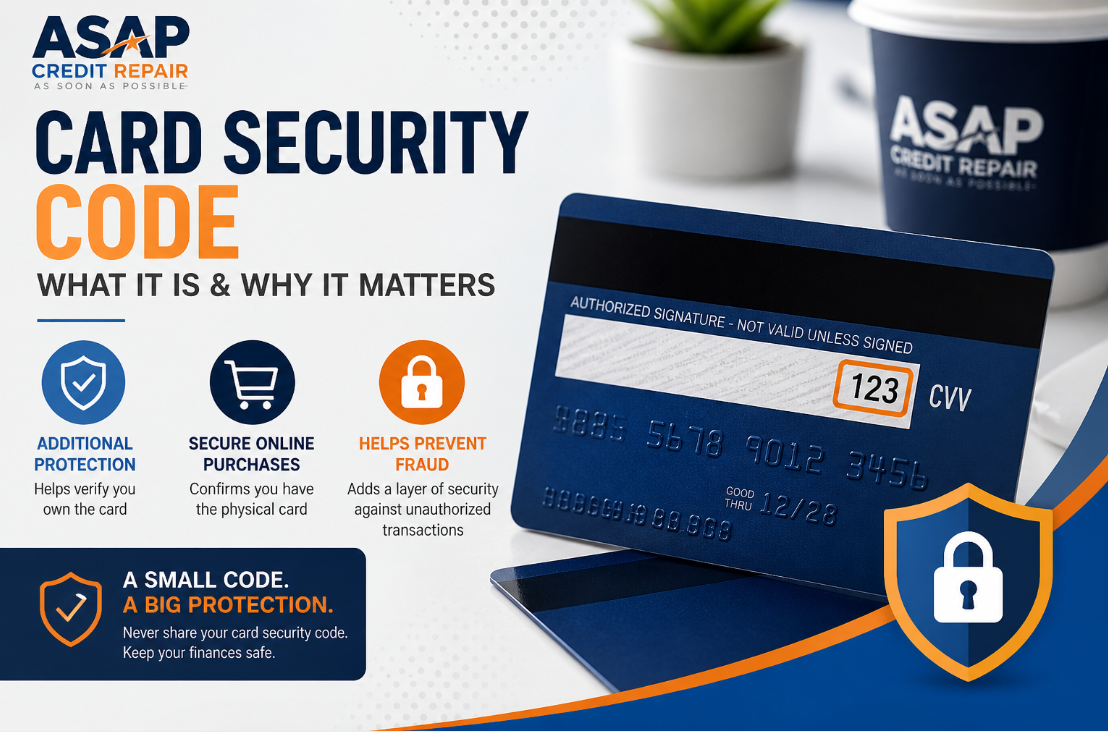
What Is a Credit Card Security Code?
A credit card security code is a short number printed on your card. It is separate from your 16-digit card number and your expiration date. Its only job is to confirm, during purchases where no card reader is present, that the buyer holds the actual card.
How a Security Code Is Generated
Card issuers do not pick codes at random. Each code is generated by encrypting your card number and expiration date using a private algorithm. Only the issuing bank knows this algorithm. The result gets converted into a 3- or 4-digit number and printed on the card.
No two cards share the same code. The code cannot be calculated from your card number alone. A thief who steals your card number from a database cannot figure out your security code. The two pieces of data are linked but stored separately. That gap is intentional.
Why Merchants Cannot Save Your Security Code
The Payment Card Industry Data Security Standard (PCI DSS) prohibits merchants from storing security codes after a transaction clears. Merchants can keep your card number, your name, and your expiration date. The security code must be deleted the moment the payment goes through.
This rule creates a critical gap for thieves. A hacker who breaks into a retailer's database and steals millions of card numbers still cannot shop online without the security codes. That is why websites ask you to re-enter your CVV even when your card number is already saved.
In Q3 last year, our firm processed 58 fraud-related disputes. In 47 of those cases, the unauthorized charges happened on websites that skipped the CVV check entirely. Sites that do not require a security code carry a measurably higher fraud rate.
What Is a Debit Card Security Code?
A debit card security code works the same way as a credit card security code. It is a 3- or 4-digit number printed on your debit card. You use it to verify purchases online or over the phone.
The Key Difference in Risk
The mechanics are identical, but the stakes are not. A credit card connects to a credit line. Fraud charges sit there while you dispute them. Your bank account stays untouched. A debit card connects directly to your checking account. When someone uses your debit security code without permission, that money leaves your account immediately.
Recovery from debit card fraud is slower. Under the Electronic Fund Transfer Act, your liability depends on how fast you report. Report within 2 days, and your liability caps at $50. Wait between 3 and 60 days, and it rises to $500. After 60 days, your bank has no obligation to reimburse you at all.
Treat your debit card security code with more urgency than your credit card code. The consequences of losing it hit your actual cash balance right away.
What Is a Card Security Code (CSC)?
Card Security Code or CSC is the official umbrella term for all security codes across all payment networks. No single issuer owns the term. It covers the concept broadly: a code that provides card-level security regardless of the abbreviation printed on your statement.
A Brief History of the CSC
The card security code was invented in 1995 by Michael Stone, an employee at Equifax in the United Kingdom. UK banks adopted it quickly as online shopping began to grow. By the early 2000s, Visa, Mastercard, and American Express each launched their own versions with slightly different names.
The original code, called CVV1 or CVC1, was embedded in the magnetic stripe. It was read electronically when you swiped. The second version, CVV2 or CVC2, is the printed code you see on the card today. It is not stored in the magnetic stripe. That means card skimmers cannot capture it. Chip and contactless transactions do not transmit the printed code at all. They use a one-time cryptographic token generated for each transaction instead.
What Are the Different Types of Security Codes?
Every card network uses a slightly different name. The codes all do the same thing, but the abbreviations confuse a lot of people. Here is a full breakdown.
CVV and CVV2 — Visa
CVV stands for Card Verification Value. Visa uses CVV for the magnetic stripe version and CVV2 for the 3-digit printed code on the back of the card. The "2" means it uses a different encryption key. The two codes are not identical even though they sit on the same card.
CVC and CVC2 — Mastercard
Mastercard uses CVC, which stands for Card Verification Code. CVC refers to the magnetic stripe version. CVC2 refers to the 3-digit code printed on the back. It works the same way as Visa's system.
CID — American Express and Discover
American Express calls its code the CID, short for Card Identification Number. American Express places a 4-digit CID on the front of the card, above the embossed card number. Discover also uses CID but places a 3-digit code on the back.
CVD — Discover
Discover also uses the term CVD, which stands for Card Verification Data, on some older card products. If you see CVD, you are being asked for the same code as CID.
CSC — Debit Cards and General Use
Many debit card issuers and banks use CSC as their default label. When a website simply says "security code," it means whichever version appears on your specific card.
Where to Find Your Security Code
Location depends on your card network.
Visa, Mastercard, and Discover
All three place a 3-digit code on the back of the card. Look to the right of the signature strip. The code sits in a separate panel. It is not embedded in the strip itself. Issuers moved the code to this separate panel so it stays visible even after you sign the card.
American Express
American Express prints a 4-digit code on the front of the card. It sits above and to the right of the embossed card number. Online merchants ask for this 4-digit code, not the 3-digit code on the back.
The U.S. government's payment portal pay.gov uses this same breakdown to guide citizens entering card details for federal payments.
One Key Limitation
Security codes do not appear anywhere except on the physical card. They are not on bank statements, online portals, or receipts. If you lose your card and cannot find the code, call your bank for a replacement card. No bank representative will read your security code to you over the phone. That would itself be a security violation.
Is a Security Code the Same as a PIN?
No. A PIN and a security code are two different tools that protect against two different threats.
A PIN is a 4-digit number you create and memorize. You enter it on a physical keypad during in-person transactions at ATMs and card terminals. No merchant receives your PIN. It lives entirely in your memory.
A security code is printed on your card. You enter it on checkout forms during online or phone purchases. Anyone who holds your card can see it.
Your PIN stops a thief who steals your physical card from draining your account at an ATM. Your security code stops someone who stole only your card number from shopping online. If a thief gets both your card and your PIN, they can hit an ATM. If they get your card number and security code but never touch the physical card, they can shop online. Neither one alone is a complete defense.
When Should You Share Your Security Code?
Share your security code in two situations only: during checkout on secure websites you trust, and on phone orders you initiate yourself with merchants you recognize.
Signs a Website Is Safe
Check the URL before entering any card data. Secure websites begin with "https://"; the "s" confirms the site encrypts data in transit. An "http://" URL without the "s" means your card details travel unencrypted. Never enter a security code there.
If you have not used a merchant before, verify them first. The Better Business Bureau lets you search any company name and see recent complaints or scam reports in under a minute.
When to Never Share Your Code
Never give your security code in response to an unsolicited call, text, or email, even if it looks like it came from your bank. Banks do not contact customers out of nowhere to ask for security codes. Hang up and call the number on the back of your card.
Never enter your code on a website you reached through a link in an email or text. Type the merchant URL directly into your browser. Phishing sites look identical to real ones. The moment you submit, your data is captured.
Protect Your Card. Protect Your Credit.
A stolen card security code can lead to fraud charges, identity theft, and hidden credit damage. See what’s affecting your credit report and learn what steps can help you protect your financial future.
Get My Free Credit Review →✔ Understand what impacts your score | ✔ Find harmful reporting errors | ✔ Take the next smart step
How to Protect Your Security Code
Sign the back of your card the moment it arrives. Merchants can flag a stolen card when the signature does not match at checkout. Review your card statements every week, not monthly. Fraud compounds fast; the average fraudulent chargeback in 2024 ran $169 per transaction. Enable real-time transaction alerts through your bank app so you see every charge within seconds.
Use virtual card numbers when you shop with merchants you do not know well. Many banks now issue one-time virtual numbers with separate security codes. Even if that merchant gets breached, your real card stays safe.
If you suspect your code has been compromised, call your card issuer the same day and request a new card. A new card means a new code. The old one becomes useless.