

You've seen the option at the ATM. Maybe you've used it once or twice in a pinch. But most people have no idea what a cash advance actually costs until they're staring at a credit card statement that makes no sense. Here's the full picture, including the part your credit card company hopes you never calculate.
A cash advance feels like magic when you're desperate for cash. You put in your credit card, punch in a number, and money comes out. Simple. Fast. No application. No waiting.
The bill arrives later. And it's almost always worse than you expected.
I've been in the credit repair industry for over a decade. I've watched people dig themselves into serious debt holes, starting with one cash advance they thought they'd pay back "next paycheck." It rarely works out that cleanly. So let's break down exactly what you're dealing with before you need it, not after.
What Is a Cash Advance?
A cash advance is when you use your credit card to borrow actual cash, not to buy something, but to pull money out. You can do it at an ATM, at a bank teller window, or through convenience checks your card issuer mails you.
Here's the keyword: borrow. Unlike a debit card withdrawal, where you're pulling your own money, a cash advance is a short-term loan from your credit card company. And like any loan, it comes with terms that are deliberately stacked against you.
Your card has a cash advance limit that's separate from your regular credit limit. It's usually a fraction of your total limit. If you have a $5,000 credit line, your cash advance limit might be $1,000 to $1,500. You can find yours on your statement or in your online account.
The Real Cost of a Cash Advance
This is where people get blindsided. A cash advance doesn't have one fee; it has several, stacked on top of each other, hitting you from different directions at the same time.
The transaction fee
The moment you take a cash advance, your card issuer charges a transaction fee. Most major issuers charge 3% to 5% of the amount you withdraw, or a flat $10 minimum, whichever is greater. Take out $200, and you're already paying $10 before interest even starts.
The higher APR
Cash advances carry a separate, higher interest rate than your regular purchases. As of early 2026, the average cash advance APR at banks sits around 30%, compared to roughly 22% for standard purchases on the same cards. Some cards go even higher.
No grace period — zero
This is the one that really stings. When you make a regular purchase with your credit card, you typically have a grace period, usually 21 to 25 days, before interest starts. With a cash advance, there is no grace period. Interest starts accruing the moment the cash leaves the ATM. The moment. Not the next day. Not the end of the billing cycle. Right now.
ATM and bank fees
On top of everything above, the ATM network itself may charge you a separate fee, typically $2 to $5, just for processing the withdrawal. That's a third layer of cost that has nothing to do with your credit card company.
What it actually adds up to
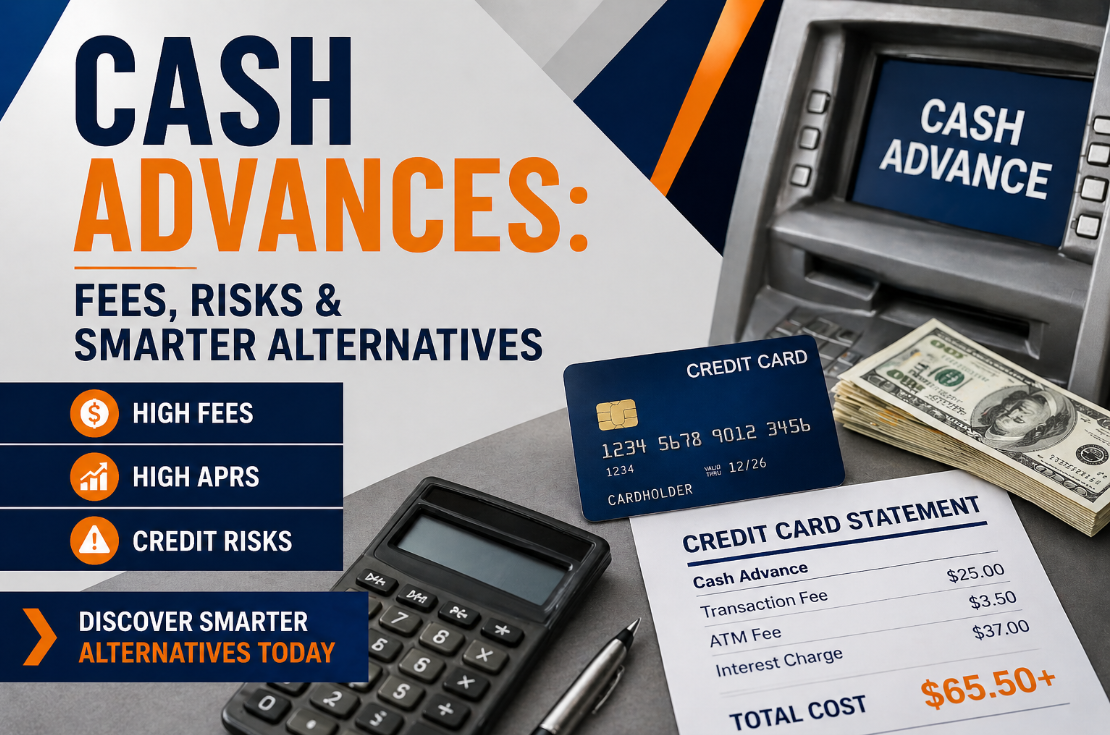
Let's make this concrete. Say you take out a $500 cash advance and make minimum payments over three months. You'll pay roughly $25 in transaction fees, $3.50 in ATM fees, and about $37 in interest at a 29.99% APR. That's over $65 in extra cost on top of the $500 you needed. And there's a catch most people never find out about until it's too late: your card issuer applies your monthly payment to the lowest-interest balance first. That means your regular purchases get paid down before your cash advance does, letting the high-interest cash advance balance sit there longer and compound even further.
The Different Types of Cash Advances
Not all cash advances come from a credit card. The term covers a broader category than most people realize.
Credit card cash advance
The most common type. You withdraw cash from an ATM or bank branch against your card's credit line. This is what most people picture when they hear the term, and it comes with the immediate fees, high APR, and zero grace period described above.
Payday loans
A payday loan is a short-term, high-fee loan tied to your next paycheck. These are technically a separate product, but they function the same way: you get cash now and pay a steep price for it. APRs on payday loans can hit 300% to 400% or more. They're in a different league of expensive and should almost always be avoided.
Merchant cash advances
This one is for businesses, not individuals. A lender provides a lump sum in exchange for a fixed percentage of the business's future credit card sales. Merchant cash advances use factor rates instead of interest rates, and when you translate those factor rates into APR terms, they're often well into triple digits.
Earned wage access apps
Apps like Dave, Earnin, and similar services let you access wages you've already earned before your next payday. Most don't charge interest; they use monthly subscription fees ($5 to $15) or optional tips instead. A December 2025 CFPB advisory opinion clarified that certain earned wage access products meeting specific criteria are not considered credit under federal lending rules. This makes them a far better option than a traditional credit card cash advance for most people.
Transactions You Didn't Know Count as a Cash Advance
Here's something that catches people completely off guard. Your card issuer doesn't just count ATM withdrawals as cash advances. Several common transactions trigger the same fees and high interest rates, and most cardholders never see it coming.
Buying casino chips or gambling tokens with your credit card counts as a cash advance. Purchasing money orders counts. Buying foreign currency at an exchange counter counts. Sending money through apps like Venmo or PayPal when you use a credit card, not a debit card, can count. Using a credit card convenience check to pay rent or bills counts.
Many people hit one of these without knowing it and discover the cash advance fee on their next statement. Always check how your card classifies a transaction before you run it.
What Cash Advances Do to Your Credit Score
Beyond the direct cost, cash advances can hurt your credit score, sometimes significantly. There are a few ways this happens.
Credit utilization spikes
Taking a cash advance raises your balance relative to your credit limit. Utilization above 30% starts dragging your score down. Above 50%, the damage accelerates. If your cash advance pushes you into that territory, your score will feel it.
It can signal financial distress to lenders
Lenders reviewing your credit report can see cash advance activity. It can flag you as someone who needs urgent cash access, and that changes how they think about you when you apply for a mortgage, auto loan, or other credit product.
It compounds into missed payments
The high interest plus immediate accrual makes balances grow faster than people expect. When balances grow faster than you can pay them down, late payments follow. Late payments are one of the most damaging entries on a credit report.
It doesn't build credit
A cash advance is pure cost. It doesn't help your credit mix, doesn't demonstrate responsible usage, and has none of the score-building benefits you'd get from using a card for regular purchases and paying it off on time.
The Myths People Believe About Cash Advances
"I'll pay it off next paycheck, so the interest won't really add up."
This is the most common one. People vastly underestimate how much even a short interest window costs when the rate is 30%, and there's no grace period. And more importantly, people overestimate how reliably they'll actually follow through on paying it off that fast. Life happens. The balance lingers.
"It's basically the same as using my debit card."
It's not even close. A debit card pulls your own money out of your own account with zero fees and zero interest. A cash advance is a loan with an immediate transaction fee, a higher-than-usual APR, and no grace period. The experience at the ATM looks the same. The financial outcome couldn't be more different.
"The cash advance limit is part of my credit limit, so I'm not really going over."
You're still taking on debt. And from a credit scoring perspective, it still raises your utilization ratio, which is what FICO actually measures. The internal classification of "cash advance" versus "purchase" doesn't create a separate bucket in your credit score calculation.
"I just need a small amount. The fees can't be that bad."
The minimum fee at most issuers is $10, regardless of how little you take out. A $50 cash advance with a $10 minimum fee is a 20% flat cost before a single day of interest accrues. Small advances aren't small mistakes.
When a Cash Advance Actually Makes Sense
I'm not going to pretend the answer is never. Sometimes you're in a situation where you need physical cash immediately, no other option exists, and the cost is worth solving the immediate problem. That scenario is real. But it's narrower than most people think.
A cash advance is defensible only when you genuinely need physical cash, not just a payment you could put on the card directly. Every alternative has been ruled out, the amount is small enough that you can pay it back in full within 30 days, and you've read your cardholder agreement to know exactly what the fees and APR are before you go to the ATM.
If those conditions aren't all true at the same time, there's almost certainly a better path.
Better Alternatives to a Cash Advance
Before you put your credit card into an ATM, run through this list.
Personal loan
A personal loan typically carries a far lower APR than a cash advance, comes with a fixed repayment schedule, and doesn't hit you with an immediate transaction fee. If you have decent credit and need more than a few hundred dollars, this is usually the smarter move.
Earned wage access apps
Dave, Earnin, and similar apps let you access wages you've already earned. No interest, just a small monthly subscription fee or optional tip. For someone who needs $100 to $300 to cover a gap before payday, this is dramatically cheaper than a credit card cash advance.
Borrow from someone you trust
Uncomfortable to ask, but free. If you genuinely need $200 until next week, asking a family member or close friend costs nothing in fees or interest. It does require a conversation, but that conversation costs less than $30 in credit card charges.
Charge it directly
If the expense itself can be paid by card, charge it as a regular purchase. The standard purchase APR is lower than the cash advance APR, there's a grace period, and there's no transaction fee. If your goal is just to cover an expense, putting it on the card directly is almost always cheaper than taking cash out and paying the expense in cash.
Paycheck advance through your employer
Many employers offer payroll advances, particularly at larger companies. No interest, no fees, just a formal request through HR or payroll. This is one of the most underused options available. Most people don't even know to ask.
Your emergency fund
The best alternative to a cash advance is never needing one. Even $500 to $1,000 sitting in a savings account eliminates most of the situations that drive people to the ATM with their credit card. Building that buffer is worth prioritizing.
Frequently Asked Questions About Cash Advances
Does a cash advance hurt my credit score?
It can. Taking a cash advance raises your credit utilization, which is a major factor in your FICO score. If the balance remains on your card or leads to missed payments due to high interest, the damage to your score can be significant.
How do I find my cash advance limit?
Check your credit card statement, your online account, or call the number on the back of your card. Your cash advance limit is almost always lower than your total credit limit, sometimes by half or more.
What's the difference between a cash advance and a payday loan?
A cash advance draws from your existing credit card line. A payday loan is a separate short-term loan product tied to your next paycheck, usually from a storefront lender or app. Payday loans typically carry far higher effective APRs, sometimes 300% to 400%, making them even more expensive than a credit card cash advance in most cases.
Is there a cash advance with no fee?
A small number of credit cards advertise no cash advance fee, but they're rare. Even those cards typically carry a higher APR and zero grace period on advances. Read the cardholder agreement carefully before assuming any card is truly fee-free for cash advances.
How fast does cash advance interest add up?
Faster than most people expect. At a 30% APR with no grace period, a $500 advance costs roughly $12.50 a month in interest alone on top of whatever transaction fee you already paid at the ATM. The longer it sits unpaid, the more expensive it becomes.
Can I use a cash advance for a down payment or rent?
Technically yes. Practically, it's one of the worst ways to cover those costs. High fees and immediate interest can turn a temporary cash shortfall into a persistent debt problem. A personal loan or earned wage access app is almost always a better path for large, predictable expenses.
Avoid Costly Cash Advance Traps
High fees and short repayment terms can keep you stuck in a cycle of debt. Explore smarter credit solutions before you borrow.
Get My Free Credit Report Check My Options NowNo impact on your credit score • Fast & secure process
The Bottom Line
Cash advances are not inherently evil. They're a tool, an expensive, blunt tool that most people reach for without fully understanding the cost until it's already done.
The transaction fee hits the moment you take the cash. Interest starts the same day. The rate is higher than your regular purchase APR. Your monthly payments go toward cheaper balances first, letting the cash advance sit and compound. And if you're not careful, one "temporary" advance becomes a balance that follows you for months.
If you're in a financial situation where cash advances feel like the only option regularly, that's worth paying attention to. It usually means something bigger is going on with your credit or cash flow, and there are real, concrete strategies to fix both.
Using a cash advance once in a genuine emergency won't ruin you. Leaning on them repeatedly will.