

Charged Off as Bad Debt: What It Really Means, How It Damages Your Credit, and Every Option You Have to Fix It. A debt charged off as bad debt means your creditor gave up trying to collect. They wrote the balance off as a loss. They reported it to all three credit bureaus. The entry stays on your report for seven years. The debt itself does not go away. You still owe every dollar.
Running a credit repair company, I see this issue walk through our doors more than almost any other. One of the most unforgettable cases I worked involved a client with a $3,200 credit card charge-off. She assumed the bank had written it off and moved on. Three years later, a debt buyer sued her. She owed $3,200 plus interest and court fees. She nearly faced wage garnishment. The charge-off was old. But the debt was very much alive.
This mistake is everywhere. According to the Federal Reserve Bank of St. Louis, the credit card charge-off rate at U.S. commercial banks hit about 4.6% in Q4 2024. That means millions of accounts cross into charge-off status every single year. If yours is one of them, this article covers everything you need to know.
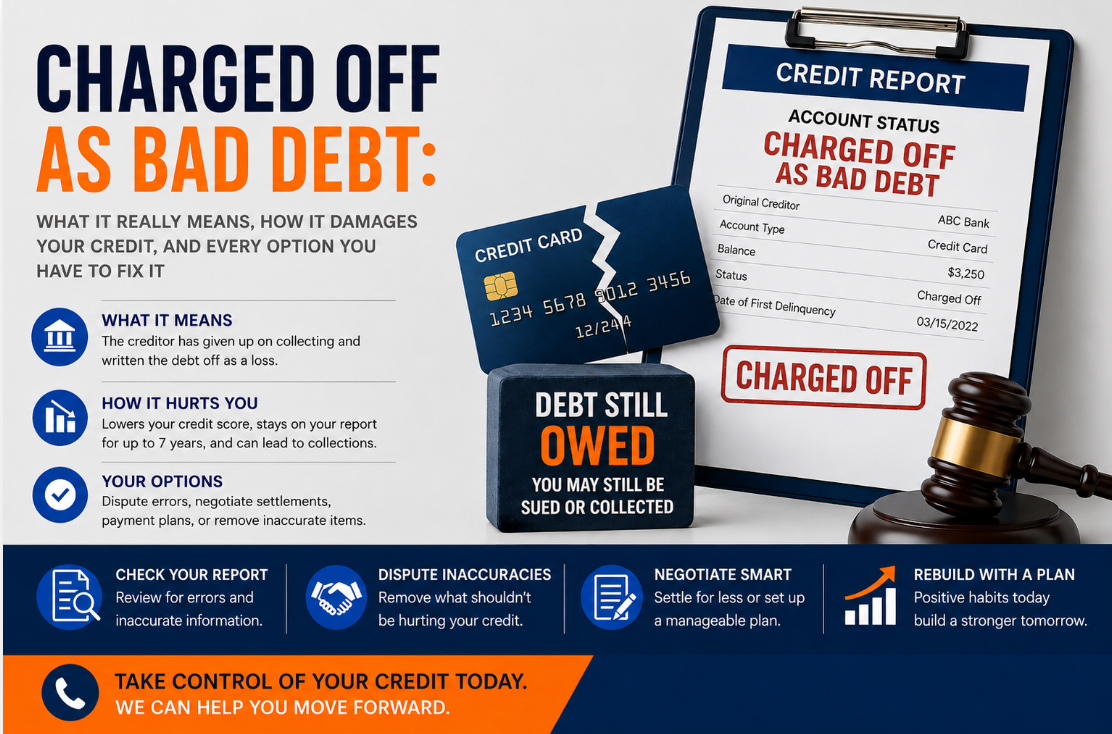
Charged Off as Bad Debt: What It Means & How to Fix It?
A charge-off happens when a creditor stops expecting payment. After 120 to 180 days of missed payments, they reclassify your balance as a loss. They close the account. They report the status to Equifax, Experian, and TransUnion.
The phrase "charged off as bad debt" describes what happened from the creditor's accounting side. They moved your balance from the asset column to the loss column. The IRS requires this. Banks cannot carry severely past-due debt as a performing asset forever. This is a rule, not a personal choice.
Here is what actually takes place during a charge-off:
The creditor writes the balance off their profit-and-loss statement.
They close the account to new charges forever.
They report "charged off" status to all three major credit bureaus.
They either pass the account to their own collections team, assign it to a third-party agency, or sell it to a debt buyer.
Charge-offs apply to credit cards, personal loans, medical debt, private student loans, and lines of credit. Secured loans work differently. A mortgage lender starts foreclosure. An auto lender begins repossession. They hold collateral, so a standard charge-off does not apply.
On your credit report, you will see this entry labeled one of three ways:
"Charged off as bad debt."
"Profit and loss write-off"
"Charged off as bad debt canceled by credit grantor."
The word "canceled" in that third label confuses people. Canceled does not mean forgiven. It means the account was closed. Your duty to repay stays fully intact.
What Does a Charge-Off on a Credit Report Actually Look Like?
Your credit report shows the charge-off as a tradeline under the original creditor's name. The entry lists the account number, original credit limit or loan amount, current balance, and a status field that reads "charge-off."
The date of the first missed payment is the most important date on that entry. That is when your seven-year clock started. The FCRA ties the removal window to the original missed payment, not the charge-off date.
Here is an example. Say your first missed payment was in March 2022. The creditor charged it off in August 2022. The entry comes from your report in March 2029, not August 2029.
If the creditor sold your debt to a collector, you may also see a second entry. The collection account appears as a separate tradeline under the collector's name. Both entries are negative. Both count against you. This is called double reporting. It is legal as long as the dates are correct.
The CFPB found that fewer than 17% of charged-off credit card accounts show up as separate collection tradelines. Most original creditors keep reporting the account themselves. The double-entry risk is still real, though, especially when the debt is sold outright.
Watch for one specific trick: re-aging. Some debt buyers report a more recent missed payment date to extend the seven-year window. This is illegal under the FCRA. If the date on your report looks newer than your actual first missed payment, dispute it.
How Much Does a Charge-Off Drop Your Credit Score?
Payment history makes up 35% of your FICO score. A charge-off signals months of missed payments plus a final closed account. Both hit your score at the same time.
How much it drops depends on where you started:
Good credit (700 to 749): Expect a drop of 100 to 150 points.
Very good credit (750 and above): The drop can reach 150 to 200 points.
Fair credit (600 to 699): Expect a drop of 75 to 100 points.
Poor credit (below 600): The drop is 50 to 75 points. Smaller in size, but it pushes a damaged profile even deeper into the high-risk range.
FICO research shows that missing one payment by 90 days can drop a score by over 100 points on its own. By the time a charge-off posts, you have likely already missed four to six straight payments. Each one landed a separate hit. The charge-off is the final blow in a chain that started months before.
There is a second impact most people miss. For credit cards, the charged-off balance often stays in your credit usage ratio until the balance is paid or settled. A $5,000 charge-off on a $6,000 limit card keeps your usage ratio near 83% on that account. High usage ratios hurt your score on their own, separate from the charge-off entry.
In our office, over the past 12 months alone, we handled more than 220 cases with active charge-offs. In more than half, the client's score was already below 580 before they came to us. The charge-off was not the only problem. But it was the anchor pulling everything down.
When Should a Creditor Charge Off a Bad Debt?
Creditors follow a set timeline. The Office of the Comptroller of the Currency requires credit card companies to charge off accounts after 180 days of nonpayment. Other loan types may move faster.
Here is the full timeline from the first missed payment to charge-off:
Day 30: The first missed payment posts to your report as a 30-day late. Your score drops right away.
Day 60: A second missed payment posts as a 60-day late. The drop picks up speed.
Day 90: Your account is now seriously past due. Collection calls increase. The creditor may send formal demand letters.
Day 120: Many lenders, especially auto and personal loan lenders, begin charge-off steps here. Some credit card companies also act at this point.
Day 150: Collection efforts shift into high gear. Your account may move to an internal collections team.
Day 180: Most credit card companies execute the formal charge-off here. The account closes. The status updates on your report.
The creditor does not choose this timeline on their own. Banking rules require consistent charge-off treatment to keep financial reports accurate. Letting past-due debt sit on the books as a good asset would mislead investors and regulators.
One exception worth knowing: if you make even a partial payment during this window, some creditors will delay the charge-off. A minimum payment keeps the account technically active, even if you fall behind again. This is not a long-term fix, but it buys time to set up a payment plan before the account closes.
Does a Charge-Off Mean You No Longer Owe the Debt?
No. This is the most dangerous myth in personal finance.
A charge-off ends the creditor's internal collection steps. It does not cancel your legal duty to pay. The creditor wrote the balance off for their own tax and accounting needs. From your side, you still owe every dollar.
After the charge-off, here is what happens to the debt:
The original creditor keeps the debt and tries to collect through an internal team.
The original creditor assigns the debt to a third-party collection agency. The agency collects on their behalf and earns a fee on what they recover.
The original creditor sells the debt outright to a debt buyer. Buyers pay four to seven cents per dollar of face value. They now own your full balance. They can legally pursue 100% of it.
Debt buyers are often more aggressive than original creditors. They paid very little. Collecting from you is the only way they profit. They call, send letters, and in many cases file lawsuits. The CFPB's complaint database takes in hundreds of thousands of debt collection complaints each year. Many involve charge-off accounts being chased by third parties years after the original event.
Can You Be Sued for a Charged-Off Debt?
Yes. A charge-off does not protect you from a lawsuit.
The creditor, collection agency, or debt buyer can sue you as long as the statute of limitations has not run out. Most states set this window between 3 and 6 years. Some allow up to 10. The clock starts from the date of your last payment or first missed payment.
Here is what makes this risky: In most states, making even a small payment on an old charged-off debt restarts the clock. A $25 payment on a debt that is five years and ten months old can give the creditor a fresh window to sue you. This is sometimes called "zombie debt." Collectors count on you not knowing this rule.
The FTC warns that even after the clock runs out, a lawsuit can still be filed. The court may award a judgment against you if you do not show up and raise the expired clock as a defense. That burden falls on you. You must respond. Ignoring a court summons guarantees a default judgment against you.
If a creditor wins a lawsuit, they may receive a judgment that allows:
Wage garnishment. Federal law caps this at 25% of your take-home pay or the amount your weekly pay exceeds 30 times the federal minimum wage, whichever is lower. Some states have stricter caps.
Bank account freezes or levies.
Property liens in some states.
Before you pay anything on an old charged-off debt, confirm the last date of activity and check your state's clock. The CFPB has a guide on how this applies to old debts.
What Happens If You Pay Off a Bad Debt After a Charge-Off?
Paying a charged-off account does not remove it from your report. The entry stays for the full seven years. What changes is the status. The entry updates from "charged off" to "paid charge-off" or "settled charge-off."
That update matters. Lenders see two very different things: an open, unresolved charge-off versus a resolved one. Mortgage lenders often require all charge-offs to be paid before they approve a home loan. The entry stays negative, but a paid charge-off shows the debt is resolved.
Newer scoring models also treat paid charge-offs better. FICO 9 and VantageScore 3.0 and 4.0 weigh paid charge-offs less harshly than older models. As lenders move toward these newer models, paying a charge-off produces a bigger score gain than it used to.
You have four main paths to resolve a charge-off:
Pay in full. The account updates to "paid charge-off." You end all legal risk. This is the cleanest result. Most mortgage lenders require this before closing.
Settle for less. You offer a lump sum below the full balance. Many debt buyers accept 40 to 60 cents on the dollar. Sometimes less for older debts. The account updates to "settled." Any forgiven amount over $600 may count as taxable income. The creditor sends a 1099-C form. The IRS expects you to report it.
Pay for delete. You offer to pay in exchange for the creditor removing the entry from your report. This is the best outcome. It is rare. Major original creditors rarely agree. Smaller collectors and debt buyers sometimes do. Always get the deal in writing before sending any money. A verbal promise is worthless.
Dispute errors. If the entry has factual mistakes, you can dispute them under the Fair Credit Reporting Act. If the creditor cannot verify the disputed facts, the bureau must delete or fix it. Disputing accurate entries will not work.
How to Dispute a Charge-Off on Your Credit Report
Errors on charge-off entries happen more than most people expect. Common problems include the wrong balance, a false date of first missed payment, duplicate entries for the same debt, or an account that is not even yours.
Here is the correct process:
Pull your three-bureau reports at AnnualCreditReport.com. This is the only free, federally authorized source.
Find the charge-off entry. Write down the original creditor's name, account number, date of first missed payment, and reported balance. Compare every detail to your own records: old statements, bank transfers, and collection letters.
Spot the specific error. Is the balance wrong? Is the date pushed forward to extend the seven-year window? Is the same debt listed twice under different names?
File a dispute with the bureau reporting the error. Do this online at their website or by certified mail. Include documents that back your claim: bank statements, payment records, and ID if the account is not yours.
The bureau has 30 days to look into it. The original creditor must respond and verify the facts. If they cannot verify, the bureau must delete or fix the entry.
If the bureau returns "verified," but you still believe an error exists, escalate to the original creditor. Send a written dispute and ask them to investigate and correct their own reporting.
The FCRA gives you these rights. Use them. But know this: disputing accurate entries will not remove them. You can only fight errors.
How to Stop a Charge-Off Before It Happens
The best move is to stop a charge-off before it posts. Once it appears and the facts are accurate, you cannot remove it. But the window between your first missed payment and day 180 gives you real options.
Most creditors have hardship programs that they do not advertise. Call your creditor before the 90-day mark. Ask about hardship deferrals, lower minimum payments, or short-term interest freezes. Creditors would rather work something out than write off the balance. They will not offer this on their own. You have to call and ask.
Before day 120, try to get a formal payment plan in writing. Confirm the written plan says the creditor will not charge off the account while you follow the plan. Never accept a verbal promise.
If the debt is a credit card, a nonprofit credit counselor can set up a debt management plan on your behalf. Under this type of plan, the counselor negotiates lower rates with your creditors. You make one monthly payment, and they split it among your creditors. Many creditors pause collection and drop late fees for clients in these plans. The National Foundation for Credit Counseling (NFCC) connects consumers with accredited agencies. Avoid any agency that charges large upfront fees or makes guarantees before reviewing your case.
How to Rebuild Credit After a Charge-Off
A charge-off is not permanent damage. Its weight on your score shrinks every year. By year three or four, with steady positive habits, most people see real recovery, even with the entry still on the report.
Here is what actually moves the score:
Pay every current account on time, every month. Payment history is 35% of your FICO score. Each on-time payment builds a positive history that slowly offsets the charge-off's weight. One new late payment after a charge-off sets recovery back hard.
Open a secured credit card. You deposit money as collateral, equal to your limit. Use it for one small charge each month, like a utility or streaming bill. Pay it in full every month. The account reports a positive payment history. This is the fastest way to add a new positive entry when regular cards are out of reach.
Keep credit usage below 30% on all open revolving accounts. Aim for below 10% on each card. High balances relative to limits hurt your score on their own. Paying down balances produces an immediate score response, often within the next billing cycle.
Avoid applying for multiple new credit products at once. Each credit check from a new application stays on your report for two years. Multiple applications in a short window signal stress to lenders and scoring models.
Consider a credit-builder loan from a credit union. These are small loans designed to build credit. The loan sits in a savings account while you pay it off each month. Every payment posts as a positive mark. When it is paid off, you get the funds. The credit history stays.
Check your credit report every four months. Pull one bureau at a time on a rotating schedule through AnnualCreditReport.com. This lets you track recovery, catch errors, and spot any new negative entries early.
The charge-off loses scoring weight year by year. Lenders who look at your file at year four see a very different picture than they did at month six. Building a positive history fast is the quickest path back.
Charge-Off vs. Collections: What Is the Difference?
Many people treat these terms as the same. They are not.
A charge-off is an action by the original creditor. The lender marked your account as uncollectible and reported it to the bureaus.
A collection account appears when a third-party collector takes over the debt. The original creditor sold or assigned the debt. The collector opens a new tradeline under their own name.
You can carry both on your report for the same debt. The original charge-off stays as its own entry. The collection account shows as a separate line. Both are negative. Both fall under the same seven-year clock, counted from the original date of the first missed payment. Selling the debt does not reset or extend that clock.
A charge-off is seen as more severe than a standard collection account. It means the original lender declared the debt a total loss. When a lender reviews your file by hand for a mortgage or large loan, a charge-off on the original account tells a worse story than a collection entry alone.
Your Rights When a Collector Contacts You
The Fair Debt Collection Practices Act (FDCPA) governs how third-party debt collectors can treat you. Once the debt is sold or assigned, the FDCPA applies fully.
Under the FDCPA, collectors:
Cannot call before 8 a.m. or after 9 p.m. in your local time zone.
Cannot contact your workplace if you tell them your employer does not allow such calls.
Must stop all contact if you send a written cease-and-desist letter by certified mail. After that, they may only reach out once to confirm they will stop, or to tell you about a specific legal action.
Cannot use abusive or threatening language.
Must send a written debt notice within five days of first contact. That notice must state the amount owed, the original creditor's name, and your right to dispute the debt.
Cannot sue or threaten to sue on a debt past its legal window.
Cannot report false details to the credit bureaus.
If a collector breaks any of these rules, you can sue them in federal court. A win can result in up to $1,000 in set damages plus actual damages and legal fees. Many consumer attorneys take these cases with no upfront cost to you. Report violations to the CFPB at consumerfinance.gov/complaint and to your state attorney general.
Key Facts About Charged-Off Debt at a Glance
A charge-off posts after 120 to 180 days of missed minimum payments.
The debt does not disappear. You still owe the full balance.
Score drops range from 50 to 200 points, depending on your starting score.
The entry stays on your credit report for seven years from the date of the first missed payment.
Selling the debt to a collector does not restart the seven-year clock.
You can still be sued if the legal window has not closed (3 to 10 years, depending on the state).
Making a partial payment restarts the legal window in most states.
Paying the charge-off does not remove the entry. It updates the status to "paid charge-off."
Pay-for-delete is possible but not guaranteed. Get it in writing before you pay anything.
You can only dispute errors. Disputing accurate entries will not remove them.
Re-aging (falsely updating the missed payment date) is illegal under the FCRA and grounds for a dispute.
FDCPA violations by collectors can result in up to $1,000 in set damages per violation.