

Getting a mortgage in Charlotte with high credit card utilization is possible, but high balances can affect the credit score lenders review when pricing and underwriting your loan. If you are carrying cards close to their limits while trying to buy a house, the real question is not simply whether you can qualify. It is whether paying those balances down before applying could put you in a stronger mortgage position.
That distinction matters in Charlotte, where the median home sale price reached $429,716 in August 2026, with homes taking a median of 52 days to sell.
In mortgage and credit forums, buyers commonly describe the same situation. Their income supports the mortgage payment, but high revolving balances are pulling down their scores before preapproval. The confusion often comes from treating credit utilization and debt-to-income ratio as the same measurement. They are not.
Experian identifies revolving utilization as an important credit-scoring factor, while the Consumer Financial Protection Bureau defines debt-to-income ratio (DTI) as monthly debt payments divided by gross monthly income. That means a card near its limit can affect your credit profile even when its required monthly payment still fits within your lender's DTI calculation.
This guide explains how high credit card utilization affects a Charlotte mortgage. How utilization differs from DTI, what credit scores lenders may consider, whether paying down cards before applying can help, and what to review first before a mortgage lender pulls your credit.
Can You Get a Mortgage in Charlotte With High Credit Utilization?
Yes. You can get a mortgage in Charlotte with high credit utilization, but high card balances can lower your credit score and potentially affect the loan terms you receive. Mortgage lenders also evaluate your debt-to-income ratio (DTI), which is based on required monthly debt payments rather than your credit utilization percentage.
The infographic below shows how these two factors work together and what Charlotte homebuyers should review before applying.
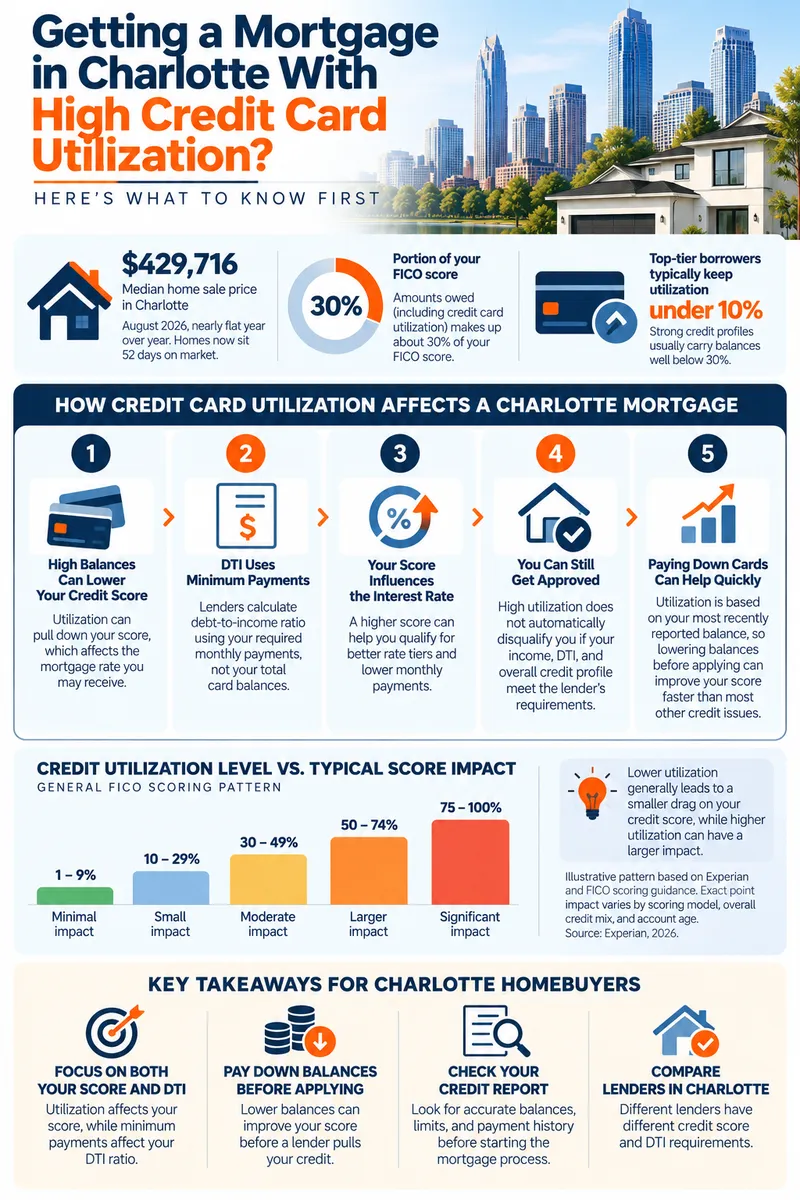
Maxed-out credit cards feel like they should sink a mortgage application, but the math works differently than most Charlotte buyers expect. Lenders qualify borrowers using debt-to-income ratio, a comparison of monthly payments to income, not the percentage of a credit limit being used. High utilization still matters, just indirectly, through the score it drags down and the rate tier that score unlocks. Here is how the two numbers actually interact, and what to fix first if you are house hunting in Charlotte.
Can You Get a Mortgage in Charlotte With High Credit Card Utilization?
Yes, though it can raise your interest rate. Underwriters approve mortgages based on your debt-to-income ratio, not your utilization percentage. High utilization mainly hurts you indirectly, by pulling down the credit score that decides which rate tier you land in.
A lender looking at your mortgage file cares about one question above the rest: can you afford the monthly payment on top of everything else you already owe. That is measured through debt-to-income ratio, a comparison of your required monthly debt payments against your gross monthly income. A credit card carrying a $9,000 balance on a $10,000 limit still only counts toward that ratio at its minimum payment, often somewhere around $180 to $270 a month, regardless of how close the account sits to its ceiling.
Utilization enters the picture through a different door. It is baked into your credit score, and your score decides which rate sheet a lender prices you off of. Two Charlotte buyers with identical income and identical debt payments can walk away with different interest rates purely because one carried a 75% utilization ratio and the other kept balances under 10%.
What Is a Good Credit Utilization Ratio Before Applying for a Mortgage?
Most scoring models start penalizing balances once they pass 30% of a card's limit, and borrowers with the strongest scores tend to sit under 10%. Lowering utilization before a mortgage application is one of the fastest ways to raise a score, since scoring models only look at the most recently reported balance.
According to Experian's breakdown of credit card utilization, utilization sits inside one of the two heaviest-weighted categories in most scoring models. The 30% figure is a ceiling, not a target. Consumers who consistently land in the top score brackets carry balances closer to single digits.
The upside is speed. Unlike a late payment or a collection account, which can weigh on a score for years, utilization is recalculated the moment a new balance reports to the bureaus. Paying a card down two weeks before a lender pulls credit can move the needle before closing, which is not true of most other credit repair work.
Does Credit Card Utilization Affect Debt-to-Income Ratio?
Not directly. Debt-to-income ratio compares your minimum monthly payments to your gross monthly income, while utilization compares your balance to your credit limit. A card can carry a high balance and a low minimum payment at the same time, so the two numbers can move in opposite directions.
The Consumer Financial Protection Bureau's explanation of debt-to-income ratio defines it simply: all monthly debt payments divided by gross monthly income. A borrower earning $6,000 a month with $2,000 in monthly obligations carries a 33% ratio, whether their credit cards sit at 20% utilization or 95%.
| Metric | What It Measures | Who Uses It |
|---|---|---|
| Credit utilization | Balance divided by credit limit, per card and overall | Credit scoring models |
| Debt-to-income ratio | Minimum monthly payments divided by gross monthly income | Mortgage underwriters |
| Where they connect | Utilization drives the score; the score drives the rate a lender offers | Both, indirectly |
This is why a borrower can technically qualify with maxed-out cards and still walk away with a worse rate than someone carrying the same total debt spread thinner across more available credit. The underwriter's math does not flinch. The pricing engine does.
What Credit Score Do You Need to Buy a House in Charlotte?
FHA loans generally accept a 580 score with 3.5% down. Conventional loans typically start at 620. The best conventional pricing usually opens up around 740, where high utilization stops being much of a factor at all.
Knowing the credit score needed for a mortgage is the starting point, but the gap between a 620 approval and a 740 approval is not just about qualifying. It is about what the loan actually costs over time. The same pattern shows up when comparing the credit score needed for a $400,000 house, where the difference between a 620 borrower and a 740 borrower on a comparable loan runs into six figures of interest over 30 years.
Debt-to-income still clears, but the lower score pushes the borrower into a higher rate bracket, adding real cost across the loan term.
Total monthly obligations barely change, but the score climbs enough to shift into a meaningfully cheaper rate tier.
What Should You Fix First Before Applying?
Start with utilization, since it moves fastest and directly shapes your rate tier. Then confirm your debt-to-income ratio against your target lender's limits, since that number decides whether you qualify for the loan amount you want at all.
According to ASAP's guide on credit repair for first-time home buyers, lenders weigh payment history, debt-to-income ratio, and employment verification well beyond the score alone. Utilization is simply the fastest lever available before a lender pulls your file.
- ✓ Pay revolving balances under 30% of each limit, and under 10% if the closing date allows time
- ✓ Avoid opening new cards or closing old ones in the months before applying
- ✓ Calculate your own debt-to-income ratio before a lender does, using minimum payments, not balances
- ✓ Ask your loan officer for a rate-tier breakdown by score range, not just a single quoted rate
- ✓ Time a large paydown to land a full billing cycle before your credit is pulled
A maxed-out card does not automatically sink a Charlotte mortgage application. What it sinks is the interest rate attached to it, and that cost compounds for as long as the loan is open.
Not Sure What Your Utilization Is Really Costing You?
A free 3-bureau audit shows exactly how your balances, limits, and utilization are shaping your score before you lock a mortgage rate.
Claim My Free Credit Analysis Now → Secure · 2 minutes · No credit card requiredWhat Is the Charlotte Housing Market Doing Right Now?
Charlotte's median home sale price sat at $429,716 in August 2026, essentially flat compared to a year earlier, with homes taking a median of 52 days to sell. A steadier market gives buyers a little more room to improve their credit picture before making an offer.
Per Redfin's Charlotte housing market data, prices have leveled off compared to the sharper swings of recent years, and homes are sitting slightly longer than they did twelve months ago. That is a market where a buyer can reasonably spend a billing cycle or two lowering utilization without losing out to a bidding war.
High credit card utilization will not stop a debt-to-income calculation from clearing, but it will shape which interest rate a Charlotte buyer gets offered. Paying balances down before a lender pulls credit is one of the few credit moves that pays off almost immediately, and in a market moving at Charlotte's current pace, most buyers have time to make it count.
Can you get a mortgage in Charlotte with high credit card utilization?
Yes, though it can raise your interest rate. Underwriters approve mortgages based on your debt-to-income ratio, not your utilization percentage. High utilization mainly hurts you indirectly, by pulling down the credit score that decides which rate tier you land in.
What is a good credit utilization ratio before applying for a mortgage?
Most scoring models start penalizing balances once they pass 30% of a card's limit, and borrowers with the strongest scores tend to sit under 10%. Lowering utilization before a mortgage application is one of the fastest ways to raise a score, since scoring models only look at the most recently reported balance.
Does credit card utilization affect debt-to-income ratio?
Not directly. Debt-to-income ratio compares your minimum monthly payments to your gross monthly income, while utilization compares your balance to your credit limit. A card can carry a high balance and a low minimum payment at the same time, so the two numbers can move in opposite directions.
What credit score do you need to buy a house in Charlotte?
FHA loans generally accept a 580 score with 3.5% down. Conventional loans typically start at 620. The best conventional pricing usually opens up around 740, where high utilization stops being much of a factor at all.
Should I pay down credit cards before applying for a mortgage in Charlotte?
In most cases, yes. Paying balances down before your lender pulls credit can lift your score into a better rate tier within one billing cycle, and it also frees up monthly cash flow that helps your debt-to-income ratio at the same time.
Get Mortgage-Ready Before You Lock a Rate
See exactly what's pulling your score down and get a clear plan to fix it before you apply, backed by a full 3-bureau review.
Claim My Free Credit Analysis Now → Secure · 2 minutes · No credit card required-
Credit Utilization Traps: How Small Spending Spikes Can Crush Your Score Fast Explains how everyday spending swings can push utilization into score-damaging territory without a borrower noticing.
-
What Credit Score Do I Need for a Mortgage? Requirements & Expert Tips Breaks down minimum score thresholds across FHA, conventional, and jumbo loan types.
-
What Credit Score Do You Need for a $400,000 House? Compares monthly payment and lifetime interest cost across credit tiers on a comparable loan amount.
-
Credit Repair for First-Time Home Buyers: What Mortgage Lenders Actually Check Covers the full underwriting picture beyond the score, including payment history and employment verification.