

Credit card churning means opening new credit cards repeatedly to collect sign-up bonuses, then closing or moving on from those cards before the next annual fee hits. Travelers use it to stack free flights and hotel stays. Cash-back seekers use it to pocket hundreds of dollars per card. Done right, it pays. Done wrong, it wrecks your credit.
Running a credit repair company, I see the aftermath of poorly executed churning more often than most. One of the most unforgettable cases was a client who opened 11 cards in 18 months chasing airline miles and ended up with a 90-point credit score drop and two accounts sent to collections. The rewards did not come close to covering the damage.
Real data backs this up. The r/churning subreddit on Reddit, which has over 400,000 members, tracks bonus strategies through community-built flowcharts and data point threads (reddit.com/r/churning). Members report earning anywhere from $1,000 to over $20,000 in rewards over several years, but the community consistently warns: churning is a marathon, not a sprint.
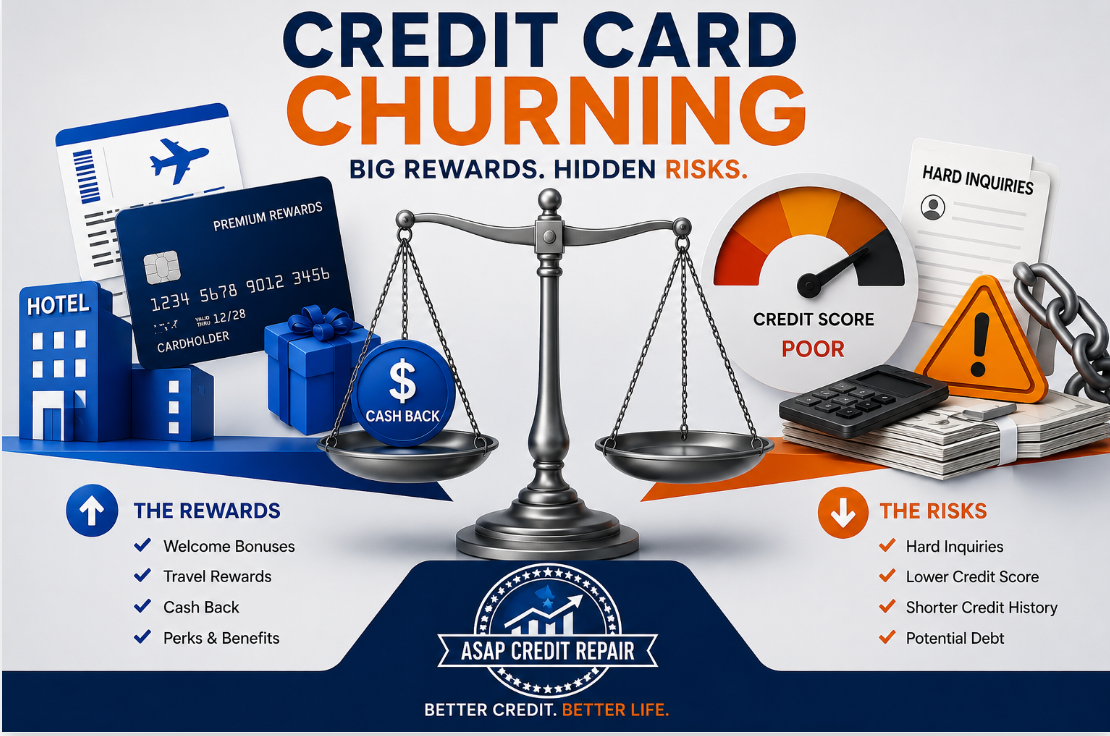
How Does Credit Card Churning Work?
Credit card churning works by exploiting welcome bonuses. Card issuers pay large sign-up rewards to attract new customers. A churner applies for a card, spends the required minimum to unlock the bonus, collects the reward, then closes the card or keeps it open without using it.
Here is a basic example. A card offers 80,000 bonus points after you spend $4,000 in the first three months. You put your regular bills on the card to hit that threshold. The points post to your account. You redeem them for flights or cash. You then wait out the required period and move to the next card.
Couples who signed up for 40 unique credit card accounts over seven years report earning over $20,000 by choosing cards with large bonuses, meeting only the minimum requirements, and then rapidly moving to the next card. That works out to roughly one new card every two months.
The strategy requires discipline in two areas: tracking spending deadlines and tracking annual fee dates. Many churners use spreadsheets to manage both.
What Is a Credit Card Churner?
A credit card churner is someone who applies for credit cards in a planned sequence to collect sign-up bonuses. Churners do not use cards for long-term spending. They treat each card as a short-term reward vehicle.
Churners open cards, earn the intro bonus, and move on to the next card. Before credit card issuers put systems in place to stop the practice, churners would open multiple credit cards in quick succession, earn the intro bonus for each account, and then close or stop using the cards.
Active churners often manage seven or more open accounts at once. They track minimum spend timelines, annual fee dates, and bonus posting windows. Some even use manufactured spending techniques, such as buying gift cards or prepaid debit cards, to meet minimum spend thresholds faster.
The r/churning community refers to your "5/24 status," which counts how many credit cards you have opened in the last 24 months. If you are under 5/24, you have opened fewer than 5 cards in two years. If you are over 5/24, you have opened 5 or more. That number matters because banks use it to flag churners and deny applications.
So far, credit card churning works by collecting welcome bonuses on new accounts, and churners plan each application around spending requirements and bonus timelines. The community around this hobby is large and data-driven, but the risks are real.
Can Credit Card Churning Earn Rewards Points?
Yes. Rewards points are the main reason most people churn. Sign-up bonuses on premium travel cards routinely reach 60,000 to 100,000 points. Those points can cover domestic flights, hotel nights, or international upgrades.
Sign-up bonuses can be converted to cash or exchanged for flights and other rewards. Every reward point holds a monetary value, and on top of points, churners can earn cash back, lounge passes, travel insurance, and other benefits.
Here is a simple value breakdown. A card offers 100,000 points at an average redemption rate of 1 cent per point. That is $1,000 in value. Subtract a $295 annual fee. You walk away with $705 from a single card. Open four cards in a year with similar offers, and the numbers grow fast.
In our credit repair practice, we tracked 23 cases over the past 12 months where clients cited rewards-chasing as the reason for opening six or more cards in under 18 months. Of those, 14 showed measurable credit score declines above 50 points.
Cash-back cards add another layer. Some offer flat-rate bonuses of $200 to $500 just for hitting a $500 to $1,000 spend in the first 90 days. No points math required.
The catch is that rewards lose their value fast if you pay interest. Credit card churning only profits you when you pay the full balance each month. Carry a balance and the interest wipes out every bonus.
Should You Churn Your Credit Card?
Credit card churning works for a specific type of person. It does not work for everyone.
You are a good candidate if you have a credit score above 700, pay your balance in full every month, spend enough naturally to hit minimum thresholds, and have the organizational habits to track multiple accounts.
You are a bad candidate if you carry balances, have a short credit history, plan to apply for a mortgage or auto loan in the next 12 to 24 months, or tend to overspend when you feel like you are earning rewards.
A single credit inquiry from a lender will have little impact on your credit score. Credit scoring models generally count multiple credit inquiries as one if they take place within a reasonably short period of time. But churning rarely means one or two applications. It means applications spread across months or years, each triggering a separate hard inquiry.
A single hard inquiry usually lowers a FICO Score by fewer than 5 points, and the impact can remain for up to one year. Hard inquiries can also stay visible on your credit reports for up to two years.
The compounding effect matters. Five inquiries in 12 months add up. Pair that with shorter average account age from new cards and a higher utilization ratio from spending toward minimums, and your score can drop significantly, even if you pay on time.
Banks have also built guardrails. Chase prohibits people who have opened five or more cards in the past 24 months from opening a new Chase consumer credit card. American Express limits welcome bonuses to once per card per lifetime. Citi has a once-every-48-month restriction on welcome bonuses.
Those restrictions reduce the ceiling on how much you can earn and how fast.
Bringing it together: churning can earn substantial rewards points and cash back, but the credit score impact is real and compounding. Whether churning makes sense depends on your credit profile, financial habits, and timing relative to major purchases or loans.
How Do Banks Prevent Credit Card Churning?
Banks use application velocity rules to slow churners down. Each major issuer has its own version.
Chase uses the 5/24 rule. Open five or more cards from any bank in 24 months and Chase denies your application for most of its cards. American Express uses a once-per-lifetime bonus rule per card. Citi blocks welcome bonuses if you received one from the same card family within the last 48 months.
Bank of America applies a 2/3/4 rule: no more than two new cards in two months, three in 12 months, and four in 24 months. Wells Fargo blocks new approvals if you opened a Wells Fargo card in the prior six months.
These rules do not stop churning entirely. Churners adapt by rotating between issuers and timing applications carefully. But the rules do slow the pace and reduce the total rewards available per year.
Does Credit Card Churning Hurt Your Credit Score?
Credit card churning affects five components of your FICO score. Each application triggers a hard inquiry. Multiple inquiries in a short window signal credit-seeking behavior to lenders.
Opening new accounts lowers your average age of credit. A 10-year-old credit history drops in average age fast when you add three new accounts in six months. Payment history risk also rises because more accounts mean more chances to miss a due date.
According to FICO, a hard inquiry can cause your credit scores to drop, usually by just a few points. Hard inquiries can stay on your credit reports for up to two years but may only affect your scores for one year. Multiple hard inquiries over a short period can have more of an impact, especially for people with few accounts or a short credit history.
In a recent stretch at our firm, we reviewed 18 client files that showed four or more hard inquiries in a 12-month window. Every single one had a credit score below 680, and most were there because of churning combined with at least one missed payment.
Credit card churning does not destroy credit automatically. But it creates conditions where small mistakes, like a forgotten payment on card number six, cause outsized damage.
What Are the Alternatives to Credit Card Churning?
Churning is not the only way to earn significant rewards. Three alternatives carry far less risk.
Choose one or two cards that match your actual spending patterns. A travel card for flights, a flat-rate cash-back card for everything else. You earn rewards without opening new accounts.
Request retention offers. Card issuers like American Express and Chase offer loyalty bonuses to long-term cardholders who call in and ask. These bonuses can rival welcome offers and require no new application.
Use the hybrid approach. Open a card, earn the welcome bonus, and keep the card for two or more years. Many issuers let you downgrade to a no-fee version after the first year. You build account age while collecting the bonus.
Complementary cards work well for long-term earners. Using cards from the same issuer lets you move rewards between accounts and manage everything from one portal.
These approaches grow your rewards over time without the credit score volatility that churning creates.
Chasing Rewards But Hurting Your Credit?
Credit card churning can quietly lower your score through hard inquiries, shortened account age, and rising balances. Before opening another card, see what’s affecting your credit and how to fix it.
Check My Credit ReportIs Credit Card Churning Legal?
Credit card churning is legal. No federal law prohibits it. However, it often violates the terms and conditions of individual card issuers.
Banks can close your accounts, cancel your bonuses, or ban you from future products if they determine you opened accounts only for sign-up rewards. American Express is known for "clawing back" points when they detect churning behavior.
The Consumer Financial Protection Bureau (CFPB) tracks hard inquiry volumes and card application trends across the U.S. market (consumerfinance.gov). Their data shows that new credit card inquiries remain a significant driver of short-term credit score changes.
Legal or not, the financial consequences are real. Credit card churning rewards careful planners. It penalizes those who lose track of deadlines, overspend to hit minimums, or carry balances even for a single month.
If churning has already created credit damage, addressing the underlying score issues matters more than chasing the next bonus. Hard inquiries fall off your report in two years. Missed payments take seven. Fix the foundation first.