
Credit card payment returned, but bank cleared leaves you facing two conflicting records and an urgent question: where did your money go? Your bank statement shows a withdrawal, but your card account still shows a payment due. Before treating either record as the complete answer, the transaction needs to be traced from your bank to the credit card issuer. The payment date, amount, processing history, and any return notice help establish whether the funds reached the correct account or were later reversed.
Resolving this mismatch starts with documenting what happened to the payment and checking whether the issuer reported an inaccurate late payment to the credit bureaus. This guide explains the reasons behind conflicting payment records, what an ACH trace number and return code reveal, and which documents to request from each institution. It also covers how to challenge inaccurate credit reporting, keep track of your account during the investigation, and escalate an unresolved complaint. The goal is to connect the payment evidence to the account record so your dispute addresses the specific error.
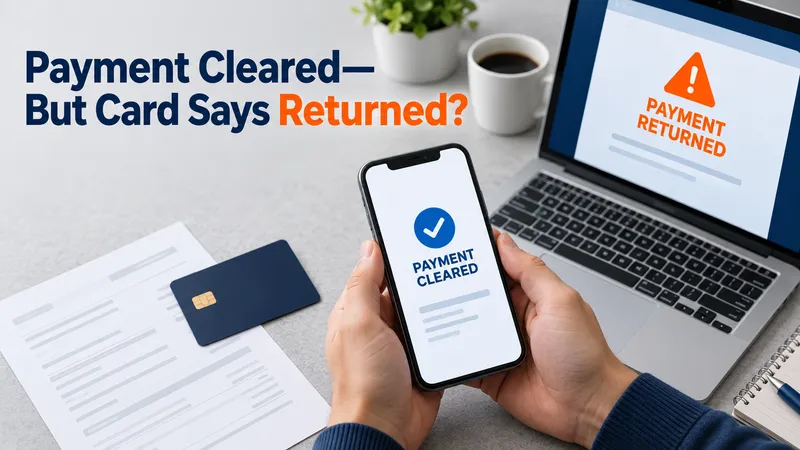
Why Does My Bank Show the Payment Cleared While My Credit Card Shows It Returned?
The conflict happens because bank debits and credit card ACH settlements run on separate processing timelines. Your bank records the debit when it releases the funds. The credit card issuer records a return when its ACH processor receives a return code from the payment network before final settlement is confirmed. A timing error, a wrong return code, or a bank routing mismatch can produce a return record on the card side even though the funds genuinely left your account.
When you make a credit card payment from your bank account, the transaction runs through the Automated Clearing House network. The credit card issuer originates a payment request. Your bank, as the receiving depository financial institution, either honors that request or sends back a return code. The problem is that this process has a lag, and errors introduced at any point in the chain produce conflicting records at each end.
Your bank's record shows the debit because it released the funds. The credit card issuer's record shows a return because an ACH return code arrived at its processor. Those two facts are not always in conflict. A return code can be generated and transmitted before final settlement is confirmed, creating a gap where both records are technically accurate at the moment they were created but only one reflects reality once settlement clears.
What Is an ACH Return Code and Which Ones Cause This Problem?
An ACH return code is a two-character identifier the receiving bank sends back to the originating institution when a payment cannot be processed as submitted. The code tells the originator why the payment failed. If your bank shows the payment settled but the credit card issuer received a return code, that code identifies where the error occurred and forms the basis for your dispute.
Nacha, the organization that governs the ACH network, defines dozens of return codes. A handful of them are responsible for most of the conflicts between a bank's cleared record and a credit card's returned record.
| Return Code | Meaning | Common Cause of Conflict |
|---|---|---|
| R01 | Insufficient Funds | Issued before final balance confirmation; bank may have honored the payment by the time the code was generated |
| R02 | Account Closed | Account number was recently updated; old routing still in credit card's system |
| R03 | No Account / Unable to Locate | Routing or account number entry error on the credit card's file |
| R10 | Customer Advises Not Authorized | Credit card processor applied this code in error; consumer never disputed the payment |
| R29 | Corporate Customer Advises Not Authorized | Applied to consumer accounts in error; processing classification mismatch |
| R08 | Payment Stopped | A stop payment on a different transaction was applied to this payment in error |
Ask the credit card issuer for the specific return code attached to your payment. That code tells you exactly what they were told happened, which is the starting point for proving the record is wrong.
What Documents Do I Need Before Contacting Either Institution?
Get the ACH trace number from your bank for the payment date in question. Also obtain your bank statement showing the debit, the credit card's return notice or statement showing the returned payment, and the specific ACH return code the credit card issuer received. These four documents establish the conflict with precision and give both institutions the specific data points they need to trace the transaction.
The ACH trace number is the single most important document in this dispute. Every ACH transaction is assigned a unique 15-digit trace number by the originating bank. That number follows the transaction through every step of the network. When you give the trace number to the credit card issuer's ACH team, they can pull the exact transaction record and compare it to the return code they received. If the trace number shows the payment settled and the return code does not match, the error is documented.
How to Get the ACH Trace Number From Your Bank
Call your bank's ACH or wire department directly, not general customer service. Ask for the ACH trace number for the payment to [credit card issuer name] on [date]. Provide the exact payment amount and date. The bank's ACH team has access to the trace records. General customer service usually does not. If the bank's front-line representative cannot provide it, ask to be transferred to the ACH operations or payment research department.
What to Get From the Credit Card Issuer
Ask the credit card issuer for the ACH return date, the return reason code, and the originating bank's routing number on file for your payment account. If any of those details do not match your actual bank account, the return was caused by a data error on the credit card's payment file, which is a straightforward documented mismatch.
How Do I Fix This When the Bank and the Credit Card Company Disagree?
Provide the ACH trace number to the credit card issuer and ask their ACH operations team to trace the transaction. If the trace confirms the payment settled, request that the issuer correct the returned payment in their system and update the credit bureau reporting accordingly. If the issuer refuses or the trace is inconclusive, file a written dispute with the credit card issuer under FCRA Section 623 and a simultaneous bureau dispute under Section 611, attaching the bank confirmation and the return code documentation.
Most of these conflicts resolve at the institution level once the ACH trace number enters the picture. The credit card issuer's ACH team can run the trace and see whether the funds actually settled. If they did, the issuer updates its own records and the returned payment designation is removed. The credit bureau reporting follows once the issuer sends a corrected data file.
1. Give the Trace Number to the Credit Card Issuer First
Start with a phone call to the credit card issuer's ACH operations team. Provide the ACH trace number, the payment date, and the amount. Ask them to trace the transaction and confirm whether funds settled. Document the name of the representative, the date and time of the call, and what they tell you. If they confirm the payment settled, ask for written confirmation and a timeline for correcting the account and the credit bureau reporting.
2. Follow Up in Writing if the Phone Call Does Not Resolve It
Send a certified-mail letter to the credit card issuer's credit dispute or ACH dispute address. State the account number, payment date, payment amount, and the ACH trace number. Attach your bank statement showing the debit and any documentation the bank provided confirming the payment settled. State clearly that the returned payment designation is inaccurate and request correction of both the account record and the credit bureau reporting.
3. File a Bureau Dispute at the Same Time
Send a certified-mail dispute to each bureau reporting the missed or late payment. Identify the account precisely by name, number, and the month of the dispute. State that the returned payment was not actually returned, that your bank confirms the funds were transferred, and that the return code was applied in error. Attach the bank statement, the ACH trace documentation, and the credit card's return notice. The bureau forwards the dispute to the credit card issuer as the furnisher. Under FCRA Section 623, the issuer must investigate the specific facts you raised, not simply confirm the return code it already has on file.
This dual-track approach mirrors the process covered in what to do when a credit report is still wrong after a lender admits an error: pressing the furnisher and the bureau simultaneously applies pressure from two directions and prevents either side from deferring to the other.
You provide the trace number. The credit card issuer's ACH team confirms the payment settled. The return code was generated in error before final confirmation. The issuer corrects the account record and updates the bureau reporting. The missed payment mark is removed without a formal dispute process.
The ACH trace is ambiguous or the issuer's team does not reverse its position. The bank confirms the debit but the issuer maintains the return. You file a written furnisher dispute under FCRA Section 623 and a bureau dispute under Section 611 simultaneously. The formal reinvestigation process begins with your documentation on file.
What Are My FCRA Rights When a Payment Is Wrongly Reported as Returned?
Under FCRA Section 611, you have the right to dispute inaccurate information with the credit bureau, which has 30 days to reinvestigate. Under FCRA Section 623, you have the right to dispute directly with the furnisher, which has 45 days to investigate and must notify each bureau of any correction. If the furnisher knowingly reports inaccurate information after receiving your documentation, FCRA Sections 616 and 617 give you the right to sue for actual damages, statutory damages between $100 and $1,000 per violation, and attorney fees.
A returned payment that did not actually happen is inaccurate information under the FCRA. The credit card issuer, as the furnisher, has a legal obligation to report only accurate payment history. That obligation does not disappear because the issuer received an erroneous return code from its ACH processor. The issuer owns the reporting, and it owns the duty to correct it when the reporting is wrong.
FCRA Section 611 — Bureau Dispute Right
Your dispute letter to the bureau starts the 30-day reinvestigation clock. The bureau contacts the credit card issuer as the furnisher. The issuer must verify the accuracy of the returned payment. If it cannot produce documentation showing the payment was genuinely returned, the bureau deletes or corrects the entry.
FCRA Section 623 — Direct Furnisher Dispute Right
You can also dispute directly with the credit card issuer. Send a written dispute to the address the issuer designates for FCRA disputes, usually listed on the back of your statement. The issuer has 45 days to investigate and must notify the bureaus of any correction. A direct furnisher dispute runs on a longer timeline than a bureau dispute but carries its own independent legal obligation.
A furnisher that receives an ACH return code is not automatically entitled to report the account as delinquent. FCRA Section 623 requires that information reported to credit bureaus be accurate at the time it is reported. If a furnisher receives evidence that the return code was applied in error, it must investigate and correct. Continuing to report a missed payment after receiving a bank confirmation showing the funds transferred is a reportable FCRA violation.
What If the Payment Was Actually Returned but It Was the Bank's Error?
If the ACH trace confirms the payment was genuinely returned due to a bank error, such as a wrong routing number on file or a system glitch on your bank's side, the bank bears responsibility for the return. Contact your bank's ACH operations department, document the error in writing, and ask for a written acknowledgment of the bank's role. Use that letter in your dispute with the credit card issuer to explain why the return occurred and to support removal of any late mark that resulted from a processing error outside your control.
A bank-side error that causes a return is different from a consumer-initiated problem like insufficient funds. Routing number errors, system outages, and bank-side ACH processing failures are not the consumer's fault. The FCRA does not require you to accept a late mark on your credit report because an institution made a processing error.
Get the Bank's Error in Writing
Ask the bank's ACH department to document the error and provide a letter on bank letterhead stating that the return was caused by a processing error on the bank's end. That letter becomes the core of your dispute package. Attach it to both the furnisher dispute letter and the bureau dispute letter.
Ask the Credit Card Issuer for a Courtesy Correction
Present the bank's error letter to the credit card issuer's dispute team and ask for a voluntary correction of the account record. Many issuers will remove a late mark or returned payment designation when a borrower presents written documentation from the bank showing the return was a processing error. This approach often resolves the situation faster than the formal 30-day bureau reinvestigation window. The same goodwill correction approach is effective for other lender-caused errors, as covered in disputing a late payment caused by a lender due date change.
How Do I Prevent This from Damaging My Credit While the Dispute Is Open?
Add a 100-word explanatory statement to your credit file under FCRA Section 611 so any lender who pulls your report during the dispute period sees your explanation. Make the replacement payment immediately if you have not already, so the account does not go further delinquent while the dispute is in progress. Monitor all three bureau reports for the duration of the reinvestigation.
A dispute in progress does not suspend the account from reporting. If the credit card issuer continues to age the delinquency while the investigation is open, the damage to your score compounds. Taking parallel steps limits that window.
Make the Replacement Payment Immediately
Even if the original payment genuinely cleared your bank, make a second payment to the credit card account right away if the issuer's records show the balance as unpaid. This prevents the account from aging into a 60-day or 90-day late while your dispute works through the system. You can address the duplicate payment later once the returned payment record is corrected. Protecting the account from further delinquency is the priority.
This is the same principle that applies when late payments still show after catching up: the act of bringing the account current does not erase the prior mark, but it stops additional marks from accumulating while the dispute is resolved.
Add a 100-Word Explanatory Statement
FCRA Section 611 lets you add a statement of up to 100 words to your credit file explaining the disputed item. Write a short, factual statement: "I dispute the returned payment reported on [account name] for [date]. My bank confirms the payment was deducted from my account on [date]. I have the ACH trace number confirming fund transfer. A formal FCRA dispute is in progress." Any lender pulling your report during the dispute period will see this statement alongside the negative entry.
Place a Fraud Alert if the Return Code Was R10
ACH return code R10 means "customer advises not authorized." If the credit card issuer received an R10 code for a payment you authorized, someone may have filed an unauthorized dispute against your payment, or the code was applied in error. Either way, R10 applied to a payment you made is worth flagging. Place a one-year fraud alert with any one bureau, and they are required to notify the other two. This protects your file while the ACH investigation is open.
What If the Credit Card Company Refuses to Fix It?
File a complaint with the CFPB at consumerfinance.gov/complaint, naming the credit card issuer specifically and attaching your ACH trace documentation and dispute correspondence. File a parallel complaint with your state attorney general. If the issuer continues to report an inaccurate returned payment after receiving your documentation, FCRA Sections 616 and 617 allow you to sue for actual damages, statutory damages, and attorney fees. The Electronic Fund Transfer Act adds additional remedies when the error originated in the electronic payment system.
A credit card issuer that refuses to correct an inaccurate returned payment record after receiving ACH trace documentation is not meeting its FCRA Section 623 obligations. The CFPB and state regulators take furnisher accuracy seriously, and a complaint with supporting documentation gives both agencies a concrete record to act on.
File a CFPB Complaint
Go to consumerfinance.gov/complaint and file against the credit card issuer. Attach your bank statement, the ACH trace documentation, the issuer's return notice showing the return code, and the dispute correspondence showing the issuer's refusal to correct. The issuer is required to respond within 15 days. CFPB complaints create a public regulatory record and are reviewed for patterns of inaccurate reporting.
Consult a Consumer Protection Attorney
If the issuer's refusal caused you real harm, such as a denied loan, a higher interest rate, or a lost rental application, a consumer protection attorney can evaluate claims under both the FCRA and the Electronic Fund Transfer Act. Many FCRA attorneys work on contingency, meaning no cost to you unless the case succeeds.
A bank record showing a cleared payment and a credit card record showing a returned payment are not necessarily permanent contradictions. The ACH trace number sits between them and tells you exactly what happened. Get that number from your bank before contacting anyone else. Give it to the credit card issuer's ACH operations team. If the trace confirms settlement and the issuer corrects the record, the problem is solved in days, not months. If the issuer refuses, file written disputes with both the issuer under FCRA Section 623 and the bureaus under Section 611, attach all documentation, and escalate to the CFPB if the reinvestigation fails. An inaccurate returned payment mark is disputable from the day it appears, and you have legal remedies if the furnisher will not correct what its own ACH records show is wrong.
What Is the Fastest Way to Get an Inaccurate Returned Payment Off My Credit Report?
Call the credit card issuer's ACH operations department with the ACH trace number before filing any formal dispute. This single step resolves the conflict at the source faster than any bureau dispute can. If the operations team confirms the payment settled, the issuer can update the account record and correct the bureau reporting within one to two reporting cycles without waiting for the 30-day reinvestigation window. Pair that call with a simultaneous written dispute to lock in your formal rights if the call does not produce a correction within five business days.
The formal dispute process takes up to 30 days because it routes through the bureau's e-OSCAR system and back to the furnisher. Going directly to the credit card issuer's ACH operations team with the trace number bypasses that routing entirely. The issuer's own records will confirm what happened. When they do, the issuer can make the correction in its system within days and send an updated data file to the bureaus in the next reporting cycle.
- Call your bank's ACH department and get the 15-digit trace number for the payment date.
- Pull your bank statement showing the debit on the payment date.
- Call the credit card issuer's ACH operations team and provide the trace number, payment date, and amount.
- Ask for the specific return code and the date it was received.
- Compare the return code against your bank's confirmation — a mismatch is your dispute evidence.
- Send a written dispute to the credit card issuer on the same day as the call, by certified mail.
- Send a simultaneous dispute to each bureau reporting the missed or returned payment.
- Make a replacement payment immediately to stop the account from aging further delinquent.
- File a CFPB complaint if the issuer does not correct within the 30-day reinvestigation window.
Frequently Asked Questions
My bank says my payment cleared, but my credit card says it was returned. Who is right?
Both records can coexist without either being fabricated. The most common cause is a timing mismatch: your bank released the funds and shows the debit as settled, but the credit card issuer's ACH processor flagged the transaction as returned before final settlement occurred. Obtain the bank's wire confirmation or ACH trace number and compare it against the credit card's return code. The document that shows the actual fund transfer determines which record is accurate.
Can a returned payment be reported to the credit bureaus?
Yes. A credit card issuer can report a returned payment as a missed or late payment once the account becomes delinquent as a result. However, if the payment was not actually returned and your bank confirms the funds were transferred, the late or missed payment mark is inaccurate and you have the right to dispute it under FCRA Section 611. The furnisher must be able to verify the return with documented proof or the bureau must delete the entry.
How do I dispute a returned payment that my bank says cleared?
Get the ACH trace number or wire confirmation from your bank showing the payment settled. Contact the credit card issuer first and ask for the return reason code and the ACH return date. If the documentation conflicts, file a written dispute with the credit card issuer under FCRA Section 623 and a simultaneous bureau dispute under Section 611. Attach the bank confirmation, the card issuer's return notice, and any ACH trace documentation to both letters.
What is an ACH return code and why does it matter for my credit?
An ACH return code is a two-character code the receiving bank sends back to the originating bank when a payment cannot be processed. Common codes include R01 (insufficient funds), R02 (account closed), R03 (no account), and R10 (customer advises not authorized). If your bank shows the payment cleared but the credit card issuer received a return code, that code is the starting point for identifying the error. R01 and R10 especially are worth scrutinizing because they are among the most frequently misapplied codes.
What if the credit card company refuses to fix the returned payment error?
File a complaint with the CFPB at consumerfinance.gov/complaint and your state attorney general's consumer protection office. If the credit card issuer knowingly reports an inaccurate returned payment after receiving your documentation, FCRA Sections 616 and 617 allow you to sue for actual damages, statutory damages between $100 and $1,000 per violation, and attorney fees. The Electronic Fund Transfer Act may also apply if the error originated in the ACH processing chain.
A returned payment that never happened is on your report. We can document it.
We pull all three bureau reports, identify every inaccurate entry, and walk you through the exact documentation and dispute letters needed to remove them. No obligation.
Get Your Free Credit Audit ASAP Credit Repair USA is registered under the Credit Repair Organizations Act. We do not guarantee specific results. Individual outcomes vary.-
Late Payments After Catching Up: Why They Still Show Why a late mark stays on your report after you bring the account current, and what the FCRA says about removing it.
-
Credit Report Still Wrong After a Lender Admits an Error? The escalation path when the creditor agrees the reporting is wrong but the bureau keeps showing the error anyway.
-
Late Payment After Due Date Change: How to Dispute Errors How to dispute a late mark that appeared because a lender changed your payment due date without proper notice.