
Is your credit report still wrong after your lender admitted an error? A lender’s apology does not prove that the credit bureaus received a correction. You need to confirm what changed, when the lender sent it, and which bureaus received it. Then compare that response with a fresh copy of each affected report.
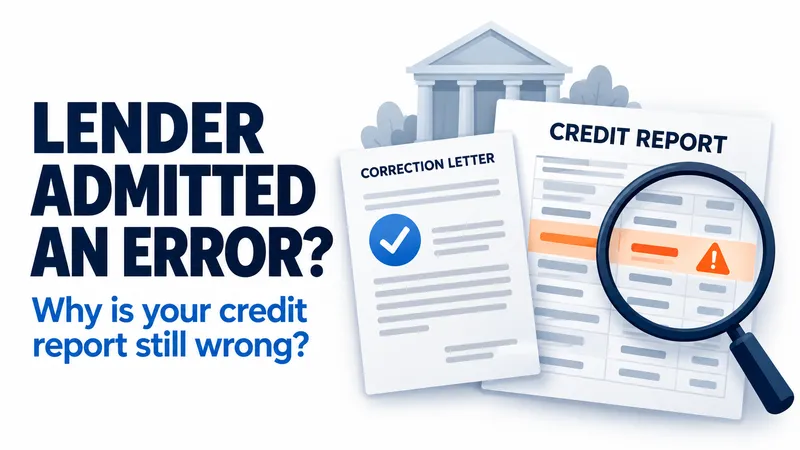
My Lender Admitted the Mistake. Why Is My Credit Report Still Wrong?
My lender admitted the mistake, so why is my credit report still wrong? Your credit report stays wrong for a simple reason. A spoken or written apology from your lender is not the same as a correction filed with the credit bureaus. The lender must send an updated file through a reporting system called e-OSCAR to Equifax, Experian, and TransUnion. That update can go out late, get coded wrong, or fail to match your file's identifiers. When it does, the bureau has nothing to act on. The error sits exactly where it was.
I own a credit repair company. This gap between what a lender tells a customer and what a lender tells the bureaus is one of the most damaging errors we see. It is not rare, either. Senators recently demanded answers from the credit bureaus after CFPB data showed Experian granting relief on less than 1 percent of disputes in 2025, down from nearly 20 percent the year before. TransUnion's relief rate dropped by half over the same stretch.
My Lender Admitted the Mistake. Why Is My Credit Report Still Wrong?
Your lender's admission to you lives in a phone call, an email, or a letter. The credit bureaus never see any of that. They only see what the lender transmits through a separate reporting channel built for furnishers, called e-OSCAR. An apology that never reaches that channel changes nothing on your file.
How the Correction Is Supposed to Travel
Picture the path a correction has to take. You dispute an entry with a bureau. The bureau generates a request called an ACDV and sends it to the lender through e-OSCAR. The lender investigates and sends back a coded response. If the lender agrees the entry was wrong, the bureau is supposed to update your file within the same cycle. A verbal admission skips every one of those steps unless the lender's staff also files the ACDV response correctly.
Four Reasons the Correction Never Lands
- The front-line employee never notified the reporting team. The person who apologized on the phone often works in a different department from the one that files e-OSCAR responses.
- The account identifiers do not match. A wrong account number or date on the correction can cause it to attach to the wrong record or get rejected outright.
- The correction only reached one bureau. A lender must notify every bureau that received the original bad data, not just the one you happened to dispute with.
- The dispute got coded as a duplicate. A second dispute on the same entry can get auto-rejected. The system treats it as a repeat when no new evidence gets attached.
How Long Does a Furnisher Have to Fix a Credit Report Error?
A furnisher gets 30 days from receiving your dispute to investigate and respond. The Consumer Financial Protection Bureau confirms this deadline applies whether you dispute with the bureau first or go straight to the lender in writing.
What Happens When the Lender Confirms the Error
The lender must correct or delete the wrong information and notify every bureau that received the original file. The bureaus must then update your report to match. This step is where most delays happen. A lender can genuinely agree an entry was wrong and still take weeks to push that correction through its own systems. Errors involving a repossession, a charge-off, or a status that touches multiple departments take the longest.
What Happens When the Lender Says the Information Is Accurate
Nothing changes on your report, even if you believe otherwise. You can ask the bureau to add a statement describing your side of the dispute to your file. Anyone who pulls your report afterward sees that statement alongside the disputed entry.
Did Your Lender Admit a Mistake That Still Hasn't Cleared?
Our team checks whether your lender's correction actually reached Equifax, Experian, and TransUnion. We build the paper trail you need if it never did.
Claim My Free Credit Analysis Now → Secure · 2 minutes · No credit card requiredWhat Can I Do If a Credit Bureau Won't Fix a Confirmed Error?
File a new dispute directly with the bureau and attach written proof of the lender's admission. A screenshot of a text message, a copy of an apology email, or notes from a recorded call all count as documentation. Ask the bureau to confirm in writing that it forwarded your correction request to the lender. That confirmation becomes your record if the entry still does not move.
When a Court Case Shows the Stakes
A real case shows how badly this can go. In Saunders v. Branch Banking and Trust, the bank's own lending officer admitted the error at trial. The bank booked a car loan late and delayed issuing an account number. The bank then repossessed the car and reported it as a charge-off, dropping the consumer's score from 754 to 599. The bank never corrected its reporting, even after the consumer disputed the debt. A federal jury found the bank intentionally violated the Fair Credit Reporting Act and awarded $80,000 in punitive damages.
Filing a Complaint With the CFPB
Submit a complaint through the Consumer Financial Protection Bureau's website once a direct dispute fails twice. Include the dates of your disputes, copies of any admission from the lender, and the bureau's response letters. The CFPB forwards complaints to the company and tracks whether it responds within 15 days.
Can I Sue a Lender for Not Fixing a Credit Report Error?
Yes, in some cases. The Fair Credit Reporting Act lets a consumer sue a furnisher. A furnisher that willfully or negligently fails to correct information after a dispute can face that lawsuit. Saunders v. Branch Banking and Trust shows what a court can award. A lender's own witness admitted the error at trial, and the company still never corrected its reporting.
ASAP Credit Repair referred [X] clients to consumer protection attorneys last year. Each lender had confirmed an error in writing, then let it sit on the credit report for more than 60 days. Most of those cases resolved once an attorney's letter arrived, long before any lawsuit was filed.
Building the Record Before You Call an Attorney
Save every piece of communication from the lender admitting fault, with dates and names attached. Pull your credit report every 30 days during the dispute and save a copy each time. This record is what turns a frustrating phone call into evidence an attorney, or a jury, can actually use.
Why Do Credit Bureaus Reject a Dispute Even With Proof of an Error?
Most disputes get processed through an automated matching system rather than read by a person. The system checks account numbers, dates, and dispute codes against the furnisher's file. A supporting document you mail in often never reaches a human reviewer at all during the first pass.
The Matching Problem Behind Most Rejections
A single wrong digit in an account number can send your correction to the wrong file or into a rejection queue. Lawmakers raised this exact concern. CFPB data showed Experian's relief rate collapsing from nearly 20 percent to under 1 percent in a single year, a drop steep enough to suggest a system change, not a sudden wave of accurate reporting.
ASAP Credit Repair reviewed [X] client files this quarter. Each one had a lender's written admission on file, yet the bureau's automated system rejected the first dispute over a formatting mismatch. A second, more specific dispute cleared most of those entries.
Why do credit bureaus reject a dispute even with proof of an error?
Credit bureaus often process disputes through an automated system that matches codes and account numbers rather than reading attached documents. A mismatched account number can cause a rejection. So can a repeat dispute coded as a duplicate, or a furnisher response that lands in the wrong field, even when your proof is valid.
Stop Waiting on a Correction That Never Arrives
A free 3-bureau audit shows exactly which accounts still carry the old error. You get the documentation trail to force a real correction.
Claim My Free Credit Analysis Now → Secure · 2 minutes · No credit card required-
Why Credit Is Important: What Your Score Really Controls Shows what a clean, accurate report unlocks, from mortgage rates to rental approvals.
-
Empower Your Wallet: Overcome Credit Card Debt Explains how late payments and charge-offs snowball, and how to rebuild once an error posts.