
Credit repair vs credit monitoring is more than a comparison of two financial services. It raises a question consumers should ask before paying another monthly fee: Are you paying someone to address inaccurate credit information, or simply to notify you when something changes?
The stakes are significant. According to the Federal Trade Commission, Americans filed more than 1.1 million identity theft reports in 2024, while complaints involving credit bureaus and information furnishers accounted for 21% of all reports received by its Consumer Sentinel Network. These figures highlight two different consumer concerns: protecting credit information and correcting problems already on file.
The costs also deserve scrutiny. The Consumer Financial Protection Bureau reports that some credit monitoring services charge more than $15 per month, yet monitoring generally alerts consumers to suspicious activity rather than preventing identity theft or correcting credit-report errors.
Credit repair focuses on identifying and disputing inaccurate credit information. Credit monitoring tracks changes and sends alerts. Neither service guarantees a higher credit score, and consumers have free options for reviewing and disputing credit-report errors.
This guide compares what each service does, what you're paying for, and when one, both, or neither makes financial sense.
Credit Repair vs. Credit Monitoring: What Are You Actually Paying For?
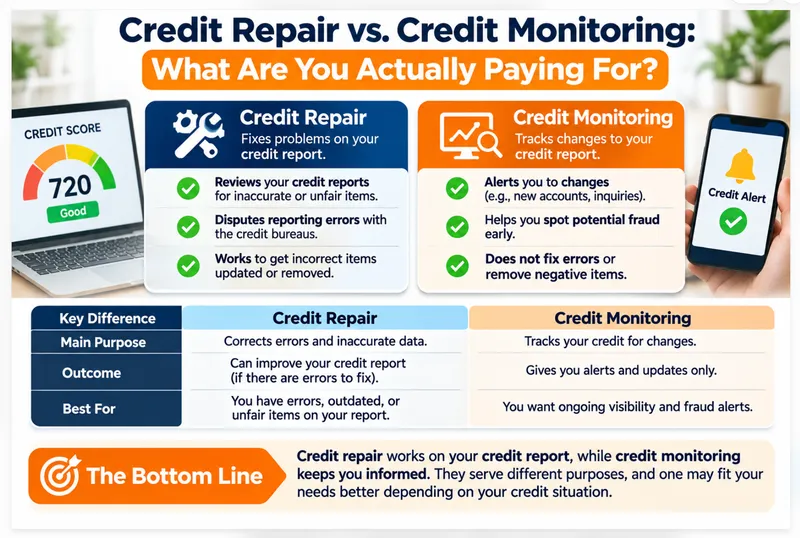
Credit repair vs credit monitoring is a comparison between two jobs that sound alike and differ completely: one watches your file, and the other works on what the file says.
Credit monitoring sends you an alert when something on your report changes: a new account, a new inquiry, a new late payment. It reports the change and does nothing about it.
Credit repair investigates and disputes inaccurate, unverifiable, or incomplete entries with the bureaus and the furnishers behind them. It does not watch your file, and it does not remove accurate information.
The confusion costs people money, because some pay for monitoring and expect their score to rise while others pay for repair when a free tool covers what they need.
Both services have a place in a credit plan. The right one depends on a single question: is the problem on your report a change you need to hear about or an error you need to fix?
This article compares the two services by job and by responsibility, not by product. At ASAP Credit Repair USA, we review credit reports for inaccuracies every day, and no service controls a lender's decision or guarantees a score.
What Is the Difference Between Credit Repair and Credit Monitoring?
Credit monitoring alerts you to changes on your credit report. Credit repair disputes inaccurate entries on that report. Monitoring informs you and repair acts for you, and neither one removes accurate, current negative information.
| Factor | Credit Monitoring | Credit Repair |
|---|---|---|
| Core job | Watches your reports and alerts you to changes | Investigates and disputes inaccurate entries |
| Who acts | You, after the alert | The provider, on your behalf |
| Effect on your report | None. It reports changes and makes none. | Corrects or removes entries that fail verification |
| Effect on identity theft | Flags signs of it | Disputes the fraudulent entries after the fact |
| Typical cost | A few dollars to over $15 a month (CFPB, identity monitoring) | Set by contract, payable only after the service is performed |
| Federal rule | Contract terms. The CFPB warns about hidden trial periods and cancellation requirements. | Credit Repair Organizations Act: no payment before services are fully performed |
The cost row matters. The CFPB says identity monitoring prices "vary widely," from a few dollars a month to over $15 a month, and the page warns about hidden trial periods and cancellation requirements.
Not Sure Whether Your Report Needs Watching or Fixing?
Start with the report itself. A review shows which entries are inaccurate, which are accurate, and which service, if any, fits.
Claim My Free Credit Analysis Now → Secure · 2 minutes · No credit card requiredWhat Does Credit Monitoring Actually Do?
Credit monitoring watches your credit reports and sends alerts about new accounts, inquiries, and changes. Many paid plans add credit scores, identity theft insurance, and black market site monitoring. A monitoring plan alerts you to a problem and does not fix it.
The CFPB describes these services as watching credit applications, public records, and websites for "unusual activity" that signals possible identity theft. Add-ons include identity theft insurance, public record searches, and black market site monitoring.
The CFPB notes that insurance covers only certain out-of-pocket losses, and that only some services help you correct problems. Read the plan terms before you assume either.
What You Get for Free
- ✓Weekly credit reports. Equifax, Experian, and TransUnion made free weekly reports permanent, according to the FTC. The official site is AnnualCreditReport.com.
- ✓A credit freeze. The FTC says there is no cost to place or lift one. It blocks new accounts in your name until you lift it.
- ✓A fraud alert. An initial alert lasts one year and is free. An extended alert lasts seven years for identity theft victims with a report.
- ✓A score on your card statement. The CFPB notes that some card issuers show your score.
Paid monitoring buys convenience: automatic alerts instead of a weekly manual check. It does not buy protection a freeze does not already give you for free.
What Does Credit Repair Actually Do?
Credit repair finds inaccurate, unverifiable, or incomplete entries on your reports and disputes them with the credit bureaus and the companies that reported them. It cannot remove accurate, current negative information, and it guarantees no score increase.
The FTC says a credit repair company helps you investigate mistakes on your credit report. It also says that "disputing mistakes or outdated things on your credit report is free" and that anything a company does legally, you usually do yourself for little or no cost.
That is the honest answer to "what am I paying for." You pay for time, organization, and follow-through on disputes, not for access to a right you do not already have.
The Rules Every Credit Repair Company Follows
- No payment up front. 15 U.S.C. 1679b(b) bars a credit repair organization from charging or receiving money before the service is fully performed.
- No promises it cannot keep. The CFPB says no provider is allowed to promise a specific score increase or guarantee removal of negative information.
- No removal of accurate, current data. The FTC says no provider has the legal power to remove information that is both accurate and current.
- A written contract. The FTC lists the services, total cost, timeline, and any guarantees as required contract terms.
- A right to cancel. The CFPB says you cancel a new contract for any reason within three business days at no charge.
Our guide to what a credit repair service does explains the process in more detail.
Who Is Responsible for What With Each Service?
A monitoring service is responsible for the alert. You are responsible for reading it, judging it, and acting on it. A credit repair company is responsible for the disputes it agreed to file. You are responsible for your payments and balances under both.
| Task | With Monitoring | With Credit Repair |
|---|---|---|
| Notice a change on your report | The service | You or the provider, at review |
| Decide if the entry is wrong | You | The provider reviews it with you |
| File the dispute | You | The provider |
| Gather evidence | You | You, with the provider's direction |
| Freeze your file | You, at all three bureaus | You, at all three bureaus |
| Pay bills and lower balances | You | You |
Which One Do You Need?
Choose monitoring if your reports are accurate and you want alerts. Choose credit repair if you found inaccurate entries and want help disputing them. Choose a freeze if you want to block new accounts. Choose neither if the negative entries are accurate.
| Your Situation | Your Move |
|---|---|
| You want to know when something changes | Pull free weekly reports, or use monitoring for automatic alerts |
| You found an inaccurate entry | Dispute it, yourself or through a credit repair company |
| You are a victim of identity theft | Place a freeze or extended fraud alert, then dispute the fraudulent entries |
| The negative entries are accurate | Neither service removes them. Rebuild payment history and lower balances. |
| You are applying for a loan soon | Review all three reports first, then dispute errors before you apply |
Our guides on disputing credit report errors and the TransUnion dispute process show the do-it-yourself route step by step.
What Should You Check Before You Pay for Either Service?
- ✓The total price and renewal terms, including what a free trial converts to
- ✓What the service does when it finds a problem: alert only, or help correct it
- ✓For repair, a written contract with services, cost, timeline, and your cancellation right
- ✓Complaints on file with your state Attorney General and consumer protection agency, as the CFPB advises
Disputes also fail when they lack evidence. Read why credit disputes fail before you file one.
When Does Credit Repair Make Sense Alongside Monitoring?
Use both when you have inaccurate entries to dispute and want to know the moment a new one appears. Repair works on the entries you have, and monitoring watches for new ones.
Credit repair makes sense when you found errors and your own disputes returned unchanged results. A review checks ownership, balances, dates, payment history, and dispute outcomes.
Not Sure What's Hurting Your Credit?
A credit report review shows what lenders see, which entries are wrong, and whether you need monitoring, repair, or neither.
Review My Credit Report → Secure · 2 minutes · No credit card requiredFrequently Asked Questions About Credit Repair vs Credit Monitoring
What is the main difference between credit repair and credit monitoring?
Credit monitoring alerts you to changes on your credit reports. Credit repair disputes inaccurate entries on those reports. Monitoring informs you and takes no action. Repair acts on your behalf. Neither one removes accurate, current negative information, and neither guarantees a score increase.
Does credit monitoring improve your credit score?
No. Monitoring watches your reports and sends alerts, and it makes no change to them. Your score moves when your payment history, balances, or report entries change. A monitoring alert helps you catch a problem early, but you still act on it yourself.
Does credit repair replace credit monitoring?
No. Credit repair works on entries already on your report and does not watch for new ones. Monitoring alerts you to new accounts and inquiries. Free weekly reports from AnnualCreditReport.com and a credit freeze cover much of the same ground at no cost.
Is credit monitoring worth paying for?
It depends on what you need. The CFPB puts identity monitoring prices between a few dollars and over $15 a month. Free weekly reports and free credit freezes provide the core protection. Pay only for the convenience of automatic alerts, and read the cancellation terms first.
Is credit repair legal, and when does a company get paid?
Yes, credit repair is legal under the Credit Repair Organizations Act. A company cannot charge or receive payment before it fully performs the service, under 15 U.S.C. 1679b(b). It must give you a written contract and a right to cancel within three business days.
Does credit repair remove accurate negative items?
No. The FTC says no provider has the legal power to remove information that is both accurate and current. Credit repair disputes inaccurate, unverifiable, or incomplete entries. Accurate negative items leave your report when the reporting period ends, which the FTC sets at seven years for most items.
Do you dispute errors yourself for free?
Yes, you have that right. The FTC states that disputing mistakes on your credit report is free, and both the bureau and the business that reported the information must correct inaccurate or incomplete data. Credit repair saves time and handles follow-up. It does not give you a right you lack.
Does a credit freeze work better than monitoring?
For blocking fraud, yes. The FTC says a freeze stops new credit accounts from opening in your name, and it costs nothing to place or lift. Monitoring only alerts you after something happens. A freeze does not repair existing errors or watch your reports.
What red flags signal a credit repair scam?
The CFPB lists pressure to pay up front, promises to remove accurate negative items, advice to dispute everything, refusal to explain your rights, and advice not to contact the credit bureaus yourself. Any of these signals a company that breaks federal credit repair rules.
Does credit repair guarantee a higher score?
No. The CFPB says no provider is allowed to promise a specific score increase. Credit repair corrects inaccurate reporting, and lenders weigh payment history, balances, and other factors on their own. Your score rises when the corrected report and your payment behavior improve together.
Monitoring tells you what changed, and repair works on what is wrong. Know which problem you have before you pay for either one.
-
What Is a Credit Repair Service and How Can It Help You? What a provider does, step by step.
-
Dispute Credit Report Errors: A Step-by-Step Guide The do-it-yourself dispute route.
-
Why Credit Disputes Fail The evidence gaps that sink a dispute.
-
How to File a TransUnion Dispute & Fix Credit Report Errors The dispute steps once you spot an inaccurate entry.
- Consumer Financial Protection Bureau — Identity monitoring and "identity theft" services
- Consumer Financial Protection Bureau — Telling a credit repair scam from a reputable credit counselor
- Federal Trade Commission — Fixing Your Credit FAQs
- Federal Trade Commission — Credit Freezes and Fraud Alerts
- Federal Trade Commission — You now have permanent access to free weekly credit reports (updated January 4, 2024)
- 15 U.S.C. § 1679b — Credit Repair Organizations Act, prohibited practices
- myFICO — What is in your credit score
- AnnualCreditReport.com — Free credit reports