

A TransUnion dispute is a free request asking TransUnion to investigate inaccurate information on your credit report. File online through TransUnion's dispute portal, by mail, or by phone, with documents backing up the error. TransUnion generally has 30 days to investigate, sometimes 45, and reports the result back to you in writing.
A paid account still marked delinquent, a collection you don't recognize, or a balance higher than your own records show. A TransUnion dispute exists for exactly these moments, when information on a credit report doesn't match reality.
Federal law gives consumers the right to dispute inaccurate information with TransUnion directly, at no cost. Under the Fair Credit Reporting Act, TransUnion generally has 30 days from receiving a dispute to investigate, with specific circumstances extending that to 45 days, per the Consumer Financial Protection Bureau.
In nearly 20 years reviewing credit files, I've found the outcome usually comes down to two things: naming the exact field that's wrong, not just the account, and backing it with a document the furnisher checks against.
A vague complaint and a specific one go through the same process but don't get the same result.
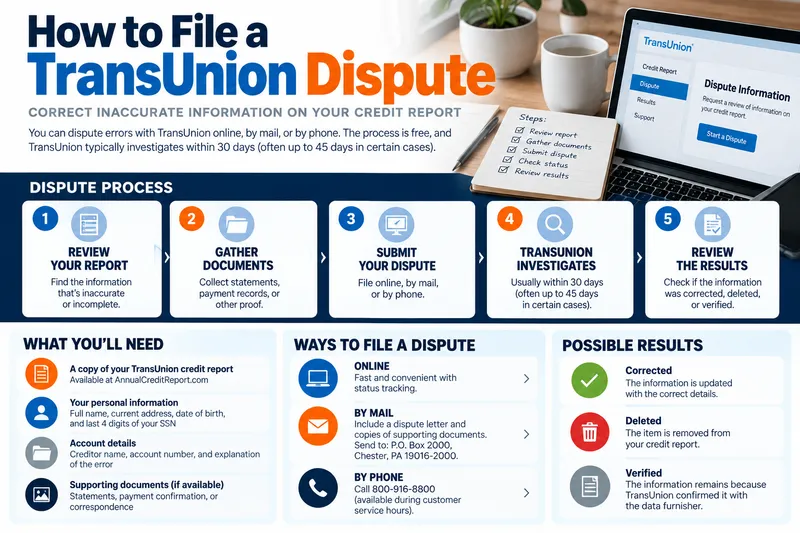
This guide covers what qualifies for a TransUnion dispute.
Talking points of what to gather first, how to file online, by mail, or by phone, what the investigation looks like, and your options once TransUnion sends back a result you don't agree with.
What Is a TransUnion Dispute?
A TransUnion dispute is a formal request asking TransUnion to investigate specific information on your credit report that you believe is inaccurate, incomplete, or unverifiable. It doesn't remove accurate negative information just because it's unflattering.
A dispute asks one thing: does this entry match what the furnisher verifies? TransUnion forwards it to the company that reported the entry, reviews the response, and corrects, deletes, or confirms accordingly.
A dispute isn't a tool for erasing accurate history. A late payment that happened or a collection genuinely owed stays on the report, because the information is correct. Disputes work on accuracy, not on how an entry affects a score.
What You Need Before You Start
A Current Copy of Your TransUnion Credit Report
Pull a current report before filing anything. Free weekly reports from TransUnion, Equifax, and Experian are available at AnnualCreditReport.com, made permanent in 2023. Locate the entry, and note the creditor name, account number, and the exact field that's wrong: balance, payment status, or open date.
Your Personal Identification Information
TransUnion asks for your name, date of birth, address, and Social Security number to confirm identity, regardless of filing method. Phone and mail disputes sometimes also confirm recent addresses or past employers for a thin file.
Account Details and Supporting Documents
Gather the creditor's name, the partial account number, and any supporting paperwork: payment confirmations, statements, settlement letters, or correspondence. Submit copies, not originals.
A Clear Explanation of the Reporting Error
Specificity decides how useful a dispute is. "This account is wrong" gives TransUnion nothing to check. Naming the exact field and the correct figure gives the furnisher a claim it checks directly against its own records.
No specific field, no account number, no evidence. The furnisher has little to verify against.
Names the field, states the correct figure, and points to a document that proves it.
How to File a TransUnion Dispute
File a TransUnion dispute online through TransUnion's Service Center, by mail to TransUnion Consumer Solutions, P.O. Box 2000, Chester, PA 19016-2000, or by phone at 800-916-8800. Each method starts the same investigation; they differ in speed, documentation, and how you track progress.
How to File a TransUnion Dispute Online
- Create or log in to a free account at TransUnion's Service Center.
- Open your current credit report and select the account or entry you're disputing.
- Choose the reason for the dispute and describe the specific error in your own words.
- Upload supporting documents, such as a statement or payment confirmation, where the portal allows it.
- Submit the dispute and save the confirmation number shown on screen.
How to File a TransUnion Dispute by Mail
Mail disputes go to TransUnion Consumer Solutions, P.O. Box 2000, Chester, PA 19016-2000. TransUnion accepts standard or certified mail; certified mail with a return receipt proves the date TransUnion received it, which matters for tracking the deadline.
A mailed letter should include your identifying information, the creditor's name, the partial account number, a specific explanation of the error, copies of supporting documents, and any correction needed to your personal information.
How to File a TransUnion Dispute by Phone
Call TransUnion's Consumer Relations team at 800-916-8800, Monday through Friday from 8 a.m. to 10 p.m. Eastern, and Saturday through Sunday from 8 a.m. to 5 p.m. Eastern. Have your Social Security number, account details, and a clear description ready, since the representative files from what you describe.
| Filing Method | Submission | Evidence Handling | Status Tracking | Limitation |
|---|---|---|---|---|
| Online | Self-service through the portal | Upload directly with the dispute | Account dashboard | Requires an online account |
| Written letter | Copies enclosed with the letter | No automatic tracking; keep mail receipts | Slowest to reach TransUnion | |
| Phone | Verbal, logged by a representative | Documents mailed in separately, if needed | Confirmation number given by phone | No written record of exact wording used |
TransUnion Dispute Letter Example
Use this as a starting structure, not a script. Fill in the specific error and keep a copy for your records.
[Your Full Name]
[Your Street Address]
[City, State, ZIP]
[Date]
TransUnion Consumer Solutions
P.O. Box 2000
Chester, PA 19016-2000
Re: Dispute of inaccurate information on my credit report
I am disputing the following item on my TransUnion credit report because it's inaccurate:
Creditor name: [Creditor Name]
Account number (partial, as shown on report): [XXXX-XXXX]
Reason for dispute: [Specific error, e.g., "This account shows a late payment for April 2026. My enclosed bank statement shows the payment posted on March 28, 2026."]
I've enclosed copies of [describe documents] supporting this correction. Please investigate this item and send me the written results of your investigation.
Sincerely,
[Your Signature / Printed Name]
What Happens After You File a TransUnion Dispute?
TransUnion logs the dispute, forwards it and your supporting information to the furnisher that reported the entry, and waits for the furnisher's response. The furnisher investigates its own records and reports back; TransUnion then updates, removes, or confirms the entry based on that answer.
- TransUnion receives the dispute and opens an investigation file.
- TransUnion sends the dispute details and any documents to the furnisher, such as the bank or collection agency.
- The furnisher reviews its own records and reports back to TransUnion within its own deadline.
- TransUnion applies the furnisher's response: correcting the entry, deleting it, or confirming it as accurate.
- TransUnion mails or posts the written results, along with an updated copy of your report if anything changed.
The furnisher, not TransUnion, decides whether the information is accurate. TransUnion manages the process and applies whatever the furnisher confirms.
How Long Does a TransUnion Dispute Take?
TransUnion generally has 30 days from receiving a dispute to complete its investigation. That window extends to 45 days if the dispute follows a free annual credit report request, or if you submit additional relevant information during the original 30-day period.
Thirty days is the FCRA standard, not a guarantee for every dispute. The 45-day extension covers two situations: disputes filed based on a free annual report, and disputes where new supporting information arrives while the investigation is still open.
How to Check Your TransUnion Dispute Status
Online disputes show status updates in the Service Center dashboard. Mail and phone disputes don't track automatically online, so note the filing date and follow up by phone as the deadline approaches. TransUnion must deliver written results once the investigation closes, regardless of method.
How to Read Your TransUnion Dispute Results
TransUnion's results generally fall into three categories: corrected, meaning the furnisher confirmed a change; deleted, meaning the furnisher couldn't verify the information within the deadline; or verified, meaning the furnisher confirmed the entry as reported. A verified result means the furnisher stands by its data, not that every detail is proven beyond question.
This is where most disputes get decided, and it deserves more attention than filing itself. A "verified" result means the furnisher checked its own records and told TransUnion the entry is correct. It doesn't mean an independent party reviewed the paperwork, and it doesn't close the door on further action if you still have documentation the furnisher hasn't seen.
| Result | What It Means | Your Next Step |
|---|---|---|
| Corrected | The furnisher confirmed the entry should be updated | Review the updated report to confirm the fix matches what you requested |
| Deleted | The furnisher didn't verify the information within the deadline | Confirm the entry is gone from your updated report |
| Verified | The furnisher confirmed the entry as accurate | Compare the result against your own documents before accepting it |
| Remains inaccurate after reinvestigation | You still believe the verified entry is wrong | Contact the furnisher directly or add a statement of dispute to your file |
What to Do If Your TransUnion Dispute Is Denied
Review exactly what the furnisher verified, compare it against your own documentation, and contact the furnisher directly if you have evidence it hasn't reviewed. Resubmitting the same dispute with no new information rarely changes the outcome.
Read the verification notice closely. It should say what TransUnion checked and what the furnisher confirmed. If your own documents contradict that confirmation, send them directly to the furnisher, in writing, and ask for a correction at the source.
| Error Type | Useful Documentation |
|---|---|
| Incorrect late payment | Bank or payment confirmation showing the actual payment date |
| Wrong balance | Current account statement from the creditor |
| Paid collection reporting incorrectly | Settlement letter or payment receipt from the collection agency |
| Account doesn't belong to you | Identity theft report or documentation showing the account isn't yours |
| Incorrect account status | Written correspondence from the creditor confirming the correct status |
Common mistakes that weaken a dispute:
- ✗ Describing the problem in general terms instead of naming the exact field that's wrong
- ✗ Leaving out the account number shown on the credit report
- ✗ Skipping available supporting documents when they exist
- ✗ Resubmitting an identical dispute with no new evidence after a verified result
- ✗ Assuming a "verified" result ends every option for correcting the record
What If TransUnion Doesn't Respond?
If TransUnion misses its 30 or 45-day deadline, the FCRA requires it to delete the disputed information, since an incomplete investigation doesn't support keeping the entry. Document your filing date and follow up directly once the deadline has clearly passed. If TransUnion still doesn't correct the issue, file a complaint with the CFPB, though doing so before the deadline passes skips the step most likely to resolve things on its own.
Does a TransUnion Dispute Affect Your Credit Score?
Filing a dispute itself doesn't change your credit score. A score moves only after the underlying report changes: up if an inaccurate negative entry is corrected or removed, occasionally down if a dispute surfaces information that was previously missing.
The dispute process and the scoring process run separately. No legitimate process guarantees a specific point increase from disputing. Whatever change happens comes from the report being more accurate, not from the act of disputing.
When to Get Help With a TransUnion Dispute
Every consumer has the right to dispute inaccurate information directly, for free, without hiring anyone. Professional help tends to fit when multiple accounts across several bureaus need attention at once, or when a dispute already went through one round and still shows an error you've documented.
A credit repair company doesn't have legal powers a consumer lacks. What it adds is organization: tracking deadlines across disputes, matching documentation to the right furnisher, and following up when a bureau or furnisher misses its own timeline.
Is filing a TransUnion dispute free?
Yes. TransUnion doesn't charge consumers to dispute inaccurate information, whether filed online, by mail, or by phone.
How do I file a TransUnion dispute online?
Log in to TransUnion's Service Center, open your credit report, select the entry in question, describe the specific error, attach supporting documents where possible, and submit.
What is the TransUnion dispute phone number?
800-916-8800, Monday through Friday from 8 a.m. to 10 p.m. Eastern, and Saturday through Sunday from 8 a.m. to 5 p.m. Eastern.
Where do I mail a TransUnion dispute?
TransUnion Consumer Solutions, P.O. Box 2000, Chester, PA 19016-2000. Standard or certified mail is accepted.
How long does a TransUnion dispute take?
Generally 30 days from the date TransUnion receives it, extending to 45 days for disputes tied to a free annual report request or when new information is submitted during the investigation.
How do I check my dispute status?
Online disputes show status in the Service Center dashboard. Mail and phone disputes don't track automatically online; follow up by phone as the deadline approaches.
What happens if TransUnion verifies incorrect information?
The entry stays on the report as reported. Contact the furnisher directly with new evidence, or ask TransUnion to add a statement of dispute to your file.
Does a TransUnion Dispute Cover Multiple Accounts?
Yes. Each account or entry gets its own dispute, and multiple errors fit in one submission as long as each is described specifically.
Does a TransUnion dispute lower my credit score?
Filing itself doesn't change your score. Any score movement comes from a correction to the underlying report, not from the dispute process.
Does Disputing the Same Account Twice Work?
Yes, but a repeat dispute needs new supporting information to have a reasonable chance at a different result. Submitting the identical claim again rarely changes a verified outcome.
Need Help Reviewing Inaccurate Credit Report Information?
Managing one dispute is straightforward. Tracking several accounts across multiple bureaus, each with its own deadline and documentation, is where it gets complicated. A free 3-bureau audit shows exactly what Equifax, Experian, and TransUnion currently report before you decide what to dispute yourself and what to hand off.
Get My Free 3-Bureau Audit → Secure · 2 minutes-
Late Payment After Due Date Change: How to Dispute Errors What to document when a lender's own due-date change causes an inaccurate late mark.
-
Credit Bureau Can't Verify My Identity? Steps to Fix It Which documents to send when a bureau doesn't match your identifying information.
-
Authorized User Debt: Fix Credit Report Errors How to dispute a balance that isn't legally yours to begin with.
-
Credit Bureau Investigated the Wrong Account? Next Steps What to do when the investigation result doesn't match the account you disputed.
-
Credit Report Still Wrong After a Lender Admits an Error? Confirming a correction reached the bureaus, and escalating when it didn't.
-
Recalled Collection Still on Your Credit Report? Why a recalled collection still shows up, and how to dispute it correctly.
- TransUnion — Online dispute process and portal
- TransUnion — Mailing address and letter requirements
- Consumer Financial Protection Bureau — Investigation deadlines and extensions
- Consumer Financial Protection Bureau — Bureau and furnisher dispute rights
- AnnualCreditReport.com — Free weekly credit reports