

The creditor recalled your collection. You checked your credit report, and the account is still there. That makes no sense at first. But there is a clear reason it happens, and it comes down to how the Fair Credit Reporting Act treats two separate entries from two separate furnishers.
This article explains what a recall means, why the entry can still appear, and exactly what you can do to get it removed if it should not be there.
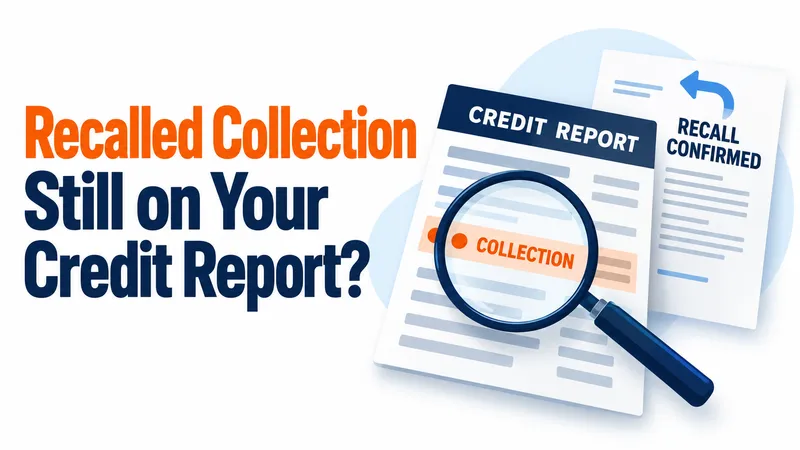
What Does It Mean When a Creditor Recalls a Collection?
When a creditor recalls a collection, they are taking the debt back from the collection agency. The agency loses the right to collect and is required to delete its tradeline from your credit report. The original creditor then handles the account directly and may attempt to collect it themselves or sell it to a different buyer.
Original creditors often send unpaid accounts to collection agencies under a contract. That contract gives the agency the right to collect and, in most cases, to report the account to the credit bureaus. When the original creditor recalls the account, that contract ends.
Once the contract ends, the collection agency has no legal basis to continue reporting the account. The CFPB has outlined furnisher obligations under the FCRA that make clear: a furnisher cannot continue to report an account it no longer has authority over. At that point, deletion of the collection tradeline is the expected outcome.
In practice, this does not always happen automatically. Collection agencies process large volumes of accounts. A recall sometimes gets lost, ignored, or delayed in that system. The tradeline stays on your report until someone disputes it or the agency catches the error on their own.
Why Is the Recalled Collection Still Showing on My Report?
The recalled collection may still appear for one of two reasons. The collection agency failed to delete its tradeline after the recall, which is a reportable error. Or the entry you are seeing is the original creditor's charge-off account, which is a separate item that exists independently of the collection and is not required to be removed when a collection is recalled.
This is the part most people do not expect. A debt that went to collections can generate two separate entries on your credit report at the same time.
The original lender marks the account as a charge-off when it writes off the debt internally. This entry stays on your credit report for seven years from the original delinquency date, regardless of what happens with the collection agency.
The collection agency's tradeline should be removed once the creditor recalls the account. If it is still there, that is an error. You have the right to dispute it and have it removed.
If you pull your credit report and see both entries, that can be correct. The charge-off entry from the original creditor is permitted to remain. The collection entry should be gone. If both the charge-off and the collection entry are still showing, you have a basis to dispute the collection entry.
Does the FCRA Require a Recalled Collection to Be Deleted?
The FCRA requires furnishers to report only accurate information. Once a collection agency no longer has authority over an account due to a recall, continuing to report that account is inaccurate. The agency is obligated to delete the tradeline. If they do not, you can dispute it with the credit bureau under FCRA Section 611.
FCRA Section 623 (15 U.S.C. 1681s-2) outlines the duties of furnishers of information. Furnishers must provide accurate information and must update or correct any information they know to be inaccurate. A recalled collection account, which the agency no longer has collection authority over, falls under that standard.
The obligation is on the furnisher, not on you, to make sure reporting stays accurate. But when the system does not work as it should, you have a clear path to force correction through a formal dispute.
| Entry Type | Furnisher | What Happens After Recall | Dispute Right |
|---|---|---|---|
| Charge-off | Original creditor | Stays on report up to 7 years from original delinquency date | Only if reported inaccurately |
| Collection account | Collection agency | Must be deleted once recall removes agency's authority | Yes, if still reporting after recall |
| New collection | New buyer (if OC resells) | Separate entry from new owner, allowed to report | Only if reported inaccurately |
What Is Re-Aging and Is It Illegal?
Re-aging is when a furnisher changes the original delinquency date on a collection or charge-off to make the account appear newer than it is. This resets the 7-year reporting clock illegally. Re-aging is prohibited under FCRA Section 605 and is a common violation in accounts that are sold or recalled multiple times.
Every negative item on your credit report has a clock. That clock starts on the date of first delinquency, which is the date you first missed the payment that eventually led to the charge-off. Under 15 U.S.C. 1681c, that date controls when the item must fall off your report. Seven years from that date, the item should not appear regardless of what happened to the debt in the meantime.
When an account changes hands, a common error occurs. The new owner or agency enters their acquisition date as the delinquency date. On your report, the account suddenly looks like it is only a few months old instead of three or five years old. The seven-year clock appears to restart. That is re-aging, and it is illegal.
The date a debt was sold, recalled, or transferred has no effect on when it must come off your credit report. The only date that matters is the date of first delinquency on the original account. If that date has been changed without your payment activity justifying the change, the account has been re-aged and you have grounds to dispute it.
If you suspect re-aging, pull your full credit report and look at the reported date of first delinquency. Then compare it to when you actually first missed a payment. If those dates do not match, note the discrepancy in your dispute letter.
How to Dispute a Recalled Collection That Is Still Showing
File a dispute with each credit bureau showing the collection account after the recall. Include documentation from the creditor confirming the account was recalled. The bureau must investigate within 30 days. If the collection agency cannot verify it still has reporting authority, the item must be deleted.
The dispute process works through the bureaus. Under FCRA Section 611, you have the right to dispute any item on your credit report that you believe is inaccurate, incomplete, or unverifiable. The bureau is required to forward your dispute to the furnisher and give them a window to respond.
What to Include in Your Dispute
- ✓ A written dispute letter addressed to each bureau showing the collection entry (Equifax, Experian, TransUnion)
- ✓ Your full name, address, and last four digits of your Social Security number for identification
- ✓ The specific account name, account number (if available), and the error you are disputing
- ✓ Any documentation from the original creditor confirming the account was recalled
- ✓ A statement that the collection agency no longer has authority to report the account after the recall
- ✓ A request for deletion of the tradeline, not just correction
What Happens After You Dispute
The bureau forwards your dispute to the collection agency. The agency has the same 30-day window to respond and verify the account. If the agency cannot verify that it still has reporting authority, the bureau must delete the entry.
If the bureau closes your dispute without removing the account, you can request the method of verification. You can also file a complaint with the CFPB or consult a consumer protection attorney. In some cases, FCRA violations by furnishers or bureaus result in the consumer being entitled to actual damages, statutory damages, and attorney fees under FCRA Section 616 and 617.
Can Both the Charge-Off and the Collection Show at the Same Time?
Yes. A charge-off from the original creditor and a collection account from the collection agency can both appear on your credit report at the same time. They are separate entries from separate furnishers. Both are legal to report simultaneously. The charge-off does not go away when a collection is added, and a recall only affects the collection agency's tradeline, not the original creditor's entry.
This is one of the most frustrating parts of how credit reporting works. The same unpaid debt can generate multiple negative entries on a single credit report, each from a different furnisher, each with its own reporting window.
The original creditor marks the account as a charge-off and continues to report it. They then sell or refer the account to a collection agency. The collection agency reports its own tradeline. Both entries appear. Both are permitted under the FCRA. Both damage your score simultaneously.
At ASAP Credit Repair, we regularly audit files where one account has created three or more negative entries through a chain of sales and recalls. Each buyer or agency added their own tradeline, not all of them deleted it when they should have, and the original charge-off was still reporting. The scoring impact compounds with each additional entry.
A recalled collection leaves the original creditor's charge-off in place. That entry has its own 7-year clock running from the original delinquency date. The collection agency's tradeline should be removed. If it is not, you have a dispute right. If it has been re-aged to appear newer, you have a separate dispute ground. Both issues can be addressed through the same dispute process with the bureaus.
What to Do Right Now if a Recalled Collection Is Still on Your Report
- ✓ Pull your credit reports from all three bureaus at AnnualCreditReport.com and identify every entry tied to the account in question
- ✓ Confirm the furnisher name on each entry: the original creditor's name versus the collection agency's name
- ✓ Note the date of first delinquency shown on each entry and verify it matches the actual date you first missed a payment
- ✓ Gather any written documentation from the original creditor confirming the account was recalled
- ✓ File separate dispute letters with each bureau showing the collection agency entry, citing the recall as your basis
- ✓ If re-aging is present, note the discrepancy between the reported date and the actual first delinquency date in your dispute
- ✓ Track all correspondence by certified mail and save copies of every letter you send and receive
Why is a recalled collection still on my credit report?
A recalled collection can still appear on your credit report for two reasons. First, the original creditor's charge-off entry exists independently and stays on your report for up to seven years from the original delinquency date. Second, the collection agency may have failed to delete its own tradeline after the recall. Those are two separate entries from two separate furnishers.
What does it mean when a creditor recalls a collection?
When a creditor recalls a collection, it is taking the debt back from the collection agency. The agency loses its authority to collect. At that point, the agency is required to delete its tradeline from your credit report. The original creditor then handles the account directly, and its own charge-off entry may remain on your report.
Does a recalled collection have to be removed from my credit report?
The collection agency's tradeline should be removed after a recall because the agency no longer has a basis to report the account. However, the original creditor's charge-off entry is a separate item and is not required to be removed. If the collection agency's entry is still showing after the recall, you can dispute it with the credit bureaus.
How long does a charge-off stay on my credit report?
A charge-off stays on your credit report for seven years from the date of the original delinquency, which is the date you first missed the payment that eventually led to the charge-off. That clock does not restart when the debt is sold, transferred, or recalled. Re-aging a charge-off by resetting that date is illegal under the Fair Credit Reporting Act.
What can I do if a recalled collection is still on my credit report?
File a dispute with each bureau showing the collection account after the recall. Include any documentation from the creditor confirming the recall. The bureau must investigate within 30 days. If the collection agency cannot verify it still has the right to report the account, the entry must be deleted.
Not Sure Which Entries on Your Report Should Be There?
A free 3-bureau audit shows exactly what Equifax, Experian, and TransUnion are currently reporting. We identify every account, every furnisher, and every entry that may have grounds for dispute before you take any action.
Get My Free 3-Bureau Audit → Secure · 2 minutes · No credit card required-
Why Credit Is Important: What Your Score Really Controls Explains what a stronger score unlocks in practice once negative entries are resolved, from mortgage rates to rental approvals.
-
Empower Your Wallet: Overcome Credit Card Debt Covers how charge-offs and collections compound over time and what strategies help rebuild credit once accounts go negative.
-
Emergency Home Repairs: How to Pay Without Hurting Your Credit Practical guide to handling unexpected expenses without letting them turn into collection accounts or long-term credit damage.