

Credit score in Arlington, TX can affect more than whether you qualify for a new credit card. It can influence your ability to finance a home, get approved for an auto loan, and determine the interest rate you may pay when borrowing money. But your score is not determined by where you live.
It reflects the information reported in your individual credit file, including your payment history, debt and credit utilization, age of your accounts, recent credit activity, and credit mix.
If your credit score is below the average you expected to see in Arlington, the more useful question is what is causing your score to be where it is today? A missed payment, high credit card balance, collection account, recently opened account, or even changes in reported balances can affect your credit profile differently.
Identifying those factors can help you understand what may be holding your score back and which areas of your credit deserve attention first.
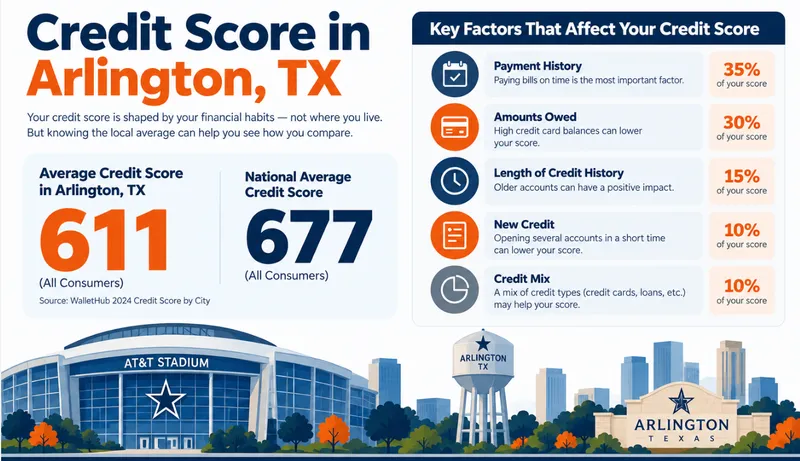
Average Credit Score in Arlington, TX
The average credit score in Arlington, TX is 611, according to WalletHub's 2026 city rankings, ranking Arlington 144th out of 182 U.S. cities studied. That number sits well below the Texas state average of 677 and the national average of 702. Arlington is not alone. Fort Worth, Dallas, and several other DFW cities post similarly low averages, pointing to shared local pressures rather than one city's spending habits. This article breaks down exactly what causes Arlington's score to lag, city by city, factor by factor, and what actually moves the needle if your own score falls below average.
What Is the Average Credit Score in Arlington, TX?
The average credit score in Arlington, TX is 611, placing it in the "fair" credit range. That is below Fort Worth (612), Dallas (622), and well below the Texas state average of 677 and the national average of 702.
A 611 score is not a crisis number, but it closes doors. Most conventional mortgage lenders want to see at least 620, and the best interest rates on auto loans and credit cards typically start around 670. At 611, an Arlington resident is likely paying more for the same loan than a neighbor in Fort Worth or a resident of Austin, where the average score sits at 660.
Curious Exactly What Is Dragging Your Arlington Score Down?
A collections account, a reporting error, or high utilization could be costing you more points than you realize. A free 3-bureau audit shows exactly what Equifax, Experian, and TransUnion currently report before you make any financial decision.
Claim My Free Credit Analysis Now → Secure · 2 minutes · No credit card requiredWhat Factors Cause Arlington's Credit Scores to Lag Behind the National Average?
A credit score is built from five weighted factors: payment history (35%), credit utilization (30%), length of credit history (15%), credit mix (10%), and new credit inquiries (10%). In Arlington, high utilization and unresolved collections accounts pull the average down the most.
Every credit score, whether it comes from FICO or VantageScore, is built from the same basic ingredients. What changes from city to city is how residents perform on each one. As explained in more depth in how a credit score is calculated, payment history and utilization together decide nearly two-thirds of the number.
| Factor | Weight | What It Measures |
|---|---|---|
| Payment history | 35% | Whether bills were paid on time over the past 7 years |
| Credit utilization | 30% | How much of your available credit is currently in use |
| Length of credit history | 15% | The average age of your open accounts |
| Credit mix | 10% | Whether you carry a mix of cards, loans, and installment debt |
| New credit | 10% | Recent hard inquiries and newly opened accounts |
Two forces hit Arlington residents harder than the national average. The first is credit card utilization, which climbs when cost-of-living increases outpace wage growth. The second is collections accounts, which are especially common across Tarrant County. A single unresolved collection can knock 100 points or more off an otherwise average score, based on how credit score ranges and tiers actually work.
Why Do Collections Accounts Hit Arlington Residents So Hard?
Tarrant County cities, including Arlington and Fort Worth, rank among the highest in the nation for collections account problems, driven largely by medical debt tied to Texas's uninsured rate, one of the highest in the country.
Texas has not expanded Medicaid eligibility, which leaves more residents uninsured or underinsured compared with states that did. A single emergency room visit can run $1,500 to $3,000 for an uninsured patient, and that bill often ends up in collections long before the person realizes it has hit their credit report.
Usually the result of ongoing balances carried month to month, which raises utilization steadily over time.
Frequently discovered only after it has already been reported to a bureau, months after the original visit.
Checking your own report regularly is the fastest way to catch one of these before it does lasting damage. Doing so causes zero score impact, a point covered in more detail in does checking your credit score lower it.
How Does Arlington Compare to Other DFW and Texas Cities?
Arlington's average score of 611 sits close to Fort Worth (612) and San Antonio (612), slightly below Dallas (622), and far below Austin (660), which posts the highest average credit score of any major Texas city.
| City | Average Credit Score | National Rank (of 182) |
|---|---|---|
| Austin | 660 | 25 |
| Dallas | 622 | 115 |
| San Antonio | 612 | 140 |
| Fort Worth | 612 | 140 |
| Arlington | 611 | 144 |
| Garland | 615 | 126 |
| Grand Prairie | 605 | 155 |
Arlington's average score is not an outlier. It matches a pattern across nearly every major DFW city, driven by the same two forces: high credit card utilization and a heavy load of collections accounts, many of them medical. Austin is the exception, not the rule, for Texas cities.
What Can Arlington Residents Do to Raise a Below-Average Score?
Pull a full credit report, dispute any account that is inaccurate or cannot be verified under the Fair Credit Reporting Act, lower credit card balances below 30% of the limit, and address collections accounts directly before they age further.
- ✓ Pull your full credit report and check every account for accuracy, especially medical collections
- ✓ Dispute any account that is inaccurate, outdated, or unverifiable under the Fair Credit Reporting Act
- ✓ Pay down credit card balances to below 30% of the limit, ideally closer to 10%
- ✓ Separate medical collections from ordinary debt and negotiate or dispute them individually
- ✓ Avoid opening new credit accounts in the six months before a major loan application
- ✓ Work with a credit repair company if collections accounts are dragging the score down and disputes are stalling
No legitimate company can promise a guaranteed score increase or the removal of accurate negative information. What actually helps is knowing exactly which accounts are dragging the score down, correcting what is wrong, and building a realistic plan for what is left.
What is the average credit score in Arlington, TX?
The average credit score in Arlington, TX is 611, according to WalletHub's 2026 city rankings. That places Arlington 144th out of 182 U.S. cities studied and well below both the Texas state average of 677 and the national average of 702.
Why is Arlington's average credit score lower than the national average?
Arlington's score sits below the national average mainly because of high collections rates, high credit card utilization, and medical debt tied to Texas's high uninsured rate. Fort Worth, Dallas, and other nearby DFW cities show similar patterns, suggesting the pressure is regional as much as local.
What factors make up a credit score?
A FICO score is built from five weighted factors: payment history (35%), credit utilization (30%), length of credit history (15%), credit mix (10%), and new credit inquiries (10%). Payment history and utilization together make up 65% of the score.
Do collections accounts affect Arlington residents more than other cities?
Yes. Tarrant County cities, including Arlington and Fort Worth, rank among the highest in the nation for collection account problems. A single collection account can stay on a credit report for up to seven years and often accounts for a large share of the score gap.
How can Arlington residents raise a below-average credit score?
Pull a full credit report, dispute inaccurate or unverifiable accounts under the Fair Credit Reporting Act, lower credit card utilization below 30%, and address collections accounts directly. Working with a credit repair company can speed up disputes on accounts that cannot be verified.
See What Is Really on Your Arlington Credit File
Collections accounts, reporting errors, and high utilization are the three biggest reasons Arlington's average score trails the nation. A free 3-bureau audit shows exactly what Equifax, Experian, and TransUnion report on your file right now.
Claim My Free Credit Analysis Now → Secure · 2 minutes · No credit card required-
How Is a Credit Score Calculated? The 5 FICO Factors Breaks down each of the five weighted factors behind a FICO score and which ones move the fastest.
-
Credit Score Ranges Explained: What Is "Good" Now? Shows exactly what separates a fair score from a good one, factor by factor, with real profile examples.
-
What Is a Fair Credit Score and Why It's Costing You More Walks through the real dollar cost of a fair score versus a good one across loans and credit cards.
-
Does Checking Your Credit Score Lower It? Truth Explained Explains why monitoring your own score regularly causes zero score impact and helps catch errors early.
-
WalletHub: Cities With the Highest & Lowest Credit Scores (2026) The city-by-city credit score data referenced throughout this article, including Arlington's full ranking.
-
Consumer Financial Protection Bureau: The Fair Credit Reporting Act Official explainer on the federal law that gives consumers the right to dispute inaccurate credit report entries.
-
AnnualCreditReport.com The only federally authorized source for free weekly credit reports from all three major bureaus.