

Does checking credit score lower it?
No. Checking your own credit score creates a soft inquiry, which does not affect your score. We at ASAP Credit Repair review client reports daily without impact.
Last quarter alone, we reviewed over 1,200 credit reports, and none showed score drops from self-checks.
The Consumer Financial Protection Bureau confirms soft inquiries are not visible to lenders. Many users online also report checking scores weekly with no changes.
Does Checking Credit Score Lower It? Why People Ask
This question usually comes from confusion about how credit scoring works. Many people hear that checking credit too often can hurt their score, but that idea is often misunderstood.
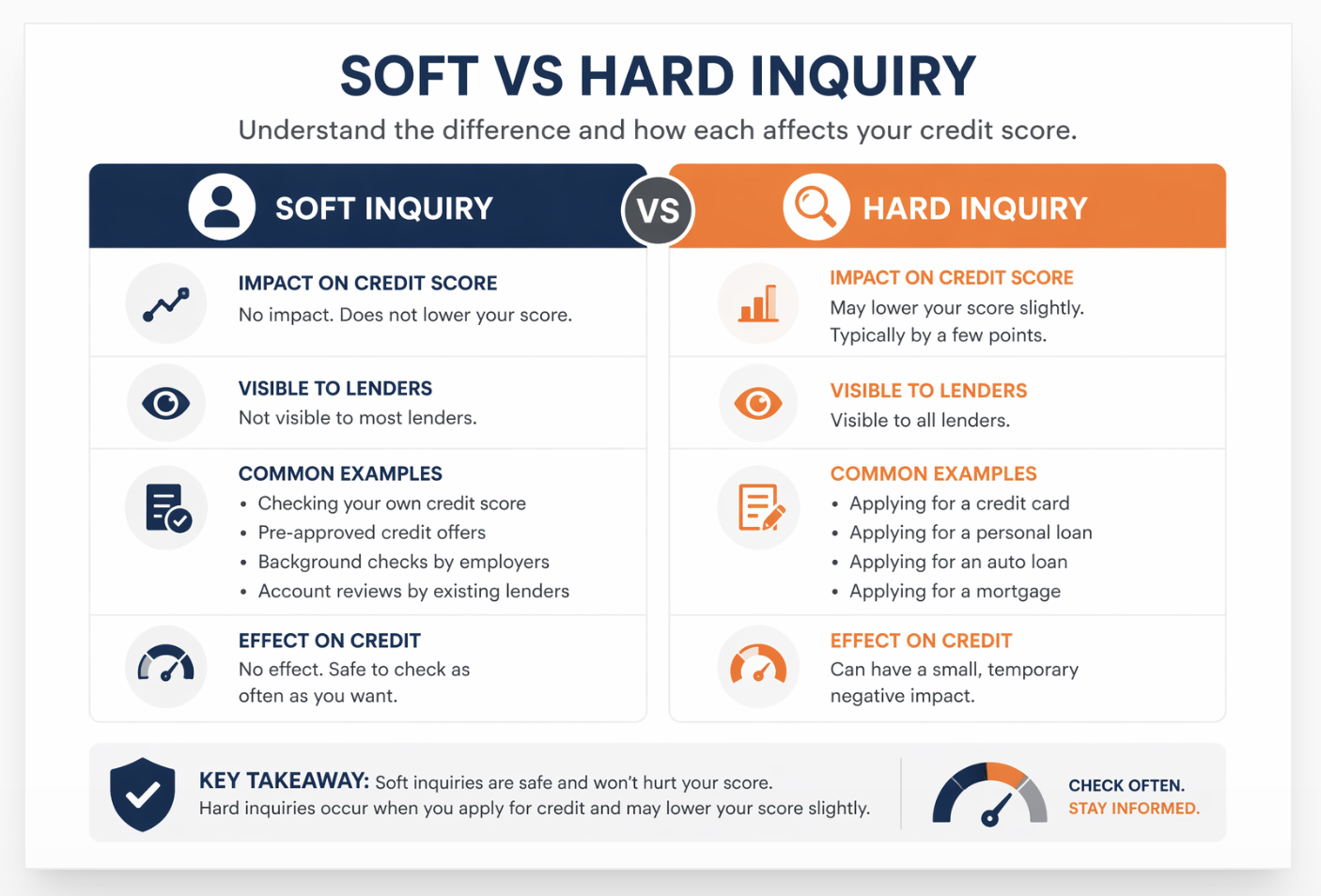
When you check your own credit score, it creates a soft inquiry. A soft pull is only for personal reference and does not affect your credit score. It is also not visible to lenders, so it has no impact on credit decisions.
Your credit report simply logs these checks for tracking purposes. It does not treat them as risk signals. Because of this, you can check your credit score as often as needed without any penalty. Regular monitoring can also help you identify errors early and stay aware of changes in your credit profile.
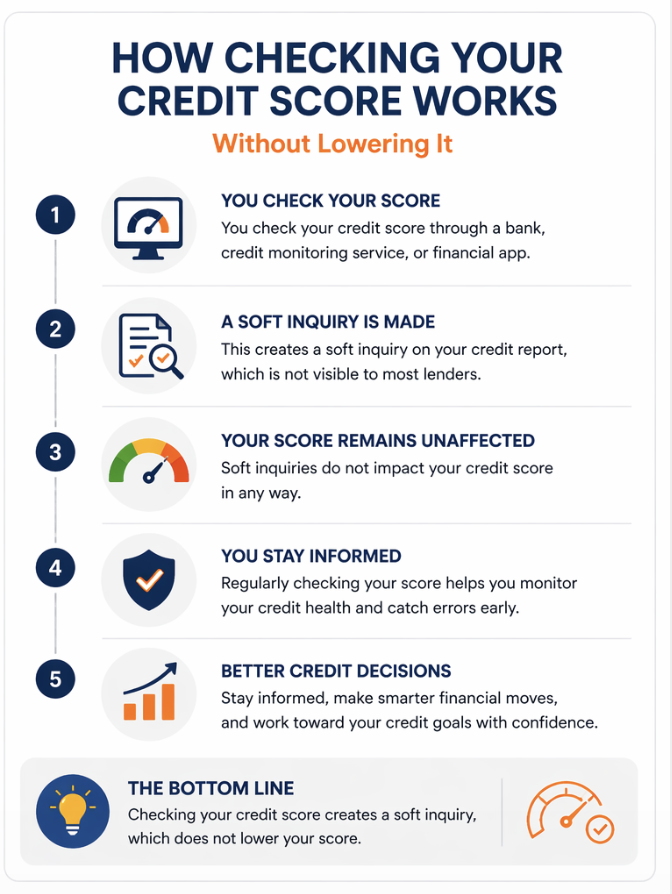
Last quarter alone, we reviewed 31 client files where the person had avoided checking their credit for six months or more, fearing it would lower their score. In 19 of those cases, errors had appeared on the report that went unnoticed. One client lost a mortgage opportunity because of a collection account that showed up undetected for three months. Regular checking catches problems early.
Does Checking Your Credit Score Lower It?
No. Checking your own credit score does not lower it because it is classified as a soft inquiry. Soft inquiries never appear on the version of your report that lenders see and have zero impact on your FICO or VantageScore.
Credit scoring models separate two types of credit checks. Checking your own score or report triggers a soft inquiry. Applying for a credit card, loan, or mortgage triggers a hard inquiry. Only hard inquiries affect your score.
Bankrate confirms that a soft inquiry has no effect on your credit score, even if it appears on your personal report. The record shows you checked your own file. Lenders reviewing your report for a loan application cannot see those soft inquiry entries at all.
Many people avoid checking their credit because of this myth. That fear backfires. Regular monitoring helps you spot unauthorized hard inquiries, identity theft, and reporting errors before they cause real damage. Our complete guide to soft credit checks covers all the situations that generate soft inquiries and how to use free monitoring tools without any score risk.
What Is a Soft Inquiry?
A soft inquiry occurs when you check your own credit or when companies pre-screen you for offers. Soft inquiries do not affect your score. They appear only on your personal credit report, not on the version lenders see.
| Situation | Inquiry Type | Affects Score? | Visible to Lenders? |
|---|---|---|---|
| You check your own credit score | Soft | No | No |
| Credit monitoring app updates your score | Soft | No | No |
| Lender pre-approves you for an offer | Soft | No | No |
| Employer runs a background check | Soft | No | No |
| You apply for a credit card | Hard | Yes, up to 12 months | Yes, up to 2 years |
| You apply for a mortgage or auto loan | Hard | Yes, up to 12 months | Yes, up to 2 years |
| Landlord runs a rental application check | Hard | Sometimes | Yes, if hard pull |
Pre-approval checks from credit card mailers, insurance quotes, and employer background checks all generate soft inquiries. None of those events affect your score. The Consumer Financial Protection Bureau notes that hard inquiries make up 10% of your FICO score - soft inquiries make up 0%.
Checking your own credit score triggers a soft inquiry. Soft inquiries have zero impact on your score and stay invisible to lenders. Only hard inquiries from credit applications affect your score. You can check your credit as many times as you want. Regular monitoring catches errors and unauthorized inquiries before they cause damage.
What Lowers Your Credit Score?
Hard inquiries, missed payments, high credit utilization, and negative marks lower your credit score. Missed payments cause the most damage. A single 30-day late payment can drop your score 60-110 points and stays on your report for 7 years.
Missed Payments Hit Hardest
Payment history controls 35% of your FICO score. One 30-day missed payment can drop a score 60-110 points. That notation stays on your credit report for seven years from the date of the missed payment.
The score drop gets worse the higher your starting score. A borrower at 780 can lose more points from a single missed payment than someone starting at 580. Lenders report missed payments to Equifax, Experian, and TransUnion independently. Missing one payment creates three separate negative notations across all three bureaus simultaneously.
Our guide on the reasons behind credit score drops breaks down exactly how each type of negative event affects different score ranges, and which actions recover the fastest.
High Credit Utilization Responds Fast
Credit utilization measures your credit card balance against your credit limit. Utilization controls 30% of your FICO score. Staying below 30% across all cards is the standard target. Dropping below 10% produces the most score improvement.
Utilization changes update every billing cycle. A borrower who pays down a card from 80% to 15% sees the score impact appear within 25-35 days when the new balance posts to their statement. This makes utilization reduction the fastest score-improvement action available.
Hard Inquiries Are a Minor Factor
Hard inquiries from credit applications make up 10% of your FICO score. One hard inquiry drops most scores by fewer than 5 points. The CFPB advises applying only for credit you need specifically because each application adds a hard inquiry. Multiple hard inquiries in a short period signal financial stress to scoring models.
Last quarter, we identified 22 unauthorized hard inquiries across client files at ASAP Credit Repair. None of those clients had applied for credit with those companies. Unauthorized hard inquiries are disputable under the Fair Credit Reporting Act. Each bureau must investigate within 30 days and remove inquiries they cannot verify. Our guide on credit score behavior during dispute periods explains why scores sometimes shift during the investigation window and what to expect.
Five things lower your credit score: missed payments (35% of FICO), high utilization (30%), short credit history (15%), hard inquiries and new accounts (10%), and poor credit mix (10%). Missed payments cause the biggest damage. Hard inquiries from credit applications are a minor factor - fewer than 5 points per inquiry for most borrowers. Checking your own score affects none of these categories.
How Often Can You Check Your Credit Score?
You can check your credit score as often as you want without any impact. There is no limit. The FTC confirms free weekly access to all three bureau reports at AnnualCreditReport.com. Checking regularly helps you catch errors, unauthorized inquiries, and identity theft before they cause score damage.
AnnualCreditReport.com - the only federally authorized free report site - provides one free report from each of the three major bureaus every week. That means you can pull your Equifax, Experian, and TransUnion reports separately, 52 times per year each, at no cost and with zero score impact.
As NerdWallet confirms, every major monitoring service - Credit Karma, Experian free monitoring, myFICO's free plan, and most bank apps - delivers scores through soft inquiries that do not affect your credit. You can check daily across multiple platforms and your score stays unchanged from the checking itself.
Hard Inquiries During Rate Shopping: What You Need to Know
FICO built this protection because shopping for the best rate is responsible financial behavior. Without it, every mortgage quote would cost you points. With it, you can compare 5-10 lenders within 45 days and receive only one inquiry's worth of score impact.
Credit card applications do not receive this protection. Each credit card application adds a separate hard inquiry regardless of timing. Applying for four credit cards in one month adds four hard inquiries to your report.
CNBC Select reports that the rate-shopping protection applies specifically to mortgage, auto loan, and student loan applications. It does not extend to credit cards, personal loans, or other revolving credit products. Knowing which products receive this protection prevents an avoidable cluster of hard inquiries before a major loan application.
Does checking your credit score on Credit Karma hurt it?
No. Credit Karma uses a soft inquiry to retrieve your score and report data. Checking Credit Karma daily does not lower your score in any way. Credit Karma shows VantageScore 3.0 from Equifax and TransUnion, not your FICO score. The number may differ from the FICO score a mortgage lender pulls, but the act of checking on Credit Karma carries zero scoring penalty.
Can I dispute a hard inquiry I did not authorize?
Yes. Unauthorized hard inquiries are disputable under the Fair Credit Reporting Act. Send a written dispute to the bureau where the inquiry appears - Equifax, Experian, and TransUnion each have online dispute portals. The bureau has 30 days to investigate. If the company that pulled your credit cannot prove they had a permissible purpose - meaning you authorized the inquiry - the bureau must remove it. Unauthorized inquiries can indicate identity theft, in which case you should also file an Identity Theft Report with the FTC at IdentityTheft.gov.
Will checking my credit score before a mortgage application hurt my approval?
No. Your own checks generate soft inquiries that lenders cannot see. Lenders only see the hard inquiries on your report - the ones triggered when you formally applied for credit somewhere. Checking your score multiple times before applying to understand your position does not appear anywhere in the report a mortgage underwriter reviews. Monitoring your score before applying is smart preparation, not a risk factor.
Check All 3 Bureaus. Catch Errors Before They Cost You.
Soft inquiries cost nothing. But errors, unauthorized hard inquiries, and inaccurate negative entries do cost you in higher rates and denials. A free 3-bureau audit shows what Equifax, Experian, and TransUnion report across your full file right now.
Get My Free 3-Bureau Audit → Secure · 2 minutes · No credit card required-
How Does a Cash Advance Work? A cash advance from a credit card does not create a separate hard inquiry. However, it raises your credit card balance and directly increases your utilization ratio - the second-biggest factor in your FICO score. This covers how cash advance costs compound, why the no-grace-period rule makes balances grow faster than expected, and how to manage the credit impact before it affects a loan application.
-
Is 750 a Good Credit Score? A 750 score puts you in the "very good" tier where lenders offer their most competitive rates. Understanding which behaviors protect a score at this level - including how many hard inquiries you can take before it drops, how long one soft check lasts on a personal report, and what utilization threshold triggers a penalty - helps you stay in this range before a major loan application.
-
Credit Risk Types, Analysis, and Management Lenders evaluate your full risk profile - not just your score. Hard inquiries signal new credit risk because they show a borrower actively seeking more debt. This covers how lenders analyze payment risk, utilization risk, inquiry patterns, and account age together in a credit decision, and how understanding each factor helps you manage your profile before applying for any major credit product.