

Getting a home loan in Laurel, MD takes more than a good credit score. You might have steady income, money saved for a down payment, and years of on-time payments, yet still face questions about your existing debts or credit history. For homebuyers in Laurel, where housing costs make every percentage point of mortgage interest matter, understanding what lenders review is an important part of preparing to buy.
Consider a buyer earning $85,000 a year with a 700 credit score and $15,000 saved. On paper, that looks promising. But a car payment, credit card balances, and the expected mortgage payment all affect how much the buyer qualifies to borrow.
Mortgage lenders examine your credit history, debt-to-income ratio, income stability, available funds, and the property's appraised value. A good credit score alone does not guarantee mortgage approval.
This guide explains what lenders check, which financial issues raise concerns, and what Laurel homebuyers should review before submitting an application.
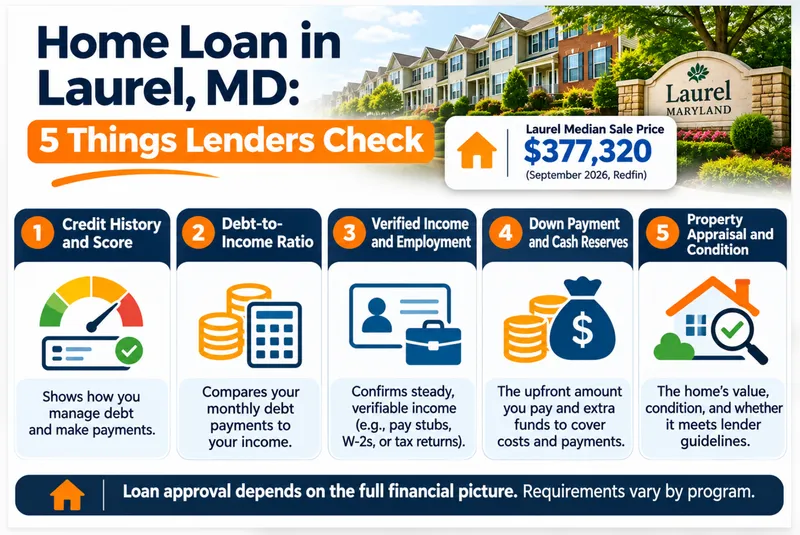
What Do Lenders Check to Decide Your Creditworthiness for a Home Loan in Laurel, MD?
Lenders in Laurel, MD judge creditworthiness on five factors at once: credit score, debt-to-income ratio, employment history, down payment, and cash reserves. A strong showing in one factor offsets a weak showing in another, so a 610 score with low debt and 10% down outperforms a 680 score with 49% DTI and 3% down.
Laurel sits on the line between Prince George's and Anne Arundel counties, and the same five factors apply on both sides. Lenders pull your credit from all three bureaus, enter your income, debts, assets, and loan terms into an automated underwriting system, and read the result. The system is Desktop Underwriter at Fannie Mae or Loan Product Advisor at Freddie Mac for conventional loans. FHA loans run through the TOTAL Scorecard.
The output is either an approval recommendation or a referral to manual underwriting. A referral means a human underwriter reads every document and applies stricter limits. Borrowers who understand the thresholds below avoid most referrals.
| Factor | What the lender checks | The number that matters |
|---|---|---|
| Credit score | Middle score from Equifax, Experian, and TransUnion | 580 FHA, 620 conventional, 640 MMP |
| Debt-to-income | Monthly debts divided by gross monthly income | 45% to 50% ceiling |
| Employment | Two years of documented, stable income | 24 months |
| Down payment | Loan-to-value ratio and program eligibility | 3% to 5% minimum, 20% to skip mortgage insurance |
| Reserves | Savings left after closing | Set by the underwriting findings |
Factor 1: How Does Your Credit Score Affect a Laurel Mortgage?
Your credit score decides which loan programs you qualify for and what interest rate you pay. Most Laurel lenders require 620 for a conventional loan and 580 for an FHA loan with 3.5% down. The Maryland Mortgage Program requires 640.
Lenders pull a tri-merge report that combines all three bureaus and use the middle of your three scores. The score is a mortgage-specific FICO model. It differs from the free score on a banking or budgeting app, so a 640 on your phone does not guarantee a 640 at the lender.
| Loan Type | Minimum Score | Down Payment | Mortgage Insurance |
|---|---|---|---|
| Conventional | 620 at most lenders | 3% to 20% | PMI under 20% down, removable later |
| FHA | 580 for 3.5% down; 500 to 579 needs 10% down | 3.5% or 10% | 0.55% annual MIP for the full loan term at under 5% down |
| VA | No VA minimum; each lender sets its own | 0% | No monthly mortgage insurance |
| Maryland Mortgage Program | 640 for most products; 720 for SmartBuy 3.0 | Varies by product | Follows the underlying loan type |
What the Score Measures
FICO weighs five categories. Payment history carries 35%, amounts owed carries 30%, length of credit history carries 15%, new credit carries 10%, and credit mix carries 10%. The lender sees your score on the day of the pull, so a balance paid down last week counts only after the card issuer reports it to the bureaus.
What a Higher Rate Costs on a Laurel Home
Your score also sets your rate. The chart shows the same $380,000 loan, a $400,000 Laurel home with 5% down on a 30-year fixed mortgage, at three rates. Each half point adds about $45,000 in interest over the loan term.
| Rate | Monthly Principal and Interest | Total Interest | Difference vs. 6.5% |
|---|---|---|---|
| 6.5% | $2,402 | $484,669 | — |
| 7.0% | $2,528 | $530,134 | +$45,465 |
| 7.5% | $2,657 | $576,525 | +$91,856 |
How to Clean Up Your Score Before the Pull
- ✓Pull all three bureau reports and read every account. Free reports are available at AnnualCreditReport.com.
- ✓Dispute inaccurate entries at all three bureaus at the same time. The bureau must finish its investigation within 30 days, or 45 days if you send new information during that window.
- ✓Pay revolving balances down in the month before the pull so the lower balance reports on the statement the lender sees.
- ✓Hold off on new accounts. A hard inquiry lowers a score by about five to ten points on average, and FICO counts inquiries from the last 12 months.
Factor 2: What Debt-to-Income Ratio Do Laurel Lenders Allow?
Fannie Mae allows a debt-to-income ratio of up to 50% on loans approved through its automated system and 36% to 45% on manually underwritten loans. The Maryland Mortgage Program allows 50% on government-backed loans at scores of 680 or higher and 45% at scores of 640 to 679.
DTI is your total monthly debt payments divided by your gross monthly income, before taxes. Lenders run two versions. Front-end DTI counts only the new housing payment: principal, interest, taxes, insurance, and any HOA dues. Back-end DTI adds your car loans, student loans, credit card minimums, and personal loans. Back-end DTI decides most denials.
| Program | Maximum DTI |
|---|---|
| Fannie Mae, manual underwriting | 36%, or 45% with qualifying score and reserves |
| Fannie Mae, Desktop Underwriter approval | 50% |
| MMP government-backed, score 680 and above | 50% |
| MMP government-backed, score 640 to 679 | 45% |
| MMP conventional | Up to 50% with automated approval |
A Worked DTI Example
Take a Laurel buyer who earns $7,500 per month before taxes. The loan is $380,000 at 6.5%, so principal and interest run $2,402. The example assumes $600 per month for property taxes and homeowners insurance, a $350 car payment, and $150 in credit card minimums.
| Scenario | Monthly Obligations | DTI |
|---|---|---|
| Front-end (housing only) | $3,002 | 40.0% |
| Back-end, all debts | $3,502 | 46.7% |
| Back-end after paying off the car loan | $3,152 | 42.0% |
Lenders count the monthly payment, not the balance. A $350 car payment you clear drops DTI by 4.7 points in the example above. Paying $3,000 toward a card with a $75 minimum moves DTI one point at most. Ask your lender to run the numbers with and without each debt before you spend a dollar.
Lenders use gross income and the minimum payment on revolving debt. Closing a card or paying it to zero removes the minimum from the calculation. Paying it down without reaching zero leaves a minimum payment in the calculation.
Factor 3: Does Your Job History Matter for a Mortgage in Laurel?
Yes. Lenders look for two years of stable, documented income. A job change inside the same field at higher pay qualifies. A move to self-employment needs two years of tax returns before that income counts.
Underwriters verify employment with pay stubs, W-2s, and a call to your employer. A borrower with three years at one job clears this factor cleanly. A borrower who left a salaried role eight months ago to freelance has to document 24 months of self-employment before that income counts toward the loan.
Laurel has a large share of federal contractors working near Fort Meade and NASA Goddard. Contractors on short-term contracts show renewal history. Commission and seasonal earners are averaged over two years, so one strong year does not set the qualifying number. Gaps in employment need a written explanation.
W-2 wages, self-employment income averaged over two years of tax returns, Social Security, pension, and disability benefits, plus rental income documented on a lease and tax return.
Cash income missing from your tax returns, gifts, the value of stock you own (only dividends count), and any income you cannot prove with official records.
Factor 4: How Much Down Payment Do You Need in Laurel, MD?
The minimum is 3% on conventional loans and 3.5% on FHA loans. On the Laurel median price of $377,320, that is about $11,320 to $13,206. A 20% down payment, $75,464, removes private mortgage insurance on a conventional loan.
Your down payment sets the loan-to-value ratio, which controls the mortgage insurance you pay and part of your rate. It also changes your odds when the rest of the file is thin, because a borrower with a 610 score and 20% down presents a different risk than the same borrower with 3% down.
What Mortgage Insurance Costs
On an FHA loan with less than 5% down, the annual premium is 0.55% of the loan and lasts for the full loan term. On a $400,000 home with 3.5% down, the base loan is $386,000, so the premium starts at about $2,123 per year, or $177 per month. A down payment of 10% or more shortens the FHA premium to 11 years. Conventional PMI ends once you build enough equity.
Maryland Mortgage Program Down Payment Assistance
The Maryland Mortgage Program (MMP) pairs a first mortgage with a second loan that covers part of your cash to close. The assistance carries a 0% rate and is repayable, deferred until you sell, refinance, or pay off the first mortgage.
| MMP Product | Assistance | On a $380,000 First Mortgage |
|---|---|---|
| 1st Time Advantage 3% | 3% of the first mortgage | $11,400 |
| 1st Time Advantage 4% | 4% of the first mortgage | $15,200 |
| 1st Time Advantage 5% | 5% of the first mortgage | $19,000 |
| Advantage 6000 | Flat $6,000 loan | $6,000 |
| HomeStart 6% (50% AMI) | 6% of the first mortgage | $22,800 |
Income limits apply. The MMP limits effective June 24, 2026 for Prince George's County are $199,320 for households of one or two people and $232,540 for households of three or more. Anne Arundel County limits run lower, and targeted-area limits differ. Check the current MMP income and purchase limits before you decide.
Factor 5: How Much Cash Reserves Do Lenders Want?
Lenders want savings left after your down payment and closing costs, measured in months of your full housing payment. The automated underwriting findings set the required reserves for your file. The Maryland Mortgage Program also caps liquid assets at less than 20% of the purchase price.
Reserves show the lender how you handle money. A borrower with $40,000 for the down payment and $12,000 left over is a different risk than one who spent every dollar and has $400 remaining. Checking, savings, money market, and brokerage balances count. Equity in another property, unvested retirement funds, gifts that have not arrived, and the funds you are already using for the down payment do not.
What Happens After You Submit a Home Loan Application in Laurel?
The lender runs your file through automated underwriting, which returns an approval recommendation or a referral. An underwriter then reviews every document by hand. Undisclosed debts, large unexplained deposits, and new credit inquiries surface at this stage.
An Approve/Eligible finding clears the file for the next step, but the underwriter still verifies your income documents, confirms the credit data, reviews the appraisal, and checks the program rules. The automated system never saw the $4,000 deposit from a relative or the store card you opened last week. The underwriter does, and each item needs a paper trail.
- Respond to every underwriter request the same day, with complete documents.
- Source every large deposit with a statement or gift letter.
- Avoid new credit and large purchases until the loan closes.
- Keep your job and your income documents unchanged through closing.
How Do You Improve Your Creditworthiness Before Applying?
Start six months before you apply. Review all three credit reports, dispute inaccurate entries, lower revolving balances, pay off small monthly debts, and avoid new credit. Three months is the minimum window for a statement cycle to report your changes.
Laurel's price range makes the gap between loan products matter. A buyer who reaches 620 qualifies for conventional financing and skips the FHA premium that runs for the full loan term. Our credit repair guide explains how the dispute process works across all three bureaus.
Medical Collections and Your Mortgage File
A federal rule to remove medical debt from credit reports was vacated on July 11, 2025, in Cornerstone Credit Union League v. CFPB, so it does not apply. The three bureaus run their own policies: they do not report medical debt under $500, they wait one year before reporting unpaid medical debt, and they remove paid medical collections. A medical collection that is older, larger, or inaccurate still appears on your report and counts in your score.
Underwriters do not approve a score. They approve a file. A borrower at 640 with a 38% DTI, 24 months of income, and savings after closing beats a borrower at 700 with a 49% DTI and nothing left. Fix the factor that is out of range first.
Know What Your Lender Will See
Review your credit reports from all three bureaus before you apply. ASAP Credit Repair USA identifies the reporting errors worth disputing and explains the dispute steps.
Review My Credit Report → Secure · 2 minutes · No credit card requiredWhat credit score do I need to buy a home in Laurel, MD?
Most conventional lenders require 620. FHA allows 580 with 3.5% down or 500 to 579 with 10% down. The Maryland Mortgage Program requires 640 for most products and 720 for SmartBuy 3.0. VA sets no minimum, and each VA lender sets its own floor.
Do I qualify for a Laurel mortgage with a 600 credit score?
Yes, through FHA. A 600 score clears the FHA floor of 580 for a 3.5% down payment, though your lender sets its own minimum and many require more. A 600 score does not meet the 640 requirement for MMP assistance.
What DTI is too high for a mortgage in Laurel?
Anything above 50% fails every program in this article. Between 45% and 50%, you need an automated approval and strong compensating factors such as savings and a higher score. Lower DTI by paying off monthly debts or raising documented income.
What down payment assistance is available in Laurel, MD?
The Maryland Mortgage Program offers 1st Time Advantage assistance of 3%, 4%, or 5% of the first mortgage, or a flat $6,000. The loan carries a 0% rate and is repayable when you sell, refinance, or pay off the first mortgage. You need a 640 score, homebuyer education, and household income under the MMP limit.
How does a collection account affect my Laurel home loan application?
A collection lowers your score and adds scrutiny in underwriting. Whether the lender requires payment depends on the loan program and the lender's own rules. Verify the account is accurate at all three bureaus first, since you dispute an inaccurate collection under the FCRA without paying it.
Does a recent job change hurt my mortgage application in Laurel?
A move to a new employer in the same field at equal or higher pay qualifies. A switch from W-2 work to self-employment means that income does not count until you document two years. Ask your lender before you accept any offer during the application.
How much does a higher interest rate cost on a Laurel home?
On a $380,000 30-year loan, moving from 6.5% to 7.0% raises the payment by $126 per month and adds $45,465 in total interest. Moving to 7.5% adds $91,856. A higher credit score is one of the main levers on your rate.
Does FHA mortgage insurance ever come off?
With less than 10% down, the premium lasts for the full loan term, so removing it means refinancing into a different loan. With 10% or more down, it ends after 11 years. Conventional PMI ends once you build enough equity.
How early should I start improving my credit before buying?
Start six months before you apply. Disputes take 30 to 45 days, balance reductions need a statement cycle to report, and hard inquiries affect your score for 12 months. Three months is the shortest window that produces measurable change.
Do medical collections hurt my mortgage application?
They count in your score when they appear on your report. The bureaus do not report medical debt under $500, wait a year before reporting unpaid medical debt, and remove paid medical collections. The federal rule that would have removed all medical debt was vacated in July 2025.
Lenders in Laurel approve files, not scores. A stable income, a DTI under the program ceiling, savings after closing, and a score above the loan floor outweigh any single number. Review the factors you control, fix the weakest one, and apply when the file shows steady repayment capacity.
-
Credit Report Correct but Still Denied? Why a clean report does not guarantee approval and what lenders check beyond it.
-
How to File a TransUnion Dispute & Fix Credit Report Errors The dispute process to run at each bureau before a lender pulls your file.
-
What Is Credit Repair Service and How Can It Help You How disputes work and how to choose between DIY credit repair and professional help.
- Maryland Mortgage Program — Product Matrix, effective September 4, 2026
- Maryland Mortgage Program — Income and purchase limits, effective June 24, 2026
- Maryland Mortgage Program — Quick Reference Sheet, liquid asset limit
- Fannie Mae Selling Guide B3-6-02 — Debt-to-income ratios
- HUD Mortgagee Letter 2023-05 — FHA annual mortgage insurance premiums
- Nerdwallet — FHA credit score and down payment requirements
- U.S. Department of Veterans Affairs — VA home loans
- Redfin — Laurel, MD housing market
- myFICO — What is in your credit score
- myFICO — How hard inquiries work
- 15 U.S.C. § 1681i — Procedure in case of disputed accuracy
- National Consumer Law Center — Medical debt on credit reports