

A deleted collection reappeared on your credit report at a time when credit reporting disputes are generating millions of consumer complaints. According to the Consumer Financial Protection Bureau's 2025 Consumer Response Annual Report, credit and consumer reporting accounted for approximately 88% of complaints received in 2025. The CFPB also reported a 182% increase in credit reporting complaints in 2024 compared with 2023, underscoring the growing volume of disputes involving inaccurate account information.
The financial consequences can extend beyond a credit score. A landmark Federal Trade Commission study found that 5% of consumers had credit report errors serious enough to potentially affect their access to credit or borrowing terms. For someone whose previously deleted collection has returned, the critical issue is whether the account was legally reinserted, transferred to another collector, or reported with inaccurate information.
Under the Fair Credit Reporting Act, information deleted following a qualifying dispute investigation cannot simply be reinserted without meeting specific requirements. The furnisher must certify its accuracy and completeness, and the credit bureau must notify the consumer within five business days after reinsertion.
This article examines why deleted collections return, how to identify reporting violations, and what evidence consumers need to challenge an inaccurate collection account.
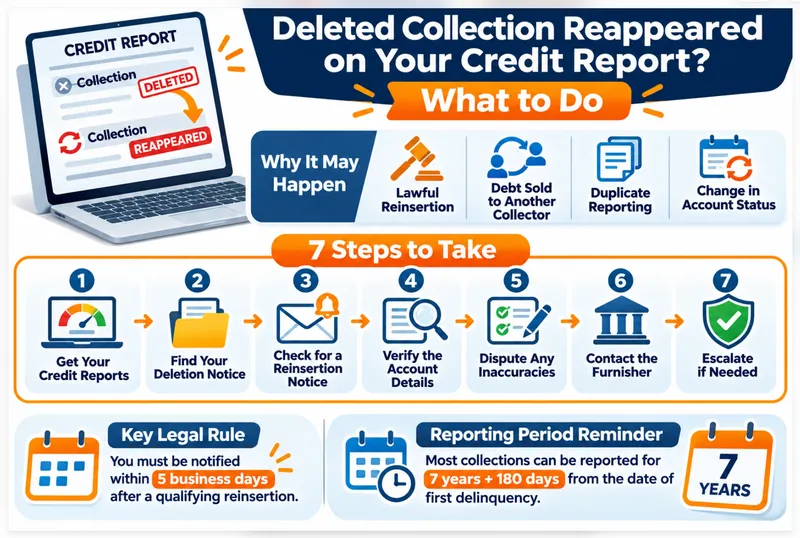
Deleted Collection Reappeared on Your Credit Report? What to Do
A deleted collection reappeared on your credit report, months after you thought the problem was over. You disputed the account, got a letter saying it was removed, and watched your score improve. Now the same debt is back, maybe under a different collector's name, right when you plan to apply for a mortgage or car loan.
That raises a fair question: does a credit bureau have the power to put back information it agreed to remove?
Under the Fair Credit Reporting Act (FCRA), the answer depends on why the account was deleted and how it came back. When information removed through a qualifying dispute investigation is reinserted, the furnisher must certify that it is complete and accurate. The bureau must also notify you in writing within five business days after the reinsertion.
Not every returning collection is a legal reinsertion, though. A debt sold to another collector, a duplicate account, or a wrong delinquency date creates a different problem. And a collection that changes hands does not restart the federal reporting clock.
Before you file another dispute, compare your original deletion notice with the new entry. This guide shows you when a deleted collection legally returns, how to spot errors, what evidence to collect, and what to do next.
- Why a deleted collection reappears
- Is it legal to put it back?
- How to tell if it is incorrect
- 7 steps to take
- A new collection agency reports the debt
- Does the seven-year clock restart?
- If you paid or settled it
- Score and mortgage impact
- CFPB complaint or attorney
- Evidence checklist and dispute letter
- FAQ
- Reinsertion has two rules: the furnisher certifies accuracy, and the bureau sends written notice within five business days after the item returns.
- Those rules cover one situation: items deleted after a dispute reinvestigation found them inaccurate, incomplete, or unverifiable.
- A new collector is a different problem. A sold debt is reported by a new furnisher, so check ownership, balance, and dates.
- The seven-year clock does not restart. It runs from the original delinquency.
Why Did a Deleted Collection Reappear on Your Credit Report?
A deleted collection reappears for four main reasons: the original furnisher later certified the information as accurate, a different collector began reporting the debt, a duplicate or incorrect entry appeared, or the account was removed for a reason unrelated to a dispute investigation. Each reason needs a different response.
Here is what each possibility looks like.
- ✓Qualifying reinsertion: the original furnisher supplied verification after the deletion.
- ✓New furnisher: a debt buyer or new collector started reporting the debt.
- ✓Duplicate or incorrect entry: the same debt appears twice, or details are wrong.
- ✓Other deletion reason: the account left your file through a voluntary removal or another process, not an FCRA dispute investigation.
Use this table to find your scenario first.
| What You See | What to Investigate First |
|---|---|
| Same collector, same account | Original deletion reason and reinsertion notice |
| Different collector, same debt | Ownership, balances, and reporting dates |
| Two active collections for one debt | Duplicate or misleading reporting |
| Newer delinquency date | Possible re-aging |
| Account returned after an identity theft block | Identity theft blocking and reinsertion rules |
Is It Legal for a Deleted Collection to Be Put Back on Your Credit Report?
Yes, in limited circumstances. If a bureau deleted a collection after a dispute reinvestigation, the information stays out unless the furnisher certifies that it is complete and accurate. The bureau then sends you written notice within five business days after reinserting it.
The rule is 15 U.S.C. 1681i(a)(5)(B). It applies to items a bureau deleted under (a)(5)(A), after a reinvestigation found the item inaccurate, incomplete, or unverifiable.
- Certification. The furnisher certifies that the information is complete and accurate.
- Notice within five business days after reinsertion. The bureau sends it in writing. It does not arrive before the item returns.
- Notice contents. It states that the information was reinserted, names the furnisher with its business address (and phone number if reasonably available), and says you have the right to add a statement disputing the information.
The statute also requires bureaus to keep reasonable procedures to prevent deleted information from reappearing, except for qualifying reinsertion.
Not sure how the original deletion worked? Our guide on how to dispute credit report errors walks through that process.
How Do You Know Whether a Reinserted Collection Is Incorrect?
Start with the entry itself. Four checks tell you what is wrong, and each takes a few minutes.
Check the Original Collection Account Number and Creditor
Compare account numbers, original creditor names, and collector names against your earlier report and deletion notice. A different collector with the same original creditor points to a sold or transferred debt.
Compare the Outstanding Balance and Account Status
Look for a balance that does not match your records, a paid account shown as unpaid, or an owner you do not recognize. Write down every difference.
Review the Date of First Delinquency
This date matters more than the date a new collector bought the debt. A newer date than your original delinquency is a sign of re-aging, and it deserves a dispute.
Check Whether the Same Debt Is Being Reported Twice
Multiple tradelines for one debt are not automatically illegal. The problem is inaccurate, incomplete, or misleading reporting, such as two active collections that each show the full balance.
Deleted Collection Reappeared? Follow These 7 Steps
Step 1: Get Current Reports From All Three Credit Bureaus
Pull your reports at AnnualCreditReport.com, the free source. Each bureau shows slightly different account information, so check Equifax, Experian, and TransUnion.
Step 2: Find Your Original Deletion Notice
Dig out the earlier investigation results and compare them with the new entry. Work out whether the deletion came from a dispute, a voluntary removal, or another process. That answer decides which rules apply.
Step 3: Check for a Reinsertion Notice
Review your mail and any electronic messages you authorized. If you find nothing, write down that fact with the date, then ask the bureau in writing about its reinsertion procedures. Do not assume a missing notice means the debt must come off.
Step 4: Verify the Debt's Reporting Age
Find the original delinquency that led to the collection. A new collector or a new reporting date does not restart the permitted reporting period, so measure from the original date.
Step 5: Dispute Specific Inaccuracies With the Credit Bureau
Tell the bureau exactly what is wrong and attach proof. "It came back" is not a reason to delete. "The balance is $0 per the attached payoff letter" is.
If the bureau verifies the item and you still hold proof, read our guide on what to do after a lost dispute.
Step 6: Contact the Furnisher or New Debt Collector
Ask the collector for account information and review any validation notice it sent. Dispute inaccurate furnishing with the collector in writing, and keep proof of delivery.
Keep two rights apart. Debt validation rights concern the debt collector. Reinvestigation rights concern the credit bureau.
Step 7: Escalate an Unresolved Reporting Error
File a CFPB complaint if documented errors remain after your disputes. Talk to a consumer-law attorney if you have documented harm, such as a denied loan. Bring the prior dispute results and your evidence to either one.
Did a Deleted Collection Reappear on Your Credit Report?
A collection returning to your credit report does not automatically mean the reporting is correct. The original deletion reason, account history, and supporting records determine what to investigate next.
Review Your Credit Report → ASAP Credit Repair USA helps you review your credit-report concerns and identify possible reporting errors.Is a New Collection Agency Allowed to Report a Debt That Was Previously Deleted?
Yes. A debt changes hands, and a new collector who owns or collects it reports it as a new furnisher, subject to accuracy rules and Regulation F. That is a separate event from the old account being reinserted.
Two different things get confused here. Reinsertion puts back the same deleted item. A new furnisher reporting a transferred debt creates its own tradeline, and the FCRA's reinsertion rules do not apply the same way.
Debt collectors must take steps before they report. According to the CFPB, a collector must contact you first: it speaks with you in person or by phone, or it mails a letter or sends an electronic message and waits a reasonable time, generally 14 days. After that, it reports the debt, if it follows other credit reporting laws.
Check the details. A new tradeline must show the right balance, the right original delinquency date, and no duplicate of the old entry. Our post on why collections stay after disputes covers what to verify.
Does the Seven-Year Credit Reporting Period Restart When a Collection Reappears?
No. The reporting period for a collection runs from the original delinquency, not from the day a new collector buys the debt or the day the item returns to your report. A new reporting date does not restart it.
Under 15 U.S.C. 1681c(a)(4), accounts placed for collection or charged to profit and loss cannot be reported past seven years. Section 1681c(c)(1) says the period begins 180 days after the delinquency started. That is why people describe it as seven years plus 180 days from the original delinquency.
Do not mix up three separate ideas. The credit reporting period, the debt collection statute of limitations, and the legal enforceability of the debt each follow their own rules. A debt that falls off your report is not erased from existence, and a debt past its statute of limitations still appears on a report until the reporting period ends.
What if the Collection Reappears After You Paid or Settled It?
Payment does not automatically force deletion. A paid collection is accurate to report if the status and balance are right. The question is whether the entry shows the correct facts.
Example (illustrative): You settled a $1,800 collection and your report showed $0. Months later the same debt returns under a new collector with a $1,800 balance marked due. Your settlement letter and bank record prove the balance is wrong.
Dispute the specific error with both the bureau and the collector. Attach the settlement agreement and payment confirmation. Our guide on what to do when a collection agency won't delete after payment covers the options.
Does a Reinserted Collection Hurt Your Credit Score or Mortgage Application?
Yes, but the effect varies. Scoring models treat collections differently, and the result depends on the account details and your overall file. A returned collection does not reset the damage in a fixed way.
If you are applying for a mortgage, give your lender the paper trail now: your original deletion notice, your dispute letters and responses, and proof of payment or settlement. The lender follows its own underwriting standards, and no one promises a faster rescore or an approval. Our explainer on why your credit score did not improve after a deletion covers the scoring side.
When Should You File a CFPB Complaint or Contact a Consumer Attorney?
Escalate when your own disputes did not fix a documented problem. Three triggers qualify:
- ✓A documented inaccuracy remains after you disputed with the bureau and the furnisher.
- ✓A reinsertion appears to have skipped the certification or the five-business-day notice.
- ✓The debt keeps reporting past the permitted period.
Submit a complaint at the CFPB complaint page after disputing with the reporting agency first. A consumer-law attorney evaluates whether the facts support a legal claim.
Damages are not automatic. Legal remedies depend on the specific provision, your evidence, the fault standard (willful or negligent), and the circumstances.
Reinsertion Evidence Checklist and Sample Dispute Letter
Gather these before you write. Missing documents are the most common reason a dispute stalls.
- ☐Original dispute confirmation or investigation results
- ☐Credit report showing the collection was deleted
- ☐Current credit report showing the returned collection
- ☐Any reinsertion notice received
- ☐Original creditor and collector account details
- ☐Payment, settlement, or payoff records, if relevant
- ☐Records supporting the original delinquency date
- ☐Copies of follow-up disputes and responses
Then adapt this letter. It names a specific error and asks for review, because a returning account only qualifies for correction when you identify an inaccuracy or a violation.
Subject: Dispute of Collection Account Reappearing on My Credit Report
To [Credit Bureau Name]:
I am writing to dispute the accuracy and reporting of a collection account that previously appeared on my credit report, was removed, and has now reappeared.
Account details:
- Collection agency: [Name]
- Original creditor: [Name]
- Account number: [Last four digits]
- Original dispute reference: [Reference number]
- Date of deletion: [Date]
- Date reappearance was identified: [Date]
The account was previously removed following [describe the reason shown in the original deletion notice].
I am disputing the following specific information: [Identify the inaccurate balance, account status, ownership, delinquency date, or other issue].
I have enclosed copies of my original investigation results, relevant credit reports, and documents supporting this dispute.
If this information was reinserted following deletion under 15 U.S.C. 1681i(a)(5)(A), please review whether the applicable certification and consumer notification requirements under 1681i(a)(5)(B) were satisfied.
Please conduct a reasonable reinvestigation of the disputed information and correct or delete any information that is inaccurate, incomplete, or cannot be verified, as required by applicable law.
Please send me the investigation results and an updated copy of my credit report.
Sincerely,
[Full Name]
[Mailing Address]
[Date]
Frequently Asked Questions About a Deleted Collection That Reappeared
Is it possible for a deleted collection to reappear on your credit report?
Yes, in legally permitted circumstances. A bureau reinserts an item deleted after a dispute only if the furnisher certifies it as complete and accurate, and a new collector reports a sold debt as its own tradeline. Either way, the reported details must be accurate, so check every field against your records and your original deletion notice.
Is it illegal for a deleted collection to come back?
Not automatically, because the deletion reason and the reporting rules decide it. A qualifying reinsertion needs furnisher certification and written notice within five business days. A returning collection without those, or with inaccurate details, deserves a dispute, but a return alone does not prove a violation of the law, and keep your records.
Does a credit bureau have to notify me when a collection is reinserted?
For qualifying reinsertion, yes. The bureau must notify you in writing within five business days after reinserting the item, naming the furnisher and telling you that you have the right to add a dispute statement. The notice comes after the reinsertion, never before it, and it applies to items deleted after a dispute reinvestigation.
Is a new debt collector allowed to report the same debt?
Yes, subject to accuracy and other requirements. The CFPB says a collector must first contact you in person, by phone, or by mail or electronic message with a reasonable wait, generally 14 days. The new tradeline must then show the correct balance, the correct owner, and the original delinquency date.
Is it possible for a collection to reappear after seven years?
Reporting past the permitted period is an error you dispute. The period for collections runs from the original delinquency, and under 15 U.S.C. 1681c(c)(1) it starts 180 days after the delinquency began. A new collector or a new reporting date does not restart it, so compare the dates on your report.
Is it possible to dispute a collection that was deleted and added back?
Yes, when the reporting is inaccurate or noncompliant. Identify the specific problem, such as a wrong balance, a wrong delinquency date, or a missing certification or notice, and attach evidence. A demand to delete because the account returned, without a stated error, gives the bureau very little to investigate or correct.
What if I never received a reinsertion notice?
Document it and find out whether the statutory rule applies to your case, since it covers items deleted after a dispute reinvestigation. Note the date you checked your mail, ask the bureau in writing about its procedures, and dispute any inaccuracy. A missing notice alone does not guarantee deletion of the debt.
Is it possible for a paid collection to reappear?
Yes, but the reported status and balance must be accurate. A paid or settled collection should not show an amount due. If a returned entry shows a balance, compare it with your payment confirmation or settlement agreement, then dispute the error with both the bureau and the collector in writing.
Is it allowed for two collection agencies to report the same debt?
Multiple tradelines for one debt are not automatically illegal, because ownership changes. The concern is duplicated outstanding balances or misleading reporting. If two collectors each show the full balance, ask which one owns the debt, compare the balances and dates, and dispute the duplicate entry with proof, and keep your records.
Will my credit score drop if a collection reappears?
Often, but it depends on the scoring model and your overall credit file. Models treat collections differently, and other accounts affect the result. A returned collection does not reset the damage in a fixed way, so compare scores from the same model and bureau before and after the change, and review the whole report.
A returned collection is a question to investigate, not a conclusion. Find out what happened first, then dispute the exact error.
- 15 U.S.C. § 1681i — Procedure in case of disputed accuracy, including reinsertion in (a)(5)
- 15 U.S.C. § 1681c — Requirements relating to information contained in consumer reports
- CFPB — When a debt collector reports a debt to a credit reporting company
- CFPB — Submit a complaint
- AnnualCreditReport.com — Free credit reports